Beyond Keywords: Using AI for Advanced Topic Cluster Research
AI Summary
Bottom Line
Use AI-driven semantic research to move past basic keyword lists and build interconnected content clusters that signal true topical authority and outperform competitors. By mapping entities, intent, and relationships, you create a strategic content ecosystem instead of isolated posts.
Key Takeaways
- Replace manual keyword dumps with AI-powered semantic maps built from live SERP and competitor analysis
- Structure content around entities, attributes, and values to align with knowledge graphs and boost AI search visibility
- Operationalize an AI research factory that delivers briefs, clusters, and measurement for long-term topical authority
Best For
Marketing and SEO teams who want to scale strategic, authority-building content and outpace rivals using AI-powered topic research.
You know the routine. You export thousands of keywords, filter for volume and difficulty, and build a content plan. But your content still doesn't rank. You are producing articles that get lost in the noise because traditional keyword research is broken. It focuses on individual search terms, completely missing how search engines now understand topics. Winning in modern SEO requires a shift from chasing keywords to owning entire topic clusters.
The problem is that building these comprehensive topic maps manually is slow and prone to error. This is where AI moves from a simple writing assistant to a core strategic partner. It’s not about generating more content faster. It’s about building the right content, structured intelligently, to signal undeniable authority.
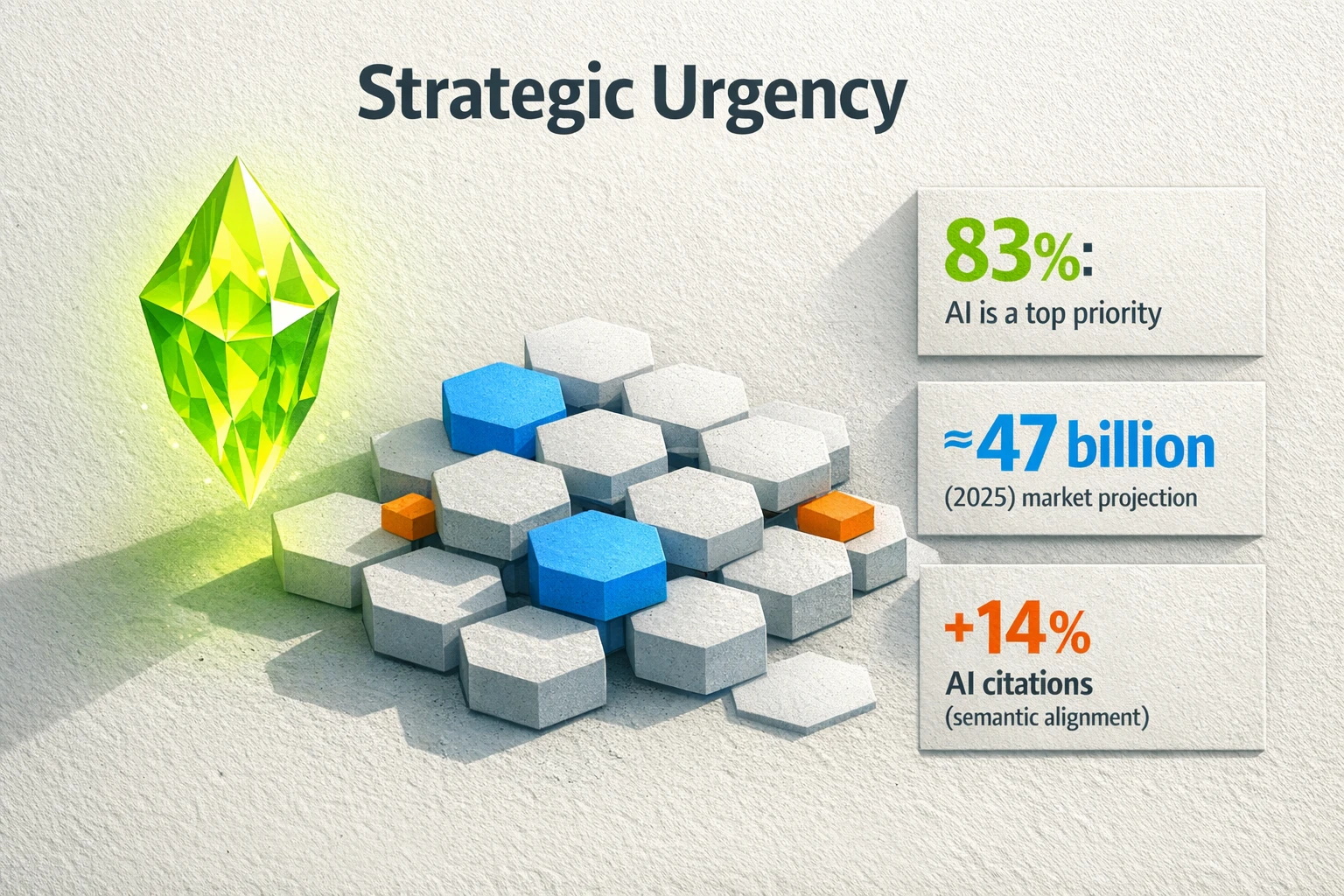
The urgency is clear. With 83% of companies reporting that AI is a top business priority, falling behind is not an option. The market for AI in marketing is projected to reach nearly $47 billion in 2025. Your competitors are already investing. The question is, are they investing smartly?
From Keywords to Semantic Maps: The AI Evolution
For years, SEO was a game of keyword density and backlinks. You found a term, repeated it on a page, and built links. That game is over. Google no longer just matches strings of text. It understands the relationships between concepts, ideas, and real-world entities.
This is the core of semantic search. It's the difference between searching for "apple" and getting results for the fruit, the tech company, or the record label, based on your previous searches and the context of your query.
Traditional keyword tools fall short here. They give you lists of related terms, but they cannot show you the intricate web of questions, problems, and concepts that make up a complete topic. They show you the trees, not the forest. AI-powered research lets you map the entire forest.
Core Methodologies: How AI Actually Understands Topics
Generic AI writers can produce text, but they cannot build authority. True AI-driven research relies on specific, advanced methodologies to deconstruct topics and build a comprehensive content strategy.
NLP and Intent Mapping
Natural Language Processing (NLP) is the technology that allows machines to understand human language. In topic research, AI uses NLP to analyze the top-ranking pages for a given subject. It doesn't just look at keywords. It identifies the underlying user intent. Is the user trying to learn, compare, buy, or solve a specific problem? By mapping these intents, AI helps you create content that directly answers the user's true question, not just their typed query.
Entity Extraction and Knowledge Graph Alignment
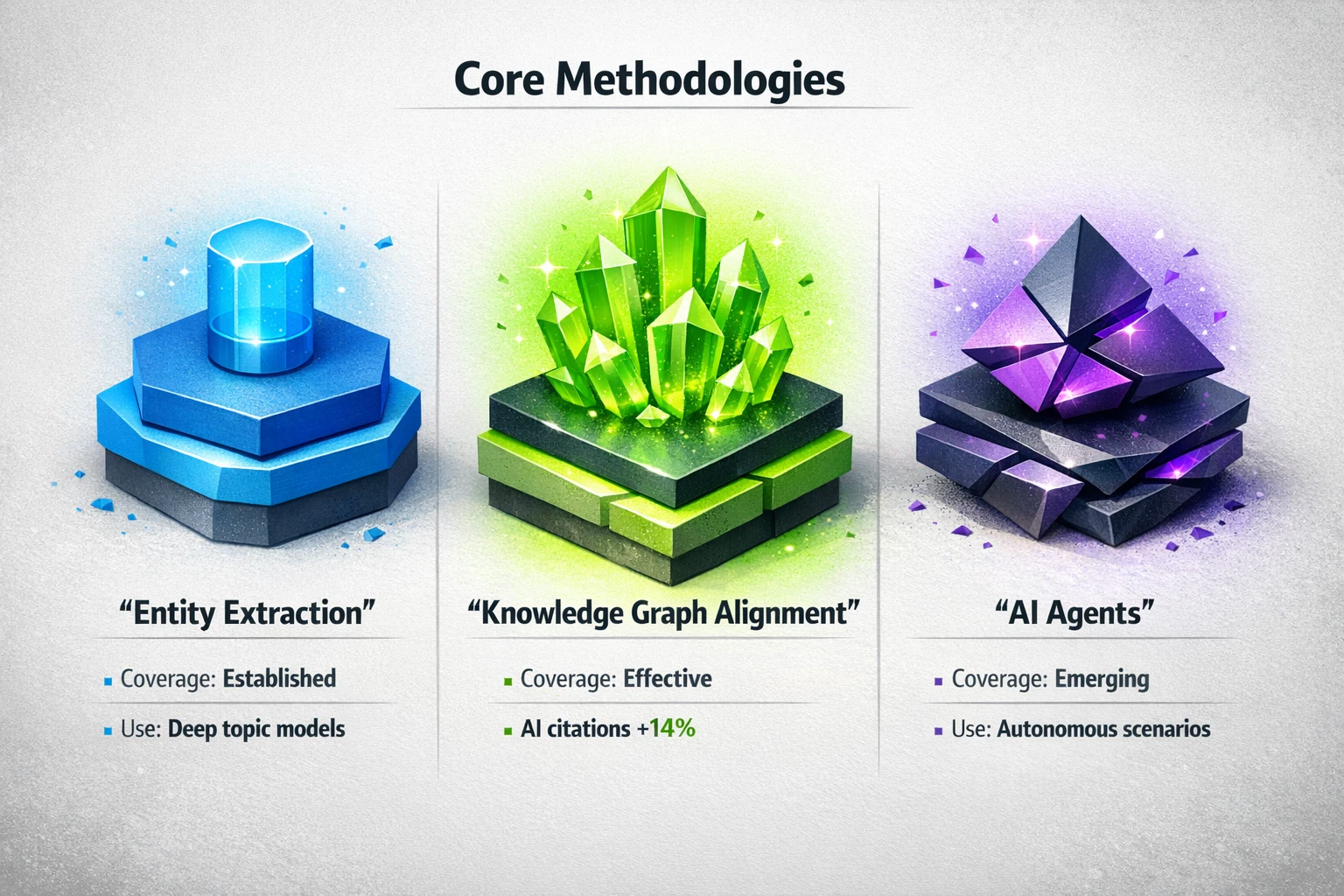
An "entity" is a specific person, place, organization, or concept that has a unique identity. Google’s Knowledge Graph is a massive database of these entities and the relationships between them. Advanced AI tools perform entity extraction, identifying the key entities within a topic.
By structuring your content around these same entities, you align your website directly with Google’s understanding of the world. This signals deep expertise. According to research from CXL and SERanking, a strong semantic structure can boost citations in AI-powered search results by approximately 14%. You are not just ranking in the top ten blue links. You are becoming a source for AI itself.
The E-A-V Framework: A Practical Model
A simple yet powerful way to apply this is the Entity-Attribute-Value (E-A-V) model.
- Entity: The core topic (e.g., "project management software").
- Attributes: The features or characteristics of the entity (e.g., "pricing," "integrations," "team collaboration features").
- Values: The specific options for each attribute (e.g., "per-user pricing," "integrates with Slack," "offers Gantt charts").
AI can automate the discovery of these E-A-V components by analyzing competitor content at scale, giving you a complete blueprint of everything you need to cover to dominate a topic.
The Next Frontier: Autonomous Agents and AI Copilots
The conversation is already moving beyond simple analysis tools. The next wave involves "Agentic AI" and "Autonomous Copilots." These are not just passive dashboards. They are proactive systems that can simulate market scenarios, identify future content gaps, and build dynamic topic models that adapt over time.
Instead of you asking the tool for a list of keywords, an AI agent will monitor the SERPs and your competitors, then proactively recommend a full content cluster, complete with briefs, internal links, and a publishing schedule. This is the future of content strategy: a partnership between human expertise and machine-scale intelligence.
How to Build Your AI-Powered Research Factory
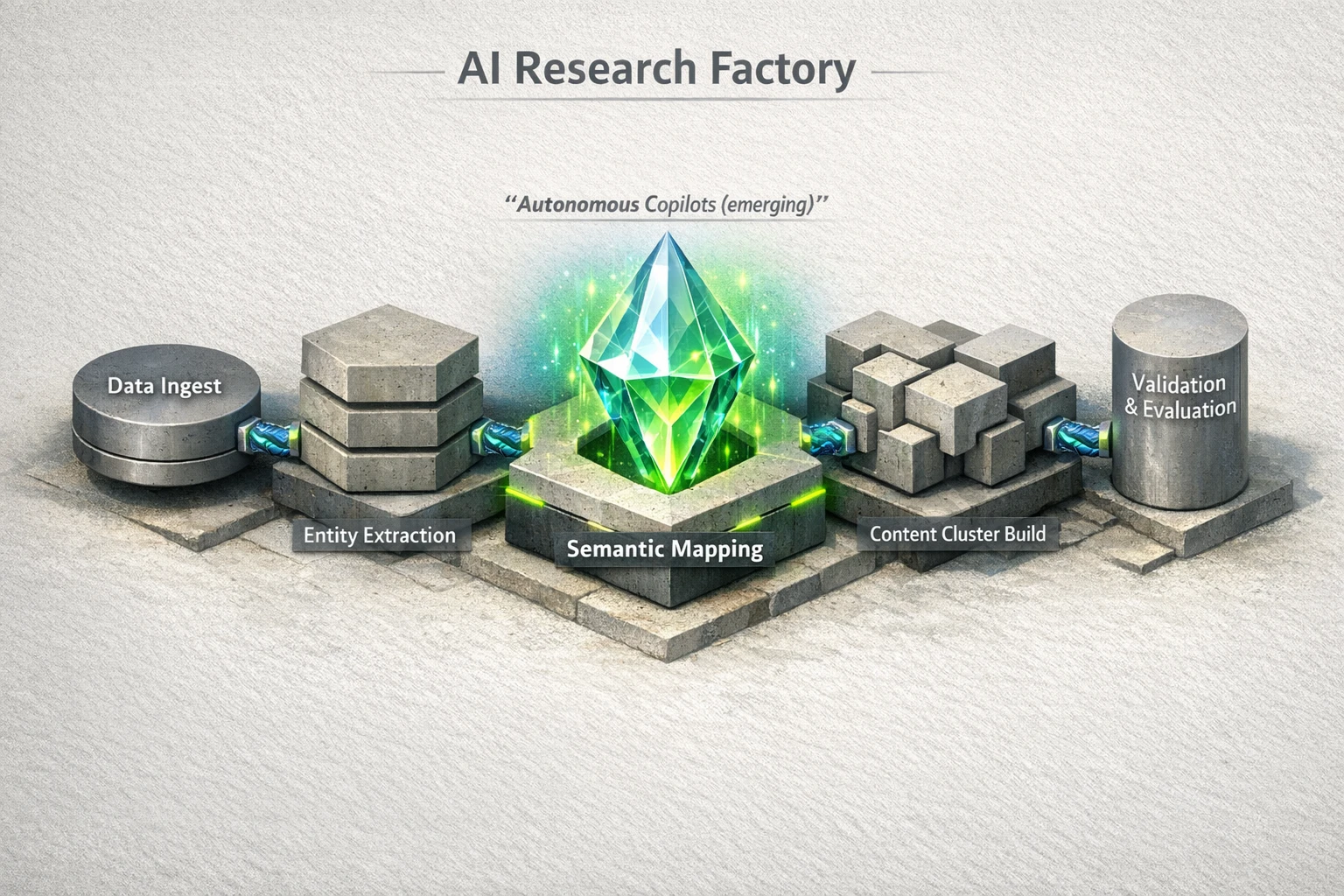
Moving from theory to practice requires a systematic process. You don't need a single magic tool. You need a workflow that turns raw data into a strategic content roadmap.
- Define the Core Topic: Start with a broad business category you want to own, like "cybersecurity for small businesses."
- AI-Powered Competitive Analysis: Use AI to analyze the top 50+ pages ranking for this topic. The goal is to extract every subtopic, user question, and entity they cover.
- Semantic Mapping: Organize the extracted data into a topic cluster model. Identify your pillar page (the main topic) and the cluster pages (the subtopics). Visualize the relationships and internal linking opportunities.
- Content Blueprint Creation: For each piece of content in your map, create an Authority Intelligence Blueprint. This detailed brief should include the target intent, primary and secondary entities to cover, key user questions to answer, and a recommended structure. Our page body process is designed to deliver exactly this.
- Execution and Measurement: Create the content based on these AI-driven blueprints. Track performance not just by individual keyword rankings but by the overall topic visibility and authority.
Conclusion: Making AI Your Unfair Advantage
Relying on outdated keyword research is like navigating a new city with a map from 2005. It might get you close, but you will miss the best routes and opportunities. AI-powered topic research provides the real-time, high-definition satellite view you need to win.
It allows you to move beyond guessing what users want and start building a content ecosystem that systematically covers every facet of a topic. This signals true authority, builds trust with your audience, and creates a durable competitive moat that generic content mills can never cross. The tools and methodologies are here. The only question is whether you will use them to build your advantage before your competition does.
Frequently Asked Questions
How is this different from just using ChatGPT for keyword ideas?
ChatGPT is a generative language model. It can brainstorm lists based on its training data, but it cannot perform real-time competitive analysis or understand the semantic structure of a live search engine results page. True AI research tools analyze winning content to build data-driven maps, a fundamentally different and more strategic task.
Will AI-driven topic research make my content sound robotic?
No, it does the opposite. The AI's role is to build the strategic blueprint, not write the final prose. It identifies the human questions, pain points, and concepts you must address. This data empowers your expert writers to create more relevant, comprehensive, and human-centric content because they are starting with a complete understanding of the audience's needs.
How long does it take to see results from a semantic SEO strategy?
Building topical authority is a long-term strategy, not a short-term tactic. While initial improvements can be seen in 3-6 months as individual articles begin to rank, the full effect of a topic cluster emerges over 6-12 months. The goal is durable authority, which compounds over time and becomes harder for competitors to displace.
Do I need to be a data scientist to implement this?
Absolutely not. The purpose of modern AI solutions, like our SEO Strategist service, is to abstract away the technical complexity. We handle the data analysis, entity extraction, and semantic mapping. You receive a clear, actionable content plan and publish-ready Ranking Asset Packages, allowing you to focus on your business expertise.
Sources:
- National University - Data on AI adoption as a top business priority.
- Statista - Market projections for AI usage in marketing.
- IBM - Insights on emerging trends like Agentic AI.
- Microsoft News - Discussion of future trends including AI Copilots.
- SERanking - Methodologies and context for semantic SEO.
- CXL - Analysis of semantic alignment and its impact on AI search citations.