Why Your Competitors Are Winning on Authority (And How AI Can Reveal Their Strategy)
AI Summary
Unpacking why some competitors dominate on authority starts with understanding how AI deconstructs E-E-A-T signals. This article explains using advanced AI models to detect experience, expertise, authoritativeness, and trustworthiness in competitor content.
Key Takeaways: Offers actionable insights on how AI analyzes multiple authority components systematically, benchmarks your content against competitors to expose gaps, and guides building a strategic authority blueprint.
Best for: Marketers, SEO professionals, and content strategists seeking to understand and leverage E-E-A-T frameworks to improve competitive rankings and authority online.
You published a well researched article. It’s comprehensive, accurate, and provides real value. Yet, it sits on page three of Google. Meanwhile, a competitor’s article covering the same ground holds a top position. What’s the difference? Often, it’s not the content itself. It’s the invisible layer of authority signals wrapped around it.
This is E-E-A-T: Experience, Expertise, Authoritativeness, and Trustworthiness. It’s how search engines separate helpful content from the massive volume of digital noise. Manually analyzing these signals across dozens of competitor pages is slow, subjective, and frustrating. You are forced to guess what works.
But you do not have to guess anymore. Advanced AI models can deconstruct these signals systematically. They can identify the specific patterns that create authority, giving you a repeatable blueprint to compete and win. This is not about writing more content. It is about building smarter content that signals authority from day one.
Mapping AI Models to E-E-A-T Signals
To reverse-engineer authority, you first need to understand what you are looking for. E-E-A-T is not a single metric. It is a collection of signals that AI can detect and categorize. Each component requires a different analytical approach.
- Experience: AI can identify first-hand experience through Natural Language Processing (NLP). It looks for first-person narratives, unique data from real-world tests, and phrases that demonstrate the author actually used the product or performed the service.
- Expertise: NLP models also detect expertise by identifying specialized terminology, citations of credible sources, and the logical depth of an argument. It separates surface-level explanations from content written by a genuine expert.
- Authoritativeness: This is about an entity's reputation. AI uses knowledge graphs and entity extraction to map connections. It identifies if an author is cited by other authorities, speaks at industry events, or contributes to reputable publications.
- Trustworthiness: Trust is measured by signals like secure website protocols, clear contact information, and positive sentiment. AI can use sentiment analysis to gauge brand perception from reviews and mentions across the web.

A Practical Methodology for Deconstructing Competitor Authority
Moving from theory to action requires a structured process. A reliable methodology ensures your analysis is consistent and produces actionable insights, not just interesting data. It transforms a complex task into a clear, five-step pipeline.
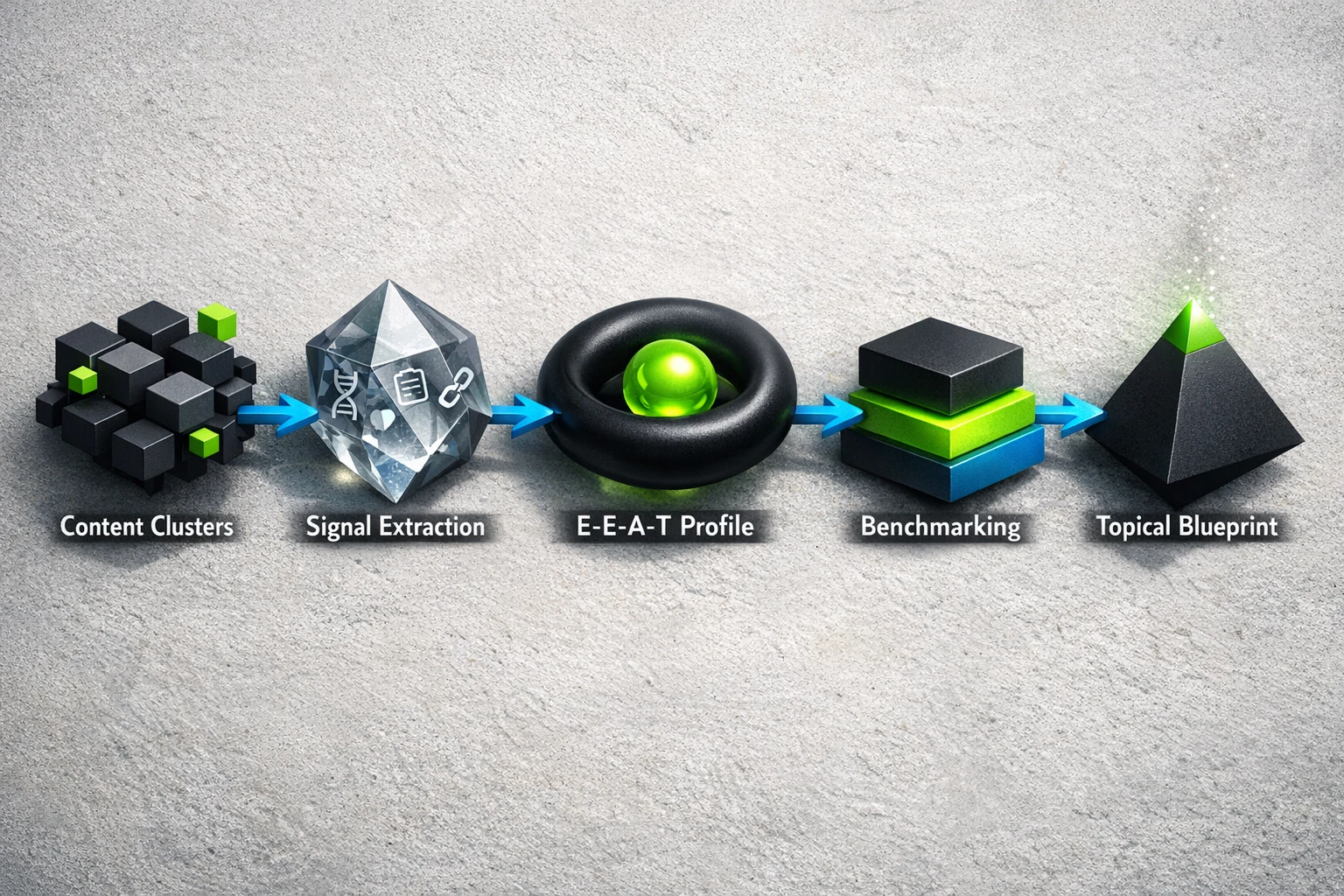
Step 1: Cluster Competitor Content
First, identify the top 10 to 20 ranking pages for your target topic. This collection of content is your dataset. The goal is to analyze the consistent patterns across all the winners, not just one competitor. This prevents you from overcorrecting based on a single outlier.
Step 2: Extract E-E-A-T Signals with AI Models
Next, use specific AI models to scan the dataset for signals.
- Natural Language Processing (NLP) reads the text to find qualitative signals. For instance, it can flag every sentence written in the first person ("I discovered," "we tested") to quantify the presence of 'Experience'.
- Knowledge Graphs and Entity Extraction build a map of connections. This process identifies key people, organizations, and concepts. It then checks how they are connected. For example, it can confirm if an author is listed as a contributor on a well-known industry site.
- Sentiment Analysis measures perception. This technique analyzes linked sources, customer reviews, or brand mentions to determine if the sentiment is positive, negative, or neutral, providing a data point for 'Trustworthiness'.
Step 3: Build a Competitor Authority Profile
With the signals extracted, you can build a profile for each competitor. This profile aggregates the findings into a clear summary. For example, a competitor’s profile might show high 'Expertise' due to dense technical language but low 'Experience' due to a lack of case studies or personal stories.
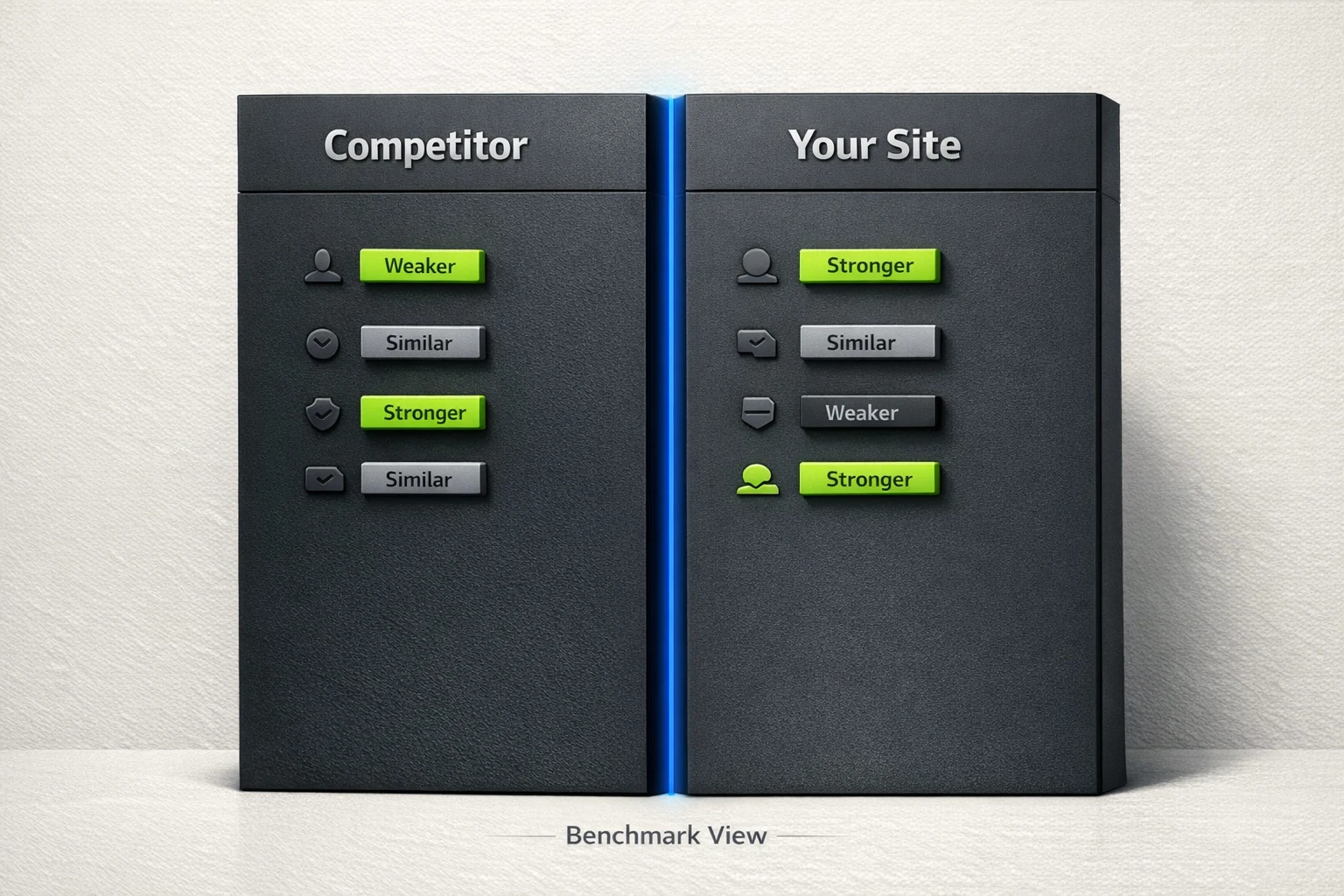
Benchmarking Your E-E-A-T to Find Your Authority Gap
The goal of analysis is to find your opportunity. By comparing your content's authority profile against the top competitors, you can identify your "authority gap." This is not about a single score. It is a qualitative comparison that reveals where your content falls short and where your competitors are strongest.
For example, your analysis might reveal that all top-ranking pages include original data or a unique case study. If your content lacks this, that is an 'Experience' gap. Another competitor might consistently get links from university websites. That highlights an 'Authoritativeness' gap you need to address.
This benchmarking process turns a vague goal like "build authority" into a specific list of tasks. You stop chasing every SEO tactic and start focusing on the signals that winning content already demonstrates.
From Insights to Action: Building Your Topical Authority Blueprint
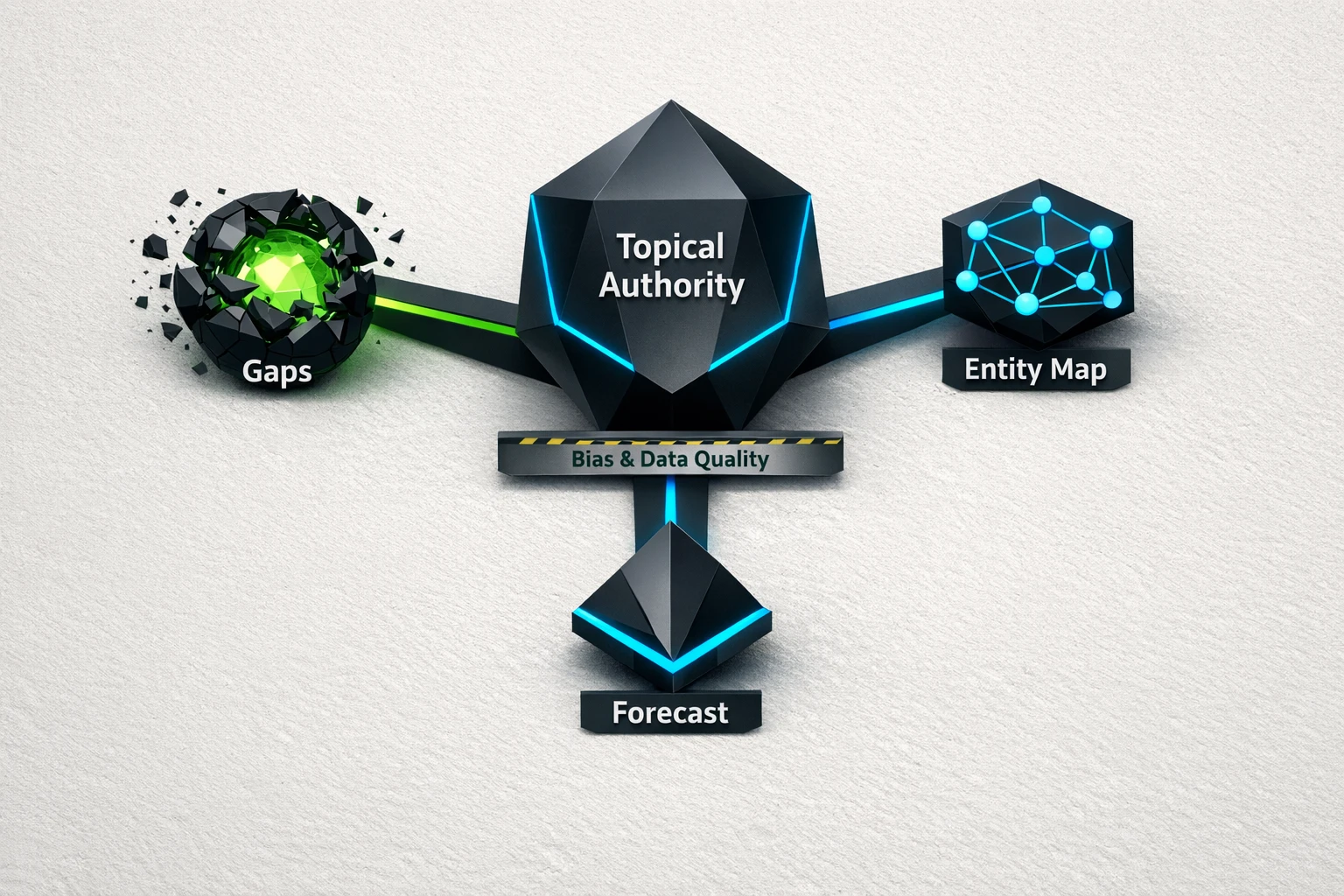
The final step is to translate your findings into a concrete content strategy. Your authority gap analysis is the foundation for your topical authority blueprint. This blueprint dictates the specific E-E-A-T signals you need to build into your new and existing content.
- Identified Gap: Low Experience. Your blueprint should prioritize creating content with first-hand accounts, product teardowns, or unique case studies.
- Identified Gap: Weak Authoritativeness. Your strategy should include collaborations with known experts, seeking citations from reputable sources, and building your author's public profile.
- Identified Gap: Poor Trustworthiness. Your plan must include adding clear author bios, citing all sources, showcasing customer testimonials, and making contact information easily accessible.
While AI provides powerful insights, human oversight remains critical. AI models can have biases, and data quality can affect results. The goal is to use AI to find the patterns, then use your human expertise to create authentic content that fills the gaps. This combination of machine intelligence and human judgment is what builds durable authority.
FAQ: AI and E-E-A-T Analysis
What is E-E-A-T and why does it matter for AI search?
E-E-A-T stands for Experience, Expertise, Authoritativeness, and Trustworthiness. It's a framework used by search engines like Google to evaluate the quality and reliability of content. As stated in Google's own documentation on creating helpful content, demonstrating these signals is crucial for ranking well, especially in an era where AI can generate massive amounts of generic content.
Can AI truly understand 'experience' or 'trust'?
AI does not "understand" these concepts in a human way. Instead, it identifies patterns and signals that are highly correlated with them. For 'experience,' it detects first-person language and unique data. For 'trust,' it can verify claims against other sources or analyze sentiment in reviews. It is a sophisticated pattern matching tool, not a conscious judge.
How can a small business use this without a data science team?
You do not need a dedicated data science team to get started. The principles can be applied manually on a smaller scale by looking for the same signals. More practically, this is the exact problem that specialized services solve. An AI Transformation Agency can provide the technology and methodology, allowing you to focus on the strategic insights and content creation.
What's the biggest mistake people make when analyzing competitor E-E-A-T?
The biggest mistake is focusing on just one component or one competitor. Many teams over-index on backlinks (Authoritativeness) while ignoring the 'Experience' signals in the content itself. A holistic analysis across multiple top competitors is necessary to see the full picture and avoid copying the wrong signals.
---
Sources:
- Google Search Central - Official documentation on creating helpful, reliable, people-first content.
- Semrush - A comprehensive guide to the E-E-A-T framework and its components.
- Search Engine Journal - Discussion on the role of E-E-A-T in building brand authority in the context of AI search.
- BrightEdge - Strategic overview of implementing E-E-A-T for AI-driven search.
- Search Engine Land - A detailed guide to understanding Google's E-E-A-T and quality assessment signals.