AI in Digital Advertising: Your Implementation Roadmap for 2026
AI Summary
Bottom Line
- Use AI to turn your paid media from manual, reactive management into a predictive engine that systematically improves ROAS and reduces wasted spend. By following a staged roadmap, you can shift from isolated AI tests to integrated workflows that enhance targeting, bidding, creative and attribution.
Key Takeaways
- Audit data and tech to unify signals before layering AI on campaigns- Run focused pilots with human-in-the-loop governance and business KPIs- Build an evaluation framework to select scalable, transparent AI ad tools**Best For** - Marketing leaders and paid media owners evaluating how to practically implement AI across their advertising stack.
You're not struggling with a lack of data. You're struggling with a lack of leverage. Your team is manually pulling levers on campaigns, guessing at audience segments, and spending days analyzing attribution reports that still feel incomplete. Meanwhile, global digital ad spending is projected to surpass $700 billion by 2025, making every inefficient dollar a competitive liability [1].
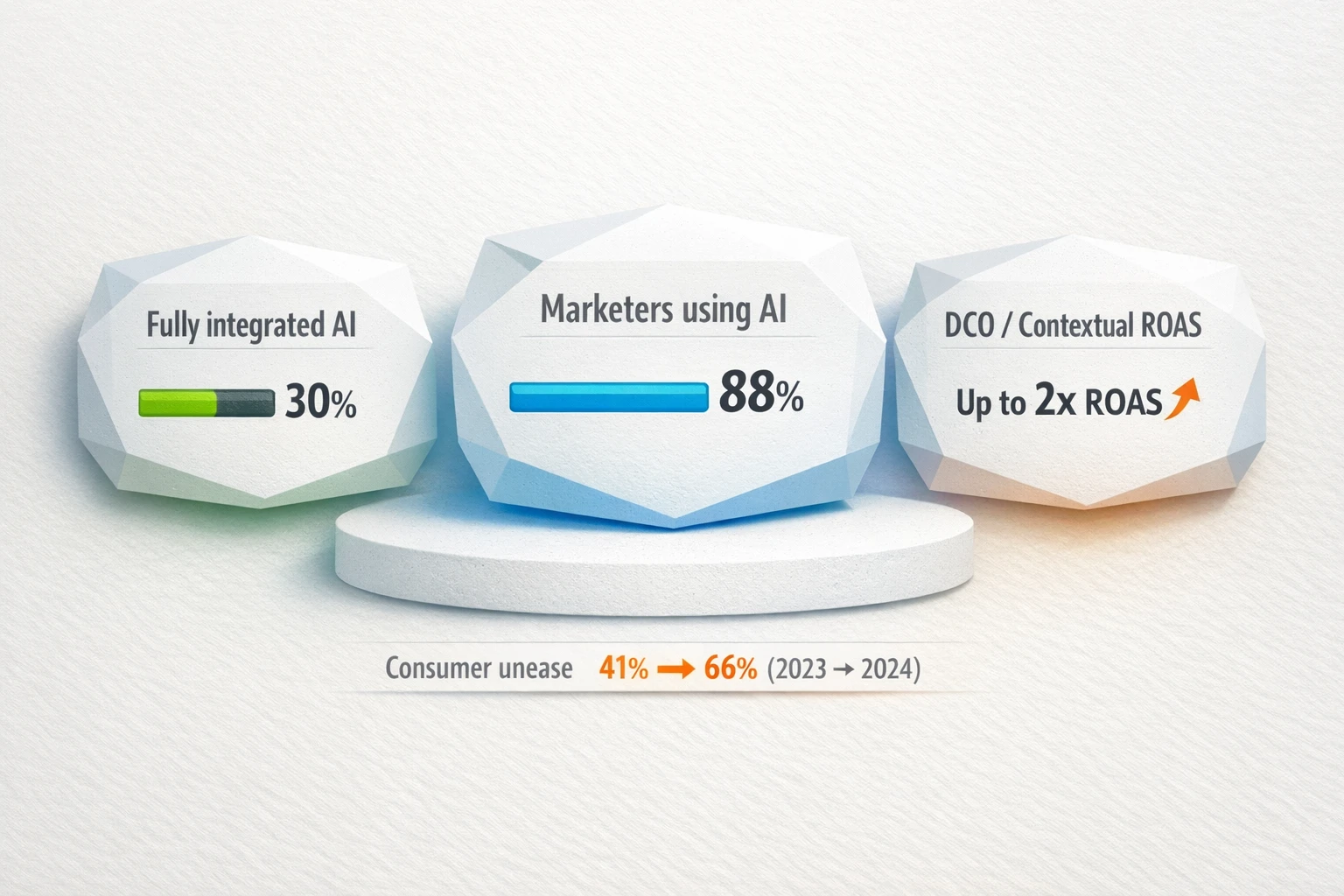
The conversation around AI in advertising has moved past "what if." Today, 88% of marketers report using AI in their day-to-day roles [2]. Yet, the real story is in the gap between usage and integration. A recent IAB report reveals that only 30% of firms have fully integrated AI across the media campaign lifecycle [3].
This isn't a technology problem. It's a strategy problem. This guide provides the strategic framework you, as a Head of Marketing, need to move from tactical AI experiments to a fully leveraged, predictive advertising engine.
The Core Pillars of AI-Powered Paid Media
AI isn't a single solution. It's a set of capabilities that transforms the core functions of paid media from reactive to predictive. AI transformation in advertising is still nascent, but its impact is concentrated in four key areas [3].
1. Intelligent Targeting and Audience Modeling
Standard demographic targeting is a blunt instrument. AI builds dynamic audience models based on real-time intent signals, behavioral patterns, and propensity scores. This moves you from targeting "people who look like your customers" to "people who are about to need your solution."
2. Predictive Bid and Budget Optimization
AI algorithms process thousands of variables in real time, far beyond human capacity, to set the optimal bid for every single impression. They can shift budgets across channels, campaigns, and audiences automatically to maximize return on ad spend (ROAS) without manual intervention.
3. Dynamic Creative Optimization (DCO)
Instead of A/B testing two ad variants, DCO uses AI to assemble the perfect ad for each user on the fly. It combines headlines, images, calls to action, and copy based on the viewer's profile and context. This level of personalization can generate 80% higher conversion rates than generic ads [1].
4. Holistic Cross-Channel Attribution
AI attribution models move beyond simplistic last-click analysis. They analyze the entire customer journey, assigning fractional credit to every touchpoint. This provides a clear view of how your channels work together, enabling smarter investment decisions and a more accurate understanding of your marketing mix. This is a critical factor for accurate content performance prediction and resource allocation.
Your Implementation Roadmap: A Framework for Marketing Leaders
Moving from theory to practice requires a deliberate, structured approach. Avoid a scattergun adoption of tools. Instead, follow this path to build a durable, scalable AI advertising capability.
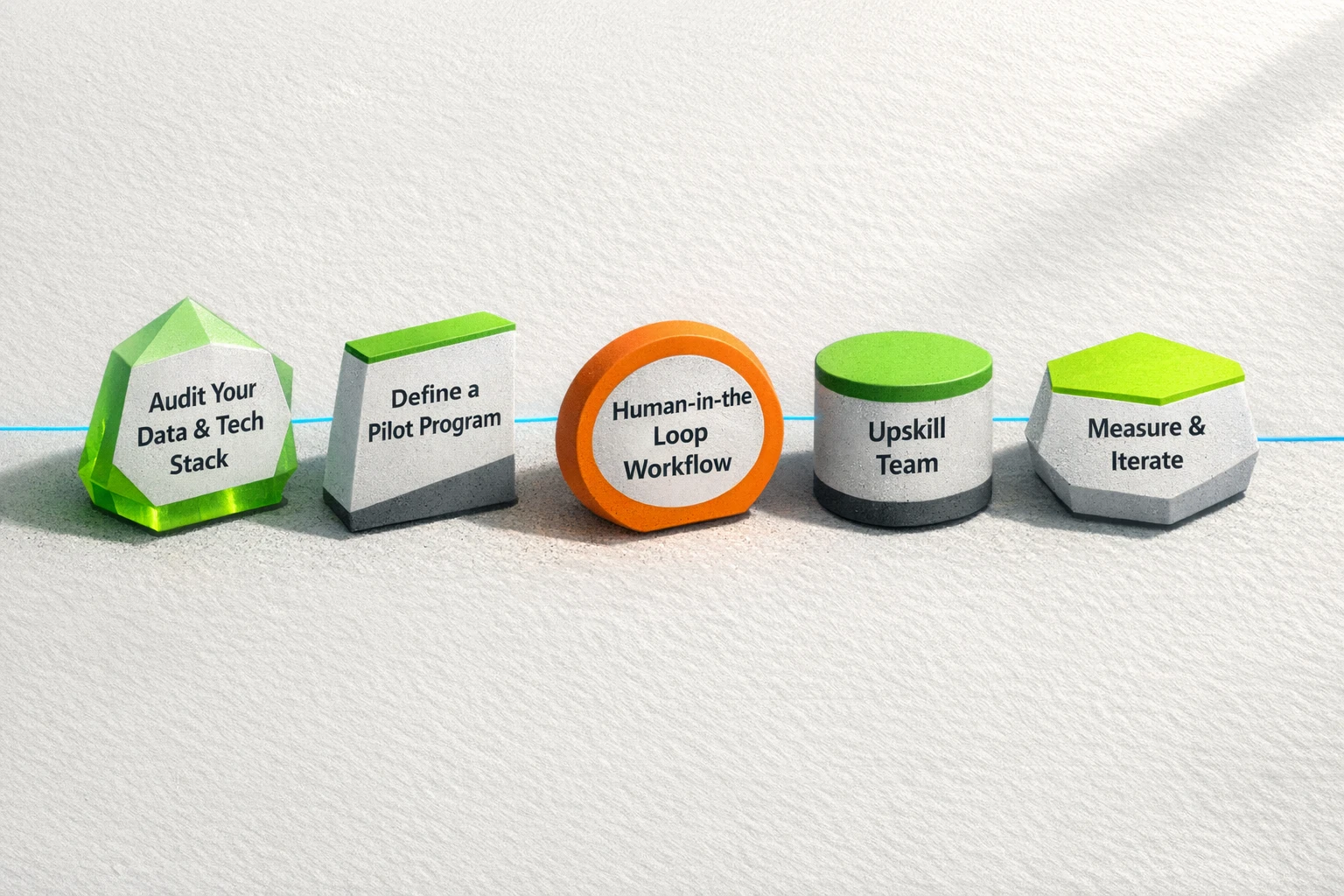
Step 1: Audit Your Data and Tech Stack
AI is only as good as the data it learns from. Before you invest in any new tool, assess your data readiness. Are your CRM, analytics, and ad platform data clean and connected? Address data silos first. Your goal is a unified data pipeline that can feed AI models with high-quality information.
Step 2: Define a Pilot Program
Do not attempt a full-scale rollout from day one. Select one specific, measurable goal for a pilot program. Examples include improving ROAS for a key campaign by 15% or reducing cost-per-acquisition for a specific channel. A focused pilot de-risks the investment and provides a clear business case for expansion.
Step 3: Build Your Human-in-the-Loop Workflow
AI is a powerful co-pilot, not an autopilot. Your team's strategic oversight is crucial. Define a workflow where AI handles the massive-scale data processing and optimization, while your human experts provide the strategic direction, creative intuition, and final approval. This balances automation with brand governance.
Step 4: Measure and Iterate
Focus on business metrics, not vanity metrics. Track metrics like customer lifetime value, pipeline velocity, and incremental revenue lift. Use the pilot's results to build a case for scaling the program, applying learnings to new channels and campaigns. True success is measured by the evolution of marketing metrics in the ai era, not just clicks and impressions.
Navigating the Hidden Hurdles
Adopting AI presents challenges beyond technology. Being aware of them is the first step to overcoming them.
- Black-Box Complexity: Many AI models are complex, making it difficult to understand exactly how they arrive at a decision. This "black-box" nature can create distrust among marketing stakeholders [4]. To counter this, partner with solution providers who prioritize transparency and can explain the logic behind their models.
- Model Bias: AI models trained on unrepresentative or historical data can perpetuate and even amplify existing biases, leading to flawed or discriminatory ad targeting [5]. You must demand transparency in training data and implement regular audits for fairness to ensure your campaigns are both effective and equitable.
- Data Quality and Integration: Poor data quality is the single biggest obstacle to successful AI implementation. Fragmented, inconsistent, or incomplete data will lead to poor model performance. Prioritizing a clean, unified data strategy is not optional.
Building Your AI Advertising Tool Stack
The market is flooded with AI tools. Instead of chasing features, categorize your needs by function and evaluate tools based on how they solve a specific problem within your workflow. When you're asking yourself where can i find ai tools with semantic understanding of business content?, you're starting to think about the right evaluation criteria.
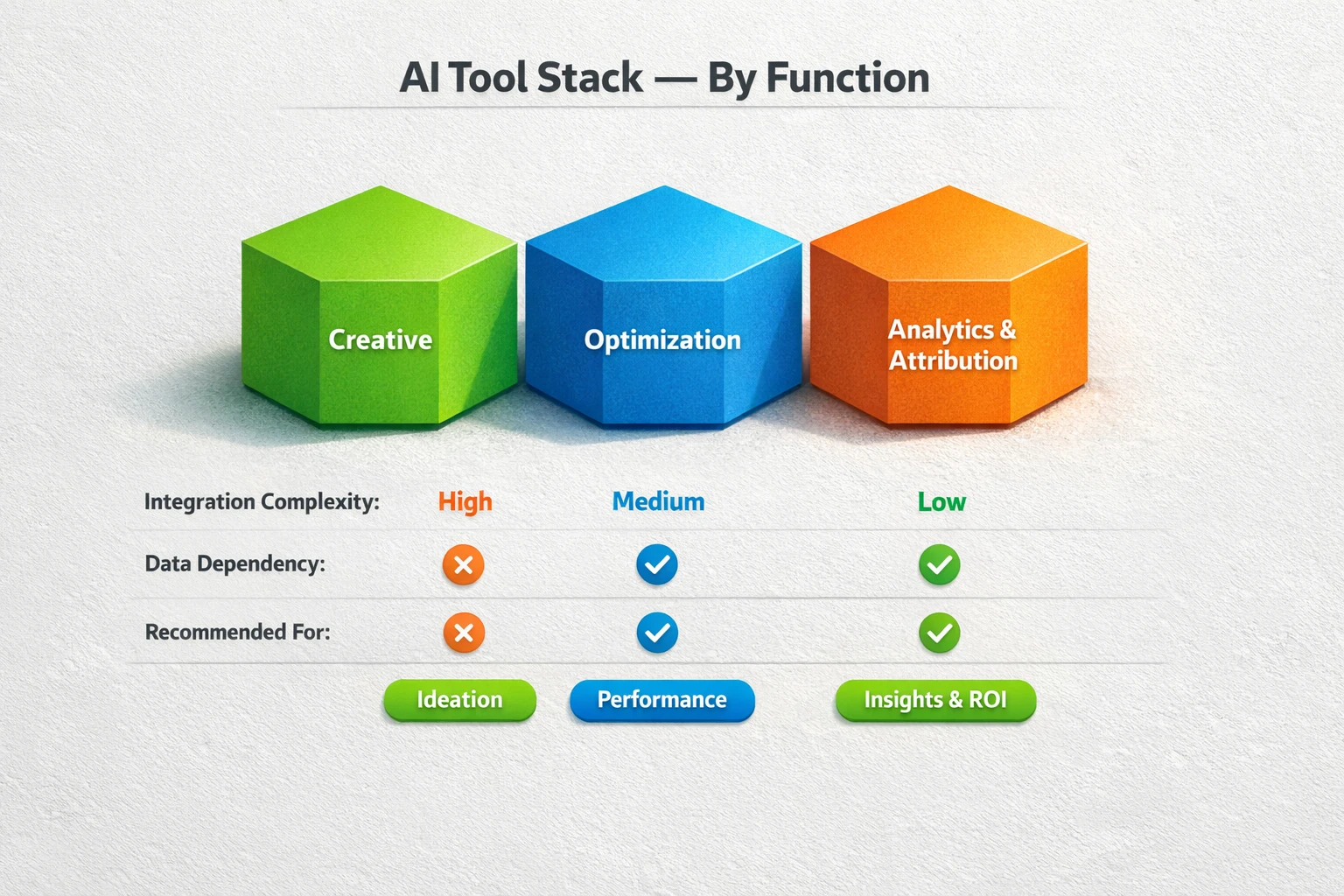
Evaluation Checklist:
- Integration: Does it connect seamlessly with your existing martech stack (CRM, analytics, CMS)?
- Transparency: Can the vendor explain how their models work and what data they use?
- Control: How much human oversight and control do you retain? Can you set strategic guardrails?
- Scalability: Can the tool grow with you from a small pilot to a full-scale deployment?
- Support: What level of strategic support and expertise does the vendor provide?
The Future is Agentic: Preparing for Ads in AI Overviews
The advertising landscape is shifting again. Paid placements are now appearing directly in Google's AI Overviews and other monetized AI assistants [6]. This creates a new imperative: your ad strategy must now account for how it will perform on llm‑indexed pages and in conversational responses. Success in this new paradigm will require a deeper focus on semantic relevance and user intent, as AI agents will prioritize ads that directly and authoritatively answer a user's underlying query.
Your Path to Predictive Advertising Starts Now
The gap between companies experimenting with AI and those embedding it into their core advertising strategy is widening. The winners will not be the ones who adopt the most tools, but the ones who follow a disciplined implementation roadmap. They will focus on data readiness, execute focused pilots, and maintain human oversight.
pageBody.ai is an AI Transformation Agency that builds these systems. We don't just recommend tools. We build the data pipelines, configure the models, and establish the workflows that turn AI from a buzzword into a measurable competitive advantage.
FAQs
Can AI replace my paid media team?
No. AI is an amplifier, not a replacement. It automates low-value, repetitive tasks like bid adjustments and data analysis, freeing your team to focus on high-value work like strategy, creative direction, and understanding customer psychology. The goal is a human-in-the-loop system where experts guide the AI.
How do I ensure brand safety with AI-generated ad creative?
This is a critical governance issue. Your implementation plan must include a robust human review and approval process. Use AI to generate variations and ideas at scale, but ensure every ad that goes live has been approved by a brand steward. Set clear brand guidelines that the AI can learn from, but never fully abdicate final creative control.
What is the real ROI I can expect from implementing AI in paid media?
The ROI varies by your starting point and implementation quality, but the impact is significant. Key metrics to track are improvements in ROAS, reductions in Customer Acquisition Cost (CAC), and increases in Customer Lifetime Value (LTV). Pilots focused on DCO have shown up to a 2x higher ROAS, while AI-driven attribution can uncover wasted spend and reallocate it to high-performing channels, directly impacting your bottom line.
Sources:
- International Advertising Solutions - Data on digital ad spend and the performance of personalized ads.
- SurveyMonkey - Statistics on the adoption rate of AI among marketing professionals.
- IAB - In-depth report on the state of data and AI integration within agencies and brands.
- Channel99 - Discussion on the challenges of AI attribution, including "black-box" complexity.
- AI Ad Insights - Analysis of bias risks in AI models for advertising and the need for audits.
- Search Engine Land - Trends report highlighting the emergence of paid ad placements in Google AI Overviews.