AI, E-E-A-T, and Semantic Search: Your Playbook for Dominating the New SERP
AI Summary
Bottom Line
- Use a structured 5-step framework to turn your site into an AI-ready authority so Google’s semantic search and AI Overviews consistently cite your content as a trusted source. By aligning E-E-A-T with entities, schema, and internal linking, you move from merely ranking to becoming the default reference.
Key Takeaways
- Map key entities with AI, then cover them deeply to match Google’s Knowledge Graph expectations
- Use schema, topical clusters, and semantic internal links to prove expertise and authority
- Inject first-hand experience and track citations in AI Overviews as core success metrics
Best For
- Marketing and SEO leaders who need a practical system to future-proof organic visibility and win AI-generated recommendations.
You are no longer fighting for a top 10 spot. You are fighting to be the trusted source for an AI. Google's AI Overviews are live, and according to recent analysis from Finch, 52% of sources cited in these AI answers come from the top 10 organic results.
This is the new reality. Ranking is just the entry ticket. Getting cited is the win. The question decision-makers are asking is no longer "How do we rank?" but "How do we make Google's AI trust our content enough to use it as a source?"
The answer is a deliberate strategy that connects E-E-A-T (Experience, Expertise, Authoritativeness, Trustworthiness) with the technical reality of how AI understands the world: semantic search. Generic AI content and outdated keyword tactics will not get you there. You need a new playbook.
Beyond the Acronym: E-E-A-T is Google's Trust Protocol for AI
For years, marketers have treated E-E-A-T as a vague quality checklist. That view is now dangerously outdated. E-E-A-T is not a direct ranking factor. It is a framework Google uses to vet information sources for its own systems, including its large language models.
Think of it this way:
- Experience: Have you actually done the thing you're writing about?
- Expertise: Do you have deep, demonstrable knowledge on the topic?
- Authoritativeness: Are you a recognized authority within your field?
- Trustworthiness: Is your information accurate, secure, and reliable?
When you satisfy these signals, you are not just optimizing for a search engine. You are building a machine-readable case that your content is a reliable source for AI-generated answers. This is the foundation of "AI-readiness."
The Technical Bridge: How Semantic Search Connects Your Content to Google's AI
Most content strategies fail because they miss the technical connection between their words and Google's understanding. Competitors focus on foundational definitions, high-level strategy, or overly theoretical concepts, but they miss the practical bridge.

Google's AI doesn't just read keywords. It understands the world through entities and their relationships. This network of understanding is called the Knowledge Graph.
- What is an Entity? An entity is a specific person, place, organization, or concept that has a distinct identity. "Apple" the company is a different entity from "apple" the fruit. Google knows the difference.
- Why Entity Salience Matters: Your goal is to make your brand, your authors, and your core topics clear, unambiguous entities in Google's Knowledge Graph. When you succeed, you are no longer just a webpage about a topic; you are the recognized authority on that topic.
- The Knowledge Graph as Google's Brain: The Knowledge Graph maps the trillions of connections between entities. Optimizing for it means you are directly feeding Google's "brain" with structured, reliable information about who you are and what you know.
This is the mechanism. E-E-A-T provides the trust signals, and semantic optimization provides the technical clarity. You need both to win.
The Actionable Playbook: 5 Steps to Engineer Trust for AI Search
This is not a theoretical exercise. Building authority for AI search is a systematic process. The goal is to get your content cited by proving your value through structure, depth, and originality.
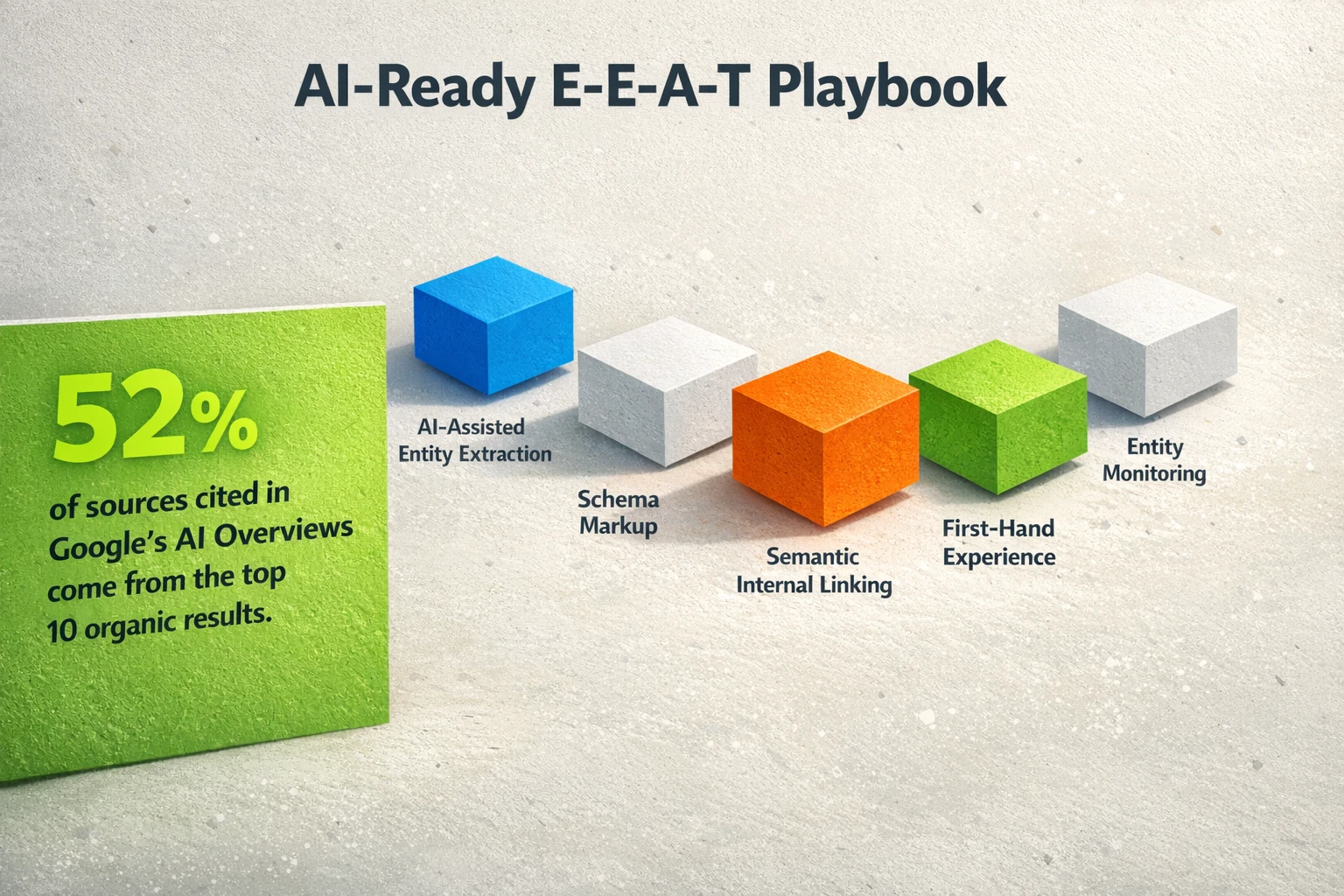
This five-step framework is the core of the digital pageBody we build for clients, turning abstract theory into a repeatable system.
Step 1: AI-Assisted Entity Extraction
Before you write a word, you must identify the core entities your content needs to cover to be seen as comprehensive. Use AI tools, like Natural Language Processing APIs, to analyze the top 20 ranking pages for your target topic. Extract the key people, organizations, and concepts they consistently mention. This forms your "entity map," ensuring your content covers the topic with the depth Google expects.
Step 2: AI-Generated Schema Markup
Schema is the language you use to speak directly to search engines. It removes ambiguity. Instead of letting Google guess who the author is, you use Person schema to define them explicitly. Use AI tools to generate and validate schema for your organization, authors, articles, and products. This is the most direct way to populate the Knowledge Graph with facts about your authority.
Step 3: Build Topical Authority with Semantic Internal Linking
A single article rarely builds authority. A cluster of interconnected articles does. Your internal linking structure should prove your expertise across a topic. Link from supporting articles to your main pillar page using descriptive anchor text. This creates a semantic web of content that signals to Google that you have covered a topic from all relevant angles, reinforcing your E-E-A-T.
Step 4: Demonstrate First-Hand Experience (The "E")
This is where human insight becomes your moat. AI can synthesize existing information, but it cannot create new, first-hand experience. You must inject this into your content.
- Include original data from your own research or surveys.
- Detail specific results from a client case study.
- Provide unique photos or videos of a process you completed.
- Offer a contrarian viewpoint backed by your unique experience.
These are signals of genuine experience that are incredibly valuable to Google's AI, as they represent novel information.
Step 5: Monitor Your Entity in AI Search
Your KPIs need to evolve. While tracking organic rank is still important, start monitoring how often your brand, products, or authors are mentioned in AI Overviews for your key topics. This is the new measure of success. Being cited is a direct indicator that Google's AI trusts you as an authoritative source.
Measuring Success: The New E-E-A-T Metrics
Success in the age of AI search is not just about a temporary spike in traffic. It is about building a durable asset that Google trusts over the long term.
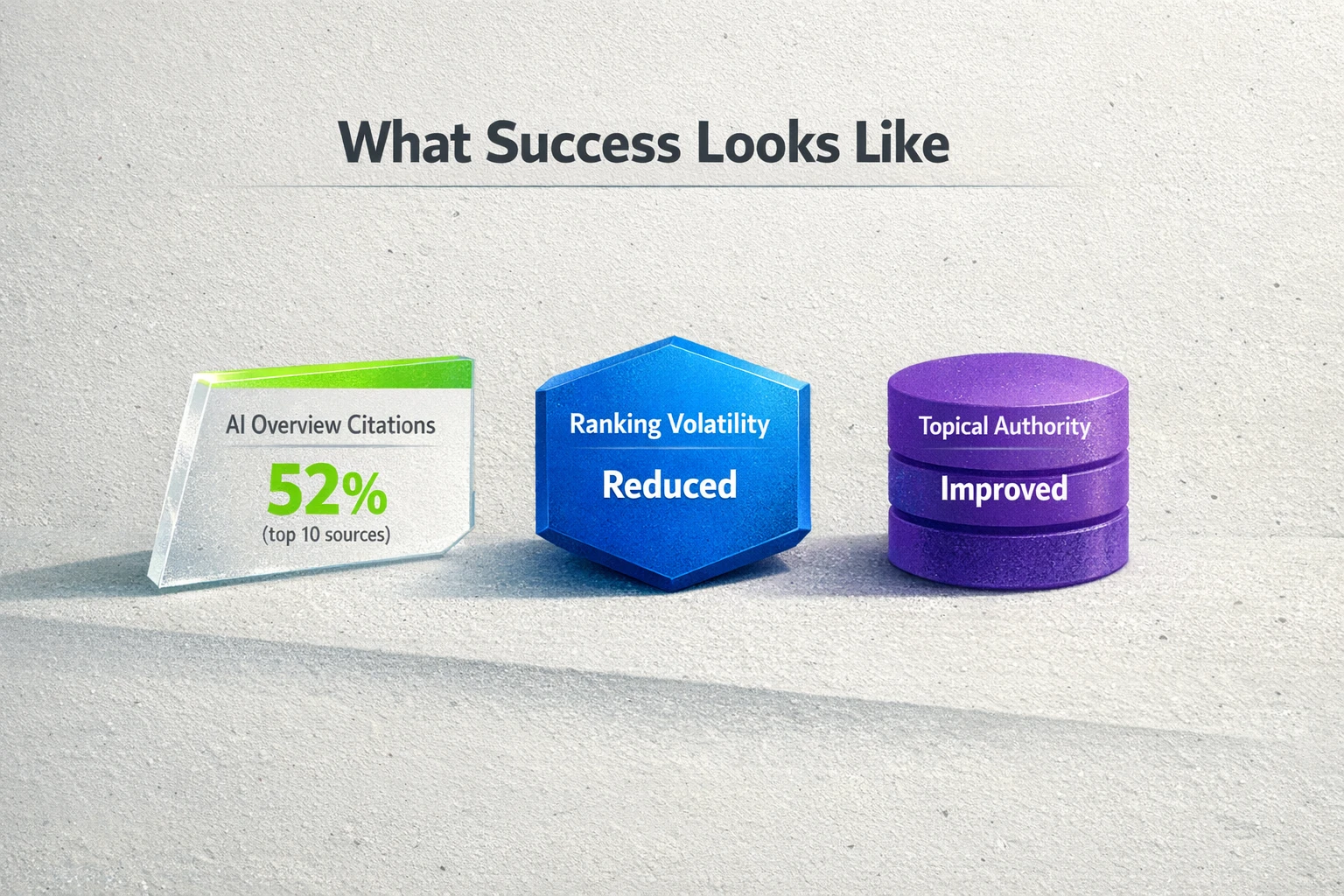
When you successfully implement this playbook, you will see three key outcomes:
- Increased Citations in AI Overviews: You move from just ranking to being the source.
- Reduced Ranking Volatility: Strong authority acts as a buffer against algorithm updates. Your rankings become more stable and predictable.
- Improved Topical Authority: You become the go-to resource for a category, which creates a compounding effect on all related keywords.
Your Content Strategy Must Evolve
The shift from keywords to entities is not a future trend. It is the current reality of how search works. Relying on generic AI writers to churn out content is a strategy for obsolescence.
The winning approach is to use AI as an intelligence tool to understand what Google's AI wants, then combine that insight with genuine human experience and technical precision. This builds real, defensible authority. It is how you stop competing for rankings and start becoming the source.
Frequently Asked Questions
Can AI-assisted content truly satisfy E-E-A-T?
Yes, when used correctly. AI is an exceptional tool for research, analysis, and structuring information, which helps build Expertise and Authoritativeness. However, the "Experience" component must come from genuine human insight, original data, and unique perspectives. The best approach is a human-in-the-loop system where AI assists a human expert, not replaces them.
How long does it take to see results from this approach?
Building true authority is a marathon, not a sprint. You can implement technical fixes like schema immediately. However, seeing significant results, like reduced ranking volatility and consistent AI citations, typically takes 3 to 6 months. The goal is durable, long-term authority, not short-term tricks.
Is this just about adding more schema markup?
No. Schema is a critical component for technical clarity, but it is not a magic bullet. Schema without substance is like a book with a great table of contents but empty pages. The underlying content must have genuine depth, first-hand experience, and be part of a larger, semantically-linked topic cluster to be effective.
What is the difference between this and just using an SEO tool?
SEO tools are excellent for providing data and diagnostics. They can tell you what entities are important or identify a missing schema tag. They cannot, however, create a strategy, generate unique experiential content, or build the cohesive narrative that connects all your content into an authoritative cluster. This playbook is a strategic framework; tools are the instruments you use to execute it.
How do you prove "Experience" with AI-assisted content?
You prove experience by embedding verifiable, unique signals that cannot be found elsewhere on the internet. This includes publishing proprietary data from your company, detailed case studies with real client names and results, unique photography or video of your process, and author bylines from credible experts with a documented history in the field. AI can help format this content, but the core information must be original.
Sources:
- Finch - Data on source citations in Google's AI Overviews.
- Google Search Central - Official documentation on creating helpful, reliable, people-first content.
- Search Engine Land - Expert perspective on advanced concepts like entity strength and semantic relationships.
- Semrush - Foundational guide on the principles of E-E-A-T and its importance in SEO.
- BrightEdge - Strategic overview on implementing E-E-A-T for the new era of AI search.
- WordLift - Technical insights into Knowledge Graph optimization and entity-based SEO.