The Industrial Leader's Guide to AI-First Content Strategy
AI Summary
An AI-first content strategy for industrial B2B is not about faster output, but about becoming the technical source AI copilots trust, cite, and use to shape buying decisions long before a prospect reaches your site. By rethinking content as structured, verifiable knowledge rather than marketing copy, you turn AI from a risk to a force multiplier for authority and pipeline.
- Map your 5-pillar AI-first blueprint across proprietary authority, principled governance, precise structure, pipeline alignment, and performance measurement.
- Run an AI-citability audit on priority technical assets to expose gaps in expert validation, schema structure, and sales objection coverage.
- Redefine success using AI-era metrics like citation rate, branded search lift, and content-influenced pipeline instead of vanity traffic numbers.
This is for industrial teams drowning in AI-generated noise who need a defensible framework to win trust, citations, and deals in AI-mediated buyer journeys.
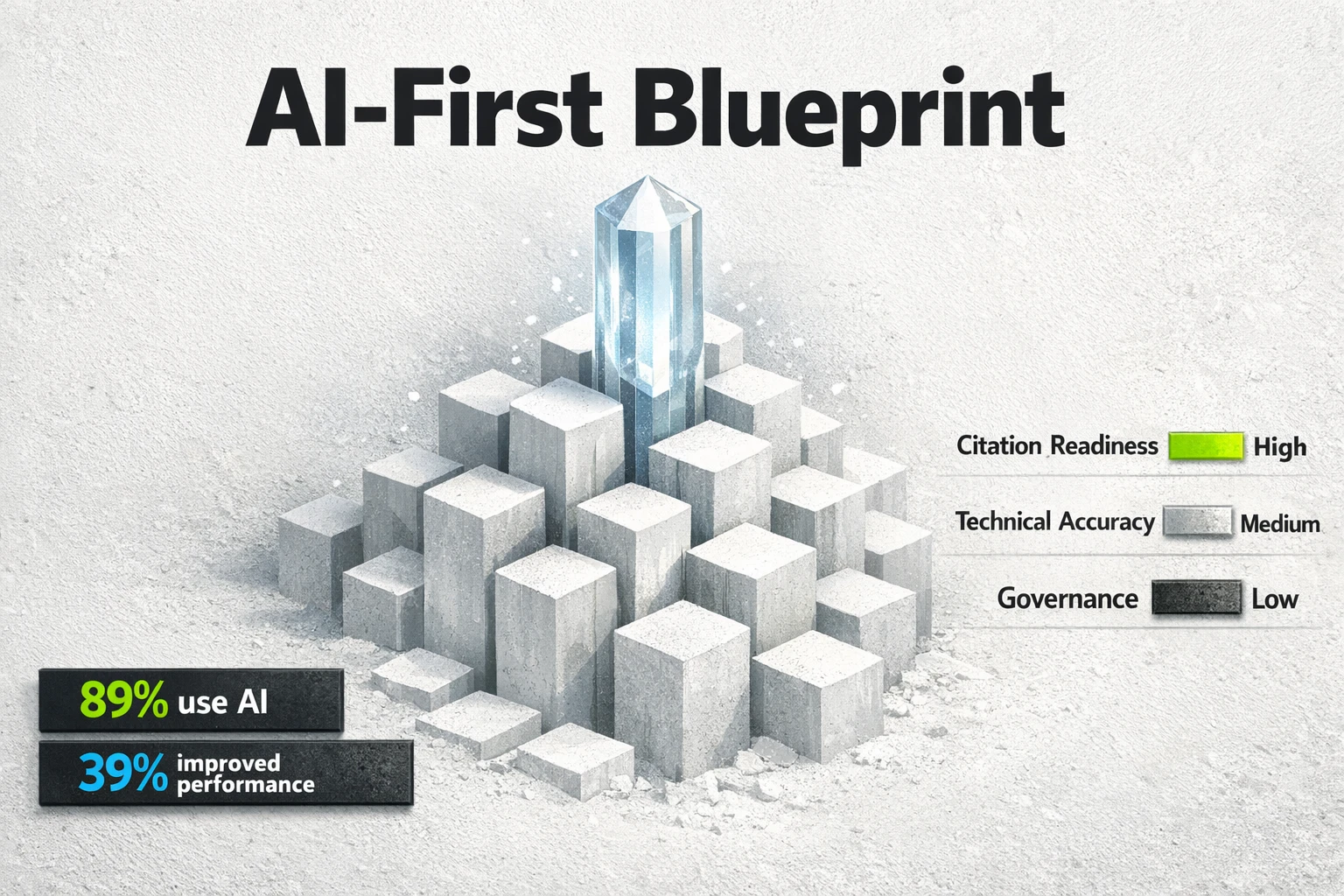
Most industrial B2B marketing teams are using AI wrong. You are likely one of them. The focus has been on efficiency, on producing more content faster. But the data shows this approach is failing. While 89% of B2B marketers have adopted AI tools, only 39% report any real improvement in content performance [1]. The race to publish more is just creating more noise, not more pipeline.
For industrial leaders, the stakes are higher. Your content is not just marketing. It is a technical resource where accuracy is non-negotiable and trust is your most valuable asset. The prevailing "AI for speed" model is a direct threat to that asset. It encourages generic content in a field that demands specifics.
This is the industrial AI dilemma. You cannot afford to ignore AI, but you cannot afford to get it wrong. The solution is not to use AI less. It is to use it with a completely different goal. The goal is not to create content with AI, but to create content for AI to consume, cite, and validate.
The Real Shift: Your Buyer's First Sales Rep is an AI
The most significant change AI brings to B2B is not how we write, but how our customers discover. Your next prospect is not starting their journey on your website. They are starting it with a question to an AI assistant or a generative search engine.
This is not a future prediction. It is happening now. GenAI already influences nearly every stage of the B2B buyer journey, as buyers use copilots and conversational search to research solutions and shortlist vendors, often without ever visiting a brand’s website [1]. They are comparing technical specifications, validating vendor claims, and interpreting complex data through an AI intermediary.
When your buyer asks an AI, "What are the best alloys for high-temperature aerospace applications?" the AI's answer becomes the new search results page. If your content is not the definitive source the AI trusts and cites, you do not exist. Your website becomes a validation tool for a decision that has already been made.
This fundamentally changes the objective of content strategy. SEO is no longer just about ranking for keywords. It is about becoming the primary, citable source of truth for AI models in your specific industrial niche.
The AI-First Content Blueprint: 5 Pillars for Industrial B2B
A generic AI content strategy will not work in a high-stakes industrial market. You need a framework that prioritizes accuracy, governance, and authority. This blueprint reorients your content engine from volume production to building a defensible moat of expertise that AI systems must rely on.
Pillar 1: Proprietary Authority
AI models are trained on public data. Your competitive advantage lies in what is not public: your proprietary data, your unique process, your primary research, and your real-world case studies. An AI-first strategy starts by identifying and codifying this internal knowledge.
Instead of asking AI to write a generic article on a topic, you provide it with your unique data as the source material. This makes your content impossible to replicate. It forces other AI models to cite you as the origin of the insight, building a durable authority signal. This requires a deep understanding of your market, because in the real-time era of AI, a strategic framework for AI-driven competitive authority defense is no longer optional. It is the only way to protect your position.
Pillar 2: Principled Governance
Trust is everything in industrial sales. The biggest risk of AI content is inaccuracy. Nearly half of marketers report encountering inaccuracies from their AI tools multiple times a week [2]. In a consumer market, a mistake might be embarrassing. In an industrial context, it can be a safety or compliance disaster.

Principled governance means creating a human-in-the-loop workflow that is non-negotiable. Every piece of AI-assisted content must be fact-checked and validated by a subject matter expert. Your process should include:
- Expert Review: A documented sign-off process by an engineer or product expert.
- Source Verification: Tracing every technical claim back to a primary source document.
- Transparent Labeling: A clear policy on how you disclose the use of AI in content creation to your audience.
This is not about slowing down. It is about building a process that makes trust repeatable and scalable.
Pillar 3: Precise Structure
AI models do not read content like humans. They parse it. They look for structure, definitions, and relationships between concepts. Content designed for AI consumption is built with a logical, machine-readable architecture.
This means using clear headings, structured data like FAQ and How-to schema, and providing concise, direct answers to specific questions. Think of your content not as an article but as a database of answers. Every heading should address a potential query. Every technical term should have a clear definition. This precision makes it easy for an AI to extract information accurately and present your content as a reliable answer.
Pillar 4: Pipeline Alignment
In industrial B2B, content is not just for marketing. It is a critical sales enablement tool. The buyer's journey is long and involves multiple stakeholders. In fact, 73% of B2B buyers prefer to research online before ever speaking to a sales rep, and they use an average of 6.8 digital touchpoints in their journey [3].
An AI-first strategy ensures your content directly supports this complex journey. Your content blueprints should be developed in partnership with your sales and engineering teams. You need to know what are the common challenges in AI search competitor analysis and how can they be addressed to create assets that disarm objections, clarify technical nuances, and build the business case for your solution. This transforms content from a lead generation tool into a deal acceleration engine.
Pillar 5: Performance Measurement
If your goal changes, your metrics must change too. Vanity metrics like page views and keyword rankings are insufficient. The new question is not just "am I ranking?" but rather, "how does AI measure content depth and am I visible there?"
The percentage of marketers who can demonstrate AI ROI actually fell last year, from nearly 50% to 41% [2]. This is because they are measuring the wrong things. An AI-first dashboard tracks metrics that reflect authority and influence, such as:
- Citation Rate: How often is your content cited in AI Overviews or referenced by other high-authority sites?
- Branded Search Lift: Is your content driving more direct searches for your brand and product names?
- Content-Influenced Pipeline: How many sales opportunities engaged with your key content assets before converting?

Putting It Into Practice: Your AI-Citability Audit
You can start this shift today. Take one of your most important technical articles and audit it against the five pillars.
- Proprietary Authority: Does this content contain unique data, insights, or a perspective that cannot be found elsewhere? Or is it a summary of existing information?
- Principled Governance: Can you trace every technical claim to a verified primary source? Was it reviewed and signed off by a subject matter expert?
- Precise Structure: Is the article structured with clear, question-based headings? Does it use schema markup? Are definitions unambiguous?
- Pipeline Alignment: Does this content answer a specific question your sales team hears every week? Does it address a key objection in the buying process?
- Performance Measurement: Is this piece of content tracked for anything beyond traffic? Can you connect it to any leads, opportunities, or closed deals?
The answers will reveal your gaps. Closing them is the first step toward building a content strategy that does not just compete, but dominates in the age of AI.
Frequently Asked Questions
Does an AI-first strategy mean replacing human writers?
No. It means elevating them. An AI-first strategy automates the repetitive parts of content creation like outlining and first drafts, freeing up your human experts to focus on what they do best: providing unique insights, verifying technical accuracy, and sharing real-world experience. The human role shifts from writer to editor, strategist, and subject matter expert.
How does this affect Google's E-E-A-T (Experience, Expertise, Authoritativeness, Trustworthiness) guidelines?
It aligns perfectly with them. By focusing on proprietary data (Expertise), getting sign-off from engineers (Experience), becoming the go-to source for AI models (Authoritativeness), and implementing rigorous fact-checking (Trustworthiness), this strategy is fundamentally about building E-E-A-T signals that both humans and machines can recognize.
We are a small team. Isn't this too complex to implement?
Starting small is key. Begin with your single most important product or service line. Identify the top five questions your customers ask before they buy and create one definitive, expert-validated, and precisely structured piece of content for each. Five incredibly authoritative assets are more valuable than fifty generic blog posts.
What is the single most important first step?
Create your governance workflow. Before you create another piece of content, document your process for expert review and fact-checking. Get buy-in from your technical and sales teams. This single step will do more to de-risk your AI adoption and improve content quality than any new tool or technology.
Sources: