Beyond Keywords: How AI Pinpoints Market Whitespace for Niche Dominance
AI Summary
Beyond Keywords: How AI Pinpoints Market Whitespace for Niche Dominance explores how advanced AI uncovers hidden market opportunities by analyzing data beyond traditional keyword research. It reveals new ways to identify underserved customer needs and validate niche markets for strategic growth.
Bottom Line:
Using AI transforms market research from guesswork to precise, data-driven niche targeting that accelerates growth and competitive advantage.
What You'll Learn:
- How AI analyzes customer intent and competitor gaps to find whitespace opportunities
- Methods for validating niche potential through signal convergence
- Strategies to execute AI-driven content plans for niche market dominance
Best For:
Business leaders and marketers seeking to outpace competitors by discovering and capturing new market segments through innovative AI insights.
You're looking for an edge. In a market saturated with competitors all chasing the same customers, sustainable growth feels less like a strategic plan and more like a game of chance. You've seen the keyword volume reports and the competitor analyses. They all point to the same crowded, expensive battlegrounds. The real question is not how to compete, but where to compete. Where are the underserved customers, the unaddressed problems, and the untapped revenue streams?
Finding these pockets of opportunity, or market whitespace, has traditionally been a slow, manual process prone to guesswork. But what if you could systematically identify and validate these niches with precision? Advanced AI doesn't just offer a better way to do market research. It provides an entirely new way to see the market, revealing lucrative gaps that your competitors are completely blind to.
The Limits of Looking in the Rearview Mirror
Traditional market research methods, like keyword reports and manual SERP analysis, are inherently reactive. They show you what has already worked for others, effectively encouraging you to enter a race that has already started. This approach has critical flaws in today's dynamic digital landscape.
It's slow, resource-intensive, and often misses the subtle shifts in consumer behavior that signal an emerging opportunity. Research shows that a staggering 85% of all searches are long-tail queries, complex phrases that reveal highly specific user needs. Manual analysis can't possibly capture or interpret this massive, nuanced dataset. You end up optimizing for broad, competitive terms while overlooking the high-intent customers who are telling you exactly what they want to buy.
This is where AI changes the entire equation. Instead of looking backward at competitor history, AI models analyze millions of data points in real-time to map the future of customer demand.
Mapping Opportunity: Using AI to See the Unseen
An AI-driven approach fundamentally shifts the goal from finding popular keywords to identifying underserved customer intent. It works by analyzing multiple layers of data simultaneously to build a comprehensive map of your market. This allows you to pinpoint the most promising areas for growth, the quadrants where customer demand is high and competitor saturation is low.
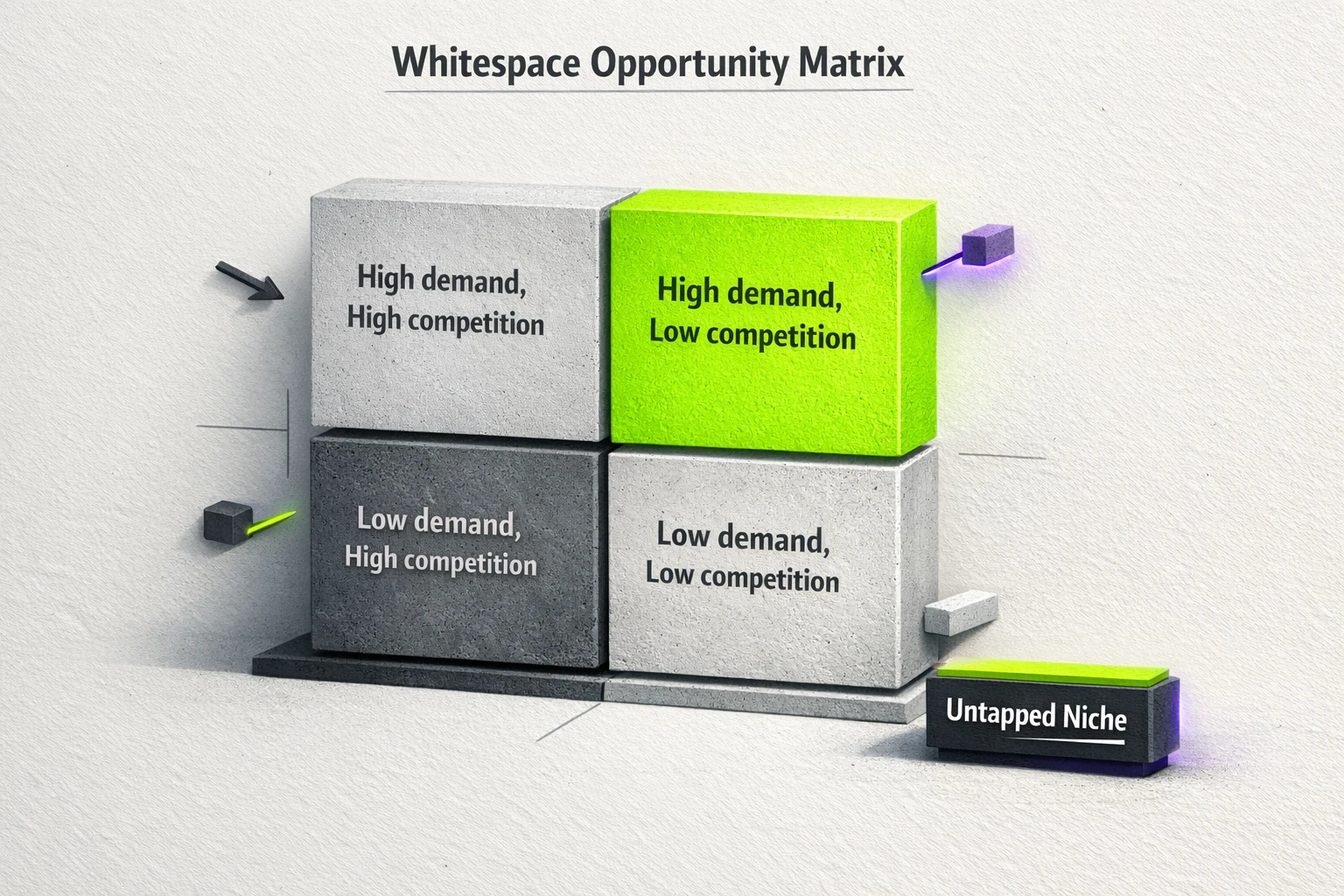
AI systems accomplish this by integrating three critical data streams:
- Semantic Search Analysis: AI moves beyond keywords to understand the meaning and intent behind search queries. It identifies clusters of related questions and problems people are trying to solve, revealing needs that are not being directly addressed by existing content.
- Competitor Content Gap Analysis: The system ingests and analyzes the content of your entire competitive landscape. It doesn't just see what keywords they rank for. It identifies the topics they cover weakly, the questions they fail to answer, and the customer segments they ignore.
- Demographic and Psychographic Pattern Recognition: By analyzing forum discussions, social media chatter, and review sites, AI can connect search intent to specific demographic and psychographic profiles. This uncovers opportunities to target unaddressed customer personas with tailored messaging and products.
Companies that leverage AI for this kind of deep market intelligence see tangible results. A recent study found that 73% of high-growth companies are already using AI for market research and insight generation, a clear indicator that the competitive landscape is shifting.
From Signal to Certainty: Validating Your Niche
Identifying a potential niche is only the first step. The critical next phase is validation. How can you be certain that a perceived gap in the market represents a genuine business opportunity and not just a low-volume anomaly? This is another area where AI provides a decisive advantage.
Instead of relying on a single metric like search volume, AI validates opportunities by looking for signal convergence. It cross-references data points from dozens of sources to build a case for a niche's viability. A strong opportunity is one where multiple indicators all point to the same conclusion.
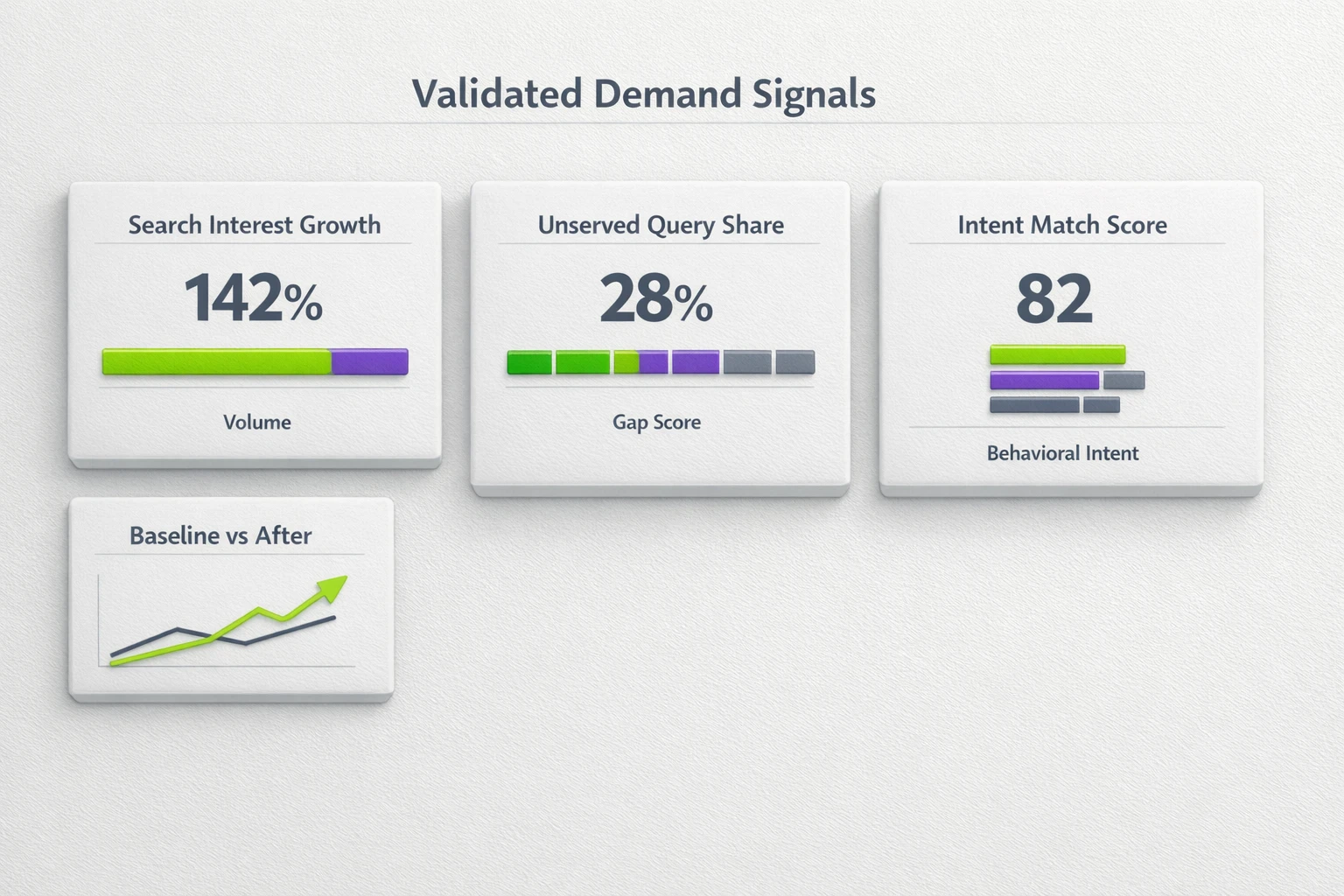
These signals can include:
- Rising Search Trend Velocity: A sustained increase in a cluster of related long-tail queries.
- High Purchase Intent Modifiers: Frequent use of terms like "pricing," "alternative," "best for," and "review" within the query cluster.
- Low Content Saturation: A low number of high-authority pages comprehensively addressing the core user problem.
- Active Community Discussion: Growing conversations on platforms like Reddit, Quora, or industry forums with no definitive solution being offered.
When these signals converge, the AI has not just found a gap. It has identified a validated, high-potential market ready for a leader. This data-driven certainty removes the guesswork and allows you to invest resources with confidence. This strategic focus is powerful; businesses that successfully target niche markets see an average conversion rate increase of 47%. Understanding the new marketing metrics in the AI era is the first step toward capitalizing on these focused opportunities.
Activating the Strategy: How to Dominate a Whitespace Niche
Once AI has identified and validated a whitespace opportunity, the final step is execution. Dominating a new niche requires a strategic content approach designed to quickly establish authority and capture demand. This isn't about producing a few blog posts. It's about building a comprehensive resource that makes your brand synonymous with the solution to the customer's problem.
An AI-powered system like PageBody AI's SEO Strategist is designed for exactly this purpose. It takes the initial whitespace analysis and translates it into a complete, actionable content plan. It outlines the precise pillars, clusters, and individual content pieces needed to cover every facet of the user's journey.
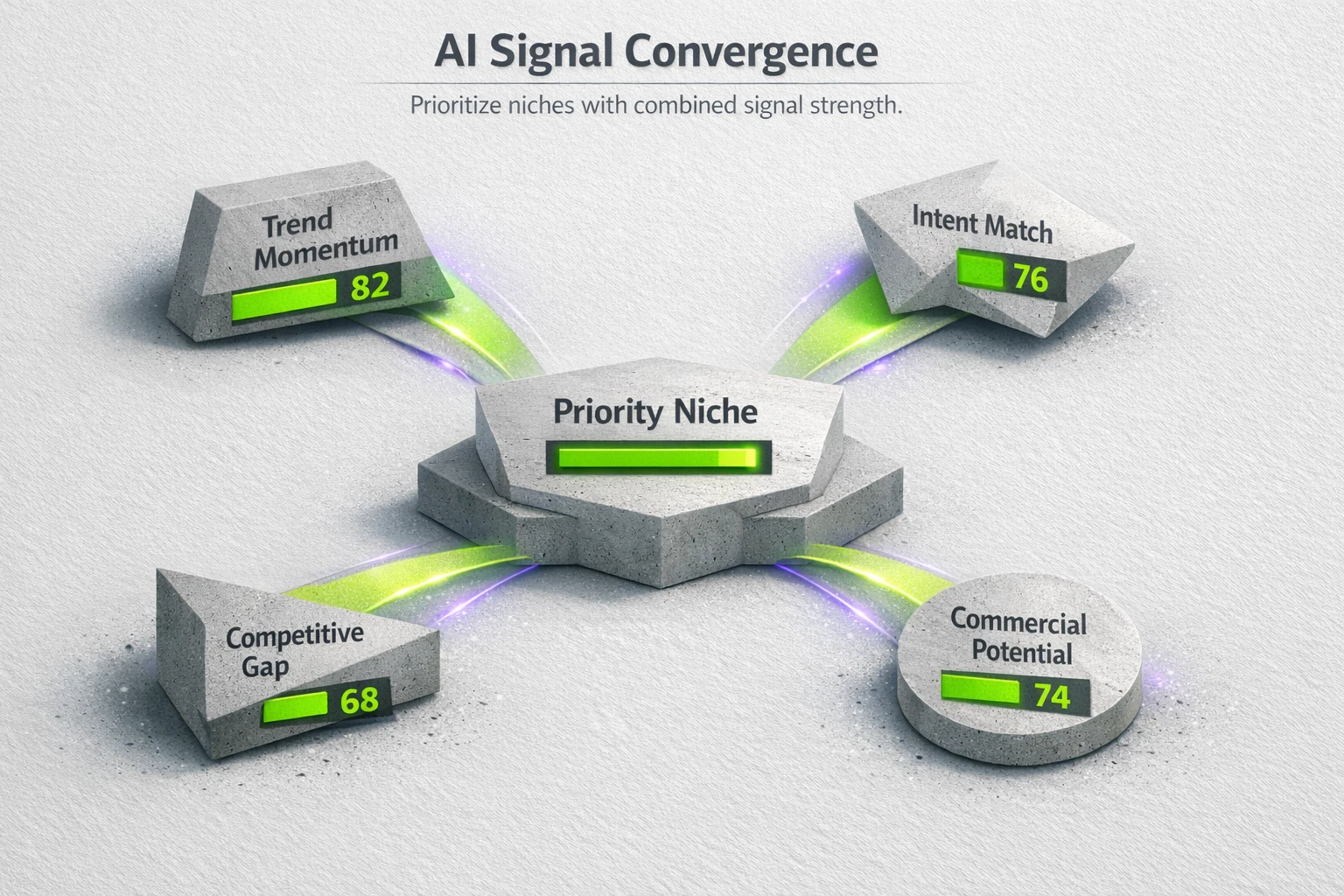
The right AI partner doesn't just hand you data. They deliver a clear, prioritized roadmap for market capture. The process is swift and efficient. While traditional agencies might spend months on research and planning, an AI system can be deployed and begin delivering strategic insights within 14 days. This speed is a significant competitive advantage, allowing you to establish a foothold in a new niche before others even know it exists. The goal is to not just participate in the market, but to define it. A well-executed strategy does more than generate leads; you need a way to estimate LTV from prompt-driven lead sources to truly understand the long-term value.
Choosing to leverage AI for market expansion is a defining moment for any business leader. It's a commitment to a future where decisions are guided by comprehensive data, not just intuition. It's the most effective path to finding, validating, and dominating the growth opportunities that will define your success for years to come.
Frequently Asked Questions
How is this different from traditional keyword research tools?
Traditional tools focus on individual keywords and their search volume, which is a very limited view of the market. AI-driven whitespace analysis looks at entire ecosystems of user intent, analyzing millions of queries, competitor content, and social data to identify unaddressed customer problems, not just popular search terms.
Can AI really understand the nuances of my specific industry?
Yes. Modern AI models are trained on vast datasets that span every industry. The system learns the specific language, challenges, and customer profiles of your market by analyzing your business, your competitors, and public data related to your field. It finds patterns and opportunities specific to your unique context.
How quickly can we expect to see results from identifying a new niche?
An AI system can be deployed and begin delivering validated niche opportunities within about two weeks. Once you begin executing the AI-generated content strategy, you can start seeing initial traction in search rankings and organic traffic within 90 days, with authority building steadily over time as you populate the niche.
Is this approach suitable for B2B as well as B2C companies?
Absolutely. The fundamental principle of identifying and serving unmet needs applies to both B2B and B2C markets. For B2B, the AI may analyze different data sources, such as LinkedIn discussions, industry reports, and trade publications, but the process of finding and validating market whitespace is just as effective.
What kind of investment is required to get started?
PageBody AI offers a transparent, subscription-based model starting at €1,997 per month for our SEO Strategist. This is a fraction of the cost of hiring a dedicated market research team or a traditional consulting agency, and it delivers insights and strategies far more quickly. There are no long-term contracts, allowing you to prove the value directly.
Sources:
- Ahrefs Blog - Data on the prevalence of long-tail search queries.
- Semrush - Statistics and context on the conversion benefits of niche marketing.
- IBM - Insights on the application of AI for market research and trend analysis.
- McKinsey & Company - Report detailing AI adoption rates among high-growth companies.
- Google AI - Information on semantic search and natural language understanding capabilities.