AI for Marketing ROI: Stop Guessing, Start Predicting
AI Summary
Bottom Line
Use AI-driven attribution, holistic metrics, and predictive models to turn scattered marketing data into a clear, forecastable ROI engine you can defend and scale.
Key Takeaways
- Replace basic ROI and ROAS with MER and LTV:CAC to see true, channel-agnostic performance
- Apply algorithmic multi-touch attribution to value every touchpoint and reallocate budget with confidence
- Build an AI ROI framework by unifying data, piloting models, and creating a continuous feedback loop
Best For
Marketing leaders and RevOps teams who need a practical path to measure, compare, and improve marketing ROI with AI-powered analytics.
You have the data. You have the dashboards. Yet, the most important question in marketing remains frustratingly out of reach: what is our real return on investment? You look at reports, but they feel incomplete. You know top-of-funnel content and brand activities matter, but you cannot connect them to revenue.
This isn't a reporting problem. It's an attribution problem. The simple formulas you were taught no longer work in a world of fragmented customer journeys and siloed data. You are not alone in this. Improving marketing ROI and attribution is a top priority for marketers everywhere [7]. The good news is that a clear, data-driven solution exists. It requires moving beyond outdated analytics and embracing AI-powered performance measurement.
The ROI Calculation You Know Is Broken
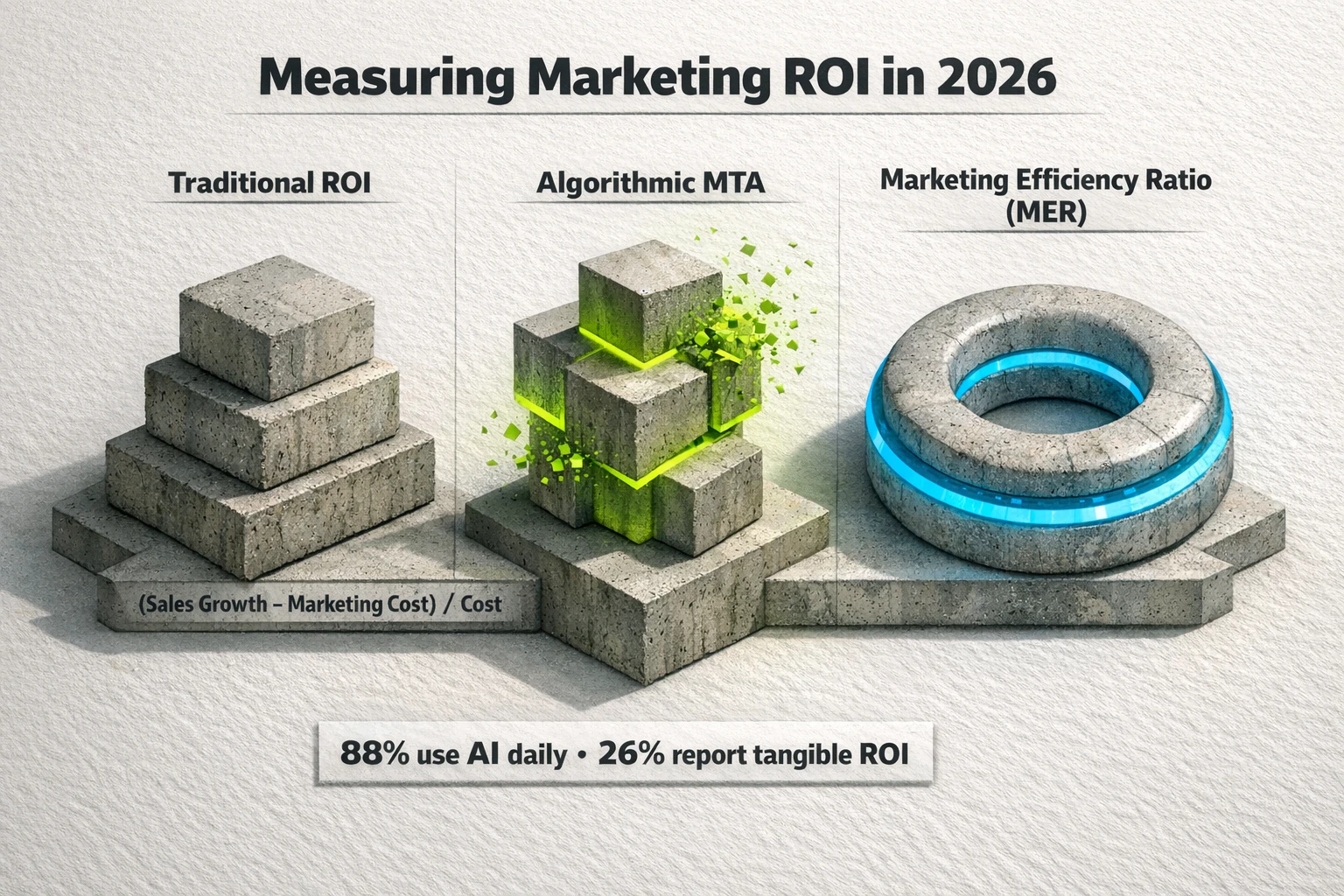
For years, the standard marketing ROI formula has been a simple one: (Sales Growth - Marketing Cost) / Marketing Cost. It was easy to calculate and sufficient for a simpler time.
In 2026, relying on this formula is dangerously misleading. It assumes a linear path from ad to purchase that no longer exists. Today’s customer journey is complex. It weaves across social media, search engines, review sites, and email campaigns before a decision is ever made. The old formula is blind to this reality. It cannot see which touchpoints truly influenced the final sale, leading to misallocated budgets and missed opportunities.
The Great Divide: Why Only 26% of Marketers See Value from AI
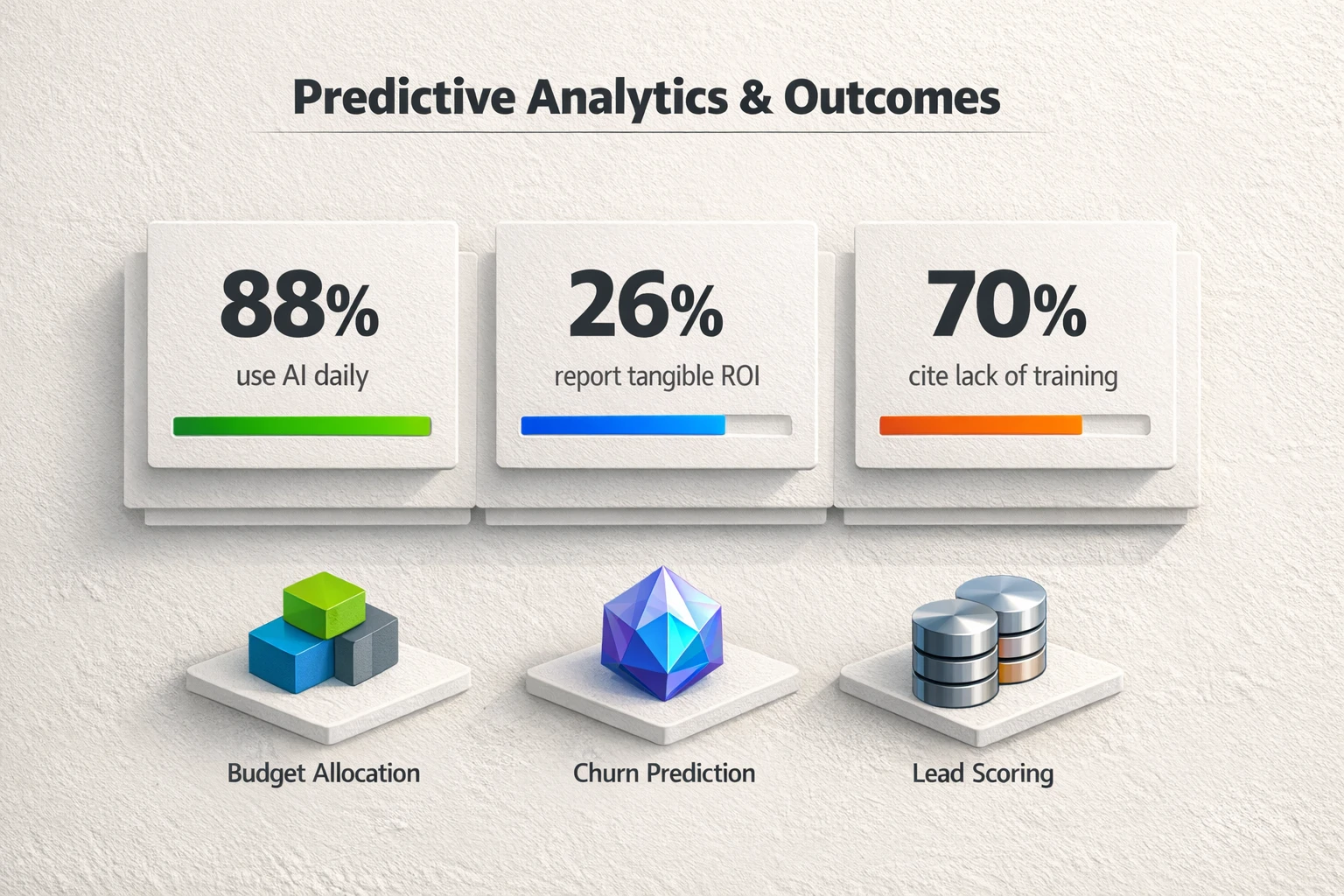
AI is no longer an emerging technology. About 88% of digital marketers report using it in their daily tasks. Yet, a massive gap exists between adoption and results. Only 26% of organizations say their AI implementation generates tangible value or ROI [1].
Why the disconnect? It is not a failure of the technology. It is a failure of strategy and training. A stunning 70% of marketers identify a lack of training as the primary barrier to successfully implementing AI [1]. Teams are given powerful tools without the playbook to use them. They automate old, broken processes instead of building new, intelligent ones. This leads to wasted investment and a false conclusion that "AI doesn't work."
The New Playbook: AI-Powered Metrics That Matter
To get real ROI, you must first measure what actually matters. AI enables a critical shift away from vanity metrics and flawed channel-specific reports toward holistic, business-level indicators. Understanding these new marketing metrics in the ai era is the first step toward clarity.
The two most important metrics for a modern marketing leader are:
- Marketing Efficiency Ratio (MER): This is calculated as
Total Revenue / Total Marketing Spend. Unlike ROAS (Return on Ad Spend), which is easily skewed by attribution models, MER provides a high-level truth source. A key trend for 2026 is the shift to holistic metrics like MER as a more attribution-proof way to measure performance [5]. - LTV:CAC Ratio: The ratio of Customer Lifetime Value to Customer Acquisition Cost. This metric tells you if your growth is profitable and sustainable. AI dramatically improves the accuracy of this calculation by predicting future customer value, not just measuring past purchases.
Decoding the Customer Journey with Algorithmic Attribution
Your biggest ROI problem is likely attribution blindness. Traditional models like "first-touch" or "last-touch" are fundamentally flawed. They give 100% of the credit for a sale to a single interaction, ignoring all the other brand-building and consideration-driving activities that came before it. This systematically undervalues content marketing, SEO, and social media.
Algorithmic multi-touch attribution (MTA) solves this. Instead of following a rigid rule, MTA uses machine learning models to analyze thousands of customer paths. It assigns a dynamic, weighted credit to every single touchpoint. AI-powered MTA models can effectively reallocate marketing spend to boost efficiency by giving proper credit to all touchpoints in the journey [6].
This approach finally gives you a clear answer to questions like, "What is the real value of our blog?" It allows you to understand how to measure brand mindshare on ai search engines and connect that awareness to bottom-line results.
From Reporting to Forecasting: Predictive Analytics for Marketing ROI
The ultimate goal is to stop reporting on the past and start predicting the future. This is where AI moves from an analytics tool to a strategic weapon. By analyzing historical data, predictive models can forecast outcomes with remarkable accuracy, allowing you to de-risk decisions and optimize spend before you even launch a campaign.
Key predictive use cases include:
- Predictive Budget Allocation: AI models can simulate how budget shifts between channels will impact overall revenue, guiding you to the most profitable allocation.
- Churn Prediction: By identifying at-risk customers, you can intervene proactively. This makes your LTV calculations more accurate and stable. Businesses using predictive analytics see a 15–25% decrease in churn rates [4].
- Intelligent Lead Scoring: AI analyzes behavioral and firmographic data to identify which leads are most likely to convert, focusing your sales team's effort where it matters most.
Your 5-Step Framework to an AI-Driven ROI Strategy
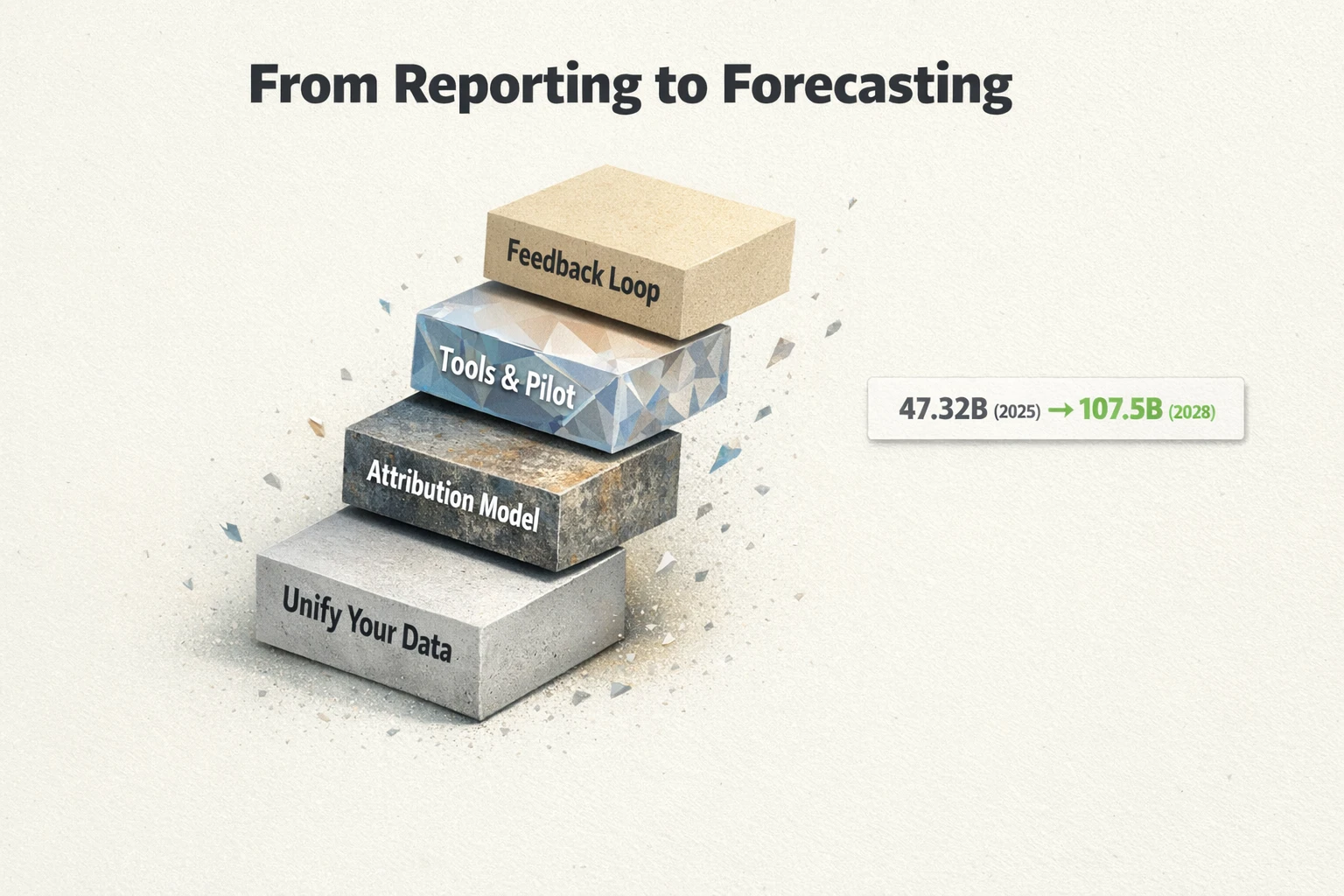
Moving to an AI-driven model is a systematic process, not a single software purchase. It is about building a capability. The global AI in marketing market is projected to reach $107.5 billion by 2028, and the companies that follow a clear framework will capture the lion's share of that value [3].
Follow these five steps to build a reliable and predictive ROI engine.
- Unify Your Data: Centralize data from your CRM, ad platforms, and website analytics into a single source of truth. AI cannot work with siloed information.
- Define Your Attribution Model: Start with your business goals. Choose an algorithmic MTA model that aligns with your customer journey and sales cycle.
- Choose Your Tools and Partners: Select analytics platforms and implementation partners that have proven expertise in AI-driven attribution and forecasting, not just dashboarding.
- Run Pilot Programs: Test your new model on a specific channel or campaign. Validate the results against your historical data before rolling it out across the entire marketing function.
- Create a Feedback Loop: Your model is not static. Continuously feed new performance data back into the system to refine its accuracy and improve its predictive power.
Conclusion: Stop Reporting the Past, Start Predicting Your Future
Measuring marketing ROI in 2026 is no longer about simple formulas and last-click attribution. It is about having a complete, unbiased view of your entire customer journey and using that insight to predict what will happen next.
By adopting modern metrics, implementing algorithmic attribution, and leveraging predictive analytics, you can finally move from reactive reporting to proactive strategy. You can stop defending your budget and start proving its value with confidence and clarity. The tools and the framework exist. The only remaining question is whether you will be in the 26% who get real value from AI, or the majority who do not.
Frequently Asked Questions
Is an AI-driven ROI model only for large enterprises with huge data sets?
No. While more data improves model accuracy, even small and mid-sized businesses have enough data across their CRM, web analytics, and ad platforms to get started. The key is data quality and integration, not just volume.
How long does it take to implement a system like this?
A foundational "quick win" automation or an initial data integration project can go live in as little as two weeks. A full multi-touch attribution model rollout is more involved, typically taking 60 to 90 days to implement, test, and calibrate properly.
Our data is a mess. Do we need to fix everything before we start?
You do not need perfect data, but you do need a plan. The first step of any successful project is a data unification strategy. A good partner will help you identify the most critical data sources and build a clean, centralized foundation for your AI models.
Will this replace our existing analytics tools like Google Analytics?
No, it enhances them. Tools like Google Analytics are excellent for tracking user behavior. An AI analytics layer sits on top of that data, connecting it with data from your CRM and other platforms to perform the advanced attribution and prediction that standalone tools cannot.
How much does an AI analytics system cost?
The cost varies based on the complexity of your data sources and the scope of the implementation. Many modern AI agencies work on a flexible monthly partnership model rather than large, high-risk upfront projects. This allows you to start small, prove the value, and scale your investment as you see results.
Sources:
- Jony Studios - Data on AI adoption rates versus tangible ROI generation and key barriers to implementation.
- Ascend2 - Research on the perceived success rates of AI implementation among marketers.
- Averi.ai - Market sizing and growth projections for the AI in marketing industry.
- Itransition - Case data on the impact of predictive analytics on customer lifetime value and churn rates.
- sandyriev.com - Insights on the strategic shift toward holistic performance metrics like MER.
- TripleWhale - Explanation of how AI-powered multi-touch attribution models work to reallocate marketing spend.
- Salesforce - Report confirming that improving marketing ROI and attribution is a top priority for marketers.
- Improvado - A guide to measuring marketing ROI that highlights the problem of data silos.