Your SEO Playbook for 2026 Is Already Obsolete
AI Summary
Winning with AI for predictive SERP analysis and opportunity discovery means treating SEO as a forecasting engine, not a reporting function stuck on rankings and traffic. You learn how to build durable authority by optimizing for AI share of voice, generative engines, and the coming wave of autonomous agents.
- Reframe success around AI Share of Voice, conversion-weighted visibility, and branded search lift instead of legacy click metrics
- Apply a predictive and prescriptive AI workflow to surface emerging intents and generate concrete content and asset recommendations
- Implement Generative Engine Optimization and agent-ready data structures so LLMs and AI agents reliably cite and transact with your brand
For teams watching organic performance erode and needing a concrete, AI-first playbook to regain leverage in search.
Let's be direct. The conversation about "how AI is changing SEO" is over. That was a 2024 problem. If you are still just reacting to AI search, you are already falling behind. The new strategic challenge is not adapting to change. It is predicting it.
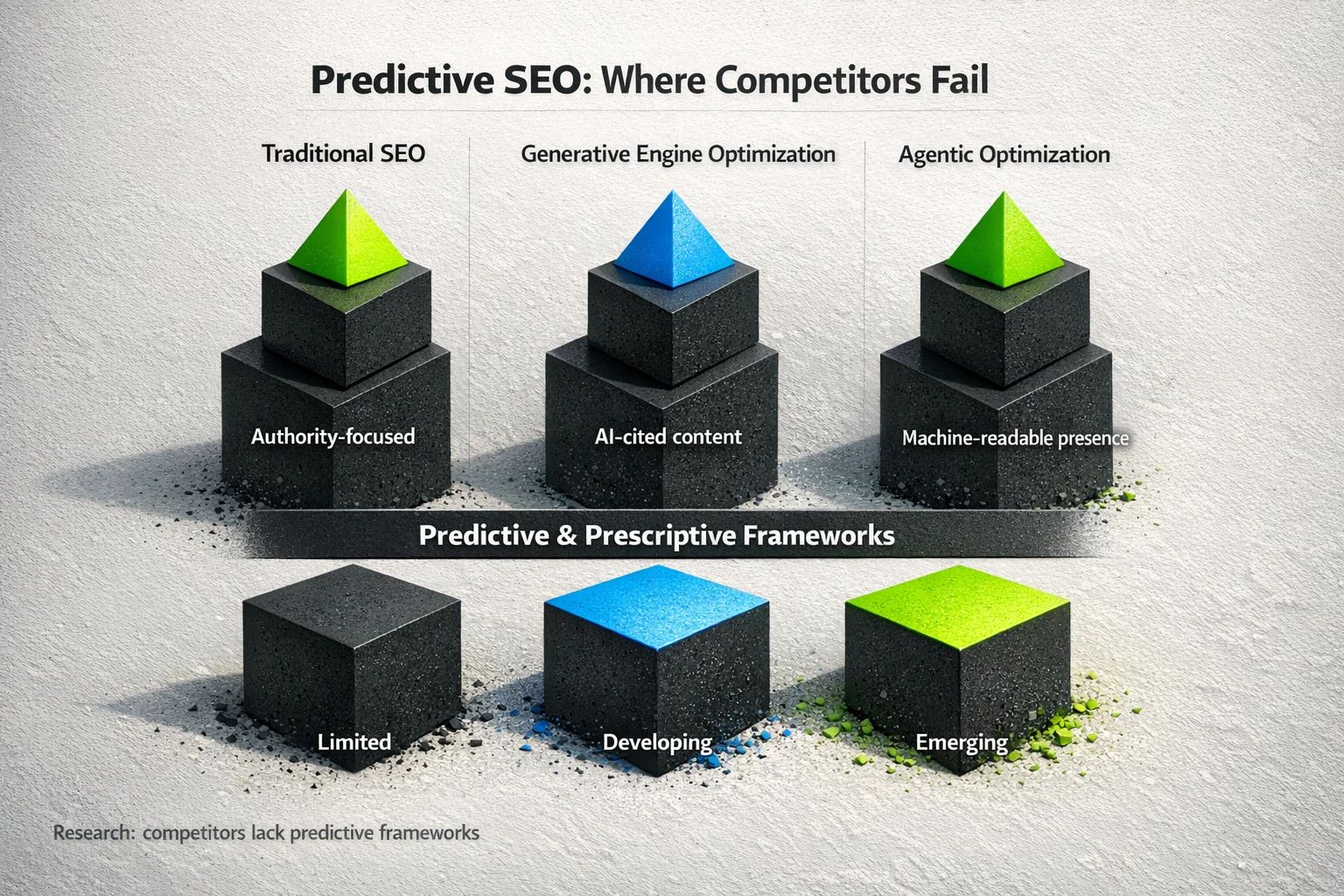
Winning in today's search landscape means moving from a reactive to a predictive posture. It requires anticipating where the market is going, understanding the questions your audience will ask tomorrow, and building the authority that makes you the only logical answer. Generic AI content tools cannot do this. Traditional SEO agencies are not built for this. This is a new discipline.
This guide provides the framework for that discipline. We will introduce the new performance benchmarks that matter, the methodology for predictive analysis, and the operational playbook for building durable authority in an AI-first world.
The New Performance Benchmark: From Clicks to AI Share of Voice
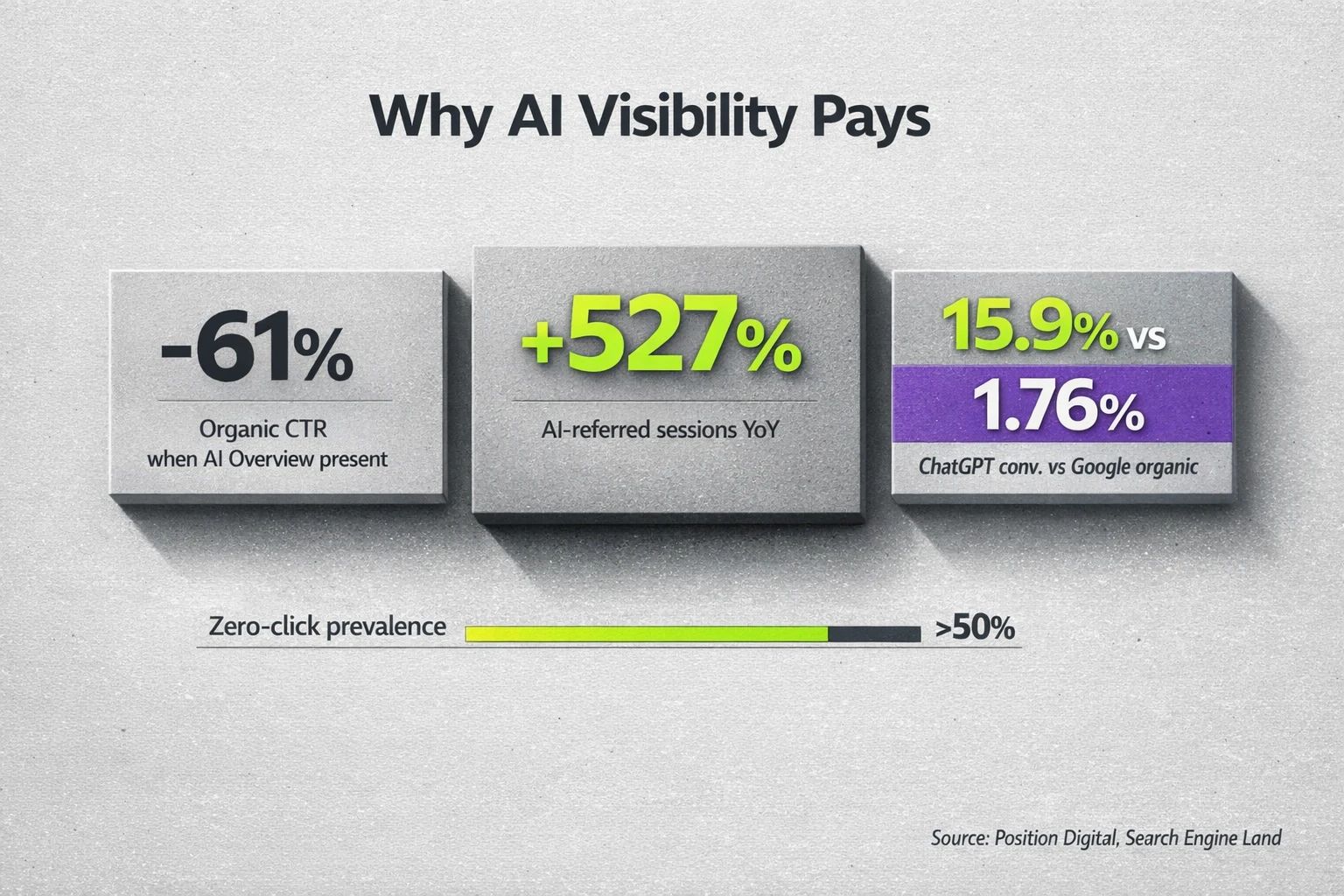
For years, marketing leaders have relied on a predictable set of metrics: keyword rankings, organic traffic, and click-through rates. These are now vanity metrics. Zero-click searches account for over half of all Google queries, a number that is only growing [1]. Your customers are getting answers directly from AI Overviews, meaning they never have to visit your site.
While this shift is alarming, it also presents a significant opportunity. Traditional click-through rates have dropped by as much as 61% on queries with an AI Overview [2]. Yet, the traffic that does come from an AI citation is highly qualified. AI-referred sessions have seen a massive year-over-year increase, and their conversion rates are dramatically higher than traditional organic traffic [2]. One analysis found traffic from LLMs converted at nearly 16%, compared to less than 2% for standard organic search [2].
This data points to a new reality. The goal is no longer to win a click. The goal is to become a trusted source cited by the AI.
This requires a new set of KPIs:
- AI Share of Voice (AI SOV): How often is your brand, its experts, and its data mentioned by AI in response to critical business queries? This is the new measure of brand visibility [3].
- Conversion-Weighted Visibility: Are your AI citations driving bottom-line results? This metric tracks the revenue impact of being featured, not just the mention itself.
- Branded Search Lift: As users discover you through AI, they often search for your brand directly. An increase in branded search is a powerful indicator of growing authority.
Measuring these new KPIs is foundational. It provides a clear way to understand how to measure brand mindshare on AI search engines and proves the business case for investing in a more sophisticated strategy.
The Methodology: Predictive and Prescriptive SEO
To increase your AI Share of Voice, you cannot rely on guesswork. You need a system that anticipates trends and prescribes specific actions. This is the core of a modern strategy, moving beyond simple analysis to active forecasting.
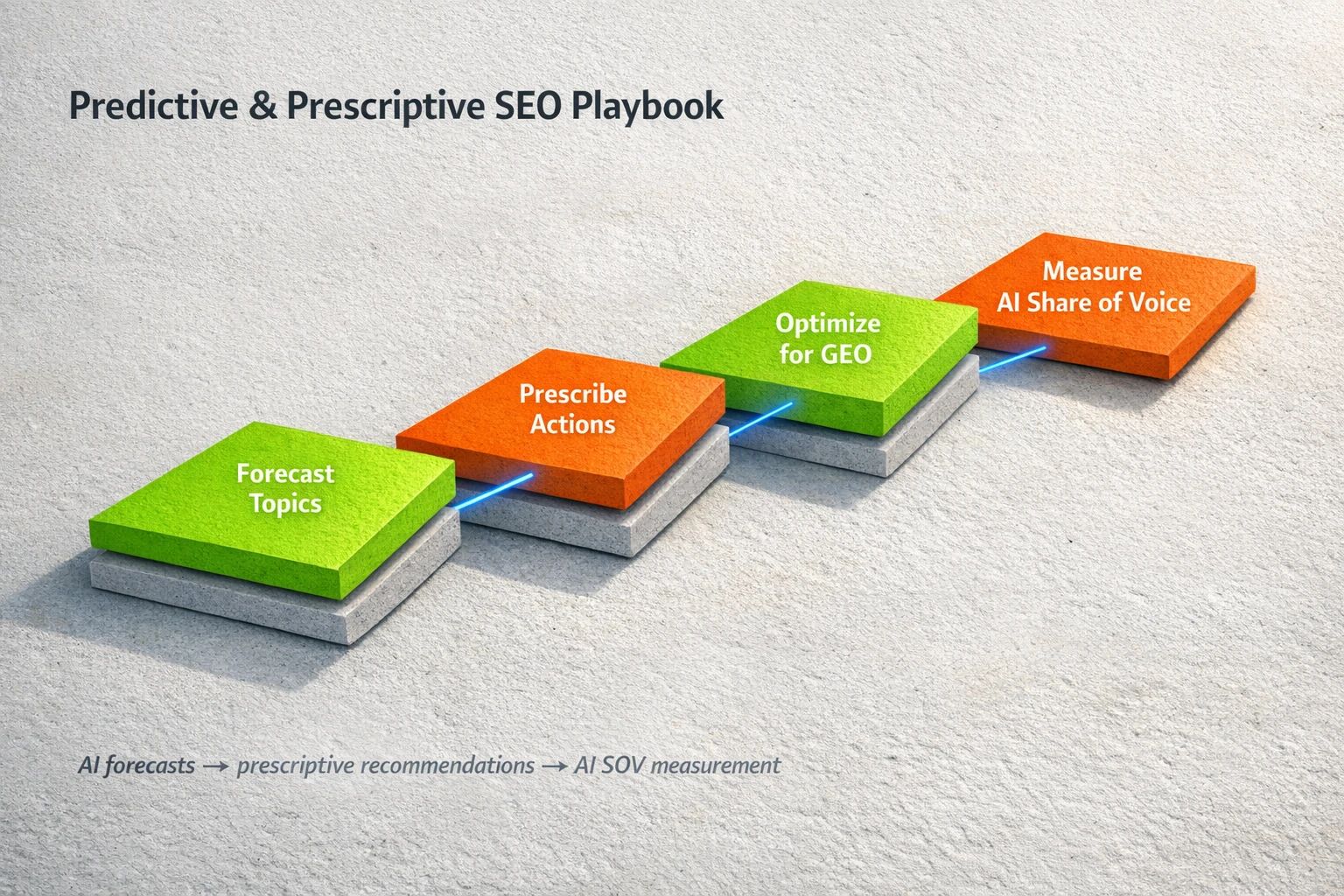
Predictive AI analyzes massive datasets to see what is next. It can forecast which topics in your industry will trend, what questions users are about to ask, and where new search intent is emerging [4]. It turns market research from a quarterly exercise into a real-time competitive advantage.
Prescriptive AI takes these predictions and provides concrete actions. Instead of just showing you a trend, it delivers specific recommendations like “create a detailed guide on X topic” or “build a calculator for Y problem” to capture demand before your competitors even see it [4].
This predictive and prescriptive model is the engine of a modern growth strategy. It allows you to build topical authority systematically, creating the exact assets that answer the questions of tomorrow. This is the work our SEO intelligence agency delivers, moving clients from content production to authority engineering.
Optimizing for AI, Not Just Google: An Introduction to GEO
Old SEO was about ranking on a results page. The new discipline is about being cited in an AI-generated answer. This is Generative Engine Optimization (GEO). GEO is the process of ensuring your content is understood, trusted, and used by Large Language Models when they construct a response [3].
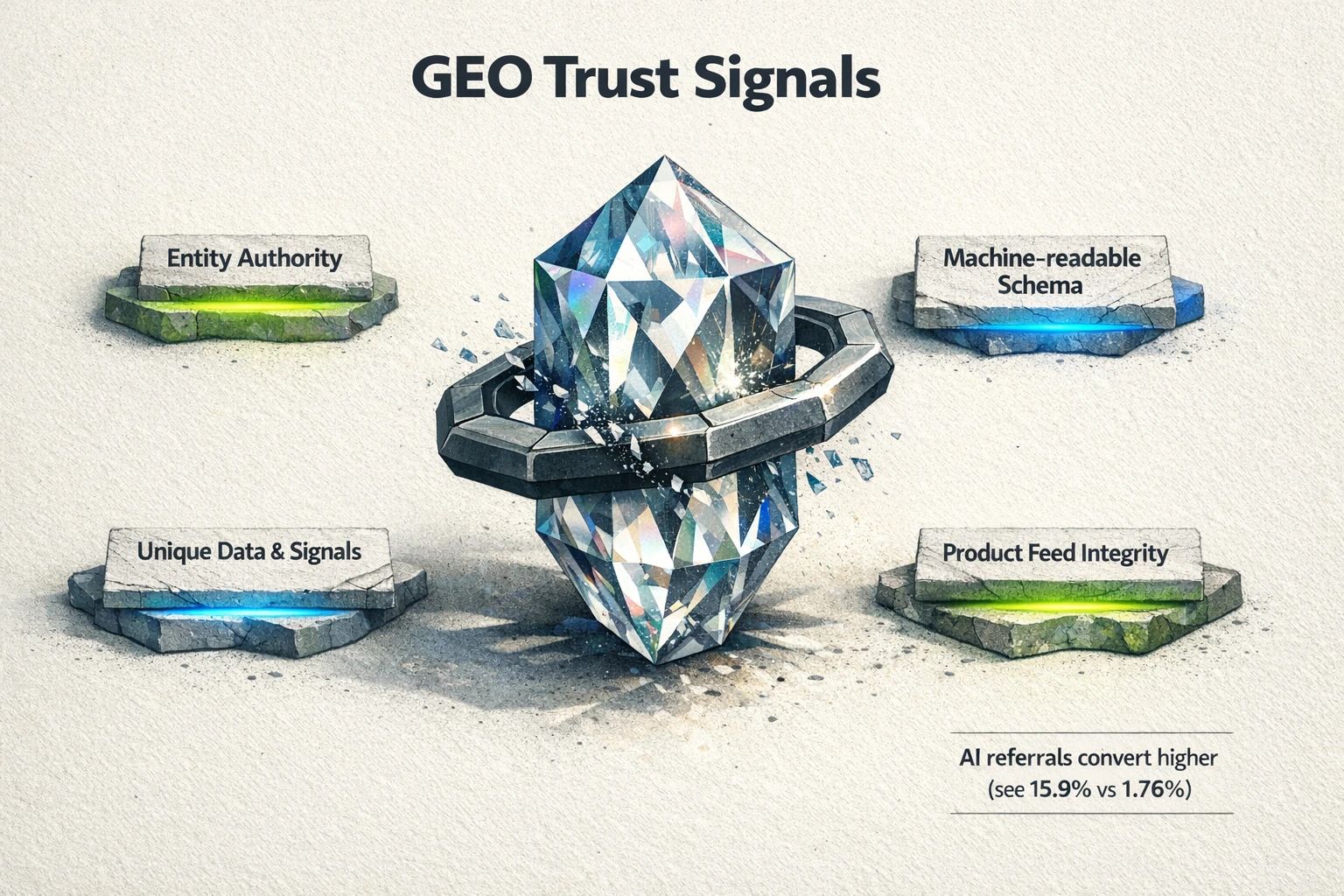
AI models do not "crawl" the web like Googlebot. They ingest information and look for signals of credibility and authority. To win at GEO, your content must be structured for machine consumption. This goes far beyond keywords. It includes:
- Verifiable Trust Signals: Clearly stating authorship, citing primary sources, and showcasing real-world experience. A focus on E-E-A-T in era AI is non-negotiable for building the credibility needed for AI citation.
- Unique Data and Insights: Publishing original research, proprietary data, and expert perspectives that cannot be found elsewhere. AI prioritizes novel information.
- Structured Content: Using clear headings, lists, and semantic HTML so machines can easily parse your core arguments and data points.
- Entity Recognition: Building a strong, consistent presence for your brand and experts across the web so AI recognizes you as a definitive entity on a given topic [1].
Ultimately, the best way to measure GEO effectiveness is to use tools for analyzing expert content impact on AI brand authority and see if your efforts are translating into a greater AI Share of Voice.
The Next Frontier: Preparing for Agentic Optimization
The final piece of the puzzle is looking beyond today's search interfaces to the near future of autonomous AI agents. These agents will perform complex tasks on a user's behalf, from booking travel to sourcing business software.
To be recommended by these agents, your data, products, and services must be perfectly structured and machine-readable. This requires:
- Advanced Schema Markup: Tagging your products, services, events, and expertise with precise data that an AI agent can read and act upon.
- API Accessibility: Allowing trusted AI agents to interact with your business data directly to get real-time pricing, availability, and specifications.
- Product Feeds: Maintaining detailed, accurate product and service feeds that can be ingested by various AI platforms.
Waiting for AI agents to arrive is not a strategy. The foundational work of structuring your business data for machines must begin now. Businesses that make themselves legible to AI will become the default choice in the agentic era.
Your Predictive SEO Playbook Starts Now
Moving from a reactive to a predictive SEO strategy is the single most important marketing decision you can make in 2026. The shift is not theoretical. It is here, and it is actively redistributing market share to those who adapt first.
The playbook is clear:
- Adopt New Metrics: Stop reporting on rankings and traffic. Start measuring AI Share of Voice and Conversion-Weighted Visibility.
- Embrace Predictive Analytics: Use AI to forecast trends and get prescriptive recommendations for content that builds authority.
- Implement GEO: Structure your content and expertise to be understood and trusted by AI language models.
- Prepare for Agents: Make your business data machine-readable to win in the coming era of autonomous search.
This is not a simple tweak to your existing SEO program. It is a fundamental change in how you approach digital growth. It requires specialized intelligence and a systematic process. The businesses that make this change now will build a durable competitive advantage that lasts for the next decade.
Frequently Asked Questions
What is the difference between traditional SEO and Generative Engine Optimization (GEO)?
Traditional SEO focuses on ranking a webpage on a list of search results, primarily for human crawlers. GEO focuses on making your content and data so authoritative and structured that AI language models will cite it as a trusted source when generating a direct answer. The goal shifts from visibility in a list to influence in an answer.
How can we trust AI predictions about future search trends?
Predictive AI models are not guessing. They analyze massive, real-time datasets including search queries, social media discussions, news articles, and industry reports to identify emerging patterns and correlations. While no prediction is perfect, this data-driven approach is far more reliable than relying on historical keyword data alone.
We have a small team. How can we possibly implement all of this?
You do not need to build an internal AI team. The key is to partner with a specialist who provides the intelligence and the deliverables. Your team's role is to provide domain expertise and fact-checking. A good partner will deliver publish-ready assets, like our Ranking Asset Packages, that your team can simply review and deploy.
Is this going to replace our content marketing efforts?
No, it makes them more effective. Instead of creating content based on what worked last year, a predictive strategy tells you what to create to win next year. It provides a data-driven roadmap for your content team, ensuring every article, whitepaper, and case study is built to capture emerging demand and establish authority.
What is the first, most practical step we can take?
The first step is a strategic audit. You need to understand your current AI Share of Voice for your most important business topics. This baseline measurement will reveal your biggest vulnerabilities and opportunities, providing a clear starting point for building a predictive and prescriptive plan.
Sources:
- The Digital Maze - Analysis of zero-click searches and the evolution of SEO toward entity and brand optimization.
- Position Digital - Statistics on AI's impact on CTR, referral traffic, and conversion rates.
- Brosch Digital - Definitions and strategic context for Generative Engine Optimization (GEO) and AI Share of Voice (AI SOV).
- Clicks Gorilla - Explanation of predictive and prescriptive AI functions in modern SEO strategy.