Beyond Keywords: Your Guide to AI-Powered Semantic Search and Entity Authority
AI Summary
Beyond Keywords: Your Guide to AI-Powered Semantic Search and Entity Authority explores how AI transforms SEO by focusing on semantic understanding and entity authority. It explains the shift from traditional keyword tactics to AI-driven semantic strategies that enhance search visibility and trustworthiness.
Bottom Line:
Mastering AI-powered semantic SEO builds lasting authority and relevance, giving your content a competitive edge in modern search.
What You'll Learn:
- How AI decodes semantic relationships to improve content relevance.
- Strategies to build and automate knowledge graphs for entity authority.
- Practical phases for auditing, optimizing, and amplifying SEO impact.
Best For:
SEO professionals and marketers seeking effective AI-driven tools to evolve from keywords to topic authority and win in today’s search landscape.
If you're evaluating SEO strategies, you've likely noticed a shift. The old playbook of keyword density and backlink volume is becoming less effective. Search engines no longer just match words; they understand concepts, relationships, and the real-world entities behind your content. This is the era of semantic search, and mastering it is the key to unassailable search dominance.
The challenge is that building this kind of authority traditionally required immense resources. Today, AI changes the equation. It provides the tools to understand and optimize for this new landscape at scale. This guide will walk you through exactly how AI is instrumental in building entity authority, decoding semantic relationships, and aligning your content with the logic of modern search.
The Core Difference: Semantic vs. Traditional SEO
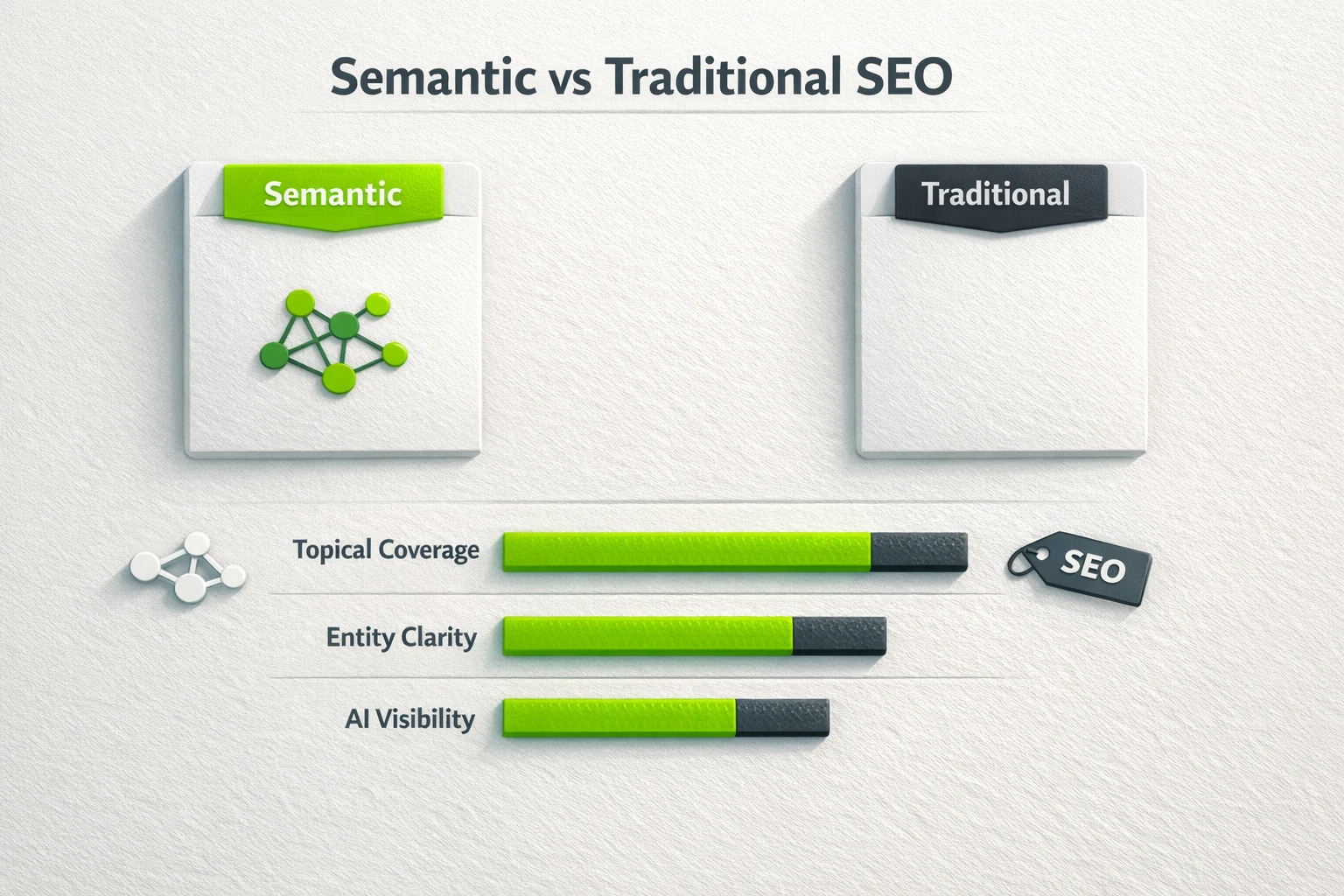
The fundamental change is Google’s move from "strings to things." A traditional approach sees "Apple financial report" as a string of words. A semantic approach understands "Apple Inc." as a business entity and connects it to related concepts like "quarterly earnings," "Tim Cook," and "stock market."
AI-driven SEO doesn't guess at these connections. It analyzes them, helping you build a web of topically relevant content that establishes your expertise. While traditional tactics still have a place, a semantic strategy is what builds a defensible moat around your search presence. With 86% of SEO professionals already integrating AI, the market is moving quickly to capitalize on this advantage.
The AI Advantage: Decoding Semantic Relationships for SEO
To win in semantic search, you need to think like a search engine. AI gives you that capability. It moves beyond surface-level keywords to uncover the deeper contextual relationships within your content and your competitors'.
AI-Powered Topic Modeling
Instead of just grouping articles by a primary keyword, AI performs sophisticated topic modeling. It analyzes vast amounts of text to identify core themes, sub-topics, and user questions that define a subject area. This allows you to see your entire content ecosystem through the eyes of a search engine, identifying critical gaps and opportunities to deepen your topical coverage. You can build content clusters that are not only comprehensive but also semantically interconnected, signaling true expertise.
Entity Recognition and Disambiguation with AI
An entity is any well-defined concept: a person, place, organization, or idea. AI uses Natural Language Processing (NLP) to identify these entities in your content and, crucially, to disambiguate them. It learns the difference between "Jaguar" the car brand and "jaguar" the animal based on surrounding context.
This process is vital for building your semantic authority. When search engines can confidently identify the entities you discuss, they can connect your content to a wider web of knowledge, strengthening your credibility and making you a go-to source. This clarity is especially critical for getting your content into llm‑indexed pages and generative AI answers.
Building Unassailable Entity Authority with AI
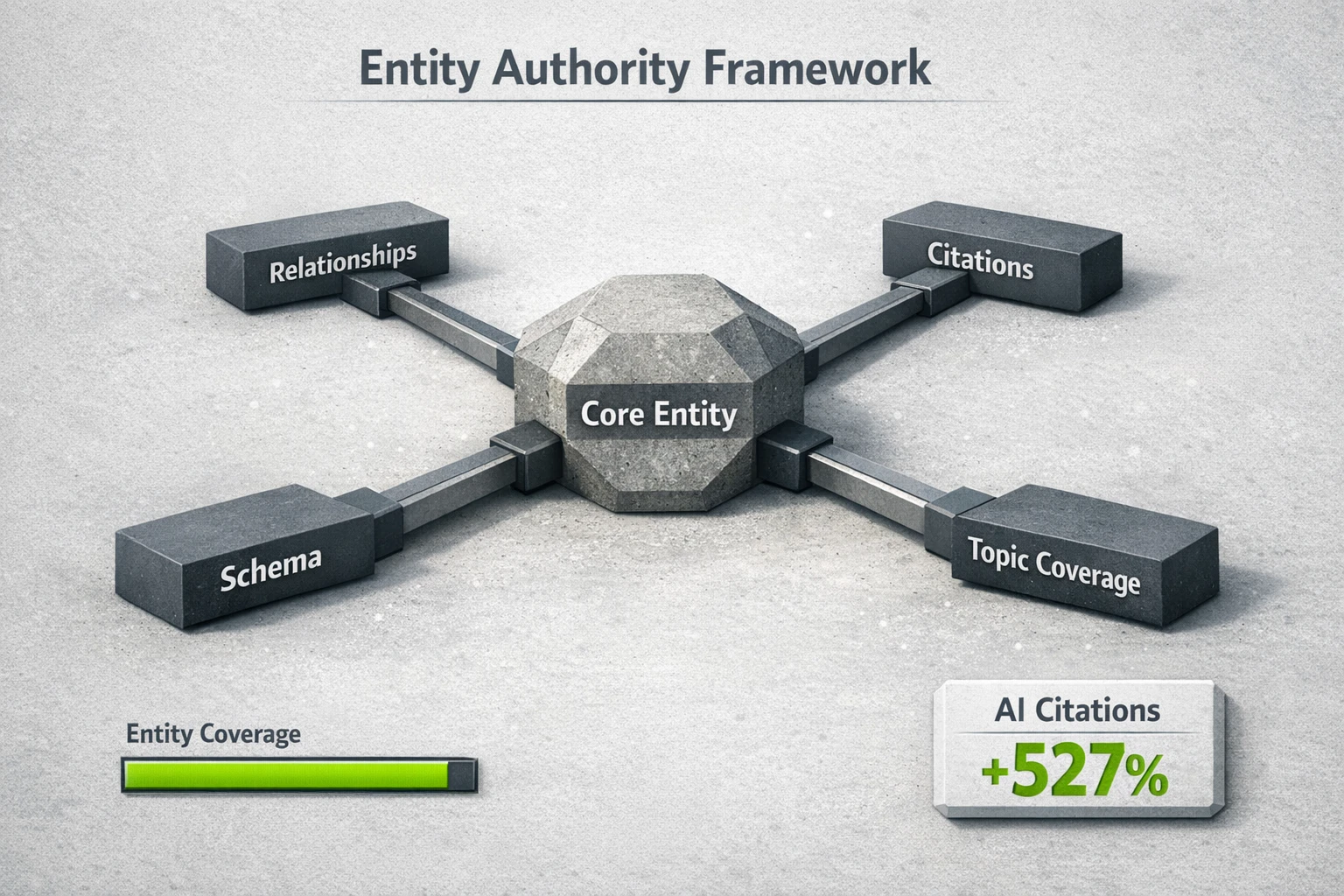
Entity authority is your brand's "digital credit score." It's the measure of trust and credibility that search engines assign to you on specific topics. A high score means your content is more likely to be featured, cited, and ranked. AI is the engine for building and scaling this authority through a knowledge graph.
What is a Knowledge Graph for SEO?
Think of a knowledge graph as your business's private map for search engines. It's a structured representation of your core entities, the services you offer, your expertise, and how all these pieces relate to one another. It's built using schema markup, a type of code that explicitly tells search engines what your content is about.
A well-structured knowledge graph removes all ambiguity. It ensures Google knows exactly who you are, what you do, and why you are an authority, making your content a prime candidate for AI Overviews and rich results.
How AI Automates Knowledge Graph Generation
Manually creating and maintaining a knowledge graph is a complex, time-consuming task. AI-powered systems can automate this process by:
- Extracting entities and relationships directly from your existing content.
- Generating compliant schema markup automatically.
- Identifying inconsistencies across your site to ensure your entity information is uniform.
- Discovering new connections and content opportunities to expand your graph.
This automation allows you to build a sophisticated authority signal that would be impractical to manage manually, giving you a significant competitive edge.
A Practical Playbook for Building Entity Authority
Adopting an AI-driven semantic strategy is a structured process, not a one-time fix. It involves auditing your current standing, building a strong foundation, and continuously amplifying your authority.
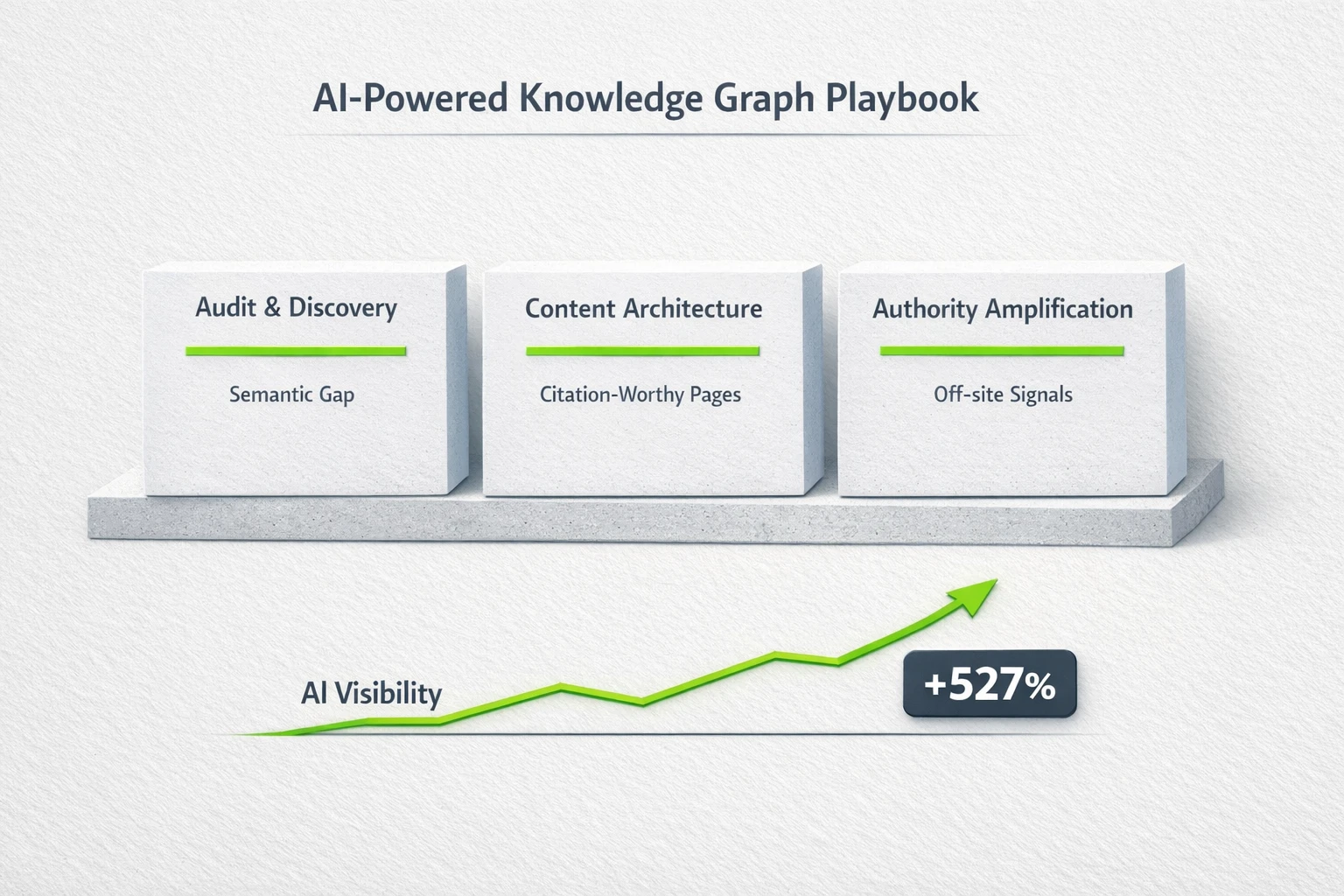
- Phase 1: Audit and Discovery. Use AI tools to analyze your existing content and identify your core business entities. The goal is to map your current topical coverage and find semantic gaps where your competitors are outperforming you.
- Phase 2: Content Architecture and Optimization. Develop content that is answer-first, directly addressing user intent. Implement advanced schema markup across your site to define your knowledge graph. Every new piece of content should be seen as an opportunity to strengthen an entity.
- Phase 3: Authority Amplification. Focus on earning mentions and citations from other authoritative sources. This reinforces the relationships in your knowledge graph and validates your expertise in the eyes of search engines.
- Phase 4: Monitoring and Adaptation. Track your visibility in AI-driven search features. The landscape is dynamic, with AI search traffic surging 527% year-over-year. Continuous monitoring allows you to adapt your strategy as new formats and algorithms emerge. For a fast start, you can explore some initial quick wins with
pagebody.
The Human-in-the-Loop Imperative
While AI provides powerful tools for analysis and automation, it does not replace human strategy and expertise. The most successful AI-driven SEO strategies embrace a "human-in-the-loop" approach.
AI is an incredible assistant for research, data processing, and scaling content production. However, human oversight is essential for:
- Strategic Direction: Defining the core entities and topics that align with business goals.
- Quality Control: Ensuring accuracy, originality, and a unique brand voice.
- Demonstrating Experience: Infusing content with firsthand experience and insights, a cornerstone of building trust and credibility in the
eeat in the ai era.
Google's guidelines are clear: they reward high-quality content, regardless of how it's produced. Using AI to create low-value, unoriginal articles is a losing strategy. Using it to augment human expertise and create deeply valuable resources is how you win.
Frequently Asked Questions
How does semantic SEO differ from keyword research?
Keyword research focuses on specific search terms ("strings"). Semantic SEO focuses on the underlying topics and concepts ("things") and how they relate to each other. It's about building comprehensive authority on a subject, not just ranking for a few phrases.
Is AI-generated content penalized by Google?
No, Google does not penalize content simply because it was created with the help of AI. Their focus is on the quality of the content. As long as it is helpful, reliable, and people-first, it can rank well. Low-quality, spammy AI content will perform poorly, just like low-quality human-written content.
How long does it take to build entity authority?
Building true authority is a long-term strategy, not an overnight fix. Initial improvements from implementing schema and optimizing existing content can be seen in a few months. However, establishing your brand as a dominant entity in a competitive space is an ongoing process of creating excellent content and earning recognition.
What are the most important metrics to track for semantic SEO?
Beyond traditional rankings and traffic, you should monitor metrics that reflect conceptual authority. These include your share of voice in AI Overviews, the number of entities you rank for, and your visibility for long-tail conceptual queries. It is also important to use tools for analyzing expert content impact on ai brand authority to see how your efforts translate into perception.
Can a small business realistically compete with larger companies on entity authority?
Absolutely. Entity authority is not just about size; it's about focus and depth. A small business can build immense authority within a specific niche by creating the most comprehensive and helpful resources on that topic. AI levels the playing field by providing access to sophisticated analysis and automation that was once only available to large enterprises.
Sources:
- Semrush AI SEO Statistics - Data on AI adoption rates among SEO professionals and AI search traffic growth.
- Search Engine Land AI SEO Playbook - Strategic guidance on answer-first content and adapting to AI-driven search.
- Salesforce AI for SEO Guide - Authoritative overview of AI's impact across different SEO functions.
- Google Search Central Blog - Official guidelines on Google's stance on AI-generated content.
- Whatagraph AI SEO Tools Review - Insights into the practical application of various AI tools in SEO workflows.
- SERanking AI Statistics - Market growth projections for AI in the marketing sector.