AI & SEO How Server Responses and HTTP Headers Signal Your Site’s True Health
AI Summary
The article about AI & SEO How Server Responses and HTTP Headers Signal Your Site’s True Health explains how artificial intelligence enhances the monitoring and interpretation of server response codes and HTTP headers to improve SEO performance.</p><ul><li><strong>Who:</strong> Website owners, SEO professionals, digital marketers, and technical teams.</li><li><strong>What:</strong> The use of AI to analyze server response codes and HTTP headers to diagnose and optimize site health for better search engine rankings.
When: As SEO demands evolve and AI search engines gain prominence, ongoing monitoring is critical now and into the future.
Where: Across all online businesses and websites that rely on SEO to attract organic traffic.
Why: To detect hidden technical issues such as redirect chains, server errors, crawl budget waste, and security vulnerabilities that can harm SEO and business results.
The article covers foundational concepts of HTTP status codes and headers, the limitations of manual audits, and how AI systems provide deeper, continuous diagnostics that translate technical data into actionable SEO insights tailored for an AI-powered search landscape.
In the world of SEO, we spend a lot of time focused on what users see: compelling content, beautiful design, and clever keywords. But behind the scenes, your website is constantly having a conversation with search engine crawlers. This technical dialogue, composed of server response codes and HTTP headers, is often invisible. It’s also one of the most critical factors determining your site's health and ranking potential.
Many businesses discover this too late. They produce great content, but a hidden technical issue, like a faulty redirect or a slow server, silently sabotages their efforts. Traditional methods of checking these signals are often manual and slow. They catch obvious breaks but miss the subtle patterns that can erode performance over time. In the age of AI, where search engines process information with unprecedented speed and sophistication, these hidden signals are more important than ever.
The Foundations: Speaking the Server's Language
Before we dive into how AI revolutionizes this process, let's cover the basics. Think of a crawler visiting your site as someone asking for a document. The server's response is its answer.
What Are Server Response Codes?
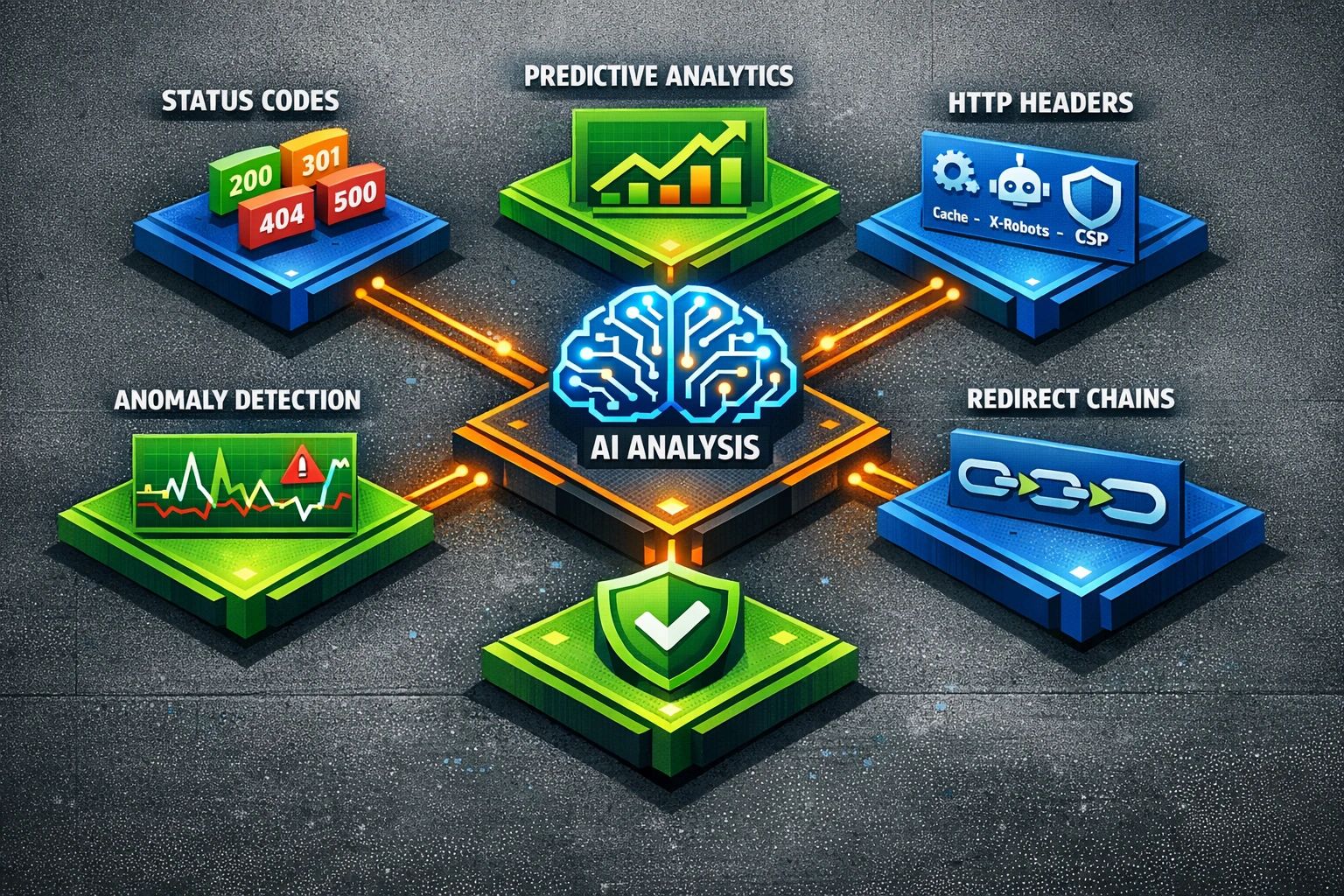
Server response codes, or HTTP status codes, are three-digit numbers that tell a browser or crawler the status of its request. They are grouped into five classes:
- 2xx Success: Everything is working correctly. A
200 OKcode means the server found the page and sent it over successfully. This is the ideal response for your healthy, accessible pages. - 3xx Redirection: The requested resource has moved. A
301 Moved Permanentlytells crawlers that a page has a new, permanent address, and they should update their index accordingly. This is crucial for preserving link equity. - 4xx Client Errors: The request itself was faulty. The famous
404 Not Foundmeans the server couldn't find the requested page. While a few 404s are normal, a large number can signal a poor user experience and wasted crawl budget. - 5xx Server Errors: The server failed to fulfill a valid request. A
500 Internal Server Erroror503 Service Unavailableindicates a serious problem on your end that prevents anyone, including search engines, from accessing your content.
What Are HTTP Headers?
If response codes are the main answer, HTTP headers are the essential notes attached to it. They provide extra context and instructions for the browser or crawler. Think of them as sticky notes providing critical information. Key headers for SEO include:
- Cache-Control: Tells browsers how long they can store a copy of your page, which impacts site speed for repeat visitors.
- X-Robots-Tag: Gives crawlers specific instructions, like "noindex" or "nofollow," directly from the server. This is useful for controlling the indexing of non-HTML files like PDFs.
- Content-Type: Specifies the format of the content, such as
text/htmlorimage/jpeg, ensuring it's rendered correctly. - Security Headers: These protect your site and its visitors from common attacks. While not a direct ranking factor, a secure site builds user trust, which is a powerful signal for search engines.
The AI Advantage: From Simple Checks to Deep Diagnostics
Manually checking response codes for a few key pages is straightforward. However, a modern website can have thousands of pages, images, and scripts. Trying to monitor them all manually is impossible. This is where the limitations of traditional audits become clear. They are often just snapshots in time and fail to detect nuanced, intermittent problems.
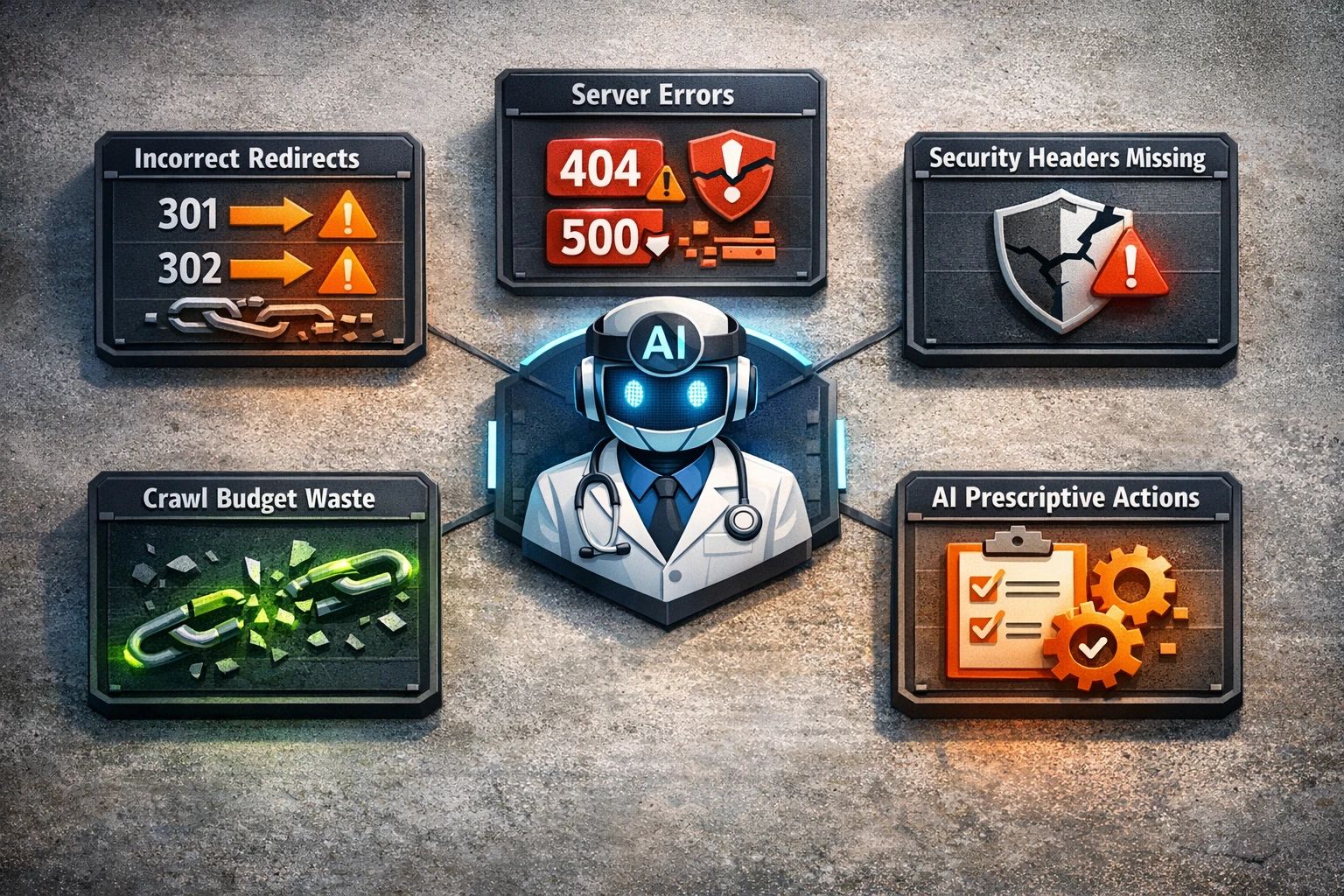
AI-driven analysis works differently. It acts like a digital doctor, performing a continuous, comprehensive health check on your entire website. It doesn't just look at individual signals. It analyzes vast amounts of data from server logs to identify patterns, predict future problems, and correlate technical issues with SEO performance drops.
How AI Interprets Technical Signals for Deeper SEO Insights
An AI system goes far beyond simply flagging a 404 error. It provides a level of analysis that uncovers problems human auditors might miss.
Uncovering Hidden Redirect Chains
A simple 301 redirect is good practice. But sometimes, a page gets redirected multiple times, creating a chain (Page A -> Page B -> Page C). These chains dilute link equity and consume valuable crawl budget. AI can instantly trace these complex paths, identifying loops and unnecessary steps. Systems using ai internal linking analysis can visualize these connections and recommend a more direct route, preserving your SEO power.
Detecting Silent Server Issues
A single 503 Service Unavailable error might be a temporary glitch. But an AI analyzing your server logs might notice a pattern: 503 errors spike every weekday at 2:00 PM when traffic is highest. This isn't just a random error. It's a predictive indicator that your server is underpowered and may soon face critical failure. AI finds these trends before they become disasters.
Identifying Crawl Budget Waste
Search engines allocate a finite amount of resources, or "crawl budget," to each site. You want them to spend it on your most important pages. AI helps optimize this by understanding the nuance between error codes. For instance, it knows a 410 Gone code is a stronger, more permanent signal than a 404 Not Found. By flagging pages that should be 410s instead of 404s, AI helps crawlers stop wasting time looking for content you’ve intentionally removed.
Pinpointing Security Vulnerabilities
AI can scan your HTTP headers across your entire site to find inconsistencies or missing security policies. For example, it can flag pages that are missing a strict Content Security Policy, making them more vulnerable. By ensuring your site is secure, you protect your users and send strong trust signals to search engines.
Connecting the Dots: How Technical Health Impacts Your Bottom Line
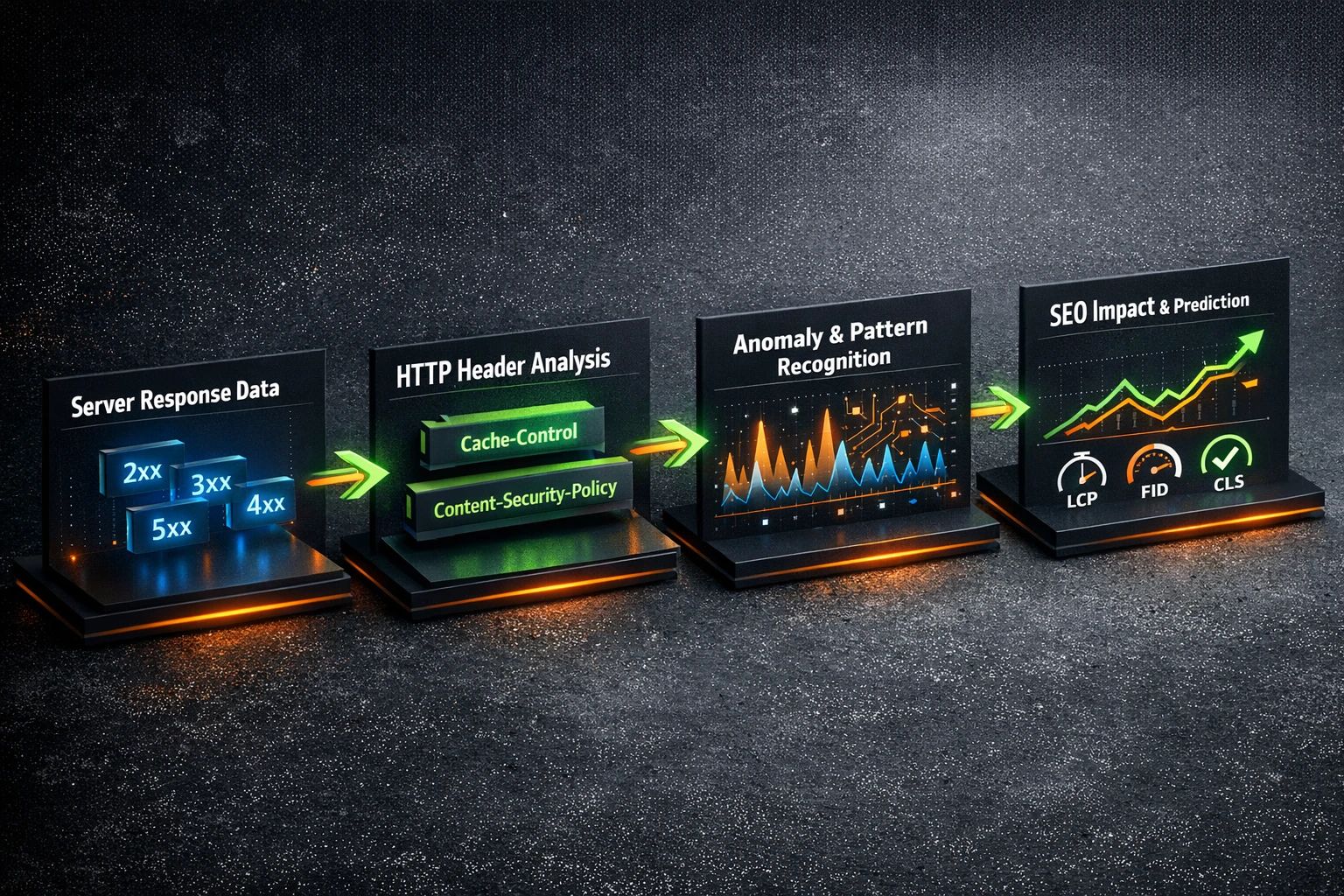
The true power of AI is its ability to connect seemingly isolated technical data points to real-world business outcomes. Traditional tools might tell you that a group of pages has a high server response time. An AI can take this a step further.
It can correlate that slow response time with a dip in Core Web Vitals for those specific pages. Then, it can connect that dip to a decrease in organic traffic and conversions. This turns an abstract technical metric into a clear business problem. AI doesn't just give you data; it gives you intelligence. It shows you precisely how a misconfigured header or a slow database query is impacting your bottom line. Getting these technical details right is a vital step toward mastering Google’s AI Overviews, as these systems prioritize accessible, reliable, and trustworthy content.
Getting Ready for an AI-First Future
As search engines rely more on AI and Large Language Models (LLMs) to understand and rank content, the importance of a flawless technical foundation will only grow. These new systems need to access and interpret your content quickly and reliably. Any friction, whether it's a slow server, a confusing redirect, or a broken page, can cause them to lose trust in your site.
Ensuring your server communicates clearly and efficiently is no longer just a best practice. It is a core pillar of a modern, foundational seo strategy. For businesses that want to thrive in this new era, leveraging an ai seo strategist to monitor and optimize these signals is not a luxury. It's a necessity for sustainable growth.
Frequently Asked Questions
What is AI-driven analysis of server response codes for SEO?
It is the use of artificial intelligence to automatically and continuously monitor your website's server response codes and HTTP headers. Instead of manual spot-checks, AI analyzes large datasets from server logs to identify patterns, predict issues, and correlate technical problems with SEO performance metrics like traffic and rankings.
What are the 4 types of HTTP headers?
While there are many specific headers, they are generally categorized into four main types: Request Headers (sent by the client/browser), Response Headers (sent by the server), Representation Headers (describe the body of the message, like Content-Type), and Payload Headers (contain information about the payload data).
Can AI really find SEO issues that manual audits miss?
Yes. AI excels at finding issues that are difficult for humans to spot, such as intermittent server errors that only occur under specific conditions, subtle patterns in response times that predict future problems, and complex redirect chains that span across thousands of pages.
How does a 301 redirect differ from a 302, and why does it matter for AI crawlers?
A 301 redirect signals a permanent move, telling search engines to transfer all link equity and indexing signals to the new URL. A 302 redirect is temporary, suggesting the original URL will return. Using a 302 for a permanent move can confuse crawlers and prevent them from properly consolidating your page authority, hurting your SEO.
What are the most common server errors that impact SEO?
The most critical are 500 Internal Server Error, which indicates a generic problem on your server, and 503 Service Unavailable, which means the server is temporarily overloaded or down for maintenance. Both prevent users and crawlers from accessing your site, leading to immediate ranking drops if not resolved quickly.
Your Next Steps to Technical SEO Health
Your website's technical foundation is the bedrock upon which all your other SEO efforts are built. Ignoring the silent conversation happening between your server and search engines is like trying to build a skyscraper on sand.
Start by getting familiar with these concepts. You can use your browser's built-in developer tools to inspect the response codes and headers of your own pages. This will give you a glimpse into your site's technical dialogue. When you're ready to see the full picture, an AI-driven approach can provide the deep, actionable insights needed to build a truly resilient and high-performing website.