The Authority Architecture: Why Your LinkedIn Profile Isn't Generating Leads (And How to Fix It)
AI Summary
Bottom Line - Turn your LinkedIn profile from a recruiter-focused resume into a buyer-focused authority page that consistently generates warm, inbound sales conversations. By restructuring each section around your ideal customer’s pains, outcomes, and proof, you turn casual profile views into qualified leads ready to talk.
Key Takeaways
- Rebuild your top-of-profile (photo, banner, headline) to answer what’s in it for the buyer in three seconds
- Use an About section built on a Pain-to-Promise arc with clear CTAs and buyer keywords
- Add proof, optimized experience, and ongoing activity so your profile works as a living sales funnel
Best For - B2B sales professionals and consultants who want LinkedIn to drive consistent, qualified pipeline instead of just showcasing their work history.
Your LinkedIn profile is likely a digital resume. It lists your past jobs, your responsibilities, and your skills. It’s professional, accurate, and completely invisible to your ideal prospects. This is the single biggest mistake sales professionals make. They build a profile designed to attract recruiters when they should be building one that attracts buyers.
The data is clear. Salespeople who are active on LinkedIn are 51% more likely to meet their sales quota. The platform generates 277% more leads for B2B marketers than Facebook and Twitter combined. Yet most profiles fail to capture this opportunity. They talk about the seller instead of speaking to the buyer.
It’s time for a fundamental mindset shift. Stop thinking of your profile as a resume. Start treating it as your most valuable digital asset: a high-converting landing page built to establish authority, build trust, and drive inbound conversations. This guide provides the strategic framework, the Authority Architecture, to transform your profile from a passive summary into an active sales engine.
The 5 Pillars of LinkedIn Authority Architecture
A high-performing sales profile isn’t a random collection of tips and tricks. It’s a deliberately engineered system where every element works together to guide a prospect from curiosity to conversation. The Authority Architecture is a five-part framework for building that system. It ensures your profile doesn't just look good; it performs.
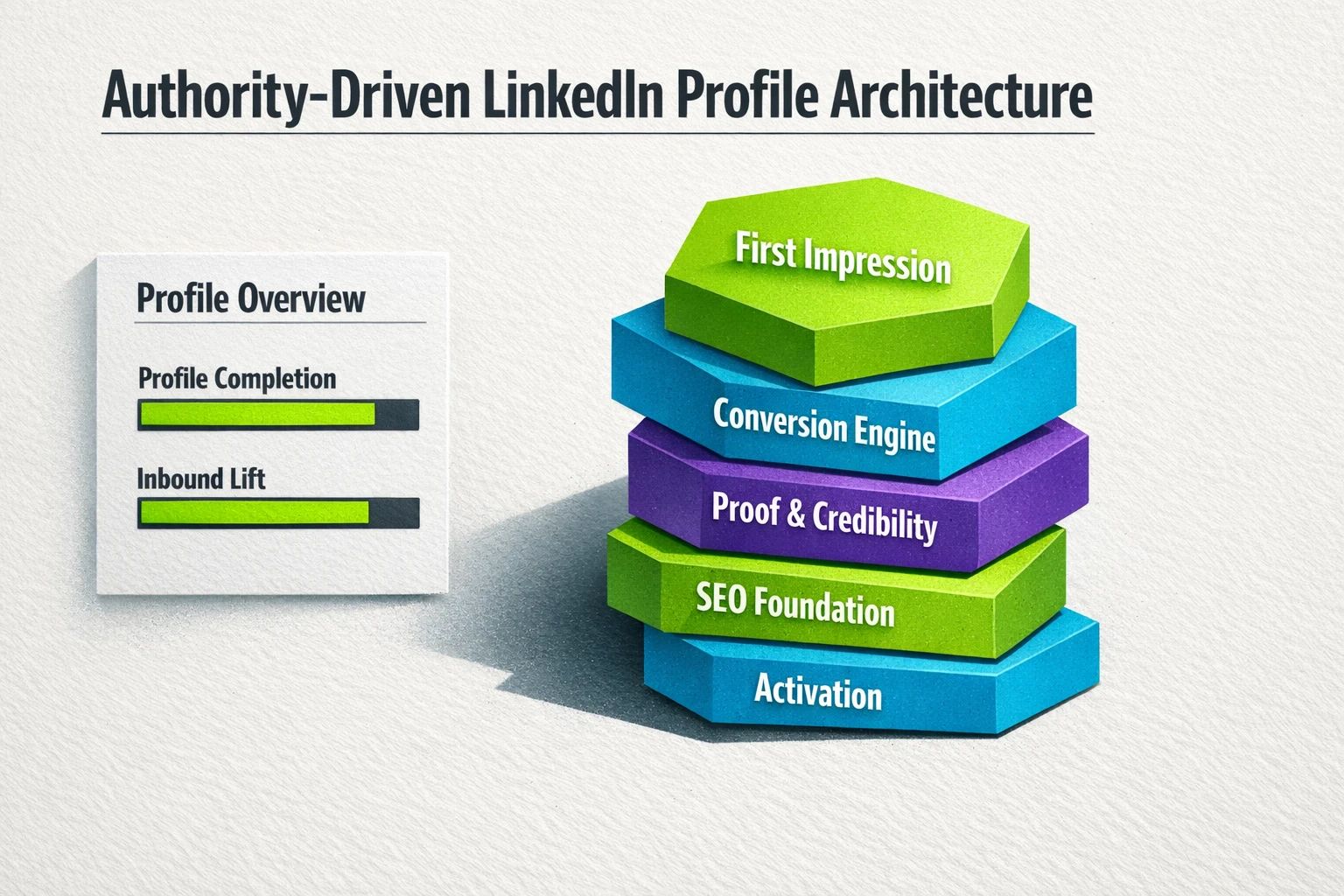
These pillars work in sequence to build trust and credibility. They take a cold visitor and turn them into a warm, inbound lead who already understands your value.
Pillar 1: The First Impression (Headline, Photo, Banner)
When a prospect lands on your profile, you have less than three seconds to answer their unspoken question: "What's in it for me?" Your photo, banner, and headline are the elements that provide the answer.
Profile Photo and Banner: Your photo should be a professional headshot where you look approachable and confident. Your banner image should not be the default blue background. Use it to communicate value. It can be a company tagline, a client logo collage, or a visual representation of the problem you solve.
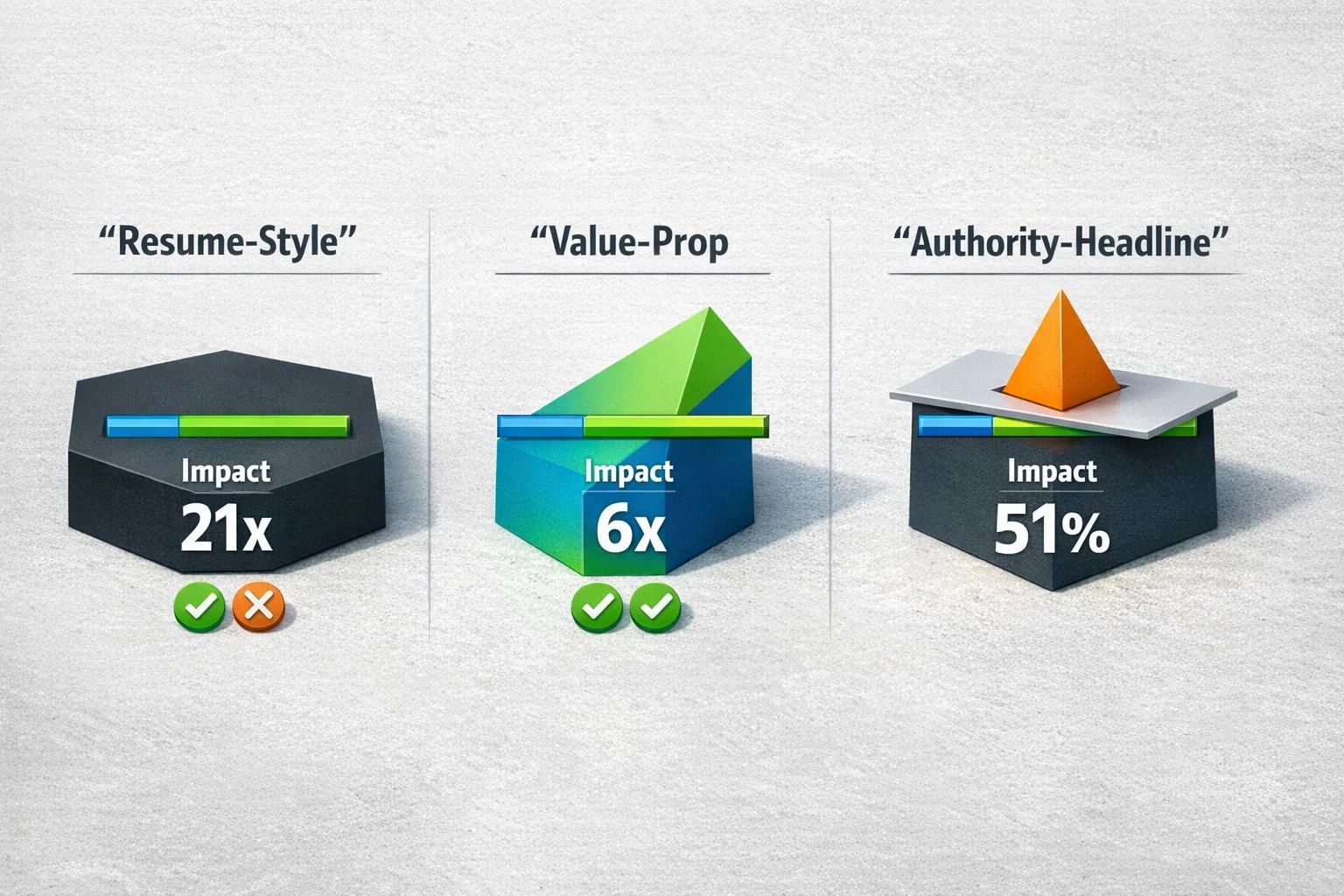
The Headline: This is the most critical real estate on your profile. A resume-style headline like "Sales Director at Acme Corp" is a wasted opportunity. It says what you are, not what you do for your clients.
Adopt a value proposition formula instead: I help [Your Audience] achieve [Desired Outcome] with [Your Solution/Method].
This simple shift transforms your headline from a passive title into an active pitch. It qualifies you, it speaks directly to your ideal customer, and it makes you discoverable for the problems you solve, not just the company you work for.
Pillar 2: The Conversion Engine (The "About" Section)
If your headline earns a click, your "About" section is where you earn their trust. This is not a biography. It's conversion copy. Your goal is to demonstrate that you understand your prospect's world better than anyone else.
The most effective structure is the Pain-to-Promise Story Arc.
- Acknowledge the Pain: Start by describing the primary challenge, frustration, or goal your ideal customer faces. Show them you understand their reality.
- Introduce the Solution: Briefly explain how you and your company help solve that specific pain point. Connect their problem to your solution.
- Paint the Promise: Describe the successful outcome. What does life look like after they work with you? Focus on the transformation.
- Provide a Clear Call to Action: Tell them exactly what to do next. This could be booking a call, downloading a resource, or visiting your website.
Advanced Tip: Your prospects are using LinkedIn's search functions. Smart sales leaders use Sales Navigator's Boolean search to find ideal clients. Weave the specific keywords and phrases your buyers use to describe their problems throughout your "About" section. This makes your profile a magnet for inbound discovery.
Pillar 3: The Proof & Credibility Hub (Featured Section & Recommendations)
Claims are good, but proof is better. The "Featured" section is your opportunity to turn your profile into a digital portfolio of success. Most people ignore this section. Using it effectively immediately sets you apart.
Feature content that validates your expertise and the claims you made in your "About" section. This can include:
- Client case studies or success stories
- Links to webinars or podcasts you've appeared on
- White papers or valuable industry reports
- Video testimonials from happy customers
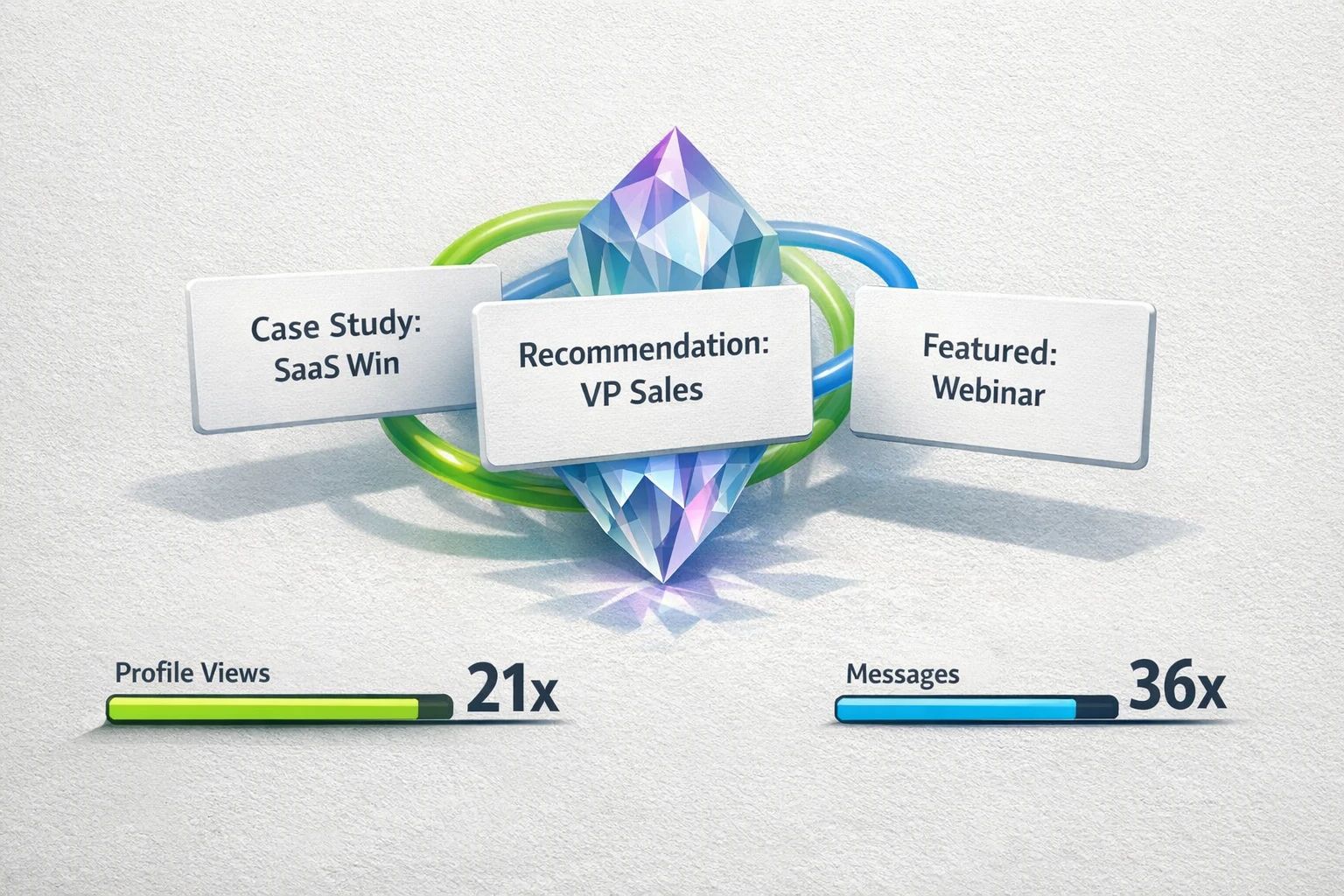
Alongside the Featured section, Recommendations provide powerful third-party validation. Proactively ask satisfied clients to write a brief recommendation focusing on the results you helped them achieve. A single, results-oriented recommendation is worth more than a dozen vague skill endorsements.
Pillar 4: The SEO Foundation (Experience, Skills & Endorsements)
While not as glamorous as the other pillars, these foundational sections are crucial for your profile's visibility. A fully completed profile gets up to 21 times more views and 36 times more messages.
Experience Section: Don't just list your job duties. For each role, write 2-3 bullet points that frame your accomplishments in terms of customer outcomes. How did your work impact the client? Use quantifiable results whenever possible. This continues the client-centric narrative.
Skills & Endorsements: This section helps LinkedIn's algorithm understand your areas of expertise. Populate it with skills that are relevant to your buyers. Prioritize the top 3-5 skills you want to be known for, as these are most prominent on your profile.
Pillar 5: Activating Your Architecture
A perfectly optimized profile is a powerful but static asset. The final pillar is about putting it to work. Your Authority Architecture fuels every aspect of your social selling activity.
When you connect with prospects, comment on posts, or share content, your value proposition headline is visible to everyone. When they click on your profile out of curiosity, they don't find a resume. They find a conversion-focused landing page that speaks directly to their needs.
This changes the entire dynamic of outreach. You are no longer a cold interrupter. You are a credible expert who has already demonstrated value before the first message is even sent. This is how you build a pipeline where audiences exposed to your message are six times more likely to convert.
The Authority Audit: A Final Checklist
Use this checklist to audit your own profile against the Authority Architecture framework.
- Mindset: Is my profile written for my buyers or for recruiters?
- Headline: Does my headline clearly state who I help, what outcome I deliver, and how I do it?
- Banner: Does my banner image add professional context and communicate value?
- About Section: Does my summary follow the Pain-to-Promise arc and include a clear call to action? Is it optimized with customer-centric keywords?
- Featured Section: Do I have at least two pieces of content featured that prove my expertise and client results?
- Recommendations: Do I have recent, specific recommendations from clients?
- Experience: Is my work experience described in terms of customer outcomes?
- Profile Completion: Are all sections of my profile complete?
Building an authority-driven profile isn't a one-time task. It's an ongoing process of refining your message and proving your value. But by implementing this architectural approach, you move from being just another salesperson on LinkedIn to becoming a trusted advisor in your industry.
Frequently Asked Questions
How long does it take to see results from optimizing my LinkedIn profile?
You can see initial results, like increased profile views and connection requests, within the first few weeks of implementing these changes. Generating consistent inbound leads depends on combining your optimized profile with consistent, valuable activity on the platform, which typically builds momentum over 1-3 months.
Is this Authority Architecture just for B2B sales professionals?
While it's highly effective in a B2B context, the core principles apply to anyone using LinkedIn to build professional authority. Consultants, freelancers, financial advisors, and founders can all adapt this framework to attract their ideal clients or partners by focusing on a clear audience, problem, and outcome.
Won't a sales-focused profile make me look like I'm always selling?
No, it's the opposite. A traditional, self-focused profile forces you into a "selling" posture during outreach. An authority-driven profile that focuses on the customer's problems and your ability to solve them positions you as a helpful expert. It attracts people to you, reducing the need for aggressive "push" tactics.
My company has strict rules about what I can put on my profile. How do I work around that?
Most corporate guidelines are concerned with official titles and company descriptions. The Authority Architecture focuses on how you frame your value to the customer, which often aligns with company goals. Frame your headline and "About" section as your personal professional mission to help your specific customer segment. This is usually compliant and far more effective. Always review your company's social media policy first.
Do I really need to ask clients for recommendations? It feels awkward.
It can feel awkward, but it's one of the most powerful forms of social proof. The best time to ask is right after a successful project completion or when a client expresses gratitude for your work. Make it easy for them by saying, "I'm so glad we achieved [specific result]. Would you be open to sharing a brief sentence or two about your experience in a LinkedIn recommendation? It would mean a lot."
Sources:
- Skrapp.io LinkedIn Statistics - Data on sales quota attainment and lead generation effectiveness on LinkedIn.
- Cognism B2B Marketing Statistics - Insights into conversion likelihood for audiences exposed to brand and acquisition messages.
- The B2B House LinkedIn Data - Statistics on the impact of profile completion on views and messages.
- Sales Gravy - Original source for the "Pain-to-Promise Story Arc" concept for profile summaries.
- RAIN Group Sales Training - A comprehensive resource on tactical LinkedIn usage for sales professionals.