Building E E A T And Trust For AI Technical Content
AI Summary
Building E E A T and trust for AI technical content means treating every guide and data sheet as structured evidence for machines, not just prose for humans, so your expertise becomes the source AI overviews are forced to cite. You will see why this is less about copy tweaks and more about engineering your site as verifiable data.
- Map GEO ranking lifts directly to your roadmap using expert quotations, statistics, citations and dense technical terms as measurable E E A T signals.
- Restructure pages around long conversational questions so AI search can extract precise answers instead of misclassifying your technology.
- Implement author entity disambiguation with schema based person profiles and reviewed by workflows to turn engineers into machine recognizable authorities.
For teams watching AI summaries favor competitors and needing a practical system to become the default technical source of truth.
You are doing everything right. You publish detailed technical guides, data sheets, and expert articles. Yet, when an AI Overview answers a question in your niche, it either ignores you completely or cites a competitor. Worse, it sometimes hallucinates, misrepresenting your technology and damaging your brand's credibility.
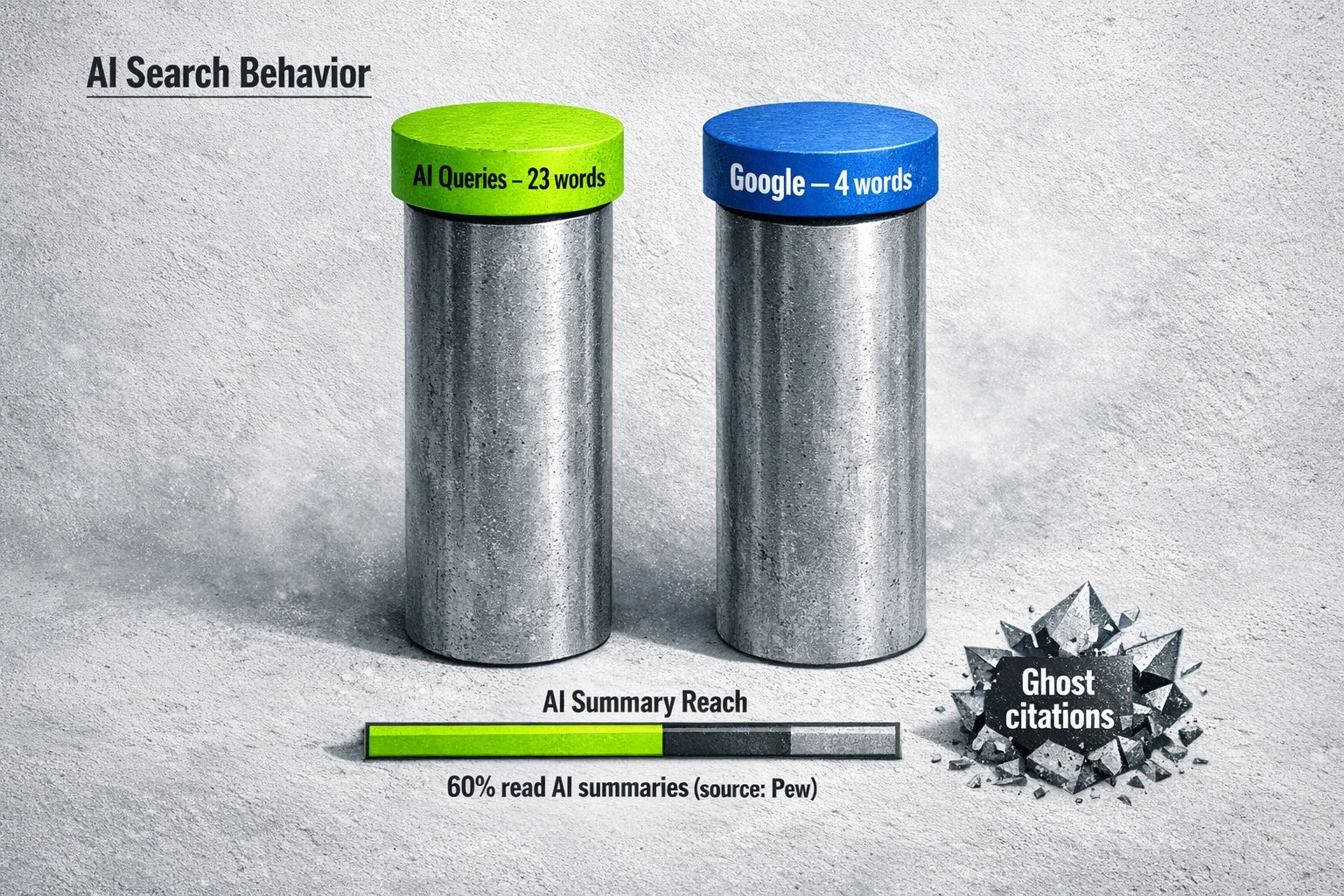
This is the new reality for industrial and technical companies. Your audience no longer just finds you through a list of blue links. They get their answers synthesized by AI. A recent Pew Research Center survey found that six-in-ten U.S. adults now read these AI-generated summaries at the top of search results [1]. Your content is no longer just a destination. It is a dataset.
The core argument most teams miss is this: building trust with generative AI is not a writing problem. It is an engineering problem. You must stop thinking about content as prose for people and start architecting it as verifiable data for machines.

Why Your Technical Content Fails the Machine Trust Test
Generative AI models are designed to synthesize information from multiple sources. When your technical content is unstructured, ambiguous, or lacks clear attribution, the AI has to guess. This is where dangerous errors occur.
Think of it as vector proximity. An LLM understands concepts by how close they are to other concepts in its model. If your article about "cryogenic valve tolerances" does not explicitly define terms and link them to industry standards, the AI might group it with content about "refrigeration plumbing," leading to a completely wrong synthesis. This is how hallucinations are born.
The University of Maryland Libraries note that this problem extends to citations. An AI might generate a response and, when asked for a source, simply make up a URL or provide a real one that leads to completely unrelated content [2]. If your content is not the most structured and authoritative source available, you risk having your brand associated with this kind of misinformation or being replaced by a competitor who is clearer. Your competitors are already using AI to win your customers; falling behind on this is no longer an option. A modern AI transformation agency focuses on building these foundational systems first.
The Shift from Keywords to Conversational Triggers
The way people search has fundamentally changed, which directly impacts how AI models are trained and what content they surface. Traditional SEO focused on short, transactional keywords. Today, we see a massive shift. AI search queries use more natural language, averaging 23 words compared to Google's old 4-word average.
This means your content must be structured to answer specific, complex questions, not just target broad terms.
Headings like "Product Specs" are obsolete. They need to become "What are the ASME B16.34 compliance standards for the Series 5 valve?" This question-led structure makes it easy for AI to parse, extract, and present your information as the definitive answer.
A Science-Backed Framework for AI Visibility
This is not guesswork. A landmark study on Generative Engine Optimization (GEO) from researchers at Princeton, Georgia Tech, and other top institutions quantified exactly what makes content more visible to AI engines. They found that specific E-E-A-T markers can boost visibility by up to 40% in generative responses [3].
The data reveals a clear hierarchy of what machines trust:
- Adding Expert Quotations: +42.6% visibility lift.
- Adding Statistics: +32.8% visibility lift.
- Citing Sources: +27.7% visibility lift.
- Including Technical Terms: +18.5% visibility lift.
This is your new checklist. Every piece of technical content you produce must be fortified with direct quotes from your named engineers, verifiable data points, and clear links to standards bodies or academic papers. These are not just elements of good writing. They are structured signals of authority that an LLM can measure. Getting these AI systems for business right is the key to owning your digital future.
Make Your Experts Legible to Machines
For an AI, an expert is not just a name in a byline. An expert is a recognized "entity," a node in a knowledge graph connected to other authoritative nodes. If your top engineer is Jane Doe, the AI needs to know it is the same Jane Doe who is listed on a patent, has a Google Scholar profile, and is a member of the IEEE.
This is called author entity disambiguation, and it is the single most overlooked part of technical E-E-A-T. Most companies treat their author bios as a simple paragraph of text. This is a huge mistake.
Your author pages must become structured data hubs. By using Person schema with sameAs properties, you can explicitly link your author's profile on your site to their profiles on LinkedIn, Wikidata, academic sites, and standards organizations. You are not just telling a human who they are. You are giving a machine their resume. This is how you prove your team's experience and expertise at scale.

This extends to the content itself. Adding a "Reviewed by" line with a link to another verified expert's profile is a powerful trust signal. It tells both Google and the user that your technical claims have passed a rigorous internal verification process. This step is critical for building durable SEO authority in a world of AI-generated noise. This is how you stop falling behind on AI and start getting in front.
The goal is to turn your website into the primary source of truth for your niche. When your content is structured, your experts are verified entities, and your claims are backed by data, AI engines have no choice but to cite you. You are not just optimizing for search. You are becoming the reference library that search engines use to build their answers. This is the only durable strategy for building AI trust and ensuring your expertise is what shapes your industry's conversations.
Frequently Asked Questions
Isn't this just good SEO?
No. Traditional SEO focuses on keywords and backlinks to signal relevance to a search engine. Generative Engine Optimization (GEO) is about structuring your content as verifiable data to signal factual accuracy to a language model. It requires a deeper focus on schema, entity recognition, and data sourcing.
How long does it take to see results from GEO?
Implementing structural changes like question-led headings and adding statistics can yield visibility lifts relatively quickly. However, building a true authority moat through author entity recognition and co-citations from standards bodies is a long-term strategic effort. The first steps provide immediate gains, while the deeper work builds lasting defensibility.
Do we need an agency to implement this?
Success requires a blend of highly technical SEO, deep content strategy, and operational workflow design. While you can implement individual tactics in-house, many teams find they need a partner to connect these disparate functions into a single, cohesive system. The right pagebody.ai systems can change your entire outlook.
What is the first step we should take?
Audit a single piece of your most critical technical content. Does it have expert quotes, statistics, and cited sources? Is the author's byline linked to a bio page with structured data connecting them to their LinkedIn or patents? The answer will reveal how ready your content is for the age of AI.
Sources:
- Pew Research Center - Survey data on American adoption and views of AI search summaries.
- University of Maryland Libraries - Analysis of AI-generated misinformation and "ghost citations."
- Pranjal Aggarwal et al. (Princeton University / Georgia Tech) - The foundational academic paper defining Generative Engine Optimization (GEO) and its visibility metrics.