Beyond the Algorithm: A Leader's Guide to Building Trust and Driving AI Adoption
AI Summary
This guide explains strategies for building trust and driving AI adoption by focusing on human-centered design beyond technical features.
Bottom Line: Enhance AI ROI by addressing user concerns and fostering confidence through transparency, ethics, and collaboration.
What You'll Learn:
- How to overcome AI skepticism by understanding user fears and ethical concerns.
- Implementing explainable AI and governance to boost transparency and fairness.
- Driving adoption through human augmentation and clear communication strategies.
Best For: Leaders and decision-makers seeking to bridge the trust gap and successfully integrate AI solutions within their organizations.
Beyond the Algorithm: A Leader's Guide to Building Trust and Driving AI Adoption
AI adoption is accelerating. Nearly three-quarters of global enterprises now use AI in their operations. Yet, a critical gap is widening. Public trust in AI companies has fallen to just 35% in the United States, and a staggering 77% of Americans distrust businesses to use it responsibly.
This isn't just a public relations issue. It's an ROI problem. An AI tool that your team doesn't trust is a tool they won't use effectively, if at all. Without adoption, there is no transformation.
The solution isn't more technology. It's more humanity. Shifting from a tech-centric to a human-centered approach is the only way to close the trust gap and unlock the true potential of your AI investment. This guide provides a practical framework for leaders to move beyond the algorithm, build genuine trust, and drive successful AI adoption.
The Trust Deficit: Why Your Team Is Wary of AI
Before you can build trust, you must understand the reasons for its absence. The skepticism surrounding AI isn't irrational. It stems from legitimate and deeply human concerns that leaders must acknowledge and address head-on.
- The "Black Box" Problem: Many AI systems deliver outputs without explaining their reasoning. For an employee asked to trust a decision that could impact their work or a customer's experience, this lack of transparency feels arbitrary and uncontrollable.
- Fear of Obsolescence: The narrative of AI replacing jobs is powerful and pervasive. This anxiety triggers resistance, as employees may view AI not as a helpful tool but as a direct threat to their livelihood.
- Ethical and Bias Concerns: Reports of AI systems perpetuating historical biases in hiring, lending, and other critical areas are widespread. Stakeholders are right to question whether these tools are fair and equitable. According to a Santa Clara University study, 82% of people care deeply about the ethics of AI.
- Misplaced Automation: When AI is implemented poorly, it can create more work than it saves, leading to frustration. If a system feels clunky or its "help" is consistently off-base, users will quickly abandon it, viewing it as another unhelpful piece of corporate technology.
Ignoring these concerns is a recipe for failure. The first step in a successful small business AI implementation is empathy. Acknowledging the validity of these fears is foundational to building a bridge to trust.
Choosing Your Path: Tech-Centric vs. Human-Centered AI
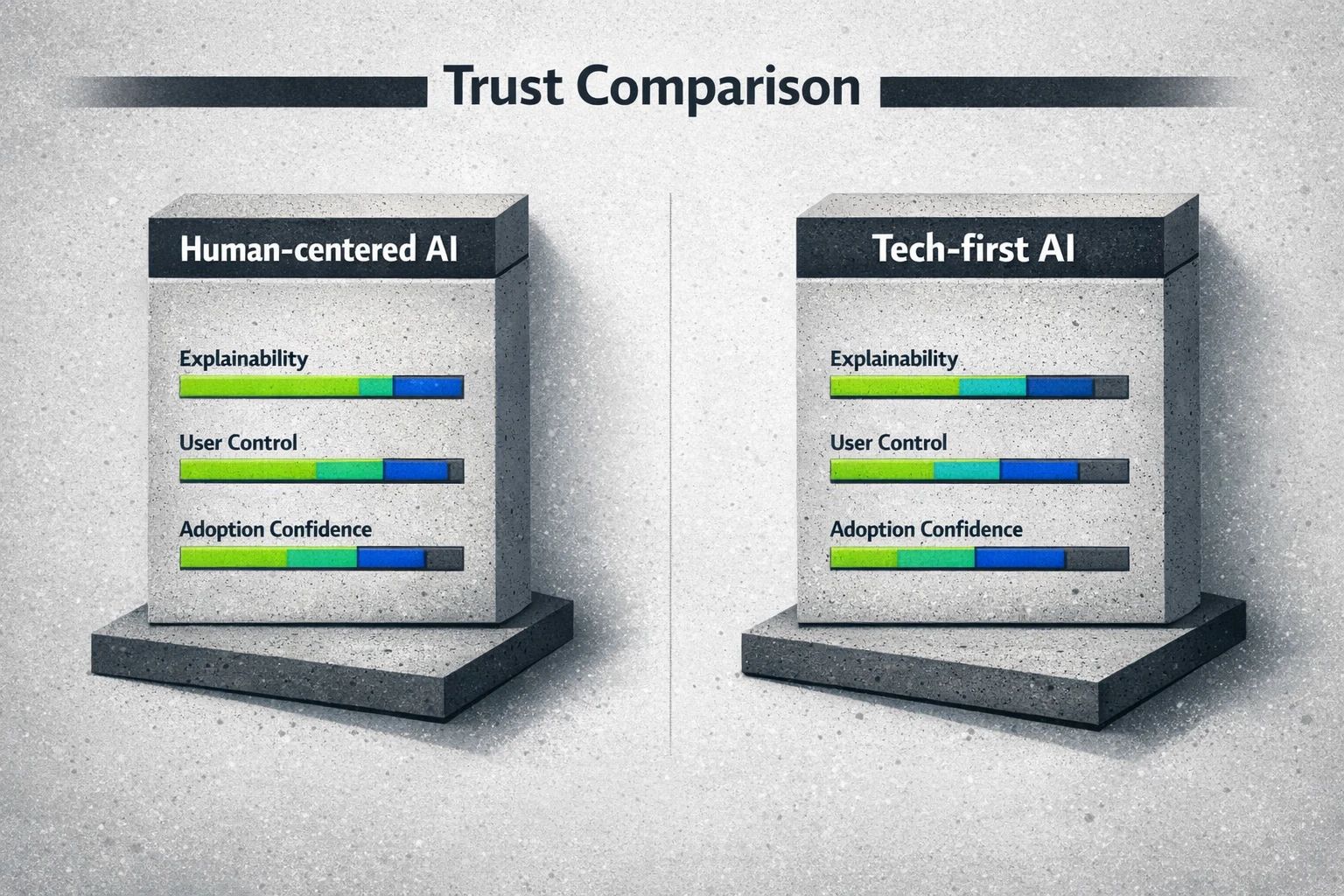
When evaluating AI solutions, many leaders focus on technical specifications. But the most important differentiator isn't the complexity of the model. It's the design philosophy. Understanding this distinction is crucial for selecting a partner that prioritizes adoption.
A tech-centric approach focuses solely on automating a task. A human-centered approach focuses on augmenting the person performing that task. This shift in perspective has massive implications for explainability, user control, and ultimately, your team's confidence in the system.
The Pillars of a Trustworthy AI Strategy
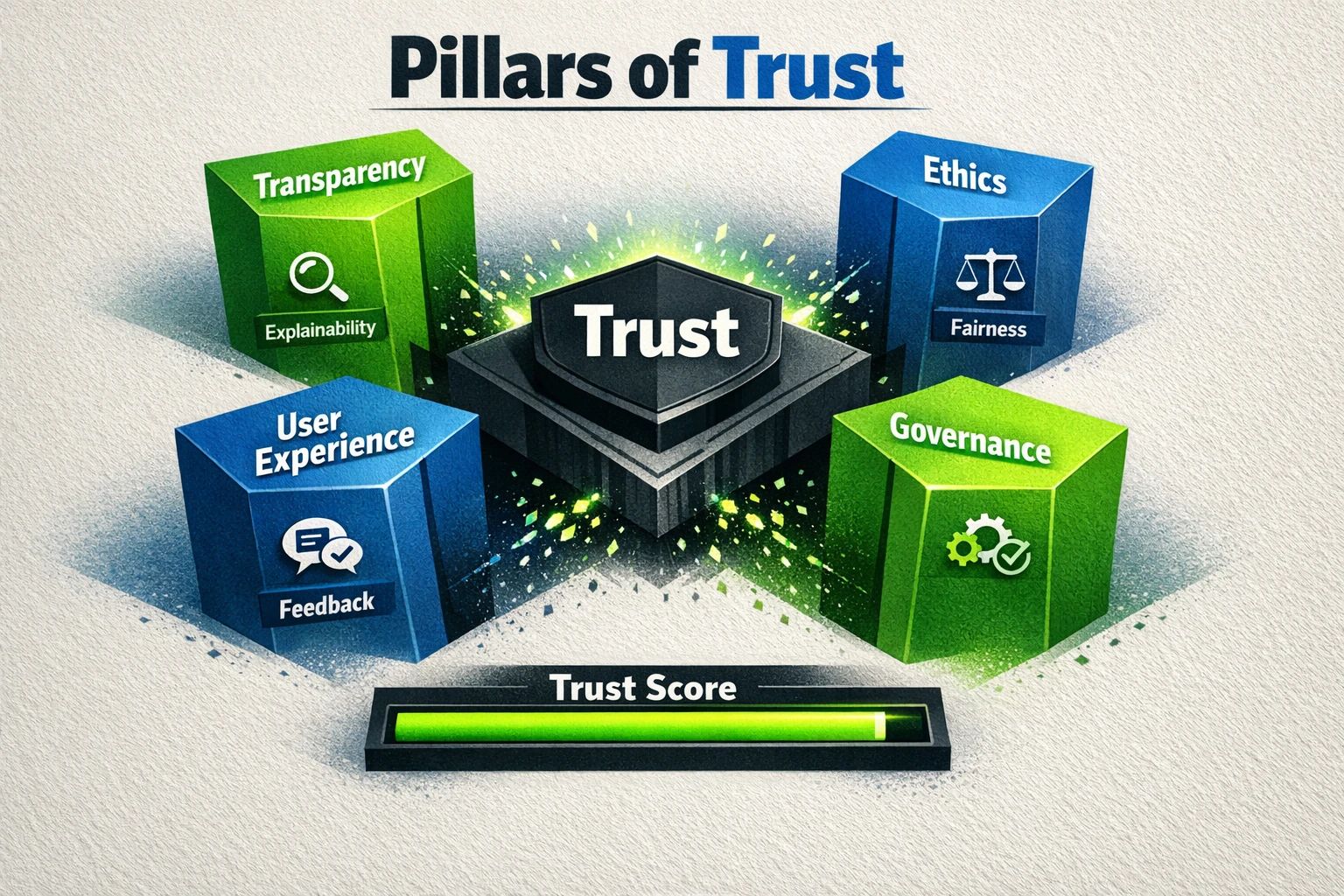
Building trust isn't a single action. It's a continuous process built on a strategic framework. By focusing on three core pillars, you can create an environment where your team feels confident and empowered by AI, not threatened by it.
Pillar 1: Radical Transparency with Explainable AI (XAI)
Explainable AI, or XAI, refers to methods that allow human users to understand the results of an AI system. It's the antidote to the "black box" problem. The business case is clear. McKinsey found that 40% of organizations see a lack of explainability as a key risk, yet only 17% are actively working to solve it. This is a significant opportunity for competitive advantage.
True transparency means tailoring explanations to the audience.
- For Executives: Explanations should connect AI outputs to business KPIs. Why did the AI recommend this market strategy? Because it identified a 30% higher conversion potential based on recent customer behavior data.
- For End-Users: Explanations should build confidence in daily tasks. Why did the SEO strategist AI suggest this content topic? Because it analyzed the top three competitors and found a significant "content gap" with high search volume and low difficulty.
- For Technical Teams: Explanations can be more detailed, showing the specific data points and model weights that influenced a decision, helping them debug and improve the system.
Pillar 2: Proactive Governance and Ethical Design
Trust requires a firm belief that the system is fair, secure, and respects privacy. This can't be an afterthought. Ethical considerations must be woven into the entire AI lifecycle, from the initial product ideation framework to ongoing monitoring.
A robust governance plan includes:
- Fairness Audits: Regularly testing models to ensure they are not producing biased outcomes for different demographic groups.
- Human-in-the-Loop (HITL) Processes: Establishing clear points where humans review and approve high-stakes AI decisions before they are executed.
- Data Privacy Protocols: Ensuring that the data used to train and run AI systems is handled securely and in compliance with regulations like GDPR.
Pillar 3: Human Augmentation, Not Replacement
The most successful AI deployments empower people to do their jobs better, not replace them entirely. Position AI as a collaborative partner that handles tedious, data-intensive tasks, freeing up your team for high-value strategic work.
For example, our SEO Strategist doesn't just write articles. It performs the exhaustive research and analysis that a human strategist would, but at a scale and speed no person can match. It analyzes competitor content, customer intent, and your business's unique DNA to create a strategic brief. This augments the marketing team, allowing them to focus on refining the final message and creative execution, which builds both their skills and their trust in the tool. Building trust and credibility is essential in the E-E-A-T in the AI era.
Measuring What Matters: From Gut Feeling to Hard Data
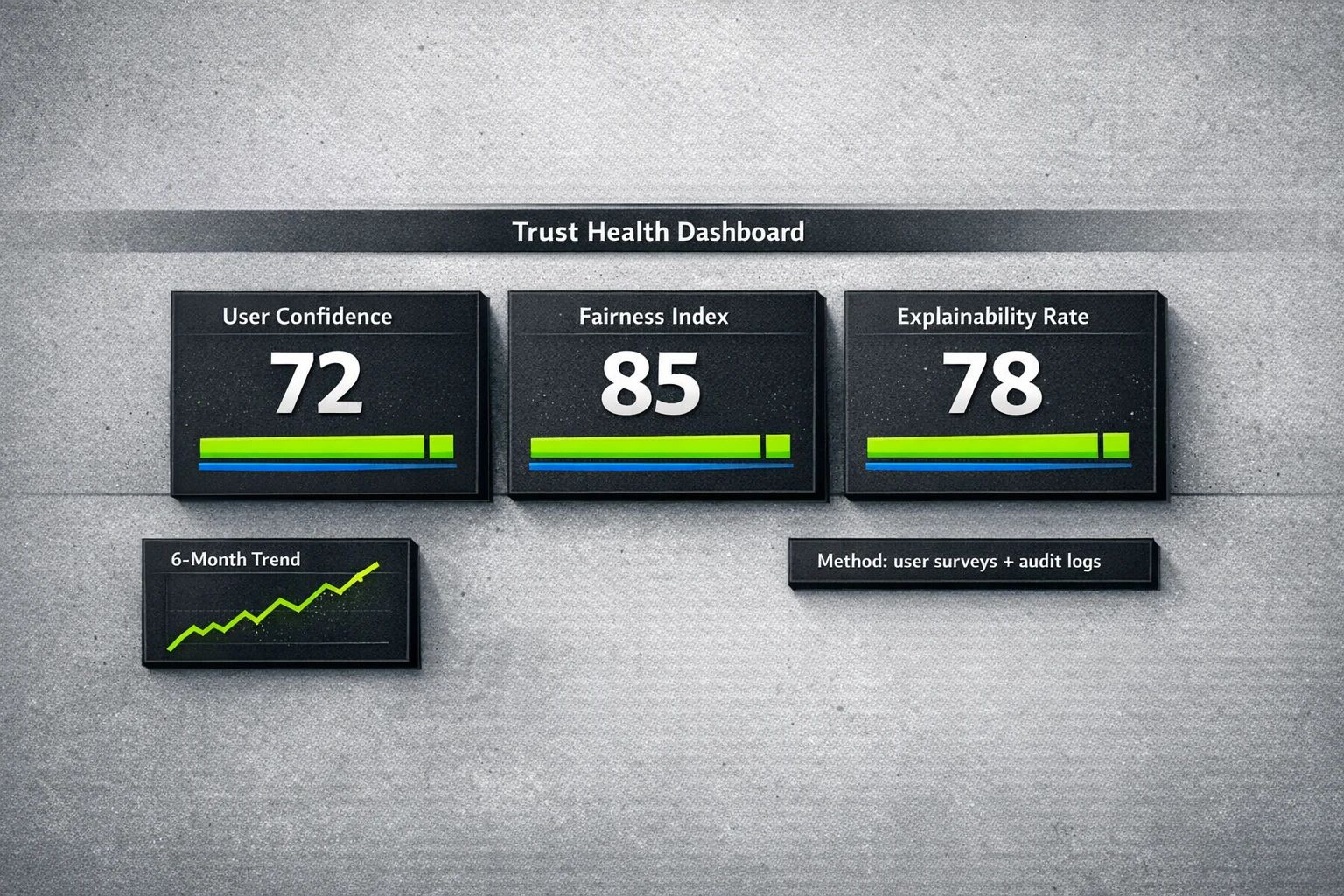
You cannot manage what you do not measure. For too long, trust has been treated as a subjective feeling. To make it a strategic priority, you need to quantify it. By tracking the right metrics, you can get a clear picture of your team's confidence in your AI systems and demonstrate the ROI of your trust-building initiatives.
Beyond simple adoption rates, a "Trust Health" dashboard should include:
- Confidence Scores: Regularly survey users about their confidence in the AI's recommendations.
- Override Rates: Track how often users accept the AI's suggestion versus manually overriding it. A decreasing override rate is a strong indicator of growing trust.
- Qualitative Feedback: Implement easy-to-use feedback mechanisms where users can explain why they do or do not trust a specific output.
- Task Efficiency: Measure the time it takes for users to complete tasks with AI assistance. As trust grows, hesitation decreases, and efficiency improves.
From Framework to Action: A Communication Plan for Adoption
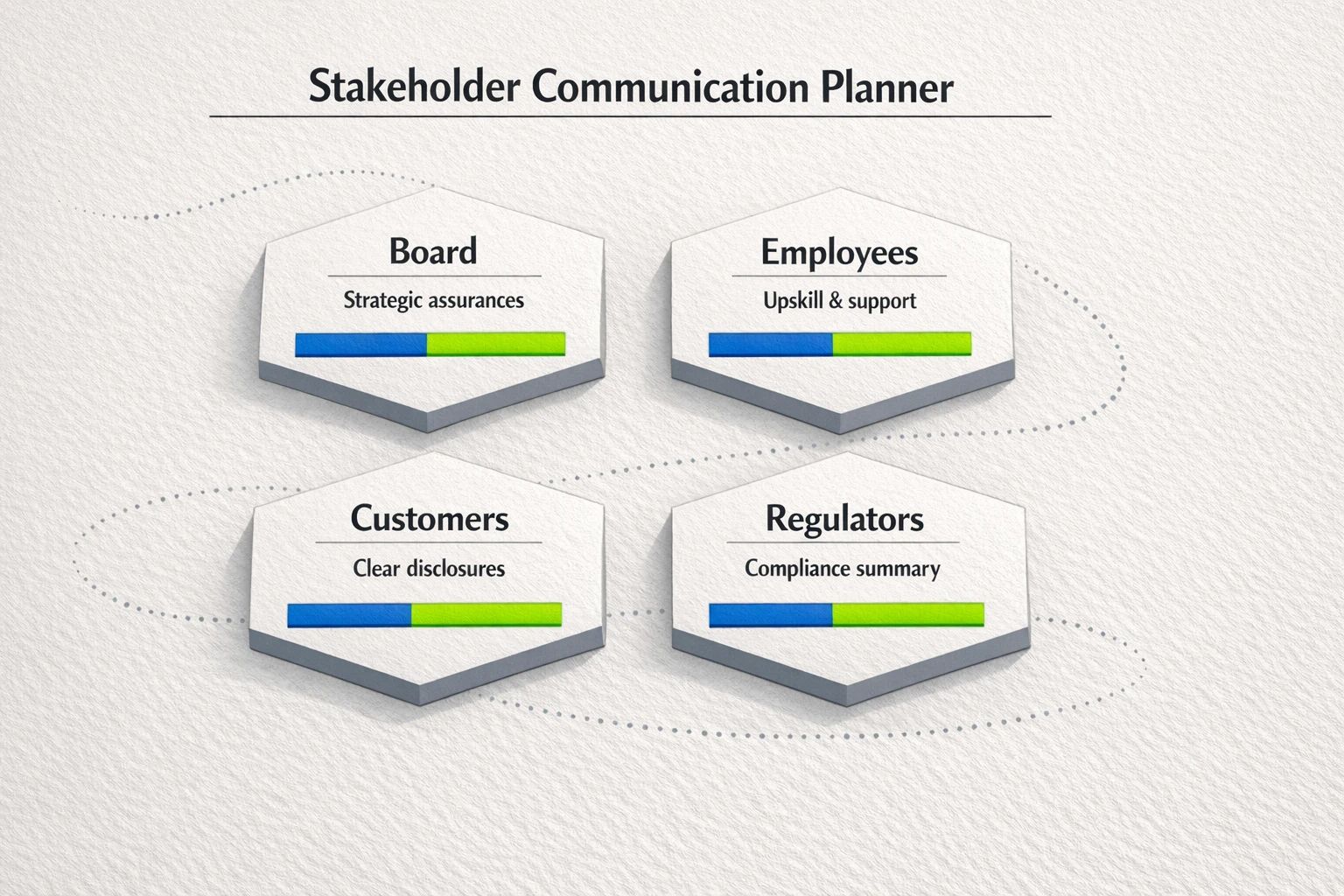
A solid framework is useless without effective communication. How you introduce and discuss AI is just as important as the technology itself. A one-size-fits-all email announcement will only fuel anxiety. You need a tailored communication plan that speaks to the specific concerns and motivations of each stakeholder group. Understanding what tools show which brand narratives resonate and are retained by AI engines can even inform how you shape your internal messaging.
This requires mapping out what each group needs to hear, what their potential objections are, and what a "ready" state looks like for them.
Your Next Step Toward Trustworthy AI
The gap between AI's potential and its current level of trust is the single biggest obstacle to transformation. Closing it requires a deliberate, human-centered strategy. By prioritizing transparency, ethical governance, and human augmentation, you can turn skepticism into advocacy and ensure your AI investments deliver their promised value.
At PageBody AI, we build our solutions on this philosophy. Our AI Strategists are designed from the ground up to be transparent, collaborative partners that empower your team. We believe trust is the ultimate metric, and we're ready to show you how to build it.
Frequently Asked Questions
How can we trust an AI if we can't fully understand its complex decision-making process?
You don't need to understand every line of code to trust the outcome. Think of it like a car. You trust it to get you to your destination without needing to be a mechanic. Trust is built through reliability, user control, and transparency in the areas that matter. Explainable AI (XAI) focuses on providing clear justifications for outputs, showing you the "why" behind a recommendation in plain language, which builds confidence even without deep technical knowledge.
Isn't building a custom, trustworthy AI solution too expensive and time-consuming for a small or medium-sized business?
This is a common misconception. Modern AI development, especially with experienced partners, has become much more efficient. At PageBody AI, we can have systems operational within 14 days. Compared to the cost of hiring a full-time specialist or a traditional agency, an AI solution provides significant savings while delivering scalable results. The cost of not adopting AI, or adopting it poorly, is often far greater.
What is the single most important first step to improve AI adoption in my organization?
Start with communication and education. Before you deploy any new tool, hold open sessions to explain the "why" behind the initiative. Address fears about job displacement directly by framing the AI as a tool for augmentation. Demonstrate how it will remove tedious work and free up your team for more strategic, creative tasks. A small pilot program with an enthusiastic team can also create internal champions who share positive experiences with their peers.
How do we handle a situation where the AI makes a mistake?
Mistakes are inevitable, both for humans and AI. The key is to have a process. First, create a "human-in-the-loop" system for critical decisions, so a person can catch errors before they impact customers. Second, implement robust feedback mechanisms so users can easily report errors. This not only helps you fix the immediate issue but also provides valuable data to retrain and improve the AI model over time. Being transparent about errors and the steps taken to correct them actually builds more trust than pretending the system is infallible.
Our team is not very tech-savvy. How can we ensure they will be able to use these advanced tools?
The burden of usability should be on the tool, not the user. This is a core principle of human-centered AI design. The best AI solutions have intuitive interfaces and integrate seamlessly into existing workflows. Look for systems that don't require coding or advanced technical skills to operate. Good onboarding and training are also crucial, but the ultimate goal is a tool that feels like a natural extension of your team's capabilities from day one.
Sources:
- McKinsey - Data on enterprise AI adoption rates and the business risks of poor explainability.
- Forbes - Statistics on the global and U.S. decline in public trust in AI companies.
- Brookings - Research into the psychological factors driving AI mistrust, such as fear and perceived societal benefit.
- Interaction Design Foundation - Foundational principles and definitions of Human-Centered AI (HCAI).
- Santa Clara University - Survey data on public concern for AI ethics.
- YouGov - Polling data on the low levels of deep trust in AI among Americans.
- NIST - Frameworks for measuring and conceptualizing trust in AI systems.