3 Parts of a Working Competitor Analysis Example
AI Summary
A working competitor analysis example reveals a costly truth: publishing more keyword-gap articles can deepen invisibility when internal authority is missing.
- How hub-and-spoke structures connect pillar pages with supporting content to build topical authority.
- Why auditing 50 winning pages and tracking internal-link density exposes the pathways behind search visibility.
- What the evidence says about 40 to 44 internal links, targeted linking changes, and the limits of backlinks for AI citations.
For teams publishing consistently without ranking, this framework turns competitor research into an actionable blueprint for restructuring existing content before commissioning more articles.
Marketing teams pushing high volumes of articles that fail to rank eventually realize they need a different competitor analysis example to understand their invisibility on Google. The standard approach of pulling a list of missing keywords from a tool provides a false sense of direction. Writing more isolated articles to fill those keyword gaps rarely moves the needle. A true analysis requires reverse-engineering the exact internal linking structures and authority signals that allow top-ranking content ecosystems to dominate search.
Moving From Keyword Gaps to Topical Authority Engineering
Tracking keyword gaps treats SEO as a list of isolated tasks. Finding a missing search term does not mean your website has the semantic foundation to rank for it. Search engines evaluate the relationships between topics rather than looking at pages in a vacuum. When you focus solely on keyword volume, you ignore the underlying architecture that actually supports high rankings.
Topical authority has become the cornerstone of visibility in both search and AI platforms [1]. An effective analysis maps out the entire semantic ecosystem of a topic. It reveals how winning brands connect core concepts together instead of just highlighting what words they use on a page. This structural shift moves your strategy away from producing disconnected blog posts and toward engineering a complete topical cluster.
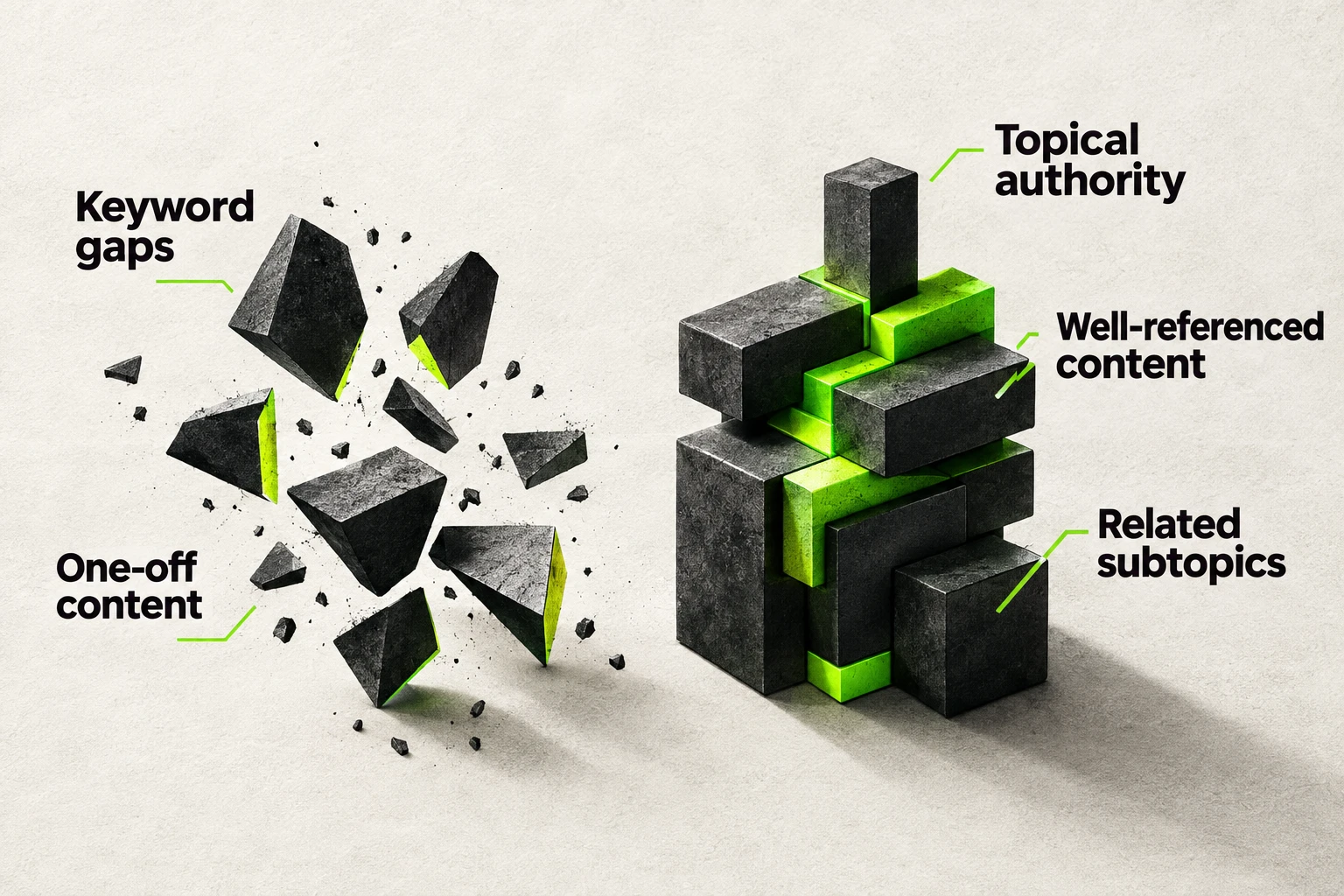
Brands with comprehensive, well-referenced content across related subtopics consistently outperform one-off content efforts.
Conceptualizing a Top Ranking Content Ecosystem
You build a much clearer picture of search dominance by looking at how winners structure their hub pages. A strong analysis identifies a central pillar page and tracks every supporting article that links back to it. This hub and spoke model creates a closed loop of relevance that search engines reward. Brands with comprehensive, well-referenced content across related subtopics consistently outperform one-off content efforts [1].
The architecture of these pages matters far more than the individual written pieces. John Mueller predicts that the weight of backlinks as a ranking factor will drop over time as Google looks beyond links to understand how content fits in with the rest of the web [2]. The new benchmark for evaluating the competition is understanding these internal entity signals. When you map out the internal pathways of a winning site, you extract the exact blueprint needed to build your own authority.

Topical authority has become the cornerstone of visibility in both search and AI platforms.
Mapping Authority Signals Across Fifty Winning Pages
Once you understand the conceptual hub, you must measure the density of the connections. You should audit winning pages per topic to find the internal link thresholds required to compete. Zyppy's analysis of 23 million internal links across 1,800 websites found that URLs with 40-44 internal links earned roughly 4 times the Google clicks of URLs with 0-4 [3].

In an analysis of 23 million internal links across 1,800 websites, URLs with 40-44 internal links earned roughly 4 times the Google clicks of URLs with 0-4.
That density dictates how authority flows through a domain. Hitting these numerical thresholds creates leverage for your existing content. SearchPilot's controlled A/B experiments measured a 5-7% organic traffic uplift from targeted internal linking changes alone [3]. This is not a theoretical exercise. IFTTT drove 33% year-on-year organic traffic growth after implementing a systematic internal linking strategy [4]. Receptional's homepage jumped to the top 5 in the SERPs for the keyword "SEO company" in three months after using InLinks to implement a smart internal linking architecture [2].
Total traffic and backlink metrics are basically 0 or negative for AI citations, meaning that just the volume does not automatically transfer to LLMs [1]. You need semantic depth and mapped topical relevance to earn those machine citations. Plico Energy achieved a 197% rise in web-based leads from Australian organic traffic after building topical authority [5]. The focus must shift from external acquisition to internal architecture.

Plico Energy achieved a 197% rise in web-based leads from Australian organic traffic after building topical authority.
FAQ
Do traditional backlink metrics guarantee LLM citations?
No, total traffic and backlink metrics are basically 0 or negative for AI citations [1]. This means that just the volume does not automatically transfer to LLMs. You need a highly structured internal ecosystem to earn visibility in AI answers rather than relying on sheer link mass.
How much traffic growth can a new internal link structure generate?
SearchPilot's controlled A/B experiments measured a 5-7% organic traffic uplift from targeted internal linking changes alone [3]. Reorganizing your existing assets provides leverage without writing new content. A proper architectural audit reveals where these new connections belong.
Will external link building remain the top priority for ranking?
No, John Mueller predicts that the weight of backlinks as a ranking factor will drop over time as Google looks beyond links to understand how content fits in with the rest of the web [2]. The engine prioritizes how well your internal content maps to a broader topical ecosystem.
Start your next competitor analysis by mapping out the internal link density of a single high-value topic cluster.
Sources:
- AirOps Team - Data on topical authority and LLM citation metrics
- Juliet John - Case study on ranking improvements and backlink shifts
- Mark Shvaya - Analysis of internal link counts and traffic uplift
- ansly Team - Case study on internal linking organic traffic growth
- Jamie - Client data on lead generation via topical authority