Your Competitors' AI Content Is Full of Holes. Here's How to Find Them
AI Summary
Finding gaps in your competitors' AI content reveals not just what they miss but where you can outsmart them with precision. This article explains why accuracy freshness and E-E-A-T are critical weaknesses in AI-driven content strategies.
- How to detect factual errors and outdated info AI naturally produces
- Why first-hand experience outranks generic AI summaries in SEO
- How local authority signals create openings for niche competitors
If you want to stop losing to volume and start winning with quality this approach reveals where to focus your efforts.
You see it every day. Your top competitor just published another three articles. They are everywhere, covering every keyword, and you are left wondering how your small team can possibly keep up. The old SEO playbook says to write more, publish faster, and build more links. That playbook is broken.
The rush to scale content with AI has created a new, critical vulnerability in your competitors' strategy. Their speed comes at the cost of quality, creating a sea of generic, error-prone articles that all say the same thing. The race is no longer about volume. It's about surgical precision. Your advantage is not to create more content, but to find and exploit the accuracy, freshness, and authority gaps their AI-driven strategy leaves wide open.

A single scan maps competitor vulnerabilities across three pillars—Accuracy, Freshness, and E-E-A-T—while keeping human oversight in the loop to handle AI limits like hallucinations and bias.
The New Competitive Landscape: Three Cracks in the AI Armor
Most companies treat competitor analysis like a keyword-counting exercise. They look at what topics are covered and try to cover them better. This is a losing game. AI can summarize the entire internet on a topic in seconds, making "comprehensive" a commodity.
Instead, you need to look for weaknesses that AI inherently creates. These fall into three main categories:
- Accuracy: Is the content factually correct right now?
- Freshness: Is the information timely and relevant to the current market?
- E-E-A-T: Does it show real Experience, Expertise, Authoritativeness, and Trust?
AI is both the cause of these problems in your competitors' content and the perfect tool for you to detect them. But first, you have to understand how the tool itself works.
First, Understand Your Tool: AI's Built-In Blind Spots
Treating a Large Language Model (LLM) like an oracle is a critical mistake. It is not a database of facts. It is a prediction engine. At its core, an AI model is simply making a statistical guess about the next most likely word in a sequence. Researchers from Carnegie Mellon University state it plainly: the fundamental weakness of all modern AI is that its results are statistical predictions, not certainties [1].
This statistical foundation is what allows AI to generate human-like text, but it is also the source of its most famous flaw: hallucination. A model can generate content that is plausible, grammatically perfect, and entirely wrong because the statistical pattern suggests it should be there [1]. This is your first and most frequent target. Competitors who are publishing at scale without rigorous editing are almost certainly seeding their websites with factual errors. Using a disciplined workflow for human in the loop AI quality assurance is the only reliable defense, one that many high-volume publishers neglect.

AI analysis is powerful but imperfect: outputs are statistical predictions and can hallucinate. A truth layer plus human oversight turns raw AI findings into reliable competitor weakness insights.
Weaponizing AI to Audit Competitor Weaknesses
Knowing that AI makes statistical guesses allows you to use it as a vulnerability scanner. Your goal is to find where your competitors trusted the AI's plausible-sounding output without verifying it.
Spotting Accuracy Gaps and Outdated Facts
AI is exceptionally good at comparing information across different documents and timeframes. You can use this to quickly identify content that has gone stale.
Feed an AI a competitor's URL and prompt it to cross-reference the claims against more recent, authoritative sources. Look for things like:
- Outdated statistics or market data.
- References to software versions that are no longer supported.
- "Current" best practices that were replaced a year ago.
- Legal or compliance advice that has since changed.
Freshness is not just about the publish date. It is about the continued accuracy of every claim within the article. An article from 2025 might be factually correct for its time but dangerously misleading today. That gap is your opportunity.
The E-E-A-T Test: Where Human Experience Wins
For years, Google has used Expertise, Authoritativeness, and Trustworthiness to evaluate content quality. Recently, they added a new pillar: Experience. This is the hardest element for AI to fake and your biggest competitive lever.
Experience is about demonstrating that you have actually done the thing you are writing about. It is the difference between a generic summary of "how to fix a leaky faucet" and an article from a real plumber that includes a story about a mistake they made on their first job. AI can generate the first. It cannot generate the second. This is a key principle for understanding E-E-A-T in the AI era. The impact is measurable. During search engine volatility in late 2025, content demonstrating first-hand experience saw visibility gains of 53% [2].
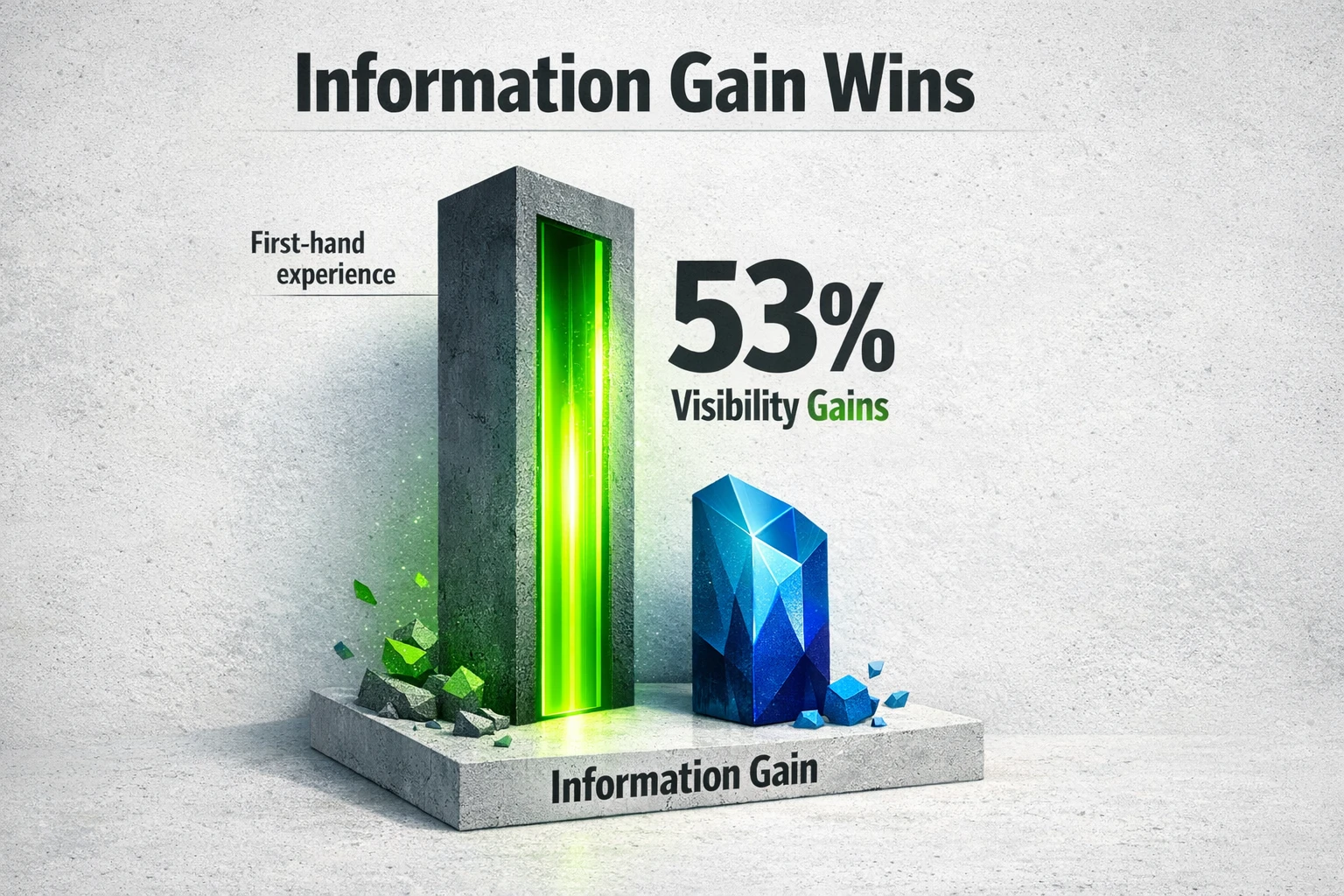
In 2026, the biggest gap isn’t a missing keyword—it's missing Information Gain. First-hand experience showed 53% visibility gains during volatility.
This leads to the most important concept in modern SEO: Information Gain. The winning strategy is no longer about covering a keyword. It is about providing unique expertise and data that AI Answer Engines need to build their responses [2]. Use AI to read a competitor's article and ask: "What unique, first-hand experience is demonstrated in this text? What perspective is missing?" Their lack of a real story is your content strategy.
Exposing the Global-Local Authority Gap
Authority is not a global constant. A brand that is a household name in the United States might have zero credibility on that same topic in Japan. Search engines and AI systems are now highly adept at evaluating these regional trust signals [3].
This creates a clear vulnerability for large, generic competitors. An article they write about financial regulations, for example, might be perfectly accurate for a US audience but miss crucial compliance details for businesses in the EU. AI can scan their content and flag the absence of local landmarks, region-specific laws, or local case studies. This is a major gap. When search engines cannot find a trustworthy local source, they may even resort to showing a machine-translated version of a foreign one, creating a poor user experience you can easily beat [3].
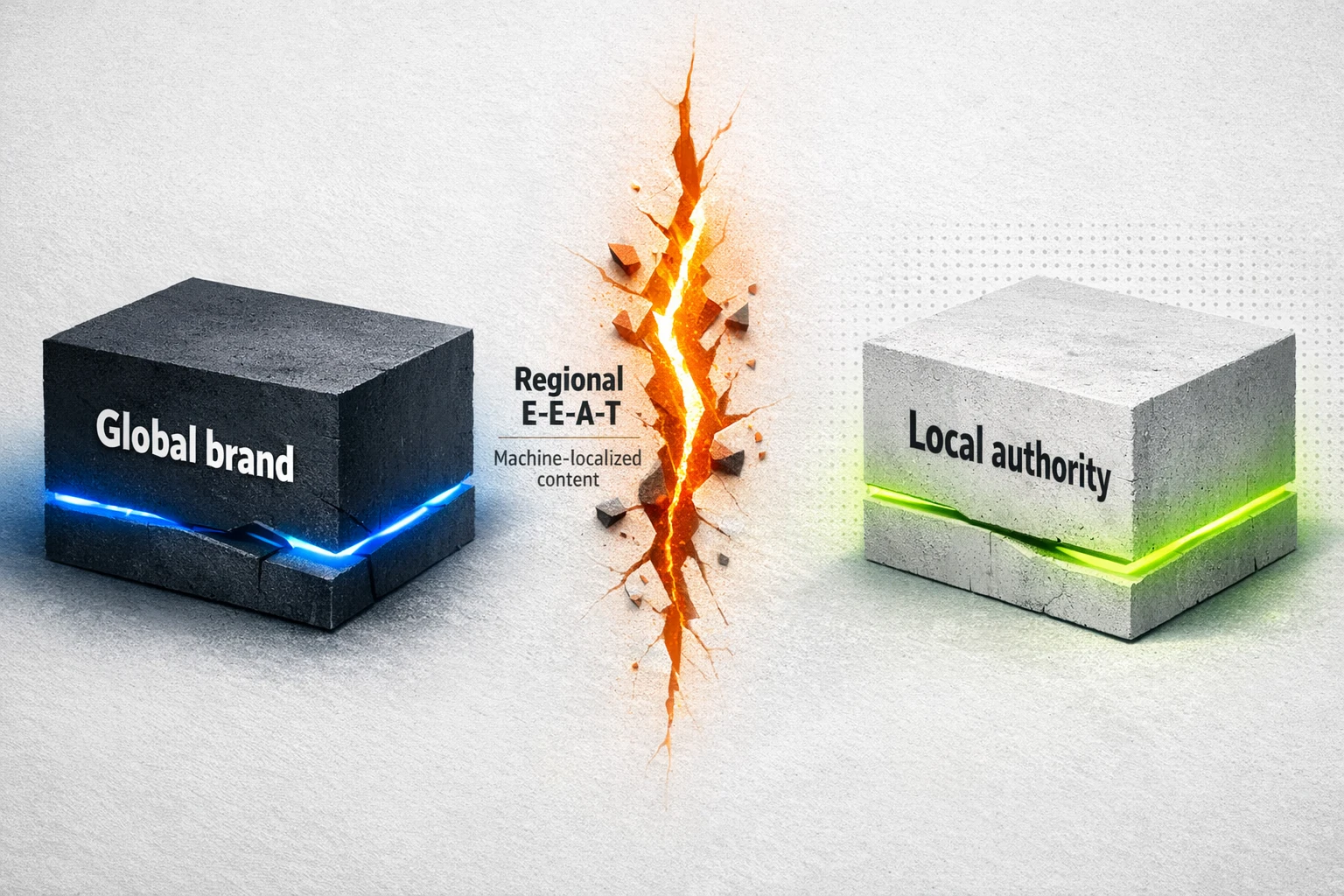
E-E-A-T doesn’t always travel. AI systems evaluate regional authority signals, so local competitors can win and search may surface machine-localized versions when trustworthy local sources are missing.
Putting It All Together: A Simple Workflow
You can deconstruct your competitors' content strategy without a massive team. The key is using AI for triage and humans for judgment. Addressing what are the common challenges in AI search competitor analysis and how can they be addressed requires a smart, hybrid approach.
- AI-Powered Triage: Use AI tools to scan your competitors' top 20 articles. Ask the AI to flag any potential accuracy issues, outdated statistics, or passages that lack first-hand experience.
- Human-Led Deep Dive: Have your subject matter expert review the handful of articles the AI flagged. Their job is not to read everything, but to validate the AI's findings and add context.
- Create Your Blueprint: Build your content to directly address the weaknesses you found. If their data is from 2024, lead with 2026 data. If their article is a generic list, write a case study. If they ignore local context, make it your centerpiece.
This human-in-the-loop system is how high-performing teams operate. They use AI for the initial draft or outline and then rely on human editors and experts to inject the quality, nuance, and experience that actually ranks [4].

Final takeaway: combine pillars for reliable competitive insight.
The Real Winner Is The Most Credible, Not The Most Prolific
The AI content explosion is a race to the bottom. It rewards speed over substance and creates an enormous opportunity for businesses that are willing to be more rigorous.
Stop trying to publish more. Start publishing smarter. Use AI as a scalpel, not a sledgehammer. Find the factual errors, the outdated advice, and the missing first-hand experience in your competitors' work. Each weakness you find is a blueprint for your next winning piece of content.
Your next step is not to write a new article from scratch. It is to pick one competitor article that ranks for a keyword you want and run it through this three-part weakness audit: Is it 100% accurate today? Is it truly fresh? And does it demonstrate real, verifiable experience? The answer will tell you exactly what to do next.
Frequently Asked Questions
What is AI competitor content analysis?
It is the process of using AI tools to automatically scan and evaluate your competitors' content for specific weaknesses. Instead of just tracking keywords, you analyze their articles for factual accuracy, outdated information, and gaps in demonstrating real-world experience (E-E-A-T).
How does AI find E-E-A-T gaps?
AI is particularly good at identifying the absence of E-E-A-T signals. It can scan an article and determine if it lacks specific authors, citations, original data, case studies, or first-person language that indicates real experience. It flags content that reads like a summary of other articles rather than a piece based on unique expertise.
Isn't using AI to write content a bad thing?
Using AI to mindlessly generate generic articles is a losing strategy. However, using AI as an analytical assistant is incredibly powerful. The approach we advocate is to use AI for research and analysis to find weaknesses, then use human experts to write content that fills those gaps with genuine quality and experience.
Can I do this without expensive tools?
Yes. While specialized tools can speed up the process, you can begin this analysis today using widely available LLMs. The key is not the tool itself, but the quality of your prompts and the rigor of your human-led verification process.
Sources:
- Carnegie Mellon University, Software Engineering Institute - A technical explanation of the inherent statistical weaknesses and vulnerabilities of modern AI models.
- Yotpo - A guide to modern content gap analysis, introducing concepts like Information Gain and providing data on the impact of first-hand experience signals.
- Search Engine Land - Analysis of how E-E-A-T and authority are assessed differently across geographic and cultural contexts by search engines.
- MarTech.org - A pragmatic look at AI content performance in search, emphasizing that human-driven quality remains the ultimate ranking factor.