Ultimate Guide to Custom AI ROI and Impact
AI Summary
Measuring custom AI ROI and business impact is not about tracking tool usage alone — it is about proving whether a tailored system creates durable financial value. The right framework connects early adoption signals to long-term revenue and cost outcomes.
- Why the 95–99% domain accuracy of custom AI can outperform the 60–70% ceiling of generic tools and reduce costly human review.
- How the Exploring, Optimizing, Enhancing, and Transforming stages distinguish trending ROI from realized ROI.
- How to build a CFO-ready model combining hard returns, quantified soft benefits, technical debt reduction, and a multi-year investment horizon.
For organizations comparing AI investments and needing a defensible path from experimentation to measurable enterprise value.
.jpeg)
Most organizations treat artificial intelligence as a software license purchase. They buy access for their team, wait for productivity to increase, and inevitably watch the initiative stall. The enterprise landscape faces a severe accountability crisis today in 2026. Leadership teams authorized vast budgets for generic tools based on theoretical efficiency gains. They expected immediate transformation. Instead, they received isolated experiments that never integrated into real operational workflows. The core issue is not a failure of the technology. The issue is a fundamental mismatch between off-the-shelf capabilities and the rigorous financial measurement required by executives. According to a summer 2025 MIT report, 95% of pilots are failing [1].
The pressure to prove financial value is mounting. Executives no longer accept vague promises of time saved or subjective employee satisfaction metrics. They demand concrete business cases built on revenue impact and cost reduction. The era of blind technological experimentation is over. Now, 72% are formally measuring Gen AI ROI, focusing on productivity gains and incremental profit [2]. The teams that secure funding are the ones that shift their perspective from buying software to building corporate assets.
Escaping the Domain Accuracy Ceiling
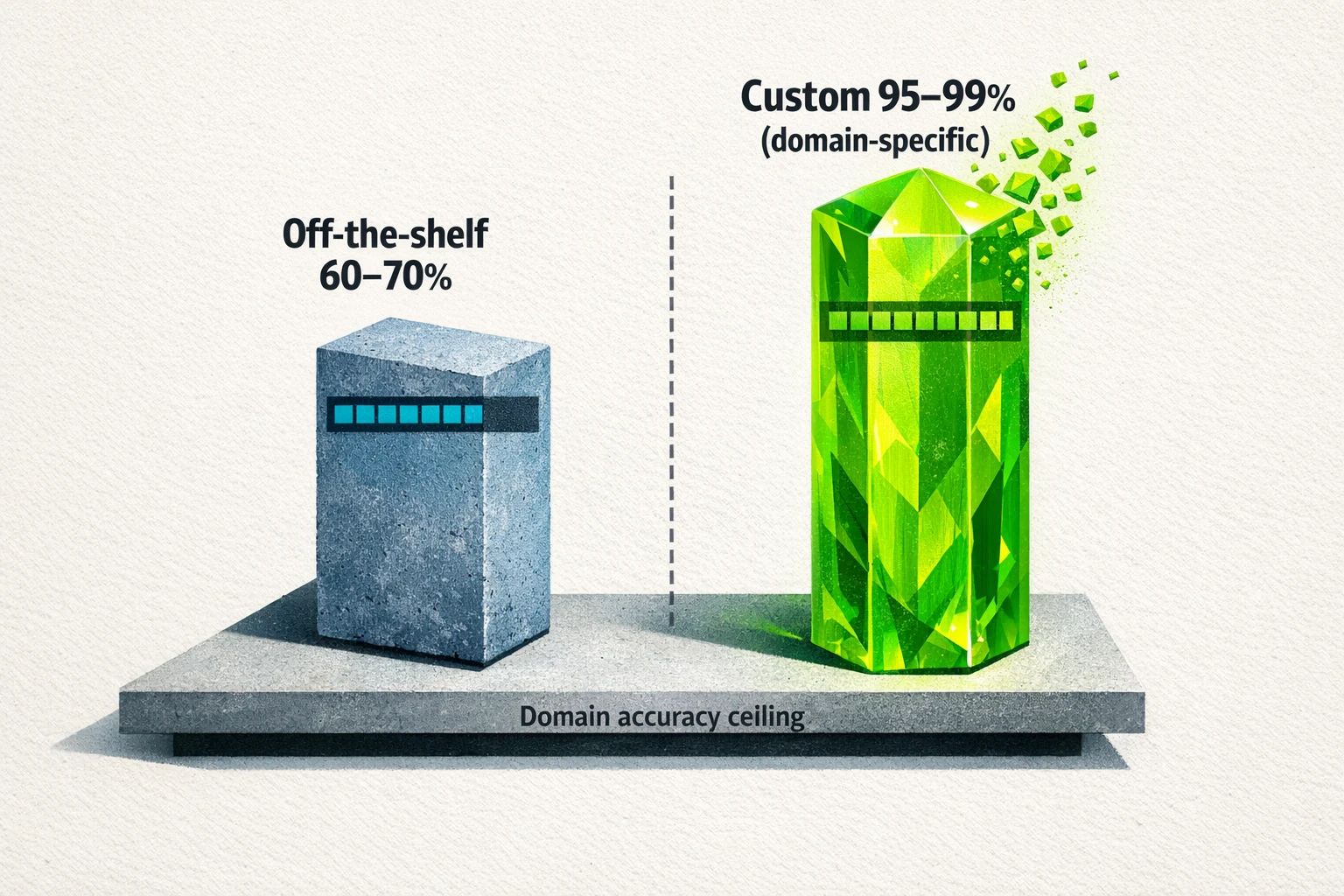
Generic platforms work beautifully for writing emails or summarizing meeting notes. They collapse completely when asked to execute core business logic. You cannot run a proprietary underwriting process or a specialized quality assurance workflow on a generic model. Off-the-shelf tools simply lack your internal context. They hit a performance wall that no amount of prompt engineering can break through. Custom AI systems trained on specific data routinely achieve 95-99% accuracy on domain-specific tasks, compared to 60-70% for off-the-shelf AI tools [3].
That massive accuracy gap is the difference between a toy and an enterprise tool. When a system makes frequent mistakes, human operators must review every single output. This review process nullifies the promised efficiency gains entirely. The human simply shifts from doing the work to babysitting the machine.
To capture real value, you must own the system. You need bespoke architecture that integrates deeply into your existing data structures. Partnering with a dedicated AI Transformation Agency fundamentally changes the trajectory of your investment. By building Custom Business Systems tailored to your exact workflows, you shift from renting generic intelligence to owning a compounding corporate asset. You dictate the data guardrails. You eliminate vendor lock-in. You build a system that actually understands your proprietary operations.
The Four Stages of Technology Adoption
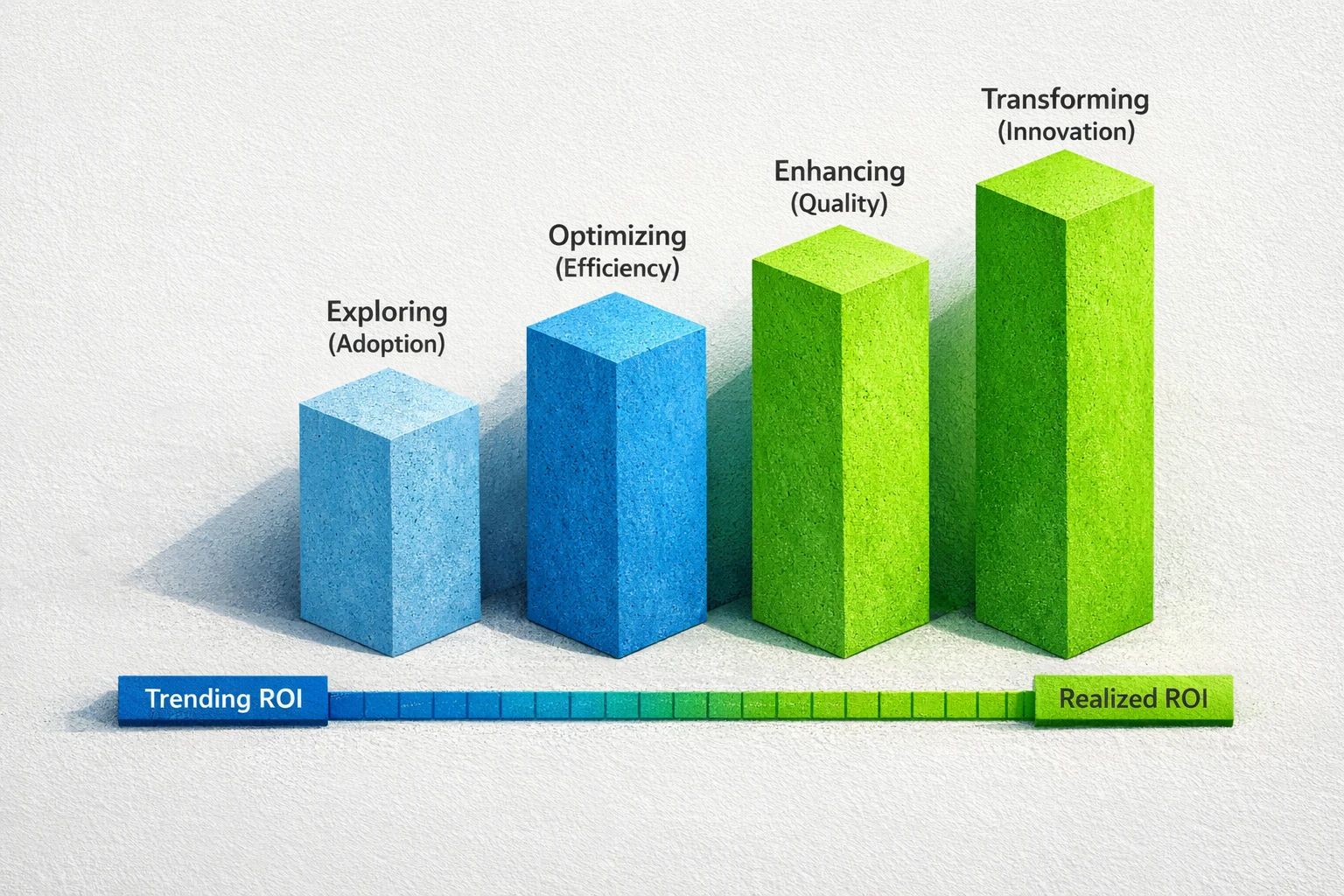
You cannot measure financial returns on day one. A structured temporal framework bridges the gap between early usage and long-term profit. You need to distinguish clearly between early trending indicators and realized financial outcomes.
The Exploring phase focuses strictly on adoption. You must determine if employees are logging into the new interface or bypassing it for legacy systems. The Optimizing phase shifts the focus to efficiency. Here, you track the specific hours saved per workflow. The Enhancing phase evaluates quality improvements. You look for reduced defect rates and lower error margins in your operational pipeline. Finally, the Transforming phase delivers the financial payload. You measure incremental profit and revenue generated from entirely new operational capacities.
Organizations that measure outcomes sequentially avoid prematurely canceling promising initiatives. They understand that bespoke software requires an integration and learning phase before it yields maximum profitability.
Realized Value and the Multi Year Horizon

Custom development requires a larger upfront investment. You have to fund the discovery, the data structuring, and the model training. The business case for the CFO must justify this initial capital expenditure. The justification lies purely in the long-term yield and the permanent reduction of operational bottlenecks. Generic tools provide a flat return curve. Bespoke solutions scale exponentially as the model learns your specific edge cases. According to a 2025 Forrester study, enterprises that deploy custom AI solutions report 2-3 times stronger ROI over three years compared to those relying solely on off-the-shelf tools [3].
The multi-year horizon is the only accurate way to assess digital infrastructure. You are building a digital workforce. The initial cost amortizes while the output capacity increases. It becomes a permanent competitive moat that generic subscribers cannot replicate.
Building the Financial Business Case
When you present your proposal to the executive board, you must speak their language. CFOs do not fund interesting technology. They fund business outcomes. You need to present a model that captures both hard and soft financial returns.
Hard returns include direct cost reductions and measurable revenue increases. Soft returns encompass improved employee bandwidth and faster decision cycles. Do not leave soft returns out of the equation. You must quantify them by assigning a concrete hourly rate to the time saved across your departments.
Furthermore, you must address technical debt. Integrating a bespoke model often forces an organization to clean up its legacy data silos. This modernization is a massive hidden benefit. The effort required to prepare your data for an advanced model simultaneously upgrades your entire technical foundation.
Frequently Asked Questions
How long does it take to see positive returns from bespoke AI?
Initial efficiency gains appear early during the optimization phase. Realized financial returns scale significantly as the system matures and handles more complex operational workflows.
Why should we build a custom system instead of buying a license?
Generic licenses hit a performance ceiling because they lack your proprietary data context. Bespoke systems bypass this limitation to deliver higher domain accuracy and compounding strategic value.
How do we justify the upfront development costs to our finance team?
You must frame the project as a capital asset rather than an operational expense. Highlight the long-term yield and the elimination of ongoing per-user subscription fees.
Stop evaluating artificial intelligence based on what it costs today. Start evaluating it based on the enterprise value it creates tomorrow. Map your current workflows, identify the exact processes constrained by human speed, and document the true cost of generic tool errors. That mapping exercise is your baseline for a winning business case.
Sources: