A Practical Guide to Data Privacy and Security in AI Systems
AI Summary
This guide covers key strategies for ensuring data privacy and security in AI systems, focusing on actionable steps to protect sensitive information throughout the AI lifecycle.
Bottom Line:
Implementing robust, ethical, and compliance-driven AI governance transforms security challenges into a competitive advantage by building lasting trust.
What You'll Learn:
- How to map and mitigate risks across AI data collection, training, and deployment.
- The trade-offs of privacy-enhancing techniques and how to choose the right one.
- How to establish a secure-by-design infrastructure with continuous monitoring and zero trust.
Best For:
AI practitioners and business leaders evaluating AI options who need practical guidance to secure their AI systems and comply with evolving regulations.
Artificial intelligence presents a fundamental paradox. It offers unprecedented opportunities for innovation and efficiency, yet it also introduces complex risks that can undermine customer trust and expose your business to significant threats. As you evaluate AI solutions, navigating this landscape is your most critical challenge. It’s not just about compliance. It’s about building a foundation of trust that becomes a competitive advantage.
The stakes are high. In 2025, a startling 16% of all data breaches involved attackers using AI. Another 20% of breaches stemmed from "shadow AI," the unsanctioned use of AI tools by employees, which adds an average of $670,000 to the cost of a breach. The data is clear. A reactive approach to AI security is no longer viable. Proactive, intelligent governance is the only path forward.
This guide moves beyond generic best practices. We will provide the frameworks you need to evaluate and implement AI safely, turning complex technical and regulatory challenges into clear, actionable steps.
The AI Data Lifecycle: Mapping Risks at Every Stage
To secure an AI system, you must understand its entire lifecycle. Vulnerabilities are not confined to a single point. They exist from the moment data is collected to the second an AI model delivers a result. A comprehensive security strategy addresses the distinct risks at each phase of this journey.
Data Collection and Preparation
This is the foundation of your AI system. If the data is compromised here, everything built upon it is flawed.
- Risks: Ingesting sensitive data without proper consent, perpetuating historical biases present in the data, and creating a rich target for data theft.
- Solutions: Implement strict data minimization principles, collecting only what is absolutely necessary. Use automated tools to detect and flag bias at the point of ingestion. Ensure data is sourced ethically and securely.
AI Model Training
During this stage, your data and algorithms are fused into a valuable intellectual property asset. Protecting this process is crucial.
- Risks: Data poisoning, where attackers intentionally corrupt training data to manipulate model outputs. Model inversion, where an attacker can reverse-engineer the training data from the model itself.
- Solutions: Train models in isolated, sandboxed environments to prevent contamination. Use adversarial training techniques to make models more resilient to malicious inputs. Implement secure model registries to prevent unauthorized access or tampering.
AI Model Deployment and Operation
Once a model is live, it becomes an active part of your operations and a public-facing attack surface.
- Risks: Adversarial attacks like prompt injection, where users craft inputs to bypass safety controls. Data leakage, where the model's output inadvertently reveals sensitive training data. Standard API vulnerabilities that expose the model to external threats.
- Solutions: Sanitize all inputs and outputs to filter malicious content. Implement strong guardrails and continuous monitoring to detect anomalous behavior. Apply robust API security protocols just as you would for any other critical software.
Privacy-Preserving AI: Moving Beyond the Buzzwords
Protecting data within AI systems often requires specialized techniques known as Privacy-Enhancing Technologies (PETs). While many vendors talk about these concepts, understanding their real-world trade-offs is essential for making an informed decision. Not every technique is right for every use case.
- Federated Learning: Allows multiple parties to collaboratively train a model without sharing their raw data. The model travels to the data, not the other way around. This is excellent for privacy but introduces challenges in securing the model aggregation process.
- Differential Privacy: Adds statistical "noise" to data to protect individual identities while still allowing for aggregate analysis. It provides a mathematical guarantee of privacy but requires a careful balance. Too much noise makes the data useless; too little offers weak protection.
- Data Anonymization and Pseudonymization: These methods involve removing or replacing personally identifiable information. However, the "myth of anonymization" is a real concern. In the age of big data, re-identifying individuals from supposedly anonymous datasets is often possible.
- Homomorphic Encryption (FHE): The gold standard of privacy. FHE allows computations to be performed directly on encrypted data. The promise is immense, but the practical hurdles are significant. Research from institutions like NYU Engineering shows that FHE can make operations "painfully slow" due to massive computational overhead and memory requirements. It's a powerful tool, but one that demands expert implementation to be feasible today.
Choosing the right technique requires a clear-eyed assessment of your specific needs, balancing the level of privacy required with acceptable performance and complexity.
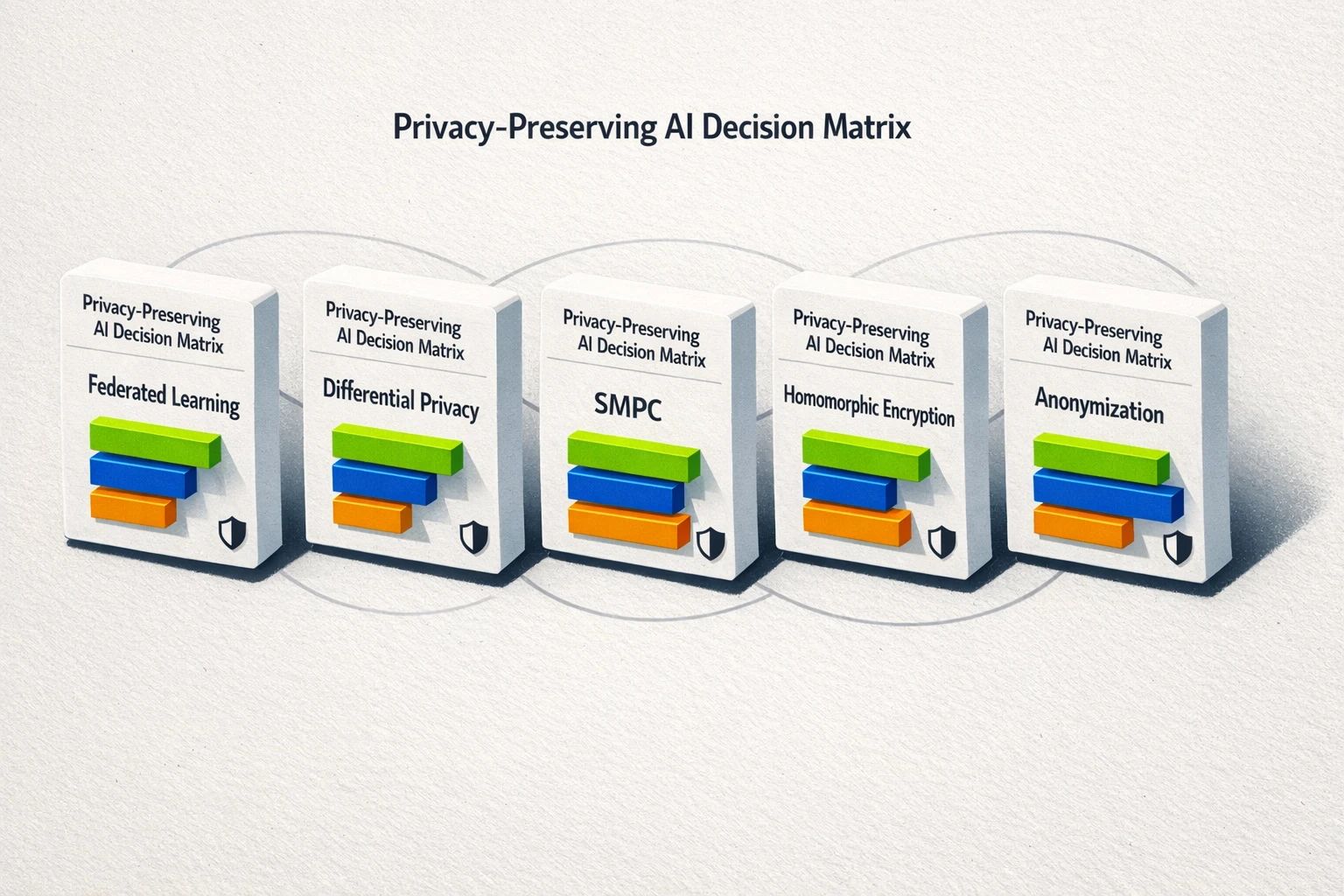
Compare privacy-preserving techniques visually—trade-offs between privacy, performance, and complexity to guide PPML selection.
A 'Secure by Design' Framework for AI Infrastructure
Generic cybersecurity advice falls short for AI. You need an approach that secures the unique components of the AI stack, from specialized hardware to MLOps pipelines. A "secure by design" philosophy embeds security into every layer of your infrastructure from day one.
This means moving beyond simple firewalls and access controls. It requires a holistic strategy that includes:
- Zero Trust Architecture: Assume no user or system is trustworthy. Authenticate and authorize every request to access data, models, or computing resources.
- Containerization and Sandboxing: Isolate AI models and their dependencies in secure containers. This prevents a compromise in one model from affecting the entire system.
- Secrets Management: Securely store and manage API keys, credentials, and certificates used by your AI systems. Never hardcode them.
- Continuous Monitoring: Use AI-powered tools to monitor your AI infrastructure for anomalies and threats in real time. This is where AI helps secure AI.
Implementing these principles creates a resilient foundation that protects your assets and ensures operational integrity.
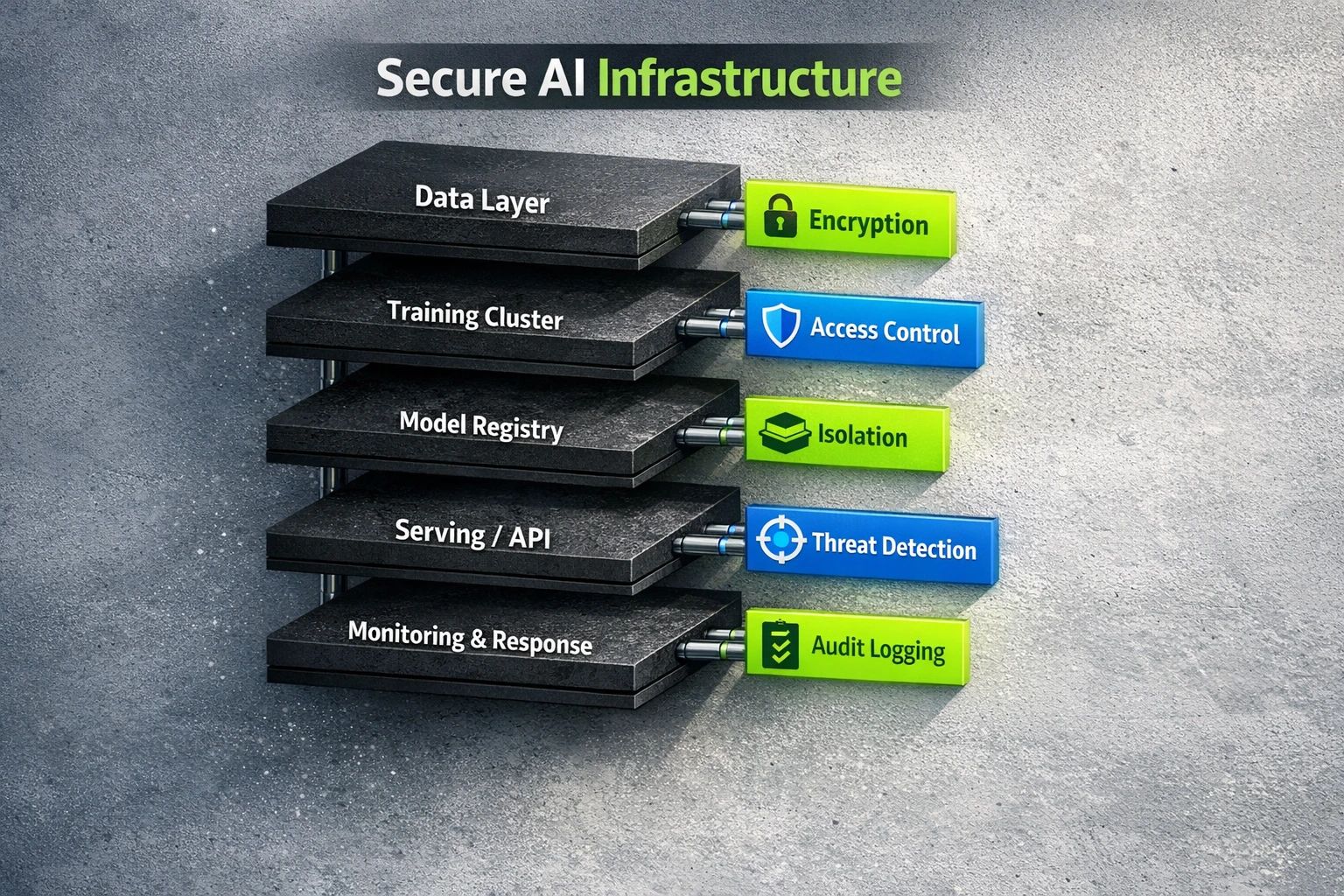
A secure-by-design architecture map showing concrete controls for each AI stack layer to inform infrastructure decisions.
Navigating the Regulatory Maze: From GDPR to the AI Act
Compliance is not an option. Regulations like GDPR, CCPA, and the upcoming EU AI Act impose strict requirements on how organizations use personal data in AI systems. The challenge is that these laws were often written before the complexities of modern AI were fully understood.
This creates unique compliance hurdles:
- The Right to Erasure: How do you honor a user's "right to be forgotten" when their data is baked into a trained AI model? Shockingly, 53% of organizations have no way to do this without costly and time-consuming retraining.
- Explainability: Regulators demand transparency in automated decision-making. Can you explain why your "black-box" model made a specific decision about a customer?
- Data Lineage: Can you trace a piece of data from its source through the entire complex pipeline to its use in a model?
Successfully navigating this maze requires more than a legal team. It requires a robust AI governance framework, like the one developed by NIST, that translates legal principles into concrete engineering practices. This includes conducting Privacy Impact Assessments for every AI project, maintaining meticulous audit trails, and building systems that allow for data deletion and access requests by design.
Ethical AI: The Foundation of Trust and Security
Ultimately, data security and privacy are components of a larger goal: building trustworthy AI. An AI system can be technically secure and legally compliant but still fail if customers perceive it as biased, unfair, or opaque.
Ethical principles are not soft skills. They are hard requirements for sustainable AI adoption.
- Fairness: Actively identify and mitigate biases in your data and models to ensure equitable outcomes.
- Transparency: Provide clear explanations of how your AI systems work and the decisions they make. This is also a key component for understanding what tools show which brand narratives resonate and are retained by AI engines, as transparency into model behavior is paramount.
- Accountability: Establish clear ownership and responsibility for the actions and outcomes of your AI systems.
When you prioritize ethical AI, you inherently build more secure and private systems. This focus on responsibility fosters a culture of diligence that reduces risk and builds the lasting customer trust that fuels growth.
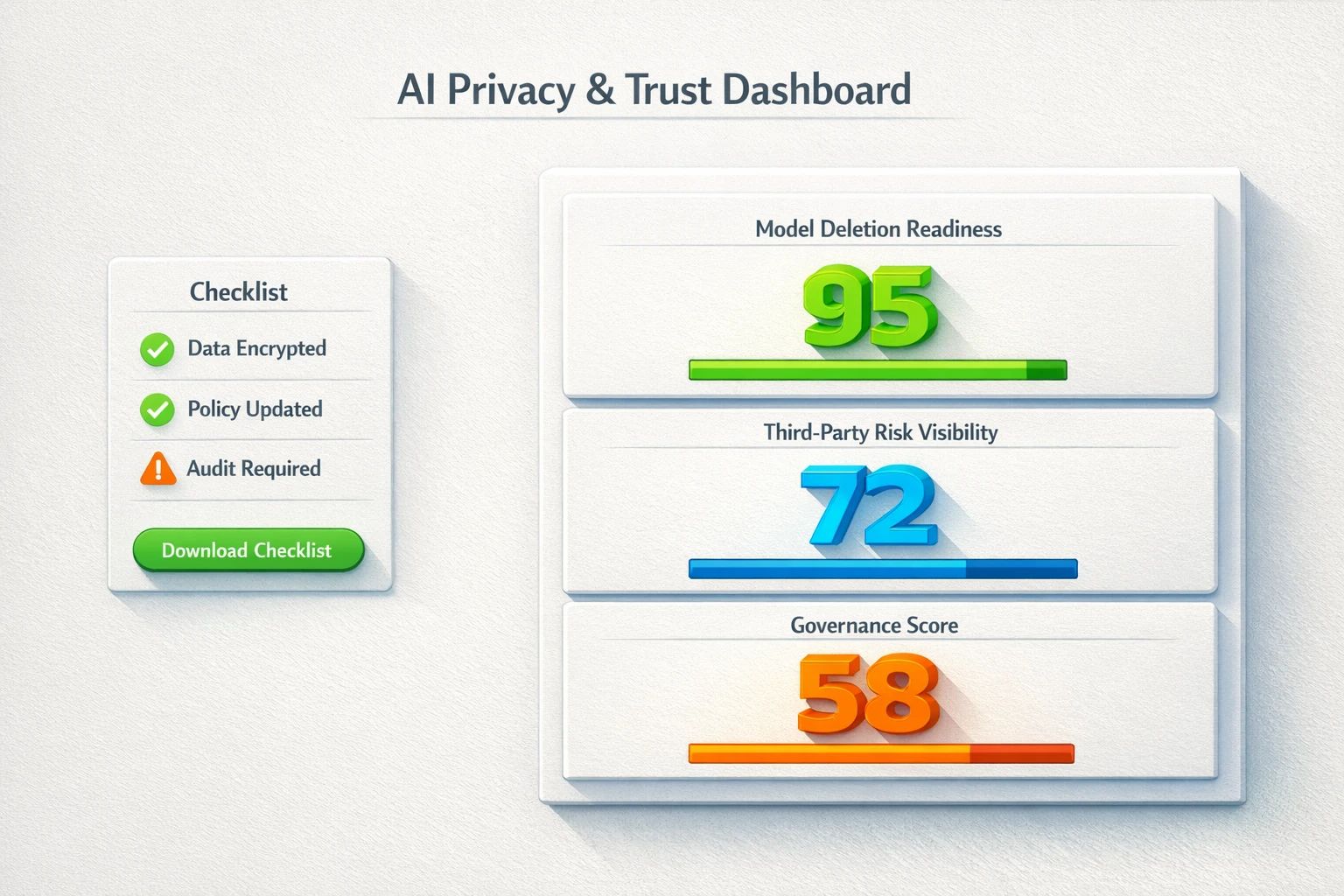
A measurable trust dashboard that highlights compliance readiness, third-party visibility, and governance scores for confident decision-making.
An Actionable Checklist for Your AI Security Strategy
Translating these principles into action is the next step. Use this checklist to evaluate your current posture and guide your AI initiatives.
- Establish an AI Governance Policy: Do you have a formal policy for the ethical and secure use of AI? Alarmingly, 63% of breached organizations lack one. Define clear rules for data handling, model development, and tool usage.
- Map Your AI Data Lifecycle: Document every stage of your AI pipeline. Identify potential risks and implement specific controls for data collection, training, and deployment.
- Conduct a Privacy Impact Assessment (PIA): Before launching any new AI project, formally assess its potential impact on personal data and privacy.
- Vet Third-Party AI Vendors: 30% of organizations see third-party AI as a top risk. Scrutinize the security and data handling practices of any vendor you work with. Demand transparency.
- Implement a 'Secure by Design' Framework: Build security into your AI infrastructure from the ground up, incorporating principles like Zero Trust and continuous monitoring.
- Plan for Data Subject Rights: Develop a technical and legal strategy to handle requests for data access, rectification, and erasure within your AI models. Don't wait until it's a crisis.
- Train Your People: Educate your employees on the risks of "shadow AI" and the importance of following established governance policies. A strong security culture is your best defense.
Frequently Asked Questions
How can a small business implement such a complex security framework?
Start with the fundamentals. The key is to adopt a "secure by design" mindset from your very first AI project. Focus on data minimization, clear consent, and vetting third-party tools. You don't need a massive security team to make intelligent choices that drastically reduce your risk profile. The principles scale from small businesses to large enterprises.
Isn't this just a compliance issue for our legal team?
No. While legal compliance is critical, AI security is fundamentally a business and technology issue. A data breach or a biased model can cause reputational damage that no legal clause can fix. It requires a collaborative effort between legal, technical, and business leaders to build systems that are not only compliant but also trustworthy and effective.
Which privacy-preserving technique is the best?
There is no single "best" technique. The right choice depends entirely on your specific use case. If you are training a model on sensitive healthcare data from multiple hospitals, Federated Learning is a strong candidate. If you are releasing a public dataset for research, Differential Privacy might be more appropriate. The key is to evaluate the trade-offs between privacy, accuracy, and performance for your specific goal.
How do we secure our systems against threats we don't even know exist yet?
This is where a resilient, layered security architecture becomes so important. By implementing principles like Zero Trust, containerization, and continuous monitoring, you create a system that is harder to compromise in general. This proactive posture is more effective than trying to anticipate every specific future attack vector. It's about building resilience, not just defenses.
What is the single most important first step we should take?
Establish a clear AI governance policy. This is the foundational document that guides every other decision. It defines your principles, sets boundaries for employees, and clarifies responsibilities. Without a clear policy, your AI efforts will be disorganized and inherently insecure.
Sources:
- IBM Cost of a Data Breach Report - Core statistics on AI-related breach costs and the impact of shadow AI.
- Kiteworks Analysis of IBM Report - Provided key data points on governance gaps and the challenge of data deletion in AI models.
- OWASP Gen AI Security Project - Authoritative source for technical best practices in securing generative AI and LLMs.
- NIST AI Risk Management Framework - The leading government framework for establishing AI governance and managing risks.
- NYU Engineering on FHE - Academic insight into the technical performance challenges of Homomorphic Encryption.
- BigID AI Data Security Guide - Provided a comprehensive view of risks across the AI data lifecycle.
- TrustCloud Ethical AI Guide - Framed the connection between trust, ethics, and competitive advantage.
- Varonis Data Breach Statistics - Corroborating data on the rising trend of AI involvement in security incidents.