What Is Digital Transformation Leadership for Lean Teams?
AI Summary
Digital transformation leadership for lean teams is less about copying enterprise playbooks and more about turning AI into measurable operational leverage before bureaucracy slows it down. The article connects leadership behavior, decision rights, and outcome-based measurement into a practical execution model.
- AI-ready leaders use clear questions, data guardrails, and human ownership of fact-checking rather than technical expertise.
- Distributed authority, cross-functional workflows, and standardized processes improve speed to value as AI takes on routine decisions.
- Actionable KPIs track decision time, confidence, hours saved, revenue, and errors instead of logins or model usage.
For founder-led teams comparing AI investments, this framework helps identify one bottleneck, test automation, and prove its return.
Effective leadership overseeing digital transformation for founder-led teams requires abandoning theoretical enterprise models to focus purely on rapid AI deployment and measurable operational leverage. Lean organizations cannot afford months of abstract consulting presentations. Building the financial business case for these systems requires tracking actual output rather than projected savings. You need workflows that capture leads, reduce repetitive work, and build durable inbound growth. The core priority is execution. Your evaluation should ignore how massive enterprises structure their committees and focus entirely on how your team can implement AI to outmaneuver them.
Traits for Overseeing AI Integration
Agility is your primary advantage when adopting new technology. Many executives mistakenly believe they must become software engineers to drive operational change. The reality is far less technical. AI-ready leaders do not need to code or build models, but instead need the ability to ask the right questions, make sound decisions with AI in the mix, and set governance that works in practice [1].
The most effective managers focus on establishing guardrails that allow their teams to experiment safely. You have to define what internal data is permissible to use and establish clear ownership for fact-checking automated outputs. When you supply the domain truth and let the system handle the execution, you create immediate leverage without needing a degree in machine learning.
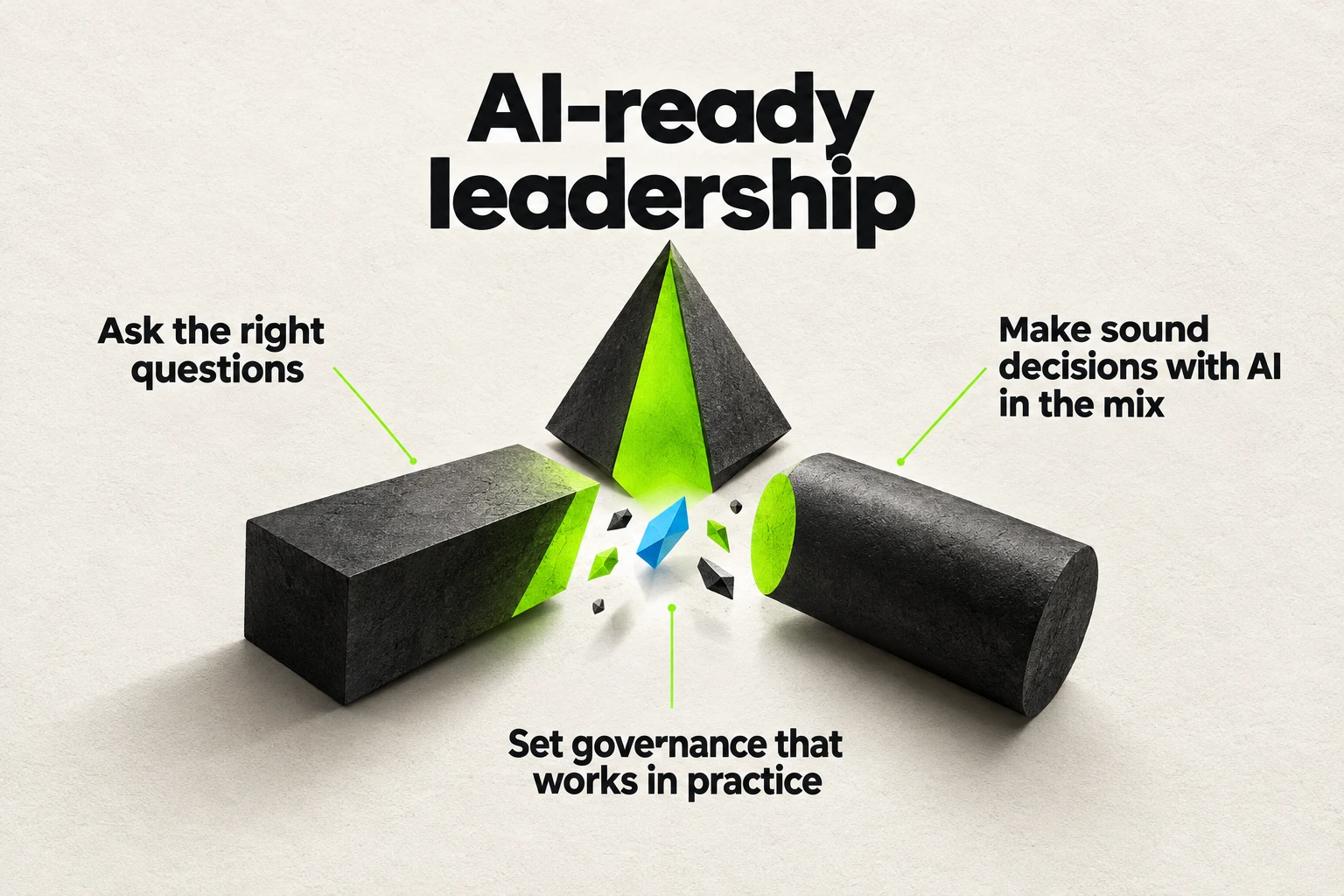
AI-ready leaders need the ability to ask the right questions, make sound decisions with AI in the mix, and set governance that works in practice.
Decision Frameworks for Speed to Value
A fast implementation cycle dies in committee. Lean teams thrive when decision-making authority is distributed to the leaders actively managing operations and finances. Centralizing every technology choice at the very top creates bottlenecks that delay deployment and dilute impact. Organizations that empower their financial and operational leaders see different outcomes. Among surveyed organizations, only 18% achieved above-average profitability when the CFO had no decision-making authority, but this jumped to 42% when the CFO had full decision-making authority [2].

Among surveyed organizations, only 18% achieved above-average profitability when the CFO had no decision-making authority, but this jumped to 42% when the CFO had full decision-making authority.
To capitalize on this structure, you must rethink collaboration across your entire organization. Siloed departments cannot scale automated workflows. You have to build systems that allow different functions to operate with shared intelligence. CEOs who actively redesign how cross-functional teams work together are more than twice as likely to have delivered on their business objectives.
Automation is rapidly absorbing routine choices. CEOs report that 25% of operational decisions are currently made by AI without human intervention, and expect this to nearly double to 48% by 2030 [3]. You must prepare your infrastructure for this shift by standardizing workflows today so that human oversight can shift from doing the work to verifying the results.

25% of operational decisions are currently made by AI without human intervention, and this share is expected to nearly double to 48% by 2030.
KPIs That Leaders of Lean Teams Must Develop
Tracking the right data separates successful automation from expensive experimentation. Evaluating content or system output using KPIs for content visibility requires distinct baselines. Many teams make the mistake of measuring adoption rates instead of business impact. Knowing how many times an employee logged into an application tells you nothing about operational leverage.
You must define success based on concrete business outcomes rather than usage statistics. Barry O'Reilly advises that organizations replace vanity metrics with actionable ones, such as measuring if AI reduced decision meeting time by 20% or increased confidence in outcomes by 15%, rather than counting if a model was used 100 times [4].

Counting AI model use is a vanity metric; decision meeting time and confidence in outcomes are examples of actionable measures.
Companies must revise their targets to match these new capabilities. Sticking to old performance indicators while deploying new systems creates misalignment. You have to define success based on hours saved, revenue generated, and manual errors eliminated.
Frequently Asked Questions
How can an AI-first mindset accelerate deployment across the organization?
Remaking your executive structure with an AI-first mentality directly accelerates deployment by bypassing traditional friction points. CEOs who are remaking the C-suite with an AI-first mindset have scaled 10% more AI initiatives enterprise wide [3]. Embedding this mentality ensures that every department moves at the same operational speed.
Should chief strategy officers have control over technology investments?
Yes, centralizing this authority directly correlates with better financial outcomes. Organizations where Chief Strategy Officers are given substantial authority in tech investment decisions could be up to 88 times more likely to achieve high ROI across key metrics [2]. Empowering strategy leaders ensures tight alignment between operational goals and technology deployment.
Can small startup studios achieve global scale with limited budgets using AI?
Yes, optimizing operational leverage allows lean teams to execute aggressive international expansion. One of Nobody Studios' early companies was able to launch in 14 languages across 20 countries in just five months for $78,000 [4].
Steering your digital transformation with decisive leadership requires an immediate audit of your internal bottlenecks. Pick one manual workflow in your current operations and document every step required to complete it. Evaluate that specific process against the actionable metrics discussed above to determine exactly where automation can extract the highest return.
Sources:
- Korn Ferry - Leadership traits for AI oversight
- Deloitte - C-suite decision-making authority impacts
- IBM - Executive redesign and operational autonomy data
- Barry O'Reilly - Actionable metrics versus vanity metrics