AI Content in Regulated Industries Your Guide to Mastering E-E-A-T
AI Summary
Imagine your company launches a new AI-powered financial blog. It produces dozens of articles a week on topics like retirement planning and investment strategies. The content is clean, keyword-rich, and driving traffic. Then, a subtle error in an AI-generated article about tax implications leads a reader to make a costly mistake. The fallout isn't just a lost reader. It's a loss of trust, a potential compliance breach, and a significant blow to your brand's reputation.
This scenario highlights a critical reality. For businesses in healthcare, finance, and legal sectors, content isn't just about marketing. It's about responsibility. When using AI to create this content, the stakes get even higher. This is where Google's concept of E-E-A-T becomes less of an SEO buzzword and more of a non-negotiable framework for compliance and trust. E-E-A-T stands for Experience, Expertise, Authoritativeness, and Trustworthiness. It’s the lens through which search engines, and more importantly your audience, judge the quality and reliability of your information.
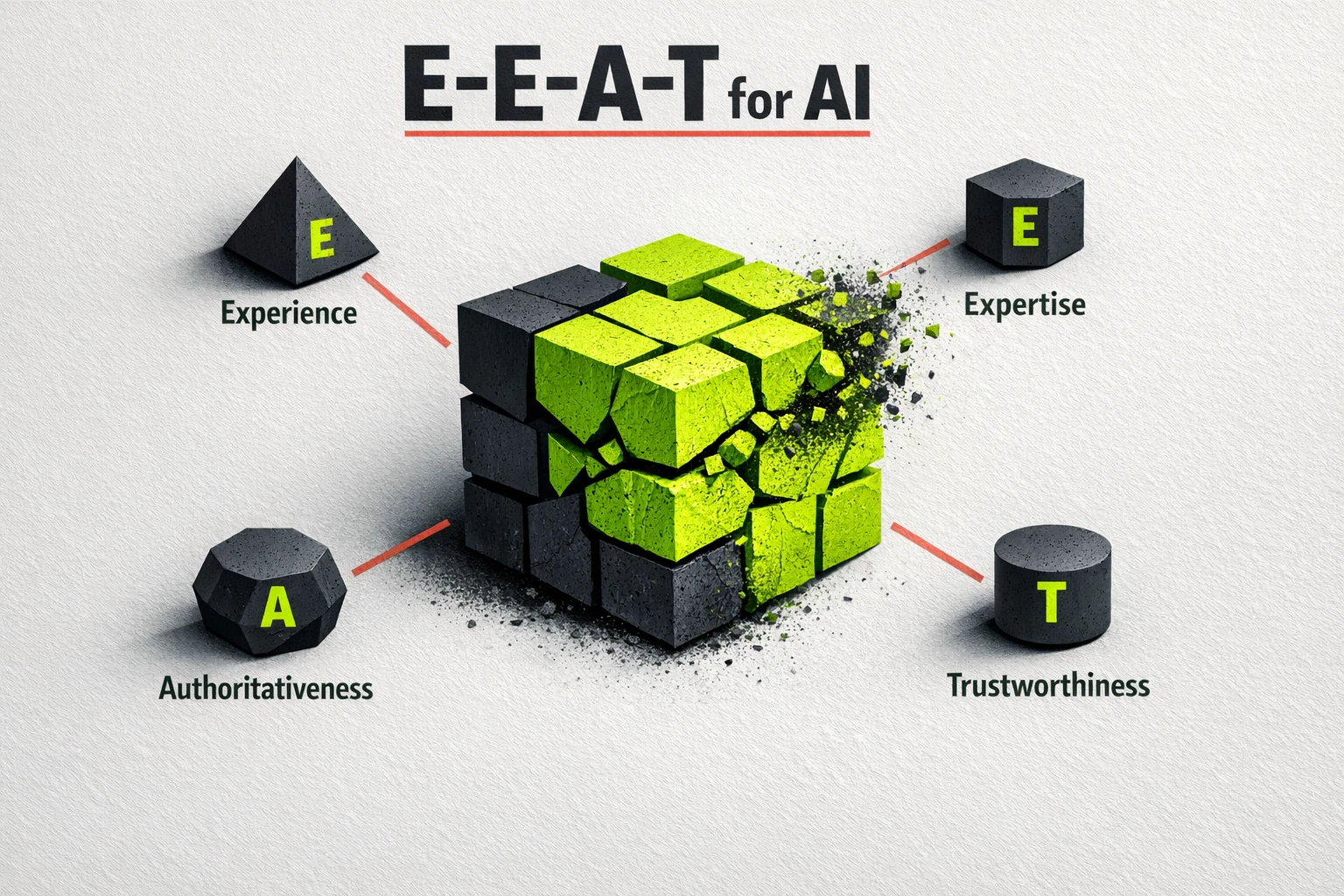
This guide will walk you through the unique challenges of applying E-E-A-T to AI-generated content in these high-stakes fields. We'll move beyond general advice to provide a clear, actionable playbook for creating content that is not only visible but also valid, verified, and valued by your audience.
Unpacking the Fundamentals: E-E-A-T in a High-Stakes World
Before we dive into measurement and workflows, let's establish a shared understanding of the core concepts. Many people have heard of E-E-A-T, but its application changes dramatically when regulatory compliance and human well-being are on the line.
What E-E-A-T Really Means for Your Industry
In highly regulated fields, the four components of E-E-A-T take on specific, critical meanings:
- Experience: This is the "boots on the ground" perspective. Did a real doctor review the medical article? Does the financial advice reflect actual market conditions? AI cannot fabricate lived experience, so this pillar demands genuine human involvement.
- Expertise: This refers to the demonstrable credentials and knowledge of the author or the organization. An AI can summarize information, but it doesn't have a medical degree or a law license. Expertise must be conferred by qualified human professionals.
- Authoritativeness: This is about your reputation among other experts and influencers in your field. Are you cited by other reputable medical journals or financial institutions? Authoritativeness is built over time through consistent, expert-validated content.
- Trustworthiness: This is the ultimate goal. It encompasses everything from the accuracy of your information to the security of your website. For AI content, it means being transparent about its use and having rigorous fact-checking processes in place. The role of E-E-A-T in the AI era is fundamentally about building this layer of trust.
The YMYL Factor: Why Scrutiny is So High
Google classifies topics that can significantly impact a person's health, financial stability, or safety as "Your Money or Your Life" (YMYL). Content in healthcare, finance, and legal sectors falls squarely into this category. Consequently, Google's quality standards for YMYL content are exceptionally high. Low-quality, unverified information doesn't just result in a poor user experience. It can cause real-world harm. This is why a casual approach to AI content generation is simply not an option in these fields.
Building a Bulletproof Framework for AI Content
The most common mistake businesses make is treating AI as a content vending machine. They input a prompt and publish the output with minimal review. In a regulated industry, this is a recipe for disaster. The solution is to wrap AI technology in a robust human-centric workflow.
The Human-in-the-Loop Imperative
A "human-in-the-loop" model ensures that AI serves as a powerful assistant, not an autonomous author. This system builds E-E-A-T directly into your content creation process. The AI can handle the initial research, drafting, and structuring, but critical checkpoints require human intervention.

This workflow isn't just a best practice. It's a way to document your commitment to quality and accuracy, which is essential for both search engines and regulatory bodies. The process of building trust and credibility with E-E-A-T and AI is an active one, requiring deliberate steps and clear oversight.
Industry-Specific Verification Protocols
While the human-in-the-loop concept is universal, its execution must be tailored to the specific rules of your industry.
For Healthcare
Content must be reviewed and signed off by a credentialed medical professional, such as a doctor or a registered nurse. All claims should be fact-checked against reputable sources like medical journals or government health organizations. Patient privacy, in line with regulations like HIPAA, is paramount.
For Finance
Any content that could be construed as financial advice must be vetted by a licensed financial advisor. Disclosures and disclaimers are not optional. They are a legal requirement. Market data must be accurate, up-to-date, and properly sourced, adhering to guidelines from bodies like the SEC or FINRA.
For Legal
Information must be reviewed by a qualified lawyer to ensure it doesn't cross the line into unauthorized legal advice. All references to statutes, case law, or legal precedent must be precise and correctly cited. Content should align with the ethical rules set forth by bar associations.
From Abstract to Actionable: Measuring E-E-A-T for AI Content
One of the biggest challenges is that E-E-A-T can feel subjective. How do you prove to an auditor or a search algorithm that your AI-assisted content meets the standard? The key is to translate these concepts into quantifiable metrics. It's not just about demonstrating quality signals, but about tracking them consistently. This is especially true as more search experiences become powered by LLMs, which will analyze the E-E-A-T signals present across all of your LLM-indexed pages.
Developing Your E-E-A-T Scorecard
Instead of guessing, you can develop an internal scorecard to audit your content. This creates an objective and repeatable process for ensuring compliance and quality.
Consider tracking metrics like these:
- Expertise Score: The percentage of AI-generated claims that are verified and validated by a credentialed subject matter expert. A target of 100% is the goal for YMYL content.
- Trustworthiness Index: The ratio of verifiable, primary sources cited per 1,000 words. A higher ratio indicates a stronger foundation of trust.
- Compliance Adherence Rate: The percentage of content that passes a checklist based on specific regulatory guidelines for your industry (e.g., FINRA advertising rules, FDA labeling requirements).
- Experience Integration: A qualitative check to ensure that a human expert has added real-world examples, anecdotes, or context that an AI could not generate on its own.

By defining and measuring these elements, you create an auditable trail that demonstrates your commitment to producing responsible, high-quality content. This transforms E-E-A-T from a vague concept into a core component of your risk management strategy.
Your Path Forward: From Awareness to Action
Navigating the world of AI-generated content in a regulated industry can feel daunting, but it is entirely manageable with the right framework. By prioritizing human expertise, establishing rigorous verification workflows, and measuring what matters, you can leverage the efficiency of AI without sacrificing the trust that is the bedrock of your business.
The journey starts with a simple audit. Use the principles outlined here to review your current content processes. Identify the gaps where human oversight could be stronger and where your E-E-A-T signals could be clearer. Building a trustworthy content engine is a continuous process, but it is one that pays dividends in brand reputation, customer loyalty, and long-term, sustainable growth.
Frequently Asked Questions
What does E-E-A-T stand for again?
E-E-A-T stands for Experience, Expertise, Authoritativeness, and Trustworthiness. It's a set of criteria Google uses to evaluate the quality of content, especially for topics that can impact a person's life and well-being.
Does Google automatically penalize AI-generated content?
No. Google's official stance is that it rewards high-quality content, regardless of how it is produced. It penalizes low-quality, spammy content. AI-generated content that is fact-checked, edited, and validated by human experts to meet high E-E-A-T standards is perfectly acceptable.
Can AI create content with good E-E-A-T on its own?
No. An AI can generate text that mimics expertise, but it cannot have genuine lived experience or hold professional credentials. True E-E-A-T requires a human-in-the-loop process where qualified experts review, edit, and take ownership of the final content. The AI is a tool, not the expert itself.
Why is E-E-A-T so much more important for my industry?
In highly regulated fields like healthcare, finance, and legal, your content falls under the "Your Money or Your Life" (YMYL) category. Inaccurate or misleading information can cause serious real-world harm. Because of this, search engines and regulatory bodies hold YMYL content to the highest possible standard of quality and trustworthiness.