Ethical AI for LinkedIn: From Automated Spam to Accelerated Pipeline
AI Summary
Bottom Line
Use AI to boost LinkedIn-driven revenue without risking spam, bans, or your reputation. Apply a clear framework to protect your account, scale real personalization, and connect every activity to pipeline.
Key Takeaways
- Build a safe automation foundation with cloud-based tools, human-like limits, and compliant workflows
- Use AI for deep, context-aware personalization that references posts, news, and signals, not just names
- Tie engagement to CRM, lead scoring, and nurturing sequences to turn conversations into qualified opportunities
Best For
B2B founders, marketers, and agencies wanting scalable, ethical LinkedIn systems that reliably generate pipeline.
AI adoption is no longer a choice in B2B sales. The data is clear. 83% of sales teams using AI reported revenue growth last year [1]. And on average, B2B companies leveraging AI see revenue jump by 13–15% while getting more from their sales budget [2]. The opportunity is massive.
But there is a catch. Most guides on AI for LinkedIn push you toward a dangerous cliff. They focus on tools that automate connection requests and messages, turning your personal profile into a spammy robot. This approach burns your reputation, alienates high-value prospects, and puts your account at risk.
You do not need to become a spammer to win. The alternative is to become an "Augmented Seller." You can use AI to scale your authenticity, deepen relationships, and build a predictable sales pipeline. This is not about automating outreach. It is about accelerating genuine engagement.
The Ethical Automation Framework: 3 Pillars for Pipeline Growth
A successful LinkedIn strategy powered by AI is not about sending more messages. It is about sending smarter messages to the right people at the right time. This requires a framework built on three pillars: Protection, Personalization, and Pipeline.
Pillar 1: Protection - Secure Your Foundation
Before you accelerate, you must protect your most valuable asset: your LinkedIn account. Aggressive, careless automation is the fastest way to get flagged or suspended. Ethical automation prioritizes safety.
This means using systems that mimic human behavior. Look for tools that offer cloud-based operation, which is safer than browser extensions. Your automation should run with randomized delays between actions and adhere to safe daily limits for profile visits, connection requests, and messages. This is the non-negotiable foundation for long-term success.
Pillar 2: Personalization - Scale Authenticity, Not Just Names
Generic outreach is dead. A message starting with Hi [First Name] followed by a generic sales pitch gets deleted instantly. Real personalization goes deeper, and AI is the key to doing it at scale.
Instead of just scraping names, use AI systems to find genuine conversation starters. These systems can analyze a prospect's recent activity to identify their posts, comments, or shared interests. They can scan company news for funding announcements or product launches. This intelligence allows you to craft messages that are relevant and timely. Remember, personalized emails deliver six times higher transaction rates because they show you have done your homework [3].
Pillar 3: Pipeline - Connect Activity to Revenue
Likes and connections are vanity metrics. Pipeline is what matters. The goal of automation should be to move qualified prospects through your sales process, not just to fill the top of your funnel with low-quality leads.
Ethical AI helps you do this intelligently. It can score leads based on their engagement, firmographics, and activity signals. It can trigger smart follow-up sequences that nurture relationships over time. More than 60% of sales organizations now use AI to qualify leads and analyze intent data for this very reason [4]. This transforms your LinkedIn activity from a series of random acts into a systematic pipeline generation engine.

The ROI of Ethical Automation: Hard Numbers
Shifting from spam to strategy delivers tangible business outcomes. The evidence is overwhelming. AI adoption drives a 50% increase in lead generation and 47% higher conversion rates for B2B companies [2].
This is not just about efficiency. It is about effectiveness. By focusing on quality engagement, AI can increase sales productivity by up to 40% and shorten sales cycles [5]. This approach turns your LinkedIn presence from a cost center into a powerful revenue driver.

Strategic Blueprints for Your Role
The Ethical Automation Framework is not one-size-fits-all. How you apply it depends on your role and goals.
For the Founder-Led Seller
Your biggest asset is your deep industry expertise. Your biggest constraint is time. Use AI systems to turn your knowledge into high-value content and outreach. The system can help you identify relevant conversations to join and craft personalized messages that reflect your unique point of view, allowing you to build authority and open doors without spending hours a day on the platform.
For the Modern B2B Marketer
You are under pressure to prove ROI and move beyond outdated top-of-funnel playbooks. Integrating this framework helps you build a high-intent pipeline directly from LinkedIn. You can use AI to identify and engage entire buying committees, track engagement across accounts, and feed qualified conversations directly into your CRM. Success requires the right tools for analyzing expert content impact on AI brand authority to demonstrate real business impact.
For the Solopreneur and Agency Owner
You need a repeatable system that delivers consistent results for you and your clients. This framework provides a proven methodology. You can use it to standardize your service delivery, ensuring every client engagement is built on a foundation of safety, authenticity, and a clear focus on pipeline. This allows you to scale your business without sacrificing quality.
Choosing Your Toolkit: An Objective Guide
The market is flooded with LinkedIn automation tools, and most vendor websites make identical claims. Instead of relying on biased "best of" lists, use the Ethical Automation Framework to evaluate your options.
A trustworthy toolkit is not a single piece of software. It is a combination of systems designed for specific jobs. Your evaluation should be based on strategic fit, not just features.
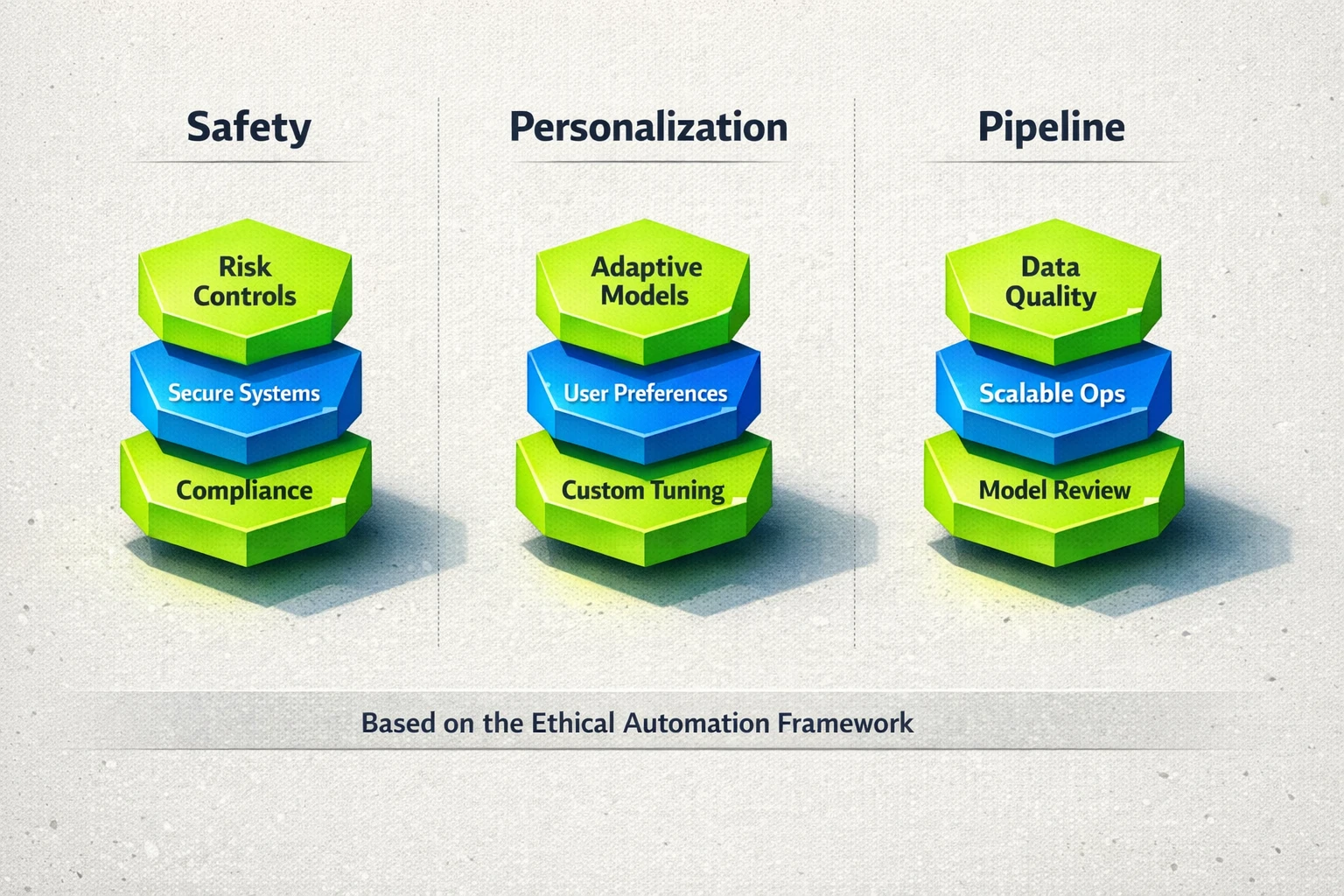
Use this checklist to make an informed decision:
- Safety: Does the tool operate from the cloud? Does it offer customizable, human-like delays and velocity settings?
- Personalization: Can it go beyond
[First Name]? Can it identify and use recent posts, shared experiences, or company news to inform outreach? - Integration: Does it connect seamlessly with your CRM and other sales tools to provide a single view of the prospect?
- Intelligence: Does it offer lead scoring or intent analysis to help you prioritize your efforts on the most engaged prospects?
Your 90-Day Plan to an Accelerated Pipeline
Transitioning to an ethical automation strategy is a process, not an event. The number of customer interactions automated by AI agents is set to grow tenfold by 2027 [6]. Starting now gives you a significant competitive advantage.
Here is a simple plan to get started:
- Month 1: Protect & Personalize. Audit your current activities. Establish a safe operational baseline. Implement an AI system to begin identifying deep personalization points for your top 25 target accounts.
- Month 2: Engage & Nurture. Launch your first ethically automated engagement campaigns. Focus on starting conversations, not booking meetings. Implement a smart follow-up sequence for prospects who show interest.
- Month 3: Analyze & Optimize. Review your results. Which messages are getting the best responses? Which personalization points are most effective? Use this data to refine your approach and scale your successes.
The future of B2B sales belongs to the Augmented Seller who combines human expertise with intelligent automation. Stop thinking about AI as a shortcut for outreach. Start using it as a catalyst for building real relationships and a stronger sales pipeline.
Frequently Asked Questions
Will using AI automation get my LinkedIn account banned?
Using aggressive, low-quality tools that violate LinkedIn's terms of service carries a high risk. Ethical automation prioritizes safety by using cloud-based systems, mimicking human behavior with randomized delays, and staying within safe daily activity limits. The focus is on quality over quantity, which significantly reduces risk.
How is this different from just sending spammy connection requests?
The difference is strategy. Spam is about volume. It uses generic templates to blast as many people as possible. Ethical automation is about relevance. It uses AI to find the right people and the right reasons to connect, leading with value and authentic personalization to start genuine conversations.
Can AI really replicate my personal voice and expertise?
AI is an amplifier, not a replacement. It cannot replicate your unique expertise. However, it can help you scale your voice. You provide the strategic direction and core insights. The AI system handles the heavy lifting of research, identifying engagement opportunities, and drafting personalized messages for your review and approval.
How do I measure the actual ROI of these activities?
You measure ROI by tracking pipeline metrics, not vanity metrics. Connect your LinkedIn activities to your CRM. Track how many conversations are generated, how many of those conversations turn into qualified sales opportunities, and the value of the deals that close as a result. This provides a direct line from activity to revenue.
Sources:
- Kondo - Data on revenue growth for sales teams using AI.
- SERPsculpt - Statistics on B2B AI adoption rates, revenue increases, and lead generation improvements.
- Meet Alfred - Data point on the effectiveness of personalized emails.
- Rev-Empire - Statistics on the use of AI tools for lead qualification and intent data analysis in sales organizations.
- Sopro - Insights on AI's impact on sales productivity and sales cycle duration.
- Demand Gen Report - Projections on the growth of AI-automated customer interactions.