Why "Black Box" AI Fails: A Guide to Explainable AI for Confident Decision-Making
AI Summary
This guide explores Explainable AI (XAI) as the key to overcoming the limitations of opaque black box AI systems by providing clear, human-understandable explanations. It covers XAI methods like LIME and SHAP, defines related concepts, and offers a practical framework for choosing the right approach. It emphasizes strategic business benefits such as improved decision-making, regulatory compliance, and stakeholder trust.
Bottom Line:
Adopting XAI transforms AI from an unclear risk into a transparent asset, enabling confident, informed decisions and stronger trust in AI-driven outcomes.
What You'll Learn:
- How to distinguish between transparency, interpretability, and explainability in AI.
- Practical comparisons of LIME and SHAP methods for different business needs.
- Four essential principles for trustworthy XAI to build accountable AI systems.
Best For:
Business leaders and data professionals evaluating AI solutions who need to ensure transparency and compliance while maximizing AI's value.
Artificial intelligence is no longer a distant concept. It's embedded in the tools we use to approve loans, diagnose diseases, and personalize customer experiences. Yet, a fundamental paradox remains. The more powerful these AI systems become, the less we often understand how they arrive at their conclusions. This opacity creates risk, erodes trust, and is a key reason why many AI projects fail to deliver on their promise.
When a model denies a loan application or flags a transaction as fraudulent, stakeholders need to know why. Without a clear explanation, you are left with a "black box," a system that produces outputs without revealing its internal logic. This is where Explainable AI (XAI) becomes essential.
XAI is a set of processes and methods that allows human users to comprehend and trust the results and output created by machine learning algorithms. It is the critical bridge between complex computation and confident human decision-making. The market reflects this urgency. Valued at nearly $8 billion in 2024, the global XAI market is projected to skyrocket to over $21 billion by 2030, growing at a rapid 18% compound annual growth rate. Businesses are no longer asking if they need transparency, but how to achieve it.
The Language of Trust: Distinguishing XAI, Interpretability, and Transparency
As you evaluate AI solutions, you will encounter several related terms. Understanding their distinctions is crucial for making an informed choice.
- Transparency refers to having access to all the components of a model, including its code, data, and algorithms. A transparent model is not necessarily an understandable one. You can see all the parts of a jet engine, but that does not mean you understand how it generates thrust.
- Interpretability is the degree to which a human can consistently predict the model's result. This is often associated with simpler models like linear regression or decision trees, where the cause and effect relationship is straightforward. These are sometimes called "glass box" models.
- Explainability, on the other hand, is the ability to describe why a model made a specific decision in human terms. This is particularly vital for complex, high-performing "black box" models like deep neural networks. Explainability does not require you to understand the entire model's mechanics, but it gives you a clear rationale for a single outcome.
Essentially, you build an interpretable model from the ground up for simplicity. You apply explainability techniques to a complex model after the fact to understand its behavior.
Choosing Your Lens: A Practical Comparison of XAI Methods
For complex models where high performance is non-negotiable, post-hoc explanation methods are the industry standard. Two of the most prominent techniques are LIME and SHAP. Choosing the right one depends on your specific needs for speed, depth, and scope.
LIME: The Local Investigator
LIME, or Local Interpretable Model-agnostic Explanations, works by creating a simpler, interpretable model around a single prediction. Imagine asking the complex AI, "Why did you make this one specific decision?" LIME answers by testing slight variations of the input data to see which features have the biggest impact on that particular outcome.
- Strengths: LIME is model-agnostic, meaning it can be applied to any black box model. It is also relatively fast for generating explanations for individual predictions.
- Weaknesses: Its explanations are only locally faithful. They explain one decision well but do not represent the model's overall behavior. It can also be unstable if the input data is perturbed incorrectly.
SHAP: The Game Theorist
SHAP, or SHapley Additive exPlanations, takes a more comprehensive approach rooted in cooperative game theory. It calculates the contribution of each feature to a prediction, ensuring a fair and accurate distribution of influence. SHAP can provide both local explanations for individual decisions and global explanations that summarize the entire model's behavior.
- Strengths: SHAP provides a solid theoretical foundation, delivering both local and global insights with guaranteed consistency. It excels at showing not just which features were important, but how they pushed a prediction higher or lower.
- Weaknesses: The primary drawback of SHAP is its computational intensity. Calculating Shapley values for large datasets and complex models can be time-consuming and require significant resources.
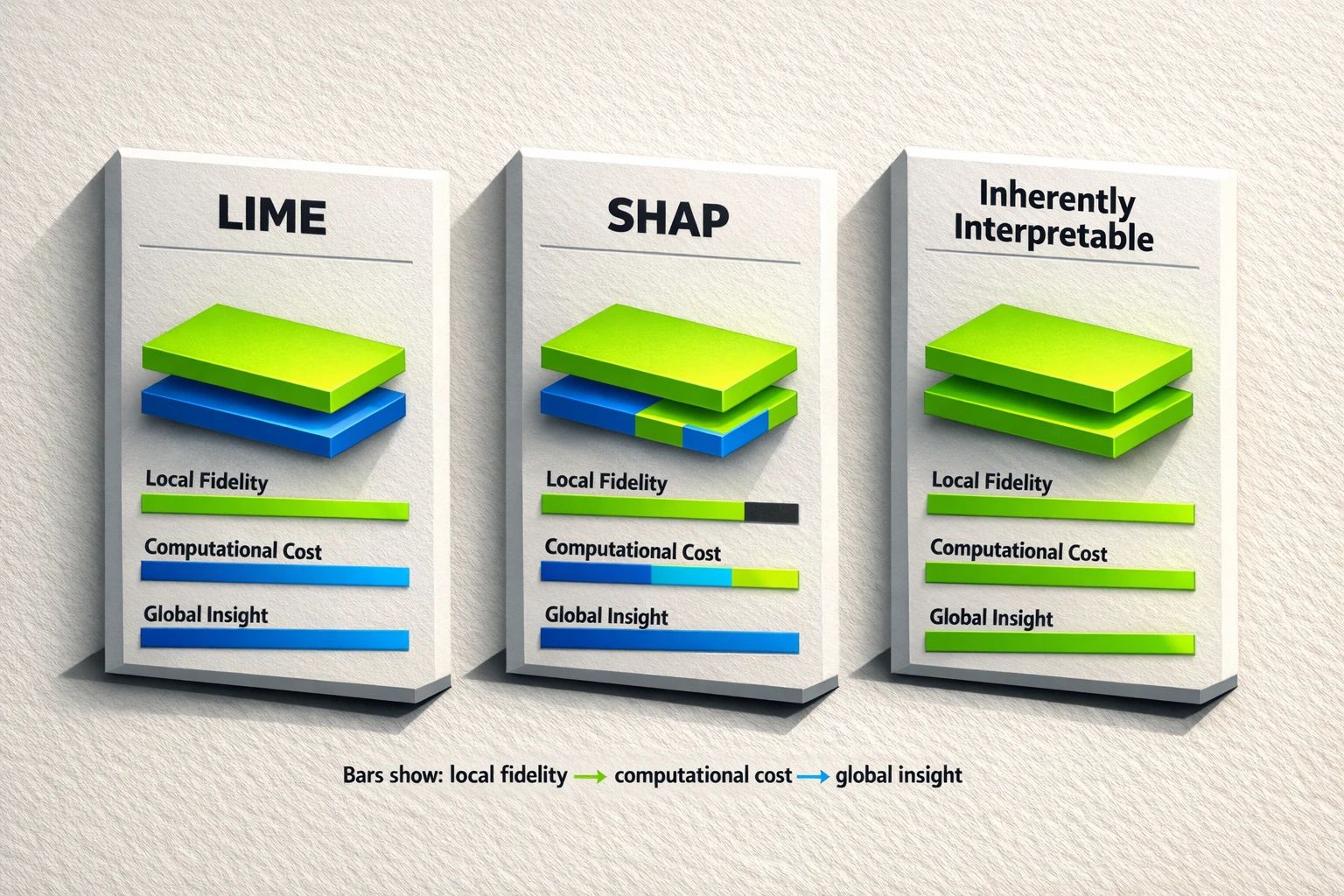
Compare LIME, SHAP, and inherently interpretable models at a glance—trade-offs in fidelity, compute, and global insight help teams pick the right XAI approach.
Making the Right Choice: A Decision Framework
Your choice of XAI technique is a strategic one.
- For simple tasks where interpretability is paramount, an inherently interpretable model may be sufficient.
- When you need fast, on-the-spot explanations for individual decisions from a complex model, LIME is a strong candidate.
- For a deep, robust understanding of both individual predictions and overall model behavior, SHAP is the gold standard, provided you can accommodate its computational demands.
From Insight to Impact: The Business Case for XAI
Implementing XAI is not just a technical exercise. It is a strategic investment that delivers tangible business value across the organization. The "solutions segment" of the market already accounts for over 81% of revenue, demonstrating a clear demand for actionable tools that build trust and meet regulatory needs.
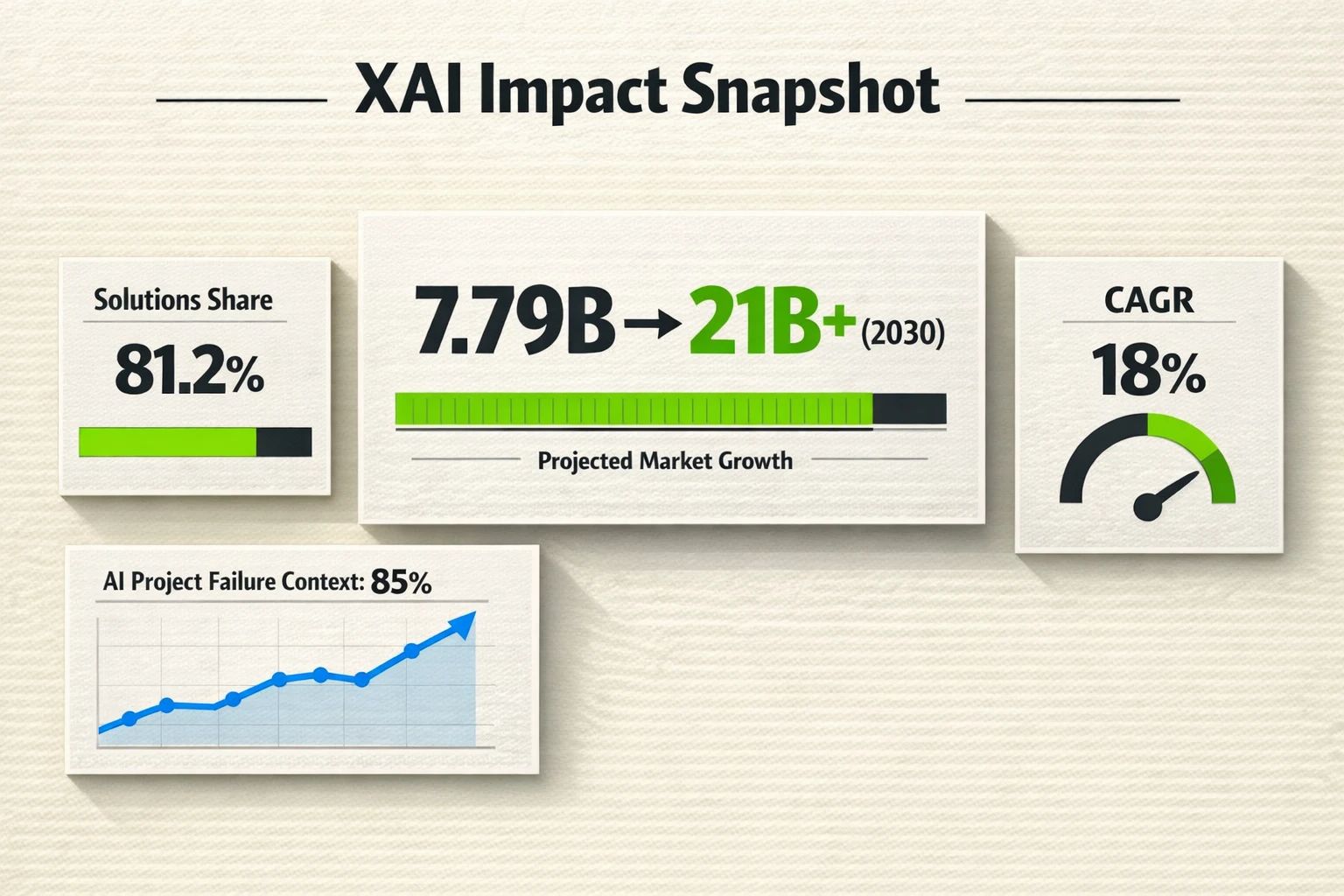
A compact XAI metrics dashboard that quantifies market growth, solution dominance, and project risk—making the case for transparent AI in decision-making.
Key benefits include:
- Enhanced Decision-Making: XAI moves you from blindly trusting an output to understanding the factors that drove it, enabling more informed and confident actions.
- Faster AI Optimization: By revealing why a model is making mistakes, developers can debug and retrain it more efficiently, improving performance and accuracy.
- Building Stakeholder Trust: Transparency is fundamental for user adoption. Explanations build confidence among customers, employees, and executives, which is particularly important in the context of creating authority and trust in the AI era.
- Navigating Regulatory Minefields: Regulations like the EU's GDPR grant consumers a "right to explanation" for automated decisions. XAI provides the mechanism to fulfill these requirements and avoid costly penalties.
Beyond the Basics: The Four Pillars of a Truly Trustworthy AI
Providing an explanation is only the first step. To build a truly robust and trustworthy AI system, your XAI strategy must incorporate four key principles defined by the U.S. National Institute of Standards and Technology (NIST). Many organizations overlook these nuances, but they are what separate superficial explainability from genuine accountability.
- Explanation: The system must deliver evidence or reasons for its outputs. This is the baseline requirement.
- Meaningfulness: The explanation must be understandable to the person receiving it. A long list of feature weights is useless to a business user. The explanation must be tailored to their context and expertise. A system with a deep semantic understanding of business content can provide explanations that resonate with non-technical stakeholders.
- Explanation Accuracy: The explanation must accurately reflect the model's underlying process for generating the output. A misleading or inaccurate explanation is worse than no explanation at all.
- Knowledge Limits: The system must be able to state when it is operating with low confidence or outside its designed parameters. A trustworthy AI knows what it does not know.
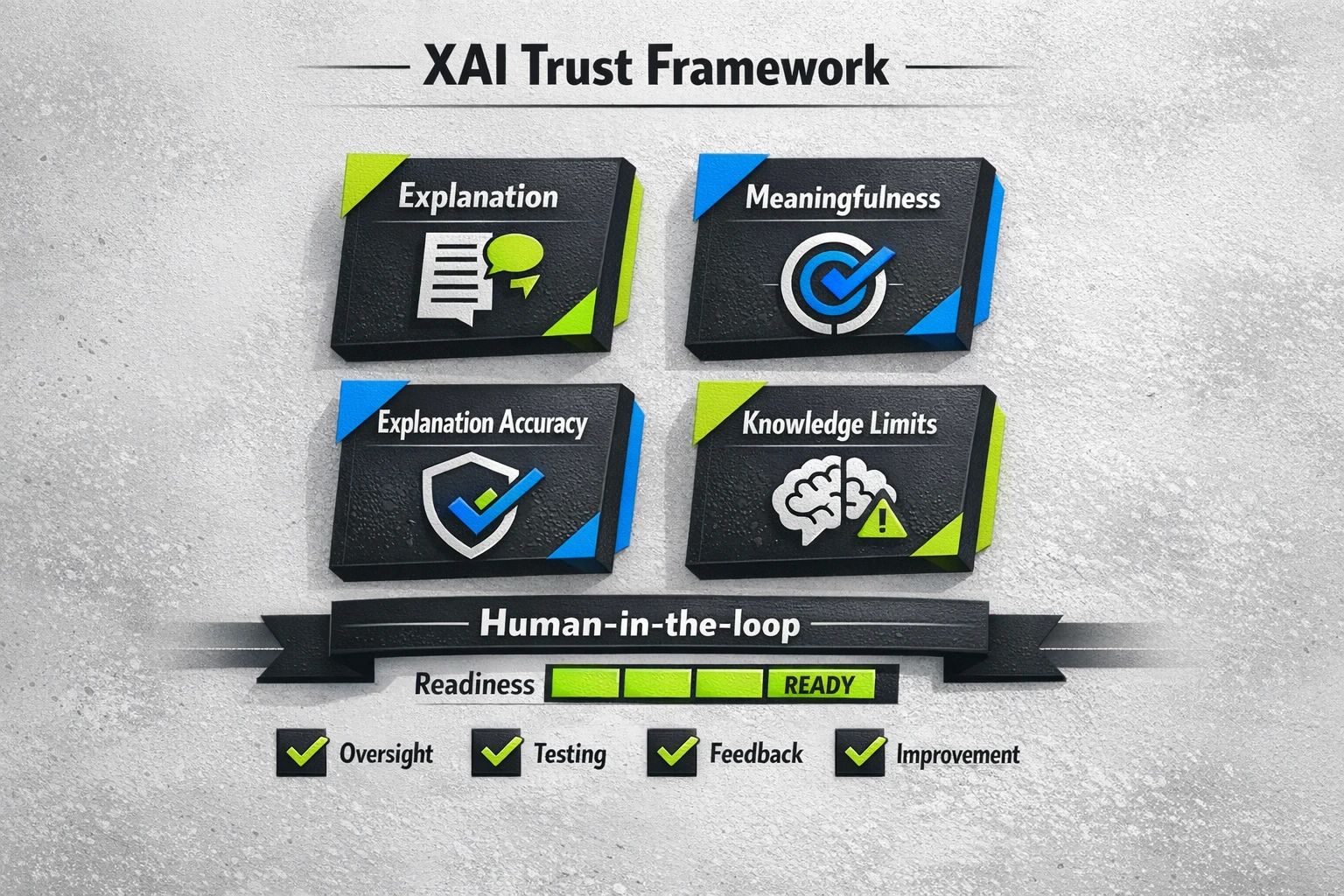
A trust-first XAI framework that maps NIST principles to governance readiness, highlighting where systems must declare limits and ensure meaningful explanations.
The Future of Transparency: Emerging Trends in XAI
The field of Explainable AI is evolving rapidly. As you plan your strategy, it is important to consider several emerging trends that will shape the future of transparent AI.
- Responsible AI Ops: This involves integrating XAI and ethical governance directly into the machine learning lifecycle. Instead of being an afterthought, transparency and fairness are monitored continuously from development to deployment.
- Explainability for LLMs: Large Language Models (LLMs) and other generative AI present unique challenges for explainability. New techniques are emerging to trace how an output was generated and to identify potential data privacy leaks or hallucinations.
- Human-in-the-Loop Governance: Rather than fully automating decisions, organizations are using XAI to empower human experts. The AI provides a recommendation along with a clear explanation, allowing a domain expert to make the final, informed judgment.
Frequently Asked Questions about Implementing XAI
What's the difference between explainability and interpretability?
Interpretability is about understanding how a model works as a whole, which is typically possible with simpler "glass box" models. Explainability is about understanding why a complex "black box" model made a specific decision, without needing to understand all its internal mechanics.
Does implementing XAI hurt my model's performance?
This is a common concern known as the accuracy-explainability trade-off. Simpler, more interpretable models are sometimes less accurate than complex ones. However, post-hoc XAI techniques like LIME and SHAP are designed to explain complex models without sacrificing their performance. You get the benefit of accuracy and the insight of an explanation.
How do I choose the right XAI technique for my business?
The choice depends on your model's complexity, your need for local versus global explanations, and your computational resources. For quick, individual explanations, LIME is a good start. For comprehensive, theoretically sound insights, SHAP is the industry standard.
Can XAI help us comply with regulations like GDPR?
Yes. Regulations like GDPR's "right to explanation" require businesses to provide meaningful information about the logic involved in automated decisions. XAI methods are the primary tools used to generate these explanations and demonstrate compliance to regulators.
Where do we even start with building an XAI strategy?
Start by identifying high-stakes decisions currently being made or supported by AI. Form a cross-functional governance team that includes business leaders, data scientists, and legal experts. Define who needs explanations and what kind of information would be meaningful to them. Finally, choose the tools and techniques that best fit your specific use cases and align with the four NIST principles of trustworthy AI.
Explainable AI is more than a feature. It is a foundational requirement for any business looking to scale its AI initiatives responsibly and effectively. By moving from opaque black boxes to transparent, understandable systems, you can mitigate risk, build lasting trust, and empower your team to make decisions with confidence.
Sources:
- Grand View Research - Provided market size, growth projections, and revenue share statistics for the XAI market.
- IBM - Offered authoritative definitions and business-centric use cases for XAI in key industries.
- NIST Internal Report 8312 - The primary source for the four principles of trustworthy AI: explanation, meaningfulness, explanation accuracy, and knowledge limits.
- DataCamp - Provided practical, tutorial-style explanations of XAI methods like LIME and SHAP.
- Qlik - Framed XAI from an enterprise perspective, focusing on governance, best practices, and decision-making.
- ScienceDirect - Offered a deep academic review of XAI methodologies and the broader context of Trustworthy AI.