How Does Automation Affect the Workforce?
AI Summary
Understanding how automation affects the workforce reveals a difficult truth: removing repetitive work can increase operational leverage while quietly weakening identity, trust, and retention. The solution is not vague reassurance, but a clear plan for how roles, metrics, and expertise will evolve.
- Why shifting from original creation to machine-output review can trigger identity erosion and algorithmic anxiety.
- How breach cascades and staggered morale decline expose the limits of surface-level engagement checks.
- The role-transition brief, human-in-the-loop judgment, and quality metrics that convert saved capacity into meaningful work.
For lean teams automating repeatable workflows while trying to preserve morale, trust, and professional pride.
When repeatable processes create operational overload, the instinct is to buy back time with software. Yet introducing automation to an existing workforce triggers a reaction that catches leadership off guard. The team does not celebrate the relief from repetitive tasks. Instead, morale stiffens, skepticism rises, and the people who built those processes start questioning their place in the company.
The decision on how to manage this transition does not hang on reassuring your team that no one is getting fired. It hangs on recognizing that removing repetitive execution strips away how loyal employees measure their daily worth, and weighing that identity loss against the transparent operational plan and redefined human-in-the-loop expertise needed to replace it. Get this weighing wrong, and quiet resistance will stall your speed-to-value before ROI ever materializes.
Why Operational Leverage Triggers an Identity Crisis
In a tight-knit operation, manual effort is personal. The employee who owns a repeatable process end-to-end often equates the sheer volume of their daily grind with their loyalty and value to the business. When you introduce a system to take over that repetitive work, you think you are curing operational overload. The employee feels you are erasing the proof of their contribution.

Worry about future workplace AI use outweighs optimism about long-term job opportunities.
It is easy to misdiagnose this friction as a simple fear of layoffs, so management responds with blanket promises that jobs are safe. Those promises miss the mark because immediate termination is not what keeps people up at night. In a Pew Research Center survey of 5,273 employed U.S. adults, about half of U.S. workers (52%) say they feel worried about how AI may be used in the workplace in the future and 33% feel overwhelmed, while only 6% say workplace AI use will lead to more job opportunities for them in the long run and 32% say it will lead to fewer opportunities [1]. The anxiety is about trajectory and ceiling, not just survival through the quarter.
When people see their core tasks handed to software without a clear picture of what comes next, they see a shrinking horizon. Protecting morale starts with addressing their future opportunity inside the business rather than just defending their current seat.
How Shifting the Task Frontier Erodes Professional Identity
Software does not replace an entire role at once; it hollows out specific tasks within a workflow. When an employee used to build a deliverable from scratch, they felt the pride of craftsmanship. When software generates the first draft or processes the routine entries, the human role shifts from original builder to someone who audits machine output. That shift feels like a demotion in status even when the paycheck stays identical.

The move from original creation to auditing machine output can erode professional identity.
Industrial psychologists Anurag Shekhar and Musawenkosi D. Saurombe define "algorithmic anxiety" as a compound syndrome encompassing seven dimensions: shattered trust and corporate betrayal, eroded identities, technostress and coerced adoption, devalued expertise, anxiety about the future, cynicism about adapting, and affirming human values [2]. In their analysis of 1,454 Reddit narratives from workers affected by AI-driven job displacement, they note that when AI tools shift work from original creation to curating, refining, and catching AI's mistakes, employees experience identity erosion even without losing their jobs [2].
Cleaning up after an algorithm does not feel like high-leverage work unless leadership explicitly changes how performance and status are recognized. If you still praise the team for raw volume rather than the complexity of the exceptions they catch, your best builders will feel reduced to janitors of a machine process.
How Staggered Technostress Breaks the Psychological Contract
The most dangerous trap during an operational transition is looking at surface morale right after launch and assuming the team is fine. People rarely quit the week a new workflow arrives. Instead, the unwritten psychological contract between the company and the employee erodes in slow motion, especially if the rollout was framed deceptively.
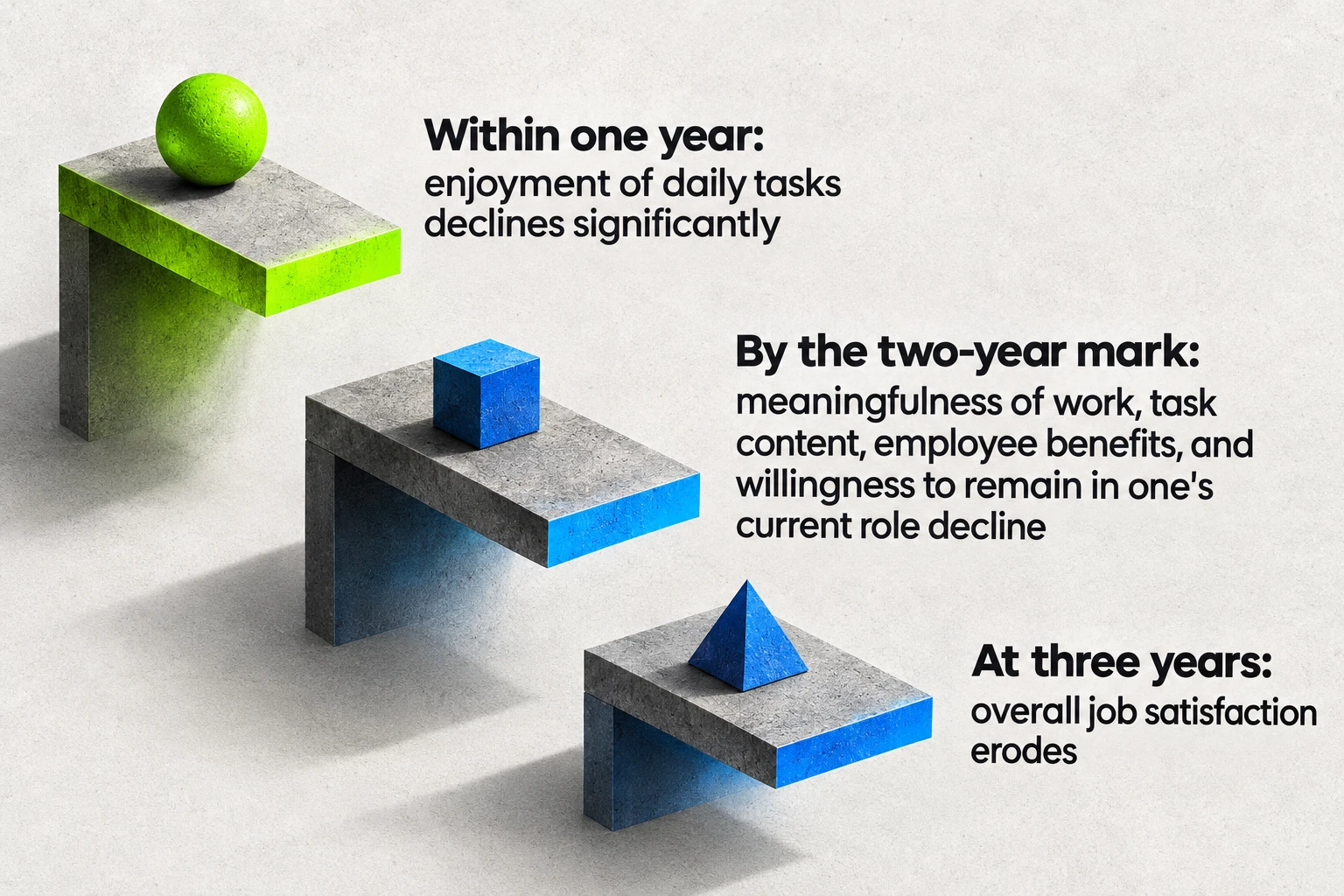
Task enjoyment, role willingness, and overall job satisfaction erode on staggered timelines.
Telling the team that a new tool is "just a little helper" while secretly expecting them to triple their output or phase out their own seats creates a deep sense of betrayal. Shekhar and Saurombe report that AI-mediated psychological contract breaches unfold gradually through incremental automation as "breach cascades" where workers particularly resent deception, specifically being told AI will "augment" work while planning replacement, and argue that transparent communication about automation plans generates less betrayal than discovered deception [2].
Even when no replacement is planned, the internal wear and tear follows a delayed schedule that standard pulse checks miss. Econometric research by Changkeun Lee, Olivia Hye Kim, and Hwanoong Lee on South Korean workers in the Korean Labor and Income Panel Study and Community Health Survey finds that while workers' broad job-satisfaction ratings initially remain largely intact after increased robot deployment, underlying morale erodes in a staggered sequence: enjoyment of daily tasks declines significantly within one year, satisfaction with the meaningfulness of work, task content, employee benefits, and willingness to remain in one's current role decline by the two-year mark, and overall job satisfaction erodes at three years [3].
| Dimension | Deceptive Efficiency Framing (Breach Cascade) | Transparent Operational Leverage Framing |
| Core Message | Frames software as a minor assistant while hiding capacity or headcount targets. | States openly which repetitive tasks will be automated and why operational overload must drop. |
| Role Impact | Leaves employees to discover on their own that their work has shifted to catching errors. | Acknowledges the shift from manual builder to human-in-the-loop quality owner upfront. |
| Morale Trajectory | Surface compliance early on, followed by declining task enjoyment and willingness to stay. | Early discomfort resolved through clear rules on how saved hours are reinvested. |
| Trust Outcome | Shattered trust and cynical adaptation as incremental changes feel like covert replacement. | Preserved psychological contract because expectations match daily reality. |
Waiting for overall job satisfaction to drop means intervening after task enjoyment and retention willingness have already decayed. You have to audit how people feel about the actual content of their daily tasks long before resentment sets in.
Closing the Leadership Strategy Gap Without False Promises
When employees resist new systems, leadership often blames a lack of technical curiosity. In reality, resistance is a rational response to a vacuum of strategy. Handing people logins to new tools without explaining how saved capacity will be used forces them to fill in the blanks with their worst assumptions.

Reported AI integration is more common than communication of a clear organizational plan.
Gallup data on U.S. employees shows that while 44% of employees say their organization has begun integrating AI, only 22% say their organization has communicated a clear plan or strategy for doing so, and even among those who report using AI, only 16% strongly agree that the AI tools provided by their organization are useful for their work [4]. That communication vacuum is the real bottleneck to speed-to-value. When U.S. employees strongly agree that their leadership has communicated a clear plan for integrating AI, they are three times as likely to feel very prepared to work with AI and 2.6 times as likely to feel comfortable using AI in their role [4].
A clear plan is not a pep talk. It is an operational document that answers three questions for every affected role:
- Which exact repetitive tasks are leaving your plate? Name the specific bottlenecks being automated so the boundary is visible.
- Where does the reclaimed capacity go? Define the higher-value work, whether that is deeper client consultation, exception handling, or process design, that will absorb the saved hours.
- How will your performance be measured now? Retire old volume metrics that rewarded manual busywork and replace them with quality and outcome metrics.
Redefining Human Value Around Judgment and Expertise
To rebuild professional pride after repetitive tasks are removed, you must show the team why the remaining human work is more valuable, not less. Software is fast at pattern generation, but it lacks context, accountability, and domain judgment. If you treat automated output as finished work, quality degrades and clients notice.
Real ROI comes from pairing machine speed with human-in-the-loop verification. MIT FutureTech researchers Guy Ben-Ishai and Neil C. Thompson argue in a Brookings Institution report that the central workforce question is not simply whether AI creates or destroys jobs, but how it changes the value of human expertise, and note that successful adoption requires domain-specific, hands-on training so workers learn not only how to use AI tools, but when to trust them, how to exercise judgment, and where they are likely to fail [5].
When you train your team to spot where automated systems fail, you elevate them from routine operators to domain experts. Curating output and handling complex exceptions ceases to feel like cleanup duty when it is recognized and compensated as the primary safeguard of company standards.
Frequently Asked Questions
Do most employees expect automation to eliminate their jobs in the near term?
No, only 15% of U.S. employees surveyed by Gallup say it is very or somewhat likely that automation, robots, or AI will eliminate their job within the next five years, unchanged from 2023 and 2024 measures [4]. Instead of immediate job loss, workers worry about shrinking long-term career opportunities and losing the daily meaning of their craft. Leaders should focus their conversations on long-term role growth inside the company rather than just repeating that jobs are safe today.
How quickly will automation reduce the share of tasks performed by humans alone?
Employers surveyed in the World Economic Forum's Future of Jobs Survey estimate that in 2025, 47% of work tasks are performed mainly by humans alone, 22% mainly by technology, and 30% by a combination of both, and expect these proportions to be nearly evenly split by 2030 [6]. Of the nearly 15 percentage point reduction in the proportion of total work tasks delivered by humans in 2030 versus 2025, nearly 82% is attributable to advancing automation while 19% is projected to derive from expanded human-machine collaboration [6]. Because standalone human task share is expected to shrink, you should proactively map out which collaborative and oversight responsibilities your team will own next.
Does using AI tools improve work quality as much as work speed?
No, among U.S. workers who have used AI chatbots for work, 40% say these tools have been extremely or very helpful in allowing them to do things more quickly, while a smaller share of 29% say they have been equally helpful in improving the quality of their work [7]. Because speed gains outpace quality gains, human-in-the-loop review remains essential to protect your standards. Make quality ownership and exception judgment the centerpiece of how you evaluate and reward your team.
Your Next Step Before Automating Another Process
Before you automate another repeatable workflow, run a 30-minute task-and-value audit with the person who currently owns that process. Ask them to list which parts of the workflow drain their energy and which parts give them a sense of professional pride, then write a one-page role transition brief together that specifies where their saved hours will be reinvested and which quality standards will require their human-in-the-loop judgment. Putting that written plan in place before changing the workflow closes the leadership strategy gap and turns potential resistance into shared operational leverage.
Sources:
- Pew Research Center - U.S. worker survey on workplace AI worries and career opportunities
- Frontiers in Psychology - Study on algorithmic anxiety, identity erosion, and psychological contract breaches
- Humanities and Social Sciences Communications - Longitudinal econometric study on workplace automation and staggered morale decline
- Gallup - U.S. workforce data on AI integration, leadership communication, and preparedness
- Brookings Institution - Economic report on AI adoption, human expertise value, and judgment training
- World Economic Forum - Global employer survey on human, technology, and collaborative task shares
- Pew Research Center - U.S. worker survey data comparing AI speed gains against work quality