Why Your LinkedIn Content Died (And How to Fix It)
AI Summary
LinkedIn's 360 Brew algorithm demands an authority-first B2B content strategy, revealing that volume alone no longer wins trust or visibility. This shift requires a focused approach with a 70/15/15 content mix balancing expertise, personal insight, and engagement.
- How 360 Brew analyzes your professional identity before distributing content.
- The importance of the 70% authority content for earning saves and trust signals.
- Strategies for boosting relevance through authentic personal insights and engaging conversations.
Ideal for B2B marketers frustrated by declining LinkedIn engagement who need a structured way to rebuild genuine authority.
The cause of this shift is an AI-driven system called 360 Brew. It has fundamentally rewired how content is judged, distributed, and valued. The core argument of this guide is simple: to win on LinkedIn in 2026, you must abandon random acts of content and adopt an authority-first strategy. This means using a deliberate content mix that proves your expertise, not just your ability to post.
.jpeg)
A high-level map of what 360Brew optimizes for: professional relevance via semantics, quality, and real interaction—useful context before changing your content mix.
What is LinkedIn 360 Brew and Why Does It Hate Your Content?
You can stop blaming yourself for low engagement. The system itself has changed. LinkedIn didn't just tweak its algorithm; it threw the old one out entirely. In its place, the platform launched 360 Brew, a new AI-driven model that redefines professional relevance and decides which posts gain traction [1].
This new system doesn’t just look at your posts. It looks at you. It analyzes your entire professional identity to understand your expertise before your content ever hits the feed. This is the most crucial shift to understand. Before your content is even considered for distribution, 360 Brew meticulously analyzes your profile, paying close attention to your headline and ‘About’ section [2]. The engine uses this information to categorize your expertise and determine what topics you should be discussing.
If you've stared at a LinkedIn post with flatlining views and wondered what went wrong, you're not alone. The B2B content game on LinkedIn has changed, and the old playbook is officially obsolete. It is not about posting more frequently or chasing viral trends. The platform has returned to its professional roots, and your content strategy needs to catch up.
.jpeg)
360Brew evaluates your professional identity first. Clear profile positioning (and 2–3 consistent topics) helps the system categorize expertise before posts are distributed.
If you claim to be a cybersecurity expert but post about productivity hacks, the system sees a mismatch. This is why content that performed well a year ago now falls flat. 360 Brew rewards focus and penalizes inconsistency. It's looking for genuine authority, not just a high volume of content.
Remapping Your Strategy: The 70/15/15 Authority Mix for 360 Brew
The most effective way to signal authority to the new algorithm is through a structured content plan. Randomly posting tips, articles, and company news will not work anymore. The 70/15/15 mix is a simple but powerful framework for organizing your content to systematically build your reputation as an expert.
70% Authority Content: The Engine of Your Expertise
The vast majority of your content, 70%, should be dedicated to teaching your audience something valuable. This is where you give away your best insights for free. Think of formats that have a long shelf life, like in-depth guides, original analysis, data-driven carousels, or frameworks that solve a real problem for your target customer.
This type of content directly targets a high-value signal for 360 Brew: the "save." When someone saves your post, they are telling the algorithm that your content is worth revisiting, which is a much stronger signal than a simple like. When you provide genuine expertise, you earn the trust required for a reader to take that next step. For any small business, building this trust is a core component of succeeding in the E-E-A-T in the AI era. When people save your post, LinkedIn interprets it as content worth revisiting [1].
15% Personal Insight: The Face Behind the Authority
This 15% is where you humanize your expertise. It is not about sharing personal vacation photos or generic motivational quotes. It is about sharing professionally relevant stories, lessons from failures, or a contrarian perspective on an industry trend. This content proves there is a real, thinking person behind the brand.
Authenticity is also a powerful defense against a key penalty from 360 Brew. The algorithm now actively detects and downgrades AI-patterned writing [1]. If your content reads like a template, its visibility will suffer. Sharing a real story from your own experience is the fastest way to signal that your insights are earned, not generated.
15% Conversational Content: The Spark for Real Engagement
The final 15% is designed to start conversations. These posts are often shorter and pose a direct question, ask for feedback on an idea, or address a common pain point. The goal is not to sell but to engage in a meaningful way.
This is critical because the new algorithm values thoughtful discussion far more than shallow reactions. One of the biggest changes with the 360Brew algorithm is its emphasis on quality engagement. A post that generates a handful of detailed, multi-sentence comments will outperform one with hundreds of likes. In fact, under the new system, your comments on other people's posts are now more valuable than your own posts for building authority [3].
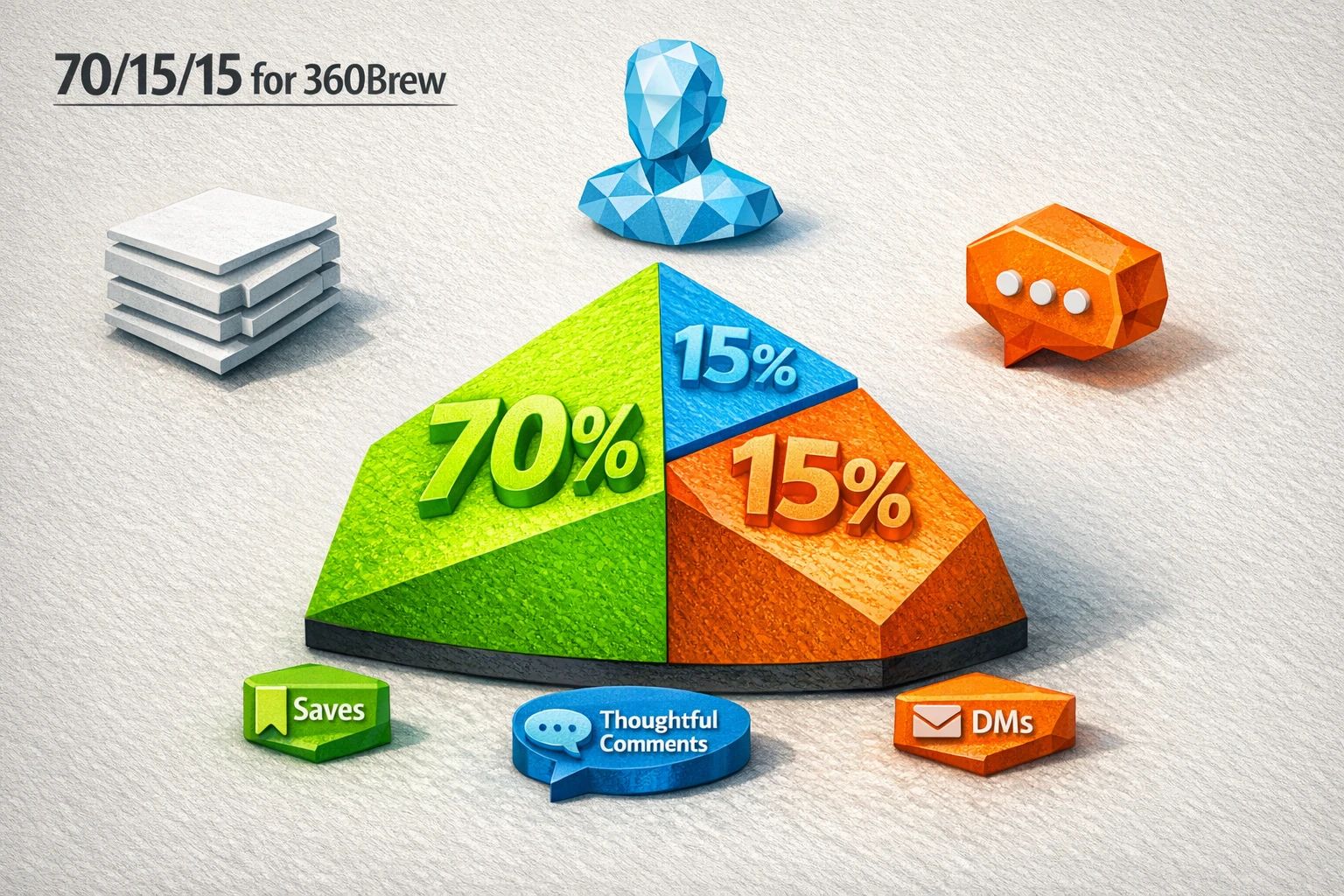
The 70/15/15 mix becomes actionable when each slice maps to formats and signals: authority content earns saves and deep comments; personal insight reinforces identity; conversational posts spark DMs.
Putting the 360 Brew-Optimized Mix into Action
A framework is only useful if you apply it. Here are the practical steps to align your LinkedIn presence with the realities of 360 Brew.
First, Fix Your Profile: Your Content's Foundation
Your profile is now the starting point for all content distribution. Before you post anything else, ensure your headline and "About" section clearly state who you help and what problems you solve. More importantly, stick to a narrow focus. Individuals and companies that focus on two or three clear topics of expertise see more stable and targeted reach [4]. Pick your lanes and stay in them.
Write for the "Lost in Distance Effect"
You have less than three seconds to capture attention. 360 Brew formalizes this with a concept LinkedIn engineers call the "lost in distance effect," where points made later in a post carry less weight than those in the opening lines [1]. Your first sentence is your entire pitch. It must clearly state the value or provoke curiosity. Stop burying the lead.
Master the Comment Section: Your New Content Stage
Your expertise is now demonstrated as much by your contributions to other conversations as by your own posts. Spending 20 minutes a day leaving insightful, value-adding comments on posts from leaders in your niche is one of the highest ROI activities on LinkedIn. This signals to 360 Brew that you are an active expert in your field. Furthermore, activating your internal team can provide a powerful initial boost. Early, thoughtful comments from internal experts amplify a post's reach and credibility [4].
How to Know if It's Working: Measuring What Matters
Stop obsessing over vanity metrics like views and likes. Under 360 Brew, they are misleading indicators of success. Instead, track metrics that signal genuine authority and intent.
- Saves: How many people find your content valuable enough to keep?
- Inbound DMs: Are people reaching out to you with specific questions related to your content?
- Quality of Comments: Are you sparking real discussion or just getting one-word replies?
- Profile Views: Are the right people (potential clients, partners) finding their way to your profile after seeing your content?
Use LinkedIn's native Page Analytics to see which topics and formats are earning the most saves and comments, then double down on what works. This creates a feedback loop that continually refines your authority-first strategy.
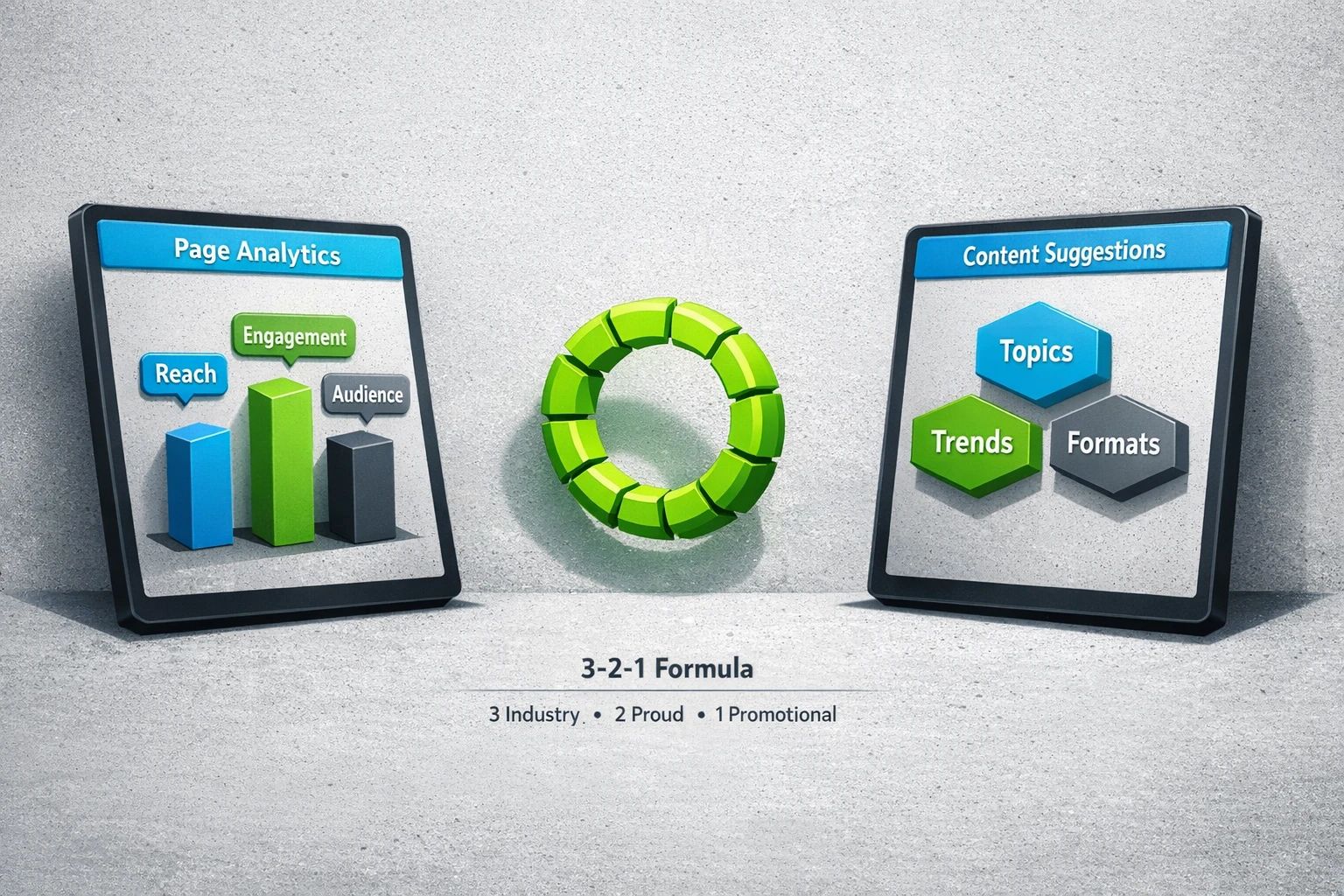
Use LinkedIn’s native tools to spot what resonates, then adjust topics and formats. The official 3-2-1 formula offers a baseline mix you can compare against your authority-first plan.
The era of gaming the LinkedIn feed is over. Success is no longer about finding loopholes. It is about building a library of genuinely helpful content that establishes you as a credible expert. By implementing the 70/15/15 mix, you align your strategy with what 360 Brew was built to reward: real authority.
Your next step is simple. Go back and look at your last ten LinkedIn posts. Categorize each one as Authority, Personal Insight, or Conversational. The gaps in your strategy will become immediately clear. For more ideas on how to build your content engine, you can explore other guides on Strategic Intelligence for the AI Economy.
Frequently Asked Questions
What is the 70/15/15 content rule for LinkedIn?
The 70/15/15 rule is a content strategy framework designed to build authority. It recommends that 70% of your content should be educational and value-driven (Authority), 15% should be professionally relevant personal stories or insights (Personal), and 15% should be designed to spark direct conversation and engagement (Conversational).
How is 360 Brew different from the old LinkedIn algorithm?
The old algorithm heavily weighted surface-level engagement signals like likes and total comments. 360 Brew is a more sophisticated AI that prioritizes deeper signals of quality. It analyzes your entire profile for expertise, values content that gets saved, rewards thoughtful comments over simple reactions, and penalizes generic, AI-patterned writing.
Does this mean I should post less on LinkedIn?
Not necessarily, but it does mean you should prioritize quality over quantity. One well-researched, high-value "Authority" post per week that earns saves and sparks discussion is more valuable than five low-effort posts that get ignored. A consistent, structured plan is more important than a high daily frequency.
Can I still use AI to write my LinkedIn posts?
Yes, but you must use it as a tool, not a template. LinkedIn's 360 Brew can detect predictable AI structures and phrasing. If you use AI for brainstorming or drafting, you must heavily edit it to add your unique voice, specific experiences, and original insights to avoid being penalized for creating generic content.
Sources:
- Melonie Dodaro via LinkedIn Pulse - An explanation of the 360 Brew algorithm's mechanics and impact on content visibility.
- EnterpriseZone.cc - Analysis of how 360 Brew evaluates user profiles before ranking content.
- Inside Hospitality Solutions - Insights on the increased value of comments over posts in the new LinkedIn algorithm.
- Project Neon - A guide outlining strategic shifts required for 360 Brew, including thematic focus.