Architecting Unassailable Authority on LinkedIn
AI Summary
Architecting unassailable authority on LinkedIn means shifting from low-engagement company page posts to a people-powered Authority Beat Framework that systematically turns your experts into market-defining voices. Instead of shouting updates into the algorithm void, you design beats, reporters, and an amplification loop that compounds reach and trust over time.
- Map 3–5 precise authority beats tied to customer problems, assign internal “beat reporters,” and reposition the company page as a validating masthead instead of a content megaphone
- Use profile clarity, active beat reporting via LinkedIn search, and high-impact formats like carousels, strong opinions, data analysis, and client stories to build personal credibility
- Close the loop with an amplification system where expert content drives profile traffic, the company page validates authority, and Premium Page features act as force multipliers, not band-aids.
For teams stuck watching flat company metrics while competitors’ leaders dominate the feed, this offers a repeatable system to own the conversations that move deals.
You post on your LinkedIn company page. You share updates, announce news, and publish articles. And almost no one sees it. The engagement is flat, the reach is minimal, and the effort feels wasted. This isn't your fault. The old playbook is broken.
Relying on a company page for organic reach in 2026 is like shouting into the wind. The algorithm has changed. Your audience is overwhelmed. The strategy of using your company page as a simple megaphone no longer works. It's time for a fundamental shift in strategy, moving from a lonely broadcast model to a dynamic, human-powered authority engine.
The Unspoken Truth: Your Company Page Is Not a Megaphone
Let’s be direct. The traditional approach to LinkedIn is a resource-draining exercise with diminishing returns. Most B2B marketing advice tells you to post consistently from your company page. This advice is now dangerously outdated.
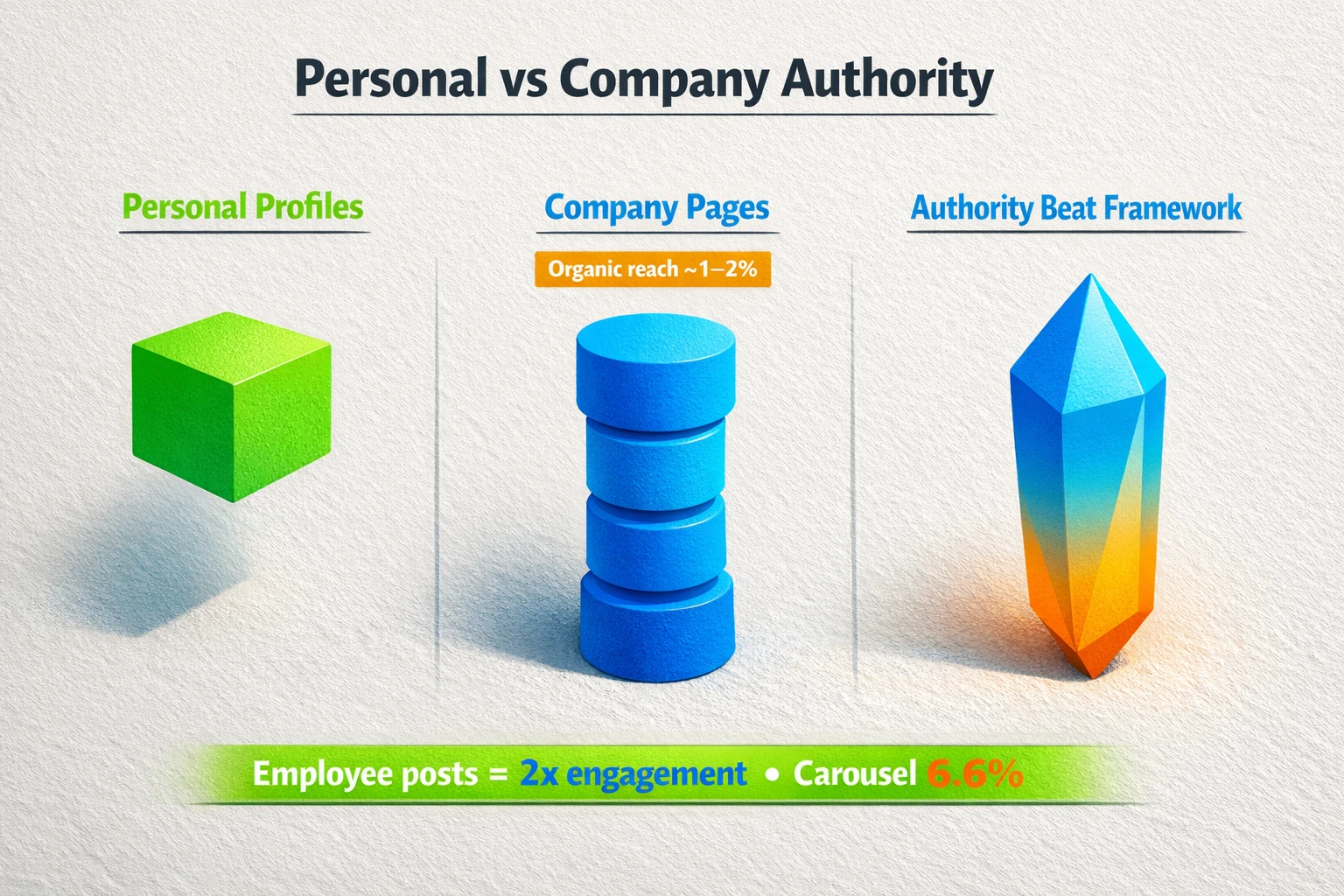
The data is clear: posts from employee profiles see twice the engagement of posts from corporate accounts [1]. While 85% of B2B marketers agree LinkedIn is their most effective channel, success is not evenly distributed [2]. It flows to individuals who build trust, not to logos that broadcast announcements. Continuing to pour resources into a company-first content strategy is a recipe for frustration and stagnation. The game has changed, and winning requires a new system.
The Shift: Build an Authority Newsroom, Not a Content Calendar
True authority is built by people. Your most valuable assets are the experts within your organization: your founders, subject matter experts, and senior leaders. Instead of a content calendar, you need an authority newsroom.
This is the Authority Beat Framework.
We borrow this concept from journalism. A "beat" is a specific area of specialization where a reporter develops deep expertise and a network of sources to become the go-to authority [3]. When news breaks on their beat, they own the story. Your company can adopt this same model. Instead of creating generic content, you identify your core "beats"—the specific market conversations you must dominate—and assign them to internal experts who become your "beat reporters."
These individuals build personal authority that, by design, establishes the company as the definitive expert in that niche. It transforms your LinkedIn presence from random acts of content into strategic territory ownership.
Part 1: Architecting Your Company's Authority Beats
The framework begins at the company level. You must define the territories you intend to own before deploying your experts. This is a strategic exercise, not a marketing one.
Identify Your Core Beats
What are the 3-5 conversations that, if you dominated them, would make your sales process exponentially easier? A beat is not your product category. It's the problem your customer has.
- Instead of "Our AI CRM," your beat is "Scaling Sales Teams Without VC."
- Instead of "Our Logistics Software," your beat is "AI in Supply Chain Resilience."
A narrower beat is better. It allows for deeper expertise and faster authority building [3].
Assign Your Beat Reporters
Identify the individuals inside your company who have credible, first-hand experience in these beats. This isn't about job titles. It's about authentic knowledge. Your Head of Product might own the "Product-Led Growth for B2B SaaS" beat, while your CEO owns the "Bootstrapping to $10M ARR" beat. Empower them with the mission to become the most trusted voice on that single topic.
The Company Page as the Masthead
Under this framework, your company page has a new, vital role. It is no longer the daily newspaper. It is the masthead, the official source of record. Its job is to validate and amplify the work of your expert reporters. It features their best content, announces major company achievements, and serves as the stable, central hub that lends institutional credibility to their individual authority.

Part 2: Mastering Your Individual Authority Beat
Once the strategy is set, execution falls to the individual beat reporters. Their mission is to build personal credibility through a systematic process of engagement and content creation.
Start with Clarity, Not Content
As practitioner Tope Olofin advises, authority doesn't start with a headline. It starts with clarity [4]. Before posting anything, each beat reporter must optimize their personal profile to reflect deep expertise in their assigned beat. Your headline, summary, and experience sections must scream "expert on this one thing."
Active Beat Reporting: Hunt for Conversations
Passive scrolling is for consumers. Beat reporters are producers. They must actively use LinkedIn's search function to find relevant conversations happening on their beat right now. Search for keywords like "scaling without VC" or "cybersecurity for finance" and filter by "Posts." The goal is to find active discussions and add value with thoughtful comments, not just "Great post!" This builds visibility and trust with the exact people you want to reach.
Create High-Impact Authority Content
When it's time to publish, focus on what works. Carousel posts and documents achieve the highest engagement rates, averaging 6.60%, which is 278% more effective than video [1]. Thought leadership content earns a 1.7x higher click-through rate and a 1.6x higher engagement rate than other post types [5].
Focus on three content types:
- Strong Opinions: Take a stand on a topic within your beat.
- Data Analysis: Interpret a trend or a new report for your audience.
- Client Stories: Share lessons learned from real-world work.
Remember, 95% of your potential buyers are not in-market to buy today [6]. Your content is not for them. It's for the 100% who need to see you as the undisputed expert, so when the time is right, you are the only one they call.

Integrating the System: The Amplification Loop
This is where the system becomes an engine. The beat reporter's consistent, high-value activity builds their personal network and authority. Their posts drive interested prospects to view their profile, which in turn leads them to the company page. The company page validates the expert's credibility by featuring their work. This creates a powerful amplification loop where individual effort builds company assets, and company assets amplify individual reach.
This entire approach is designed to master the modern platform dynamics detailed in our guide about how the LinkedIn algorithm has changed. To see how your current efforts stack up against this framework, take our free LinkedIn Assessment.
MOFU Deep Dive: Is a Premium Company Page Worth It?
With a functioning Authority Beat Framework, the question of investing in a Premium Company Page becomes much clearer. Features like a content assistant, custom call-to-action buttons, and enhanced analytics are not magic bullets. They are force multipliers.
If your beat reporters are already driving traffic and building credibility, Premium features can help you convert that attention more effectively. The custom CTA can direct engaged visitors to a demo or a lead magnet. The analytics can help you identify which beats are gaining the most traction. But without the underlying human-driven authority strategy, you are simply paying to optimize a ghost town.
Conclusion: Stop Posting, Start Owning Your Territory
The path to unassailable LinkedIn authority is not about posting more. It's about being more strategic. It’s about trading the failed megaphone model for a sophisticated newsroom operation.
Stop wasting time on low-reach company posts. Instead, build an authority engine powered by your people. Identify your beats, assign your reporters, and empower them to own the conversations that matter. This is how you build a brand that attracts premium clients and opportunities, creating a durable competitive advantage in a world of increasing digital noise. The rise of AI search, SEO, GEO, ChatGPT, or Perplexity shows that expertise and authority are becoming the most valuable currencies online.
Frequently Asked Questions
How is this different from just having employees share company posts?
Employee advocacy is reactive and focuses on amplifying the company's message. The Authority Beat Framework is proactive. It empowers individuals to create original thought leadership and become the primary source of authority, with the company acting as a validator. It's about ownership, not just amplification.
How much time does this take for our experts?
This is about impact, not hours. A focused 2-3 hours per week of high-leverage activity, like writing one thoughtful post and leaving ten insightful comments, will produce far greater results than 10 hours of aimless scrolling and sharing.
What if our experts aren't professional writers?
Authority comes from insight, not prose. Your experts should share what they know, not worry about crafting perfect sentences. Simple frameworks, bulleted lists, and short, opinionated text posts are highly effective. The goal is to transmit expertise, not win a writing award.
How do we measure success for this framework?
Look for both leading and lagging indicators. Leading indicators include an increase in profile views, connection requests from ideal prospects, and engagement in relevant conversations. Lagging indicators are the business outcomes: inbound demo requests, higher quality leads, and prospects mentioning "I saw your expert's post on LinkedIn" during sales calls.
Sources:
- ConnectSafely - Provides 2026 LinkedIn statistics on engagement rates for different content formats and user types.
- SeoProfy - Compiles B2B marketing statistics, including LinkedIn's effectiveness for lead generation.
- NBCU Academy - Offers an explanation of beat reporting from a professional journalist's perspective.
- The Marketing Black - Details a practitioner-led system for building authority on LinkedIn, starting with clarity.
- Rosica Communications - Discusses 2026 trends and statistics for effective thought leadership on LinkedIn.
- LinkedIn Business - Presents research on the "95-5 Rule," explaining the long-term nature of B2B buying cycles.