Stop Feeding the AI Spam Machine: A Guide to LinkedIn Thought Leadership That Sells
AI Summary
LinkedIn thought leadership content powered by AI reveals the gap between generic posts and trusted authority that drives sales. The shift from churned-out advice to authentic narrative engagement demands new rules to win attention and pipeline.
- Prioritize signals like Dwell Time, Saves, and Expert Comments to unlock algorithmic reach instead of superficial likes
- Use “How-I” stories to stand out amid AI-generated generic advice by sharing personal insights and scars
- Optimize your profile for Generative Engine Optimization so AI systems confidently recommend you as the answer
For professionals frustrated with low engagement, this shows how to connect authentically and ethically while leveraging AI as a tool, not a crutch.
Your LinkedIn feed is a graveyard of good intentions. You see it every day. Well-meaning founders and experts publish posts generated by AI, full of generic advice, and get nothing back but a few polite likes. The promise of AI-powered efficiency has created a tidal wave of noise, and your voice is getting lost in the flood.
This is not a content problem. It is a strategy problem.
The game is no longer about producing more content faster. It is about generating pipeline. The new strategy uses AI not as a writer, but as an intelligence engine to find unique ideas and understand the mechanics of distribution. It prioritizes human experience over robotic perfection and drives qualified sales conversations, not just vanity metrics. Forget what you know about AI writing. It is time to learn how to build authority that actually converts.
The New Rules of LinkedIn: Decoding the 360Brew Algorithm
Your first mistake is optimizing for the wrong signals. Likes and comments are cheap. LinkedIn’s new sorting mechanism, the 360Brew algorithm, is playing a much deeper game. It has moved beyond surface-level engagement to reward content that captures and holds attention.
Here are the signals that actually matter now:
- Dwell Time: How long someone spends reading your post. The algorithm interprets this as a sign of value. A post that stops the scroll and gets read is worth more than one that gets a quick like.
- Saves and Sends: These are high-intent actions. A save means your content is valuable enough to be a reference. A send means it is so useful that someone is staking their reputation on it by sharing it with a peer. These signals carry significant weight.
- Expert Comments: Not all comments are equal. A comment from an industry peer with a strong profile is weighted 5 to 7 times more heavily than a comment from a random user. The algorithm rewards content that sparks peer-to-peer conversation.
There is also a critical distribution mechanic you need to know: the 8-to-24-hour Reactivation Window. If your post gets strong, high-quality engagement within that first day, particularly comments that deepen the conversation, the algorithm "reactivates" it. This triggers a second wave of distribution to a wider audience, reaching decision-makers outside your immediate network. To win, you must understand the mechanics of the 360brew algorithm.

This visual summarizes the 360Brew signal hierarchy: optimize for reading depth and share intent (Dwell Time, Saves, Sends), spark expert comments (weighted 5–7x), and win the 8–24-hour reactivation window for second-wave reach.
Your Scarcity Signal: Why "How-I" Beats "How-To"
With AI able to generate infinite generic advice, lived experience has become the most valuable asset you have. The LinkedIn algorithm, and more importantly, your potential customers, are bored with "How-To" content. They have seen "5 Ways to Improve X" a thousand times. What they have not seen is your way.
This is the critical distinction between "How-To" and "How-I":
- How-To is commodity content. It is instructional, generic, and easily replicated by an AI. It explains a process.
- How-I is authority content. It is a narrative based on your personal wins, failures, and unique perspective. It tells a story.
AI has Large Language Models. People have "little life moments," as creator Jay Acunzo puts it [1]. Those moments, the scars from a project that went wrong or the specific insight from a hard-won deal, are your differentiator. On a platform where it is estimated that over 54% of longer posts are already AI-generated, your humanity is your competitive edge [2]. Use AI to find data and identify trends, but use your own experience to build the narrative.
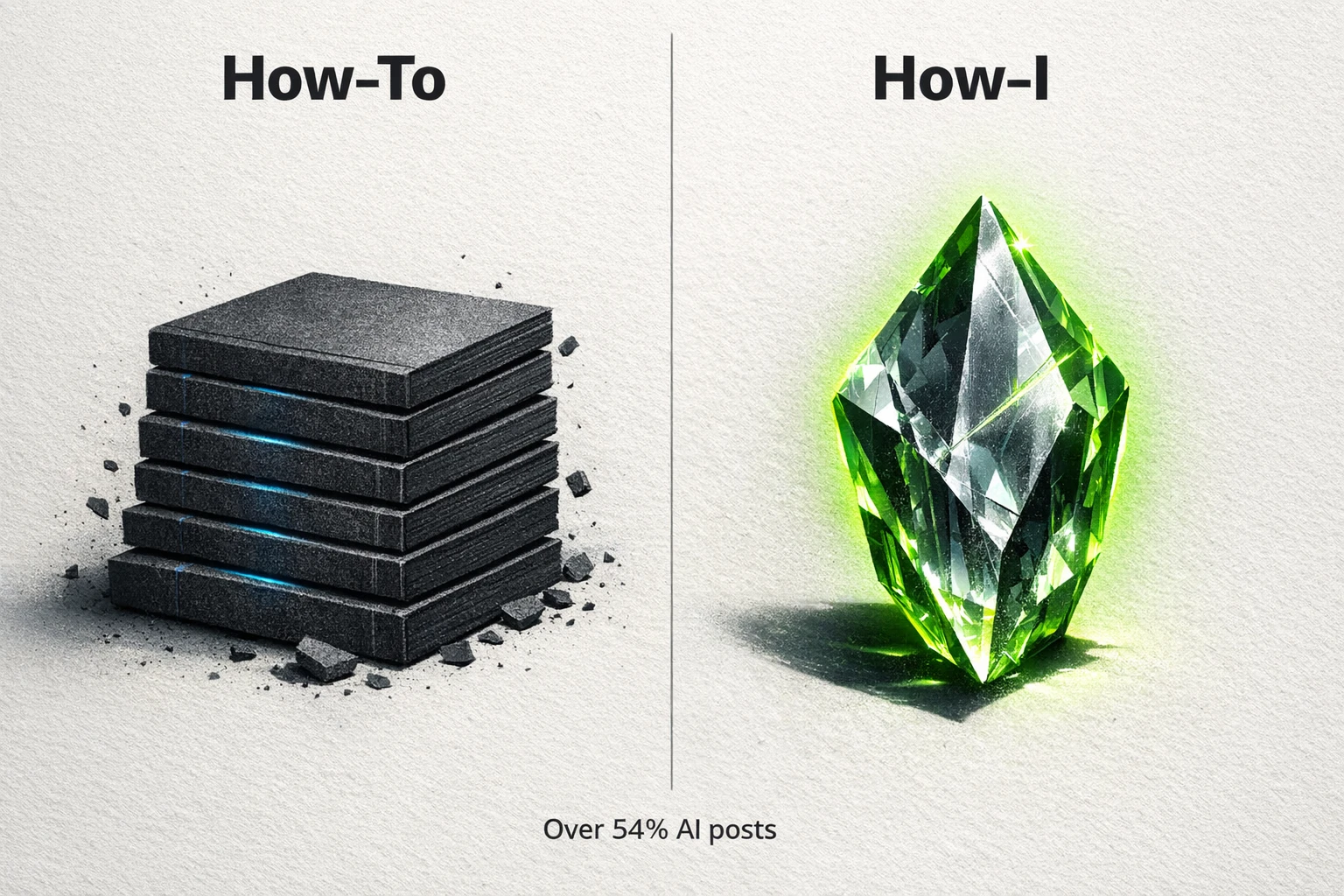
As AI makes generic advice infinite, the scarcity signal becomes lived experience. Use “How-I” stories and specific scars, not “How-To” templates—especially in a feed where over 54% of longer posts are estimated to be AI-generated.
Generative Engine Optimization (GEO): Becoming the Answer
Your content can be brilliant, but it will fail to generate pipeline if your profile looks like a résumé. The game is shifting from Search Engine Optimization (SEO) to Generative Engine Optimization (GEO). The goal is no longer just to get a click. The goal is to be the answer.
As communications expert Sarah Evans defines it, "Generative search is when people ask a system a question and get a synthesized answer, not a list of links. SEO tries to earn clicks. Generative visibility tries to earn mentions, citations, and inclusion in the answer itself" [3].
This means your LinkedIn profile must be re-engineered as a landing page for both humans and AI. When a potential buyer uses an AI tool to ask, "Who is an expert in B2B lead generation for SaaS companies?" your profile needs to be structured so the AI confidently recommends you.
This requires a few tactical shifts:
- Use Sales-Focused Keywords: Replace vague job titles like "Founder" with outcome-oriented phrases like "Founder helping B2B SaaS companies build pipeline."
- Clarify Your Entity: Your "About" section should clearly state who you are, who you help, what problem you solve, and your unique perspective.
- Create a Canonical Home: Your core ideas need to live on a domain you control, like your company blog [3]. Your LinkedIn content then acts as a distribution channel that points back to that source of truth, teaching AI systems that you are the authority.

Content can’t convert if your profile reads like a résumé. GEO reframes the profile as a landing page: clear entities, sales-focused language, and a canonical home so AI systems surface you as the answer.
The Trust-to-Pipeline Framework: Ethical AI and Human Oversight
Trust is the ultimate conversion tool, and your audience is growing more skeptical. Over-automating your presence or blindly publishing AI-generated text is the fastest way to destroy it. In fact, 42% of U.S. consumers are now uncomfortable reading content written entirely by AI [4]. B2B buyers are even more discerning.
Building a pipeline requires building trust first. This means adopting a "Human-in-the-Loop" (HITL) approach as a non-negotiable part of your workflow. AI is your research assistant, not your ghostwriter.
An ethical, trust-building framework includes:
- Fact Verification: AI models "hallucinate" and can present false information with complete confidence. A human must verify every data point and claim before publishing.
- Authenticity Review: AI can mimic tone, but it cannot replicate genuine belief or experience. A human must ensure the final content reflects your true voice and perspective.
- Compliance Oversight: Unethical scraping of competitor or user data for content ideation can violate GDPR and platform terms of service. Human oversight is your compliance backstop, ensuring your methods are ethical and sustainable.
Your reputation is on the line with every post. As innovation expert Nick Skillicorn advises, always perform "final reviews of text... since the risk of misunderstanding and hallucinations are still too high" [5]. Do not sacrifice long-term credibility for short-term speed.

Trust is a pipeline lever. Data-driven thought leadership matters (55%), but audiences resist AI-only writing (42%). A Human-in-the-Loop review process protects accuracy, reduces hallucinations, and keeps your voice credible.
Frequently Asked Questions
How can I measure Dwell Time on my LinkedIn posts?
LinkedIn does not provide a direct "Dwell Time" metric. You must measure it indirectly through the quality of engagement. Long, thoughtful comments that respond to the substance of your post are a strong indicator that people spent time reading it. Focus on sparking conversations, not just collecting likes.
What is the first step to optimizing my profile for GEO?
Start with your headline and "About" section. Rewrite your headline to focus on the outcome you provide for your target customer. Then, use the "About" section to clearly define who you are, who you serve, the problem you solve, and what you believe. This gives AI systems a clear, concise summary of your expertise.
Can I still use AI to write first drafts?
Yes, but use it strategically. AI is excellent for outlining a structure, brainstorming different angles, or summarizing research. Use it to build the skeleton of your post. But the final voice, the personal stories, and the core insights must be yours. Think of AI as a collaborator that handles the grunt work, freeing you up to provide the irreplaceable human element.
How do I encourage "expert comments" on my posts?
The best way is to post content that is worthy of an expert's time. Share a specific, non-obvious insight, take a contrarian stance, or ask a provocative question that invites debate among your peers. You can also tag a few relevant experts directly, but do so sparingly and only when their specific expertise is genuinely needed for the conversation.
The flood of low-effort AI content on LinkedIn is an opportunity. While others are chasing vanity metrics with generic posts, you can build a real pipeline by being more strategic, more human, and more focused on trust.
Your next step is simple. Go to your LinkedIn profile right now and spend 15 minutes rewriting your headline. Change it from what you are to what you do for your ideal customer. That is the first step to stop broadcasting and start connecting.
Sources
- Andy Crestodina on LinkedIn Pulse - Distinguishing between human-driven thought leadership and AI-generated commodity content.
- The Drum - Perspective on the prevalence of AI-generated content on LinkedIn and its impact on authenticity.
- Sarah Evans on LinkedIn - Defines the shift from traditional SEO to Generative Visibility for AI-driven search.
- CSuite Content - Research on consumer sentiment towards content written entirely by AI.
- Nick Skillicorn on LinkedIn Pulse - Expert insight on the necessity of human review for AI-generated text to mitigate risks like hallucinations.