Beyond Volume: The Blueprint for Scalable AI Content and Unassailable Authority
AI Summary
This article explores Beyond Volume The Blueprint for Scalable AI Content and Unassailable Authority, emphasizing a shift from quantity to authoritative, original AI-driven content enhanced by human expertise.
The Bottom Line: It offers a clear framework to scale AI content that builds trust and brand authority instead of eroding it.
What You'll Learn:
- How to integrate human expertise in AI content workflows for accuracy and uniqueness.
- Steps to implement multi-phase quality control including fact-checking and brand voice consistency.
- Techniques for leveraging proprietary knowledge to create original, authoritative content at scale.
Best For: Marketers and content strategists seeking to scale AI content without sacrificing quality or brand credibility.
The promise of AI content generation was scale. We were told we could publish more, faster, and dominate the digital landscape through sheer volume. Yet, many organizations now face a difficult reality. While AI adoption has surged, with up to 78% of businesses using it, consumer trust is eroding. A recent study found that 52% of consumers reduce their engagement with content they suspect is purely AI-generated.
This creates a critical paradox. The very tool meant to build your presence could be undermining it. The market is saturated with generic, repetitive articles created by AI tools that scrape and rephrase existing information. This "consensus content" lacks unique perspective, factual rigor, and the genuine expertise that builds authority.
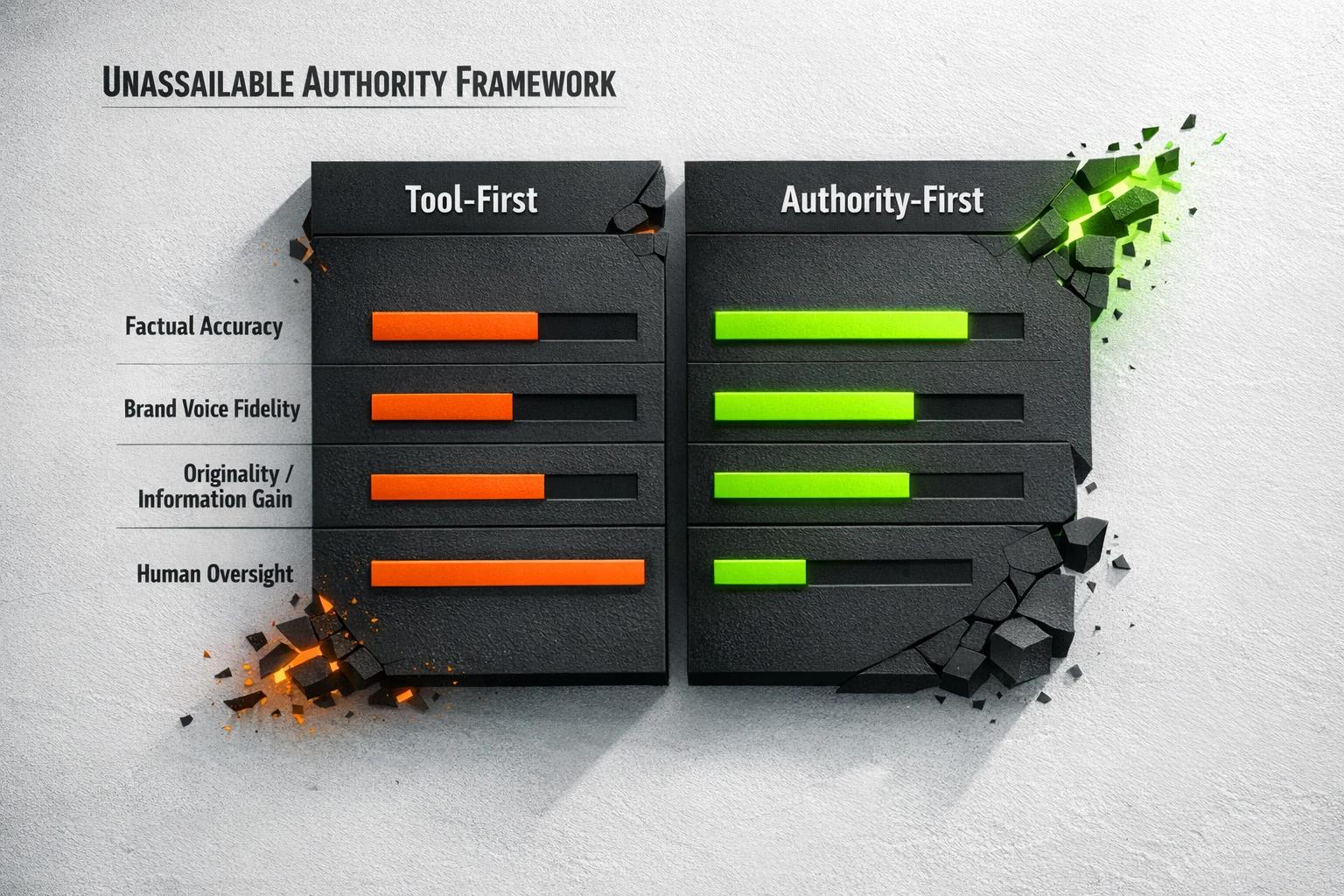
The problem isn't the technology. It's the strategy. Chasing volume with a tool-first approach is a race to the bottom. The future belongs to businesses that master an authority-first framework, building a scalable content engine that produces original, trustworthy, and expert-level material. This guide provides that framework.
Why 'Good Enough' AI Content Fails: Decoding the New Authority Paradigm
A quick search for "AI content writing" reveals a landscape dominated by tool listicles and basic tutorials. This content answers the "what" but completely misses the "how" of building sustainable authority. It addresses the explicit need for efficiency but fails to resolve the hidden, more critical concerns of decision-makers. These implicit needs include ensuring factual accuracy, maintaining a unique brand voice, and mitigating the risk of publishing low-quality, untrustworthy information.
Enterprises hesitate to fully commit AI to core content creation for good reason. They worry about brand damage from factual errors, the loss of their unique perspective, and the ethical implications of automated content. To move forward, we must shift the goal from simply creating content to engineering credibility. This means building a system that prioritizes building trust and credibility with E-E-A-T in the AI era, making human expertise the guide, not the afterthought.
The Foundational Pillars of an Authority-First AI Workflow
An authority-first approach fundamentally changes how you view AI. Instead of seeing it as a content creator, you see it as a powerful co-pilot for your subject matter experts. This philosophy rests on three foundational pillars that separate authoritative content from the sea of generic output.
First is the human-in-the-loop philosophy. The most effective systems embrace the "30% AI Rule," where AI handles about 30% of the repetitive, heavy-lifting tasks, freeing up the remaining 70% of effort for human creativity, strategic oversight, and expert validation. Your experts are no longer just editors. They become architects of the entire process.
Second is strategic AI model selection. A general-purpose large language model is a starting point, not the final destination. True authority comes from using a combination of models. This includes specialized AI for research, data analysis, and fact-checking, all orchestrated to serve a specific content goal. This requires [continuous fine-tuning of your AI content models](https ofAI Content with Continuous Fine-Tuning) to ensure they evolve with your brand's expertise.
Third, and most important, is proprietary knowledge integration. Your AI must be trained on what makes your business unique. This includes your internal data, transcripts from expert interviews, proprietary research, and customer insights. By feeding the AI your unique knowledge base, you enable it to generate content that provides genuine "information gain" for the reader, not just a summary of what’s already known.
A Step-by-Step Framework for Authoritative AI Content at Scale
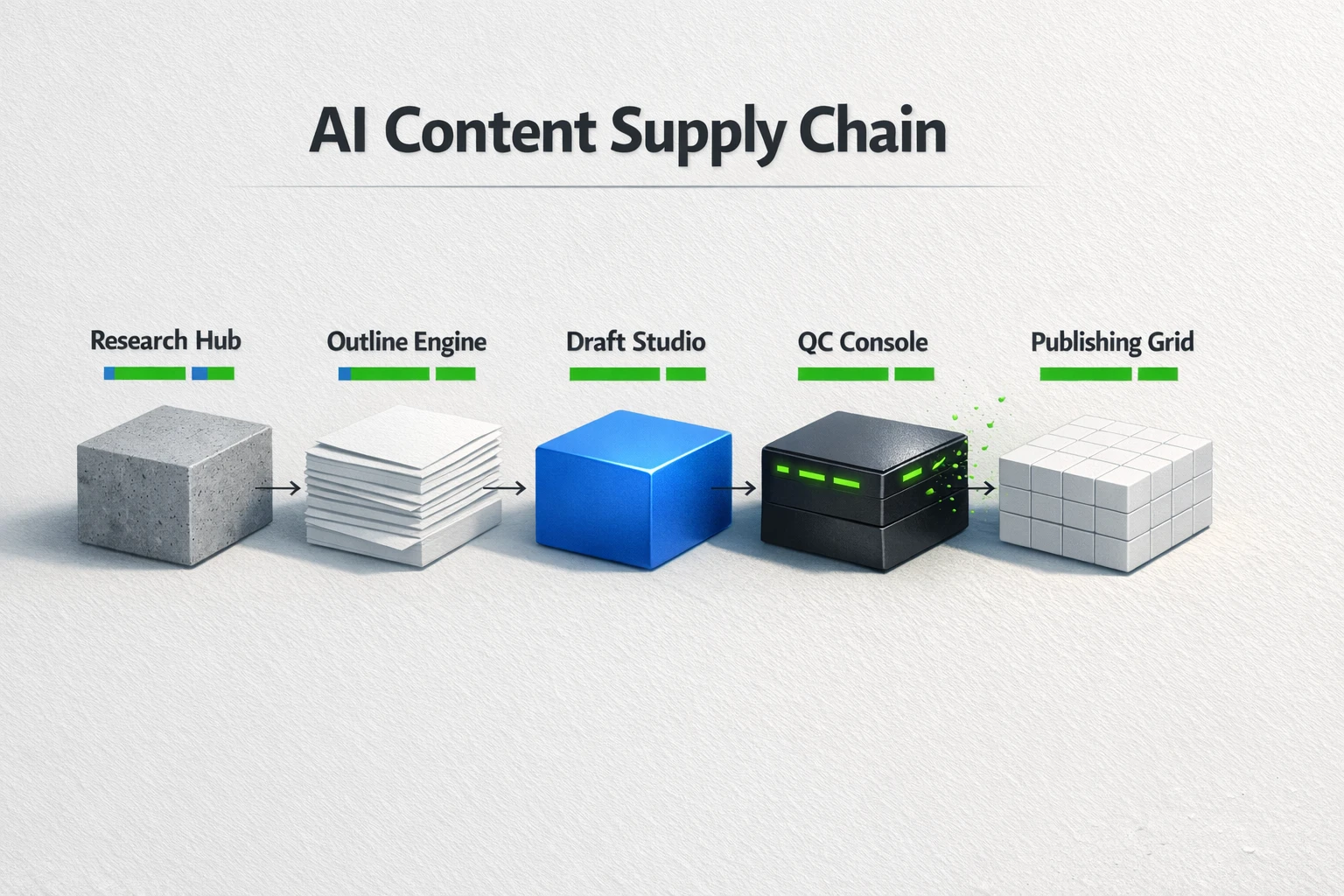
Building an AI-powered content supply chain requires a structured, repeatable process. This four-phase framework ensures that every piece of content is engineered for authority, accuracy, and brand alignment from the very beginning.
Phase 1: Intelligent Outlining and Strategic Ideation
This phase moves beyond basic keyword research. It uses AI to perform a deep analysis of user intent and identify content gaps in the market. The system generates comprehensive content briefs that are not just lists of keywords but strategic documents. These briefs embed E-E-A-T signals from the start, outlining sections that require proprietary data, expert quotes, and unique analysis to build semantic authority for your business.
Phase 2: Expert-Level Drafting and Augmentation
With a strategic brief in hand, the AI generates the first draft. The key here is advanced prompt engineering designed to coax out nuanced, expert-level content aligned with your brand voice. The output is not a finished product. It is a highly structured, information-rich draft for your human expert to refine, augment, and infuse with their unique perspective and experience.
Phase 3: Rigorous Quality Control and Ethical Assurance
This is the most critical phase for building trust. It involves a multi-layered verification process.
- Automated Fact-Checking: The system cross-references claims against a verified knowledge graph and reliable sources in real time.
- Originality Scoring: The process goes beyond simple plagiarism checks. It analyzes the content for "information gain" to ensure it contributes a new perspective rather than rephrasing common knowledge.
- Brand Voice Consistency: AI tools, guided by human-defined style guides, check the draft for adherence to brand tone and messaging.
- Provenance and Transparency: The system can embed Content Credentials metadata, creating a transparent record of how the content was created. This technical solution directly addresses user skepticism about AI's role.
Phase 4: Optimization for AI Overviews and Omnichannel Presence
The final step is to structure the verified content for modern search engines and user behaviors. This means formatting for inclusion in AI-powered search results and rich snippets. It also involves using AI to adapt the core long-form piece into multi-modal assets like video scripts, social media posts, and audio summaries. This ensures your authoritative message reaches your audience across all platforms and prepares you for new ways of measuring brand resonance in AI search.
The Enterprise Advantage: Governance, Security, and Demonstrable ROI
For an enterprise, scaling content isn't just about production. It's about governance, security, and measurable results. An authority-first framework provides clear advantages in each of these areas. By defining roles for humans and AI, you create a clear governance model that aligns with internal policies and legal compliance.
Secure API integrations allow your AI content system to connect with your existing tech stack, like CRMs and CMSs, without compromising sensitive data. This transforms your content workflow into an intelligent, connected ecosystem.
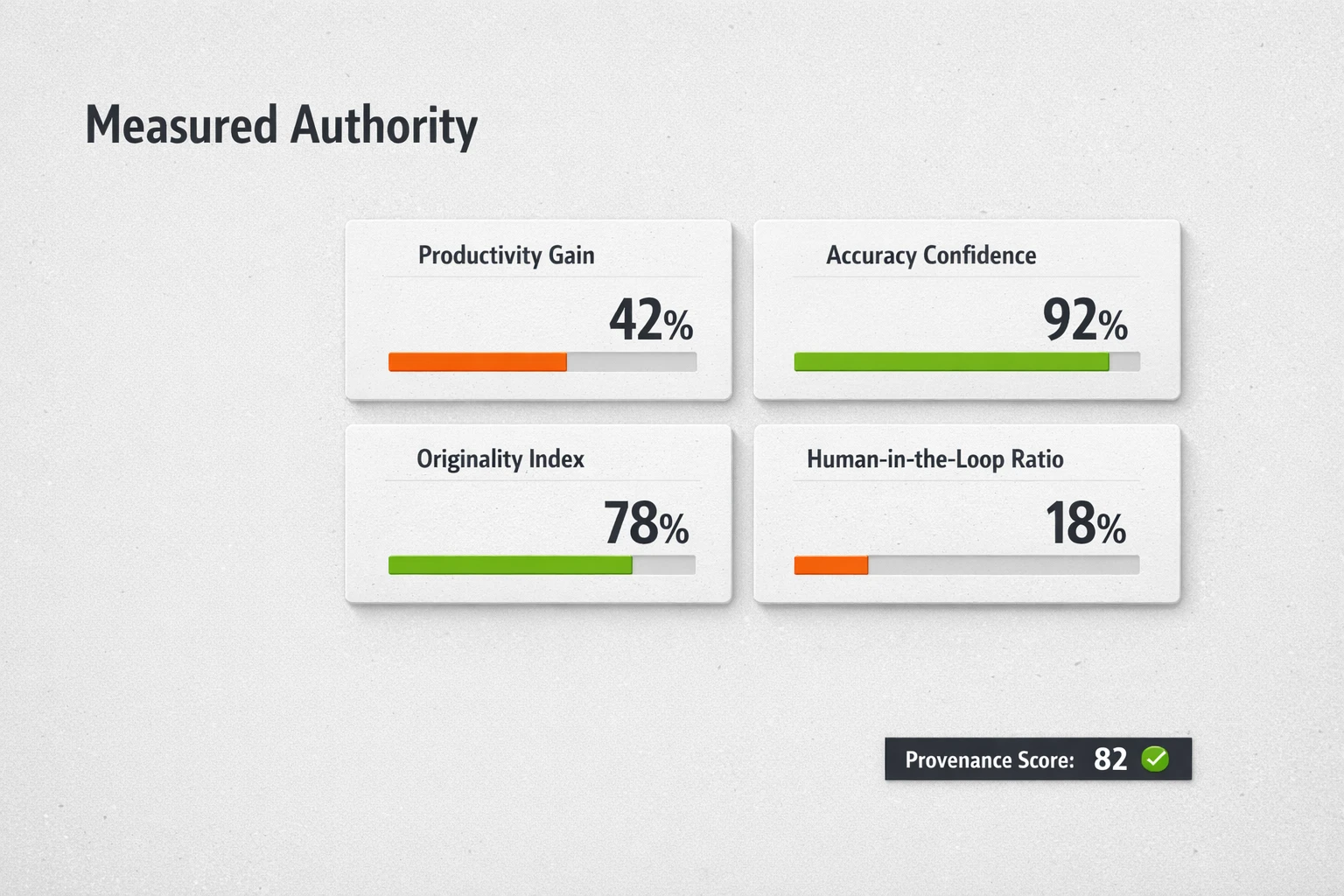
Most importantly, this approach allows you to measure what matters. Instead of tracking volume, you can measure the true impact of your content. You can calculate the long-term value of AI content by tracking engagement, conversion rates, and shifts in brand perception. This provides a clear path to demonstrating the ROI of AI on brand authority and justifies the investment in a quality-focused system. For businesses ready to implement this level of strategic oversight, an AI SEO strategist can integrate these complex workflows seamlessly.
Frequently Asked Questions
How can we ensure AI-generated content truly matches our unique brand voice?
Achieving a unique brand voice requires moving beyond basic tone settings like "professional" or "friendly." A robust system is trained on your best-performing content, internal communications, and style guides. It learns the specific nuances, terminology, and perspectives that define your brand. This is then consistently reinforced by human subject matter experts during the review and augmentation phase, creating a feedback loop that continually refines the AI's understanding.
What is the real difference between this framework and just using a top-tier AI writing tool?
The difference is between having a tool and having a system. A standalone writing tool can generate text, but it operates in a vacuum. Our framework integrates AI into a complete content supply chain. It incorporates strategic intent analysis, proprietary data integration, multi-stage human oversight, automated fact-checking, and performance measurement. It's a holistic workflow designed for authority, not just an application for generating words.
How do we prevent factual errors or "AI hallucinations" in our content at scale?
Preventing factual errors requires a multi-layered quality control process. The first layer is training the AI on a curated, verified knowledge base, which limits its exposure to unreliable information. The second is integrating real-time automated fact-checking APIs that validate claims against trusted sources. The final and most important layer is mandatory review by a human subject matter expert whose primary role is to verify accuracy, add context, and approve the content before publication.
Is it possible to scale authoritative content without hiring a massive team of editors?
Yes, that's the core benefit of this framework. AI handles the most time-consuming parts of the process. It performs the initial research, generates the first draft, and conducts preliminary checks for style and grammar. This gives your human experts a massive head start. Instead of writing from scratch, they can focus their time on high-value tasks like validating accuracy, adding unique insights, and ensuring strategic alignment. This allows you to scale quality and authority without a proportional increase in headcount.
How can we start implementing this authority-first approach?
Implementation begins with a pilot project focused on a specific content cluster. Start by documenting your unique expertise and creating a small, proprietary knowledge base. Define a clear workflow with specific checkpoints for human review. Test and refine the process on a handful of articles, measuring both production efficiency and content quality. This iterative approach allows you to build a proven, scalable system before rolling it out across the entire organization.