Beyond the Bot: A Framework for Scalable AI Content with Editorial Excellence
AI Summary
Bottom Line - Use a human-governed AI content system to scale production without sacrificing originality, accuracy, or brand trust so every piece drives authority and results.
By structuring work into a 5-stage pipeline, AI handles repeatable research and drafting while editors own strategy, depth, and voice. A clear editorial scorecard then standardizes quality so your team can consistently ship search-ready, high-impact assets at volume.
Key Takeaways
- Design a human-in-the-loop workflow so humans lead strategy, judgment, and brand voice while AI accelerates system work
- Build a 5-stage pipeline spanning planning, drafting, editing, distribution, and performance optimization
- Use an editorial excellence scorecard to objectively govern quality as you scale output
Best For - Marketing and content teams wanting to scale AI-assisted content while protecting brand authority and editorial standards.
The promise of AI content was scale. The reality, for many, has been a flood of commodity content that sounds robotic, lacks originality, and fails to connect with discerning buyers. Hitting "publish" more often is a losing strategy if the quality erodes the trust you have worked so hard to build. The market is saturated with articles that are technically well-written but strategically empty. Ranking on page one of Google is no longer just about quality. It requires content that is exceptionally insightful and deeply resonant.
The fundamental challenge is not a choice between machine scale and human quality. It is about designing a system where they amplify each other. Winning in this new landscape requires moving beyond simple prompts and single tools. It demands a deliberate, human-governed content pipeline that uses AI for system work while reserving human judgment for what truly matters: strategy, originality, and authority.
This is not just a philosophical shift. It is a strategic imperative driven by clear market signals. Your audience is growing wary, and the stakes for getting it wrong have never been higher.
The Human-in-the-Loop by Design Framework
The initial approach to AI content was flawed. It treated human input as a final, optional touch-up. A quick spell-check or a minor edit after the AI did 99% of the work. This "AI-first, human-last" model is the primary source of the generic content crisis.
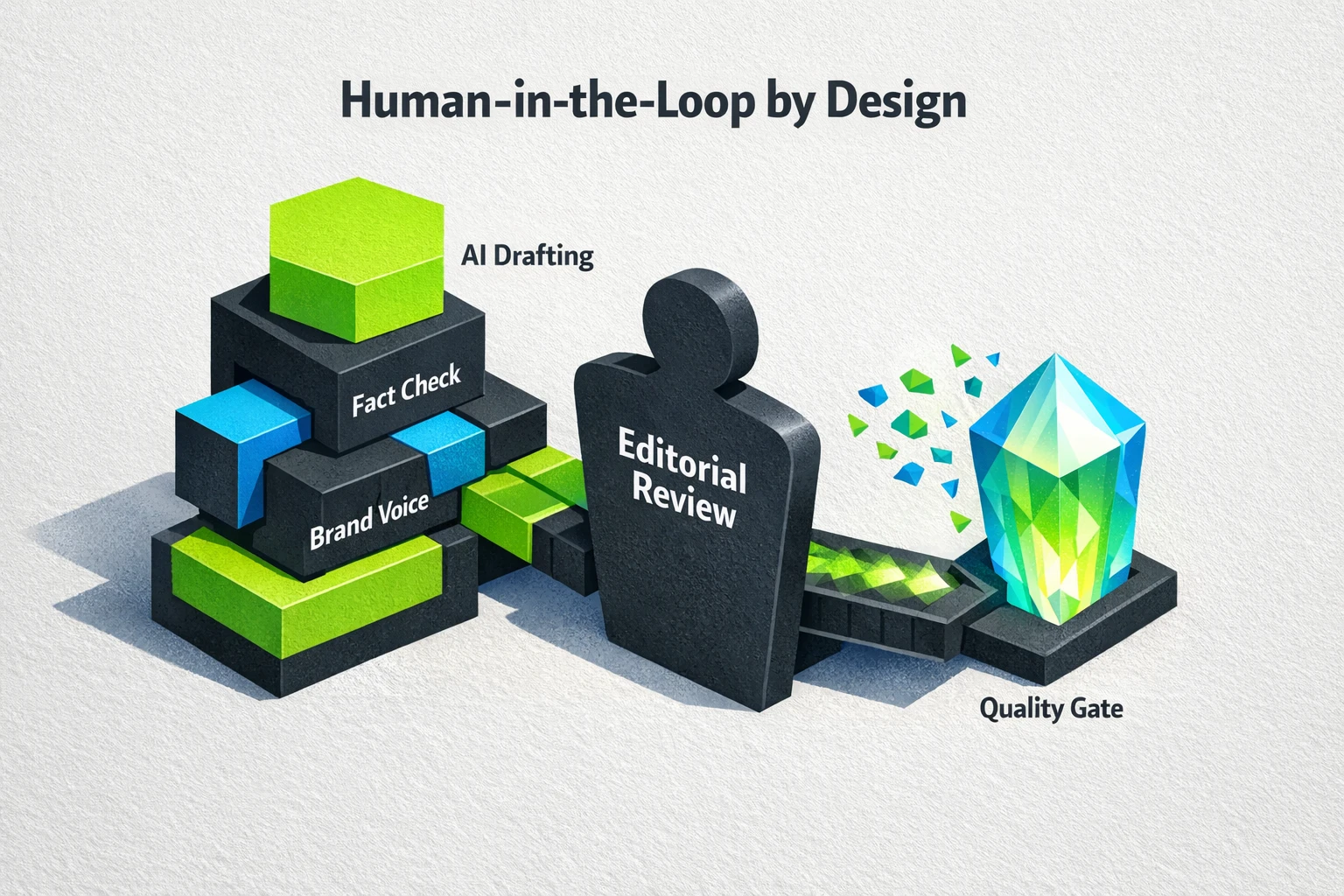
A far more effective model is Human-in-the-Loop (HITL) by Design. This framework embeds human strategic and editorial judgment at every critical stage of the content lifecycle. It is not about "fixing" AI output. It is about guiding it from the very beginning to ensure the final product is strategically sound, factually accurate, and aligned with your brand's unique voice.
This is critical because audience trust in AI is fragile. According to a SurveyMonkey report, consumer comfort with brand AI use fell from 57% to 46% in just one year. When readers suspect content is purely machine-generated, their skepticism rises and your credibility falls. The HITL framework is your defense against this erosion, creating a system for building trust and credibility in the AI era. The goal is to use AI to augment your team's intelligence, not to replace it.
Building Your 5-Stage Scalable AI Content Pipeline
A robust HITL system is not abstract. It is a concrete, five-stage pipeline where human expertise and AI efficiency work in tandem.
Stage 1: AI-Assisted Planning and Briefing
Garbage in, garbage out. The quality of your final article is determined before a single sentence is written. Instead of asking an AI to "write a blog post about X," a systematic approach uses AI to build a comprehensive "ranking blueprint."
- System Work (AI): Analyze top-ranking competitor articles at scale, perform keyword clustering to identify semantic gaps, and extract common questions, statistics, and entities.
- Human Work (Strategist): Review the AI's research to identify the core search intent, define a unique angle or contrarian viewpoint, and synthesize the findings into a structured brief. The human strategist decides the narrative, not the machine.
Stage 2: Structured First-Draft Generation
With a data-rich brief, the AI's role shifts from creator to high-speed synthesizer. The goal is not a perfect final draft but a well-structured foundation built on the strategic decisions made in Stage 1. This stage is about translating the blueprint into prose efficiently. Advanced systems may even use multiple specialized AI models, one for introductions, another for technical explanations, to create a more varied and robust initial draft.
Stage 3: The Human-Led Editorial Workflow
This is the most critical stage and where most AI content strategies fail. It is a non-negotiable quality gate that transforms a generic draft into a trusted asset. This goes far beyond a simple proofread. A rigorous editorial process includes:
- Factual Verification: Every claim, statistic, and data point is cross-referenced with primary sources. Humans are accountable for accuracy.
- Originality and Depth Review: Does the piece offer a fresh perspective or just rephrase existing content? An editor ensures the arguments are compelling and add genuine value to the conversation.
- Brand Voice Alignment: The content is meticulously edited to reflect the company’s tone, style, and point of view. A recent study found that 86% of B2B marketers heavily edit AI output specifically for brand alignment.
- Narrative and Flow Enhancement: An editor ensures the article flows logically, tells a coherent story, and guides the reader effectively from one point to the next.
Stage 4: AI-Powered Distribution and Repurposing
A single pillar page is the start, not the end. AI can be a powerful partner in maximizing the reach of your core content. Once a human has approved the final asset, AI can atomize it into dozens of formats. This includes drafting social media posts, creating email newsletter summaries, generating video scripts, and even outlining presentation slides. This scales distribution without requiring massive manual effort.
Stage 5: Performance Analysis and Optimization
The content pipeline is a closed loop. AI tools can help analyze performance data to identify which topics resonate, what formats perform best, and where opportunities for updates exist. This creates a data feedback loop that makes Stage 1 (Planning) of the next content cycle smarter and more effective. By exploring alternative metrics for generative search presence, you can gain a much deeper understanding of your content's true impact.
The Editorial Excellence Scorecard
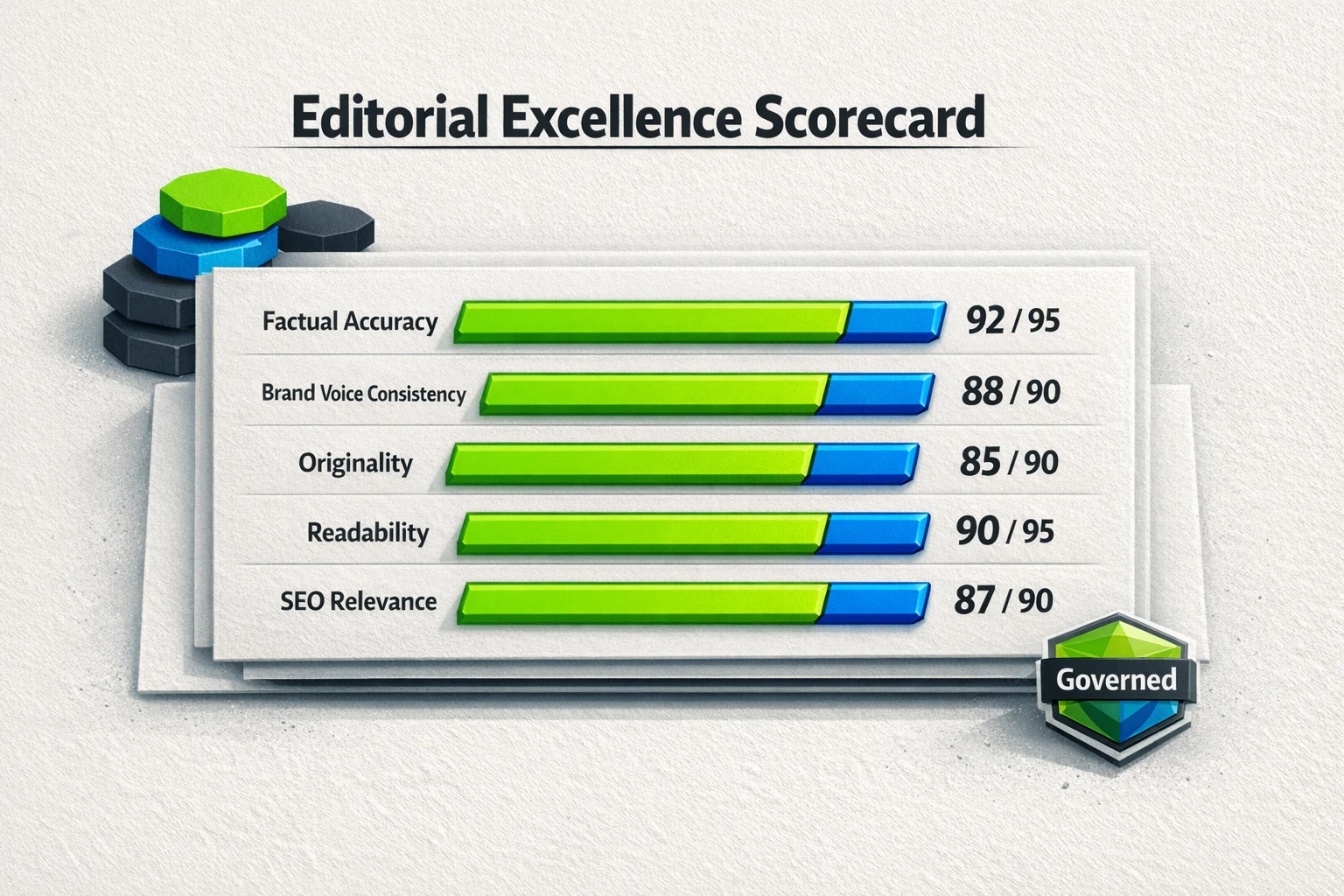
To ensure quality is maintained at scale, you need objective standards. A simple "looks good" from an editor is not enough. An Editorial Excellence Scorecard provides a tangible framework for quality control, turning subjective assessments into measurable metrics. This ensures every piece of content meets a consistent, high bar before publication.
Key metrics should include:
- Factual Accuracy: Are all claims supported by credible, cited sources?
- Strategic Alignment: Does the content directly address the search intent defined in the brief?
- Originality of Insight: Does the piece introduce a unique perspective or simply summarize others?
- Brand Voice Consistency: Does the tone and language sound like it came from your experts?
- Narrative Cohesion: Is the argument clear, logical, and easy to follow?
- Readability and Formatting: Is the content structured for both skimmers and deep readers?
How We Produce High-Quality Content at Scale
At pageBody, we do not just write about this framework. We live it. Our SEO Strategist service is the operational version of this entire philosophy. We built our internal AI system, AImee, to execute the "system work" with precision, freeing up our human experts to focus on the "human work" that creates a competitive advantage.
Our process follows the five stages precisely. We use AI to conduct deep, multi-layer research on over 50 competitor pages per topic, but it is our human strategists who validate the intent and define the unique angle. AImee generates a structured first draft based on this human-led blueprint. Then, every single article passes through our rigorous human-led editorial workflow, including editorial direction, originality review, and final approval by a senior strategist.
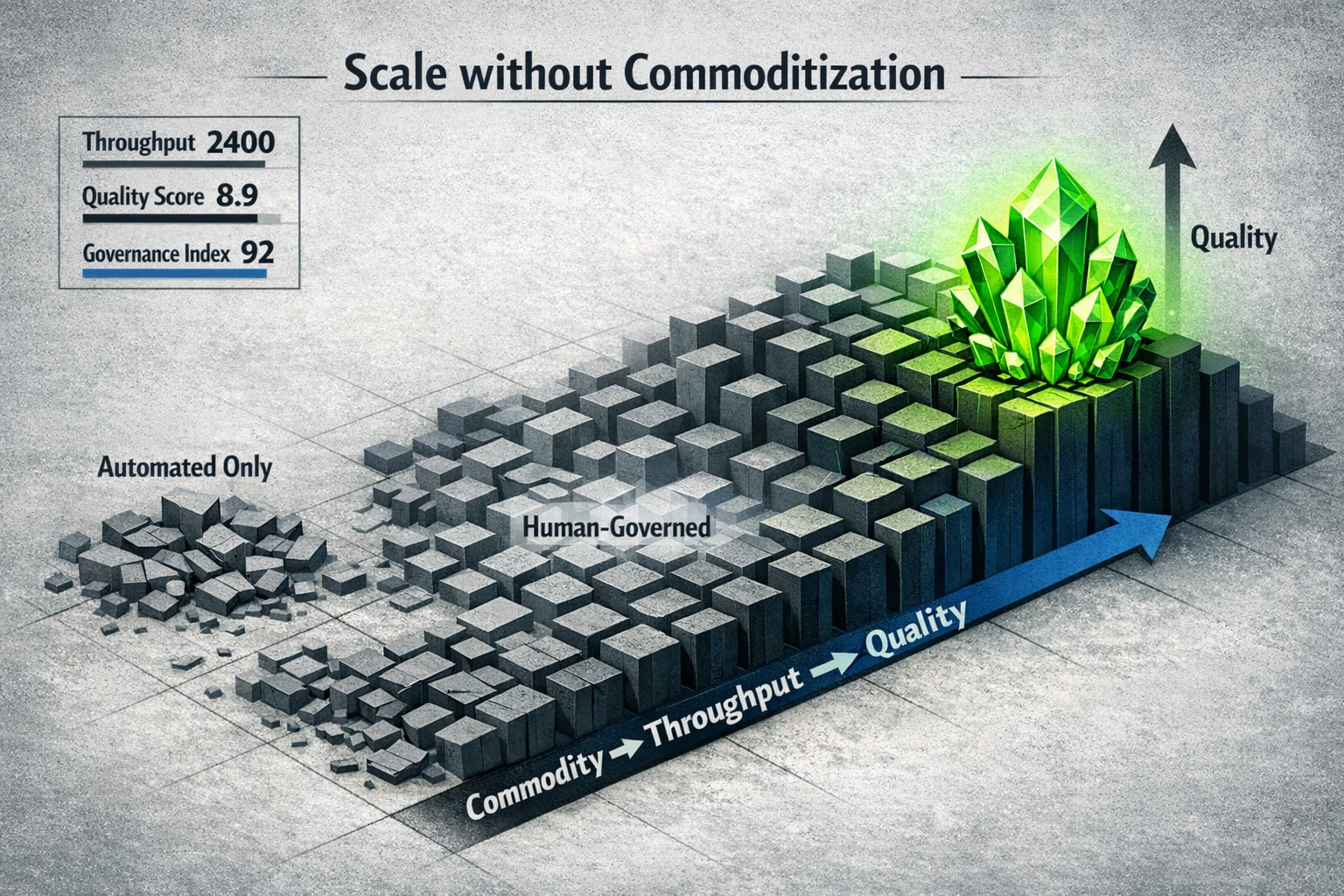
This hybrid approach allows us to produce strategic, high-quality content at a volume that a purely manual team could never achieve, all while keeping our clients in their zone of genius. they only provide 10-20% of the input for validation and final judgment.
Marrying the Machine and the Master
The future of content does not belong to the machines alone. It belongs to the strategists, editors, and experts who learn how to direct them effectively. AI is an incredibly powerful co-pilot, capable of navigating vast amounts of data and executing complex tasks at superhuman speed. But the human remains the pilot, responsible for setting the destination, making critical judgments, and ensuring the journey is safe and successful.
By implementing a human-governed AI content pipeline, you can achieve both scale and excellence, turning your content program from a cost center into a powerful engine for authority and growth.
Frequently Asked Questions
How is this different from just using ChatGPT with a good prompt?
ChatGPT is a powerful tool, but it is just one component of a much larger system. A single prompt lacks the deep competitive research, strategic intent analysis, and multi-layer human editorial oversight required to create content that consistently ranks and builds authority. Our framework is a complete production pipeline, not just a text generation step.
How much time does my team need to commit to this process?
Our system is designed to minimize client involvement while maximizing their strategic input. We typically see clients spend 10-20% of their time on this, focused on the high-value "human work" like validating the initial strategy and providing final approval. We handle the 80-90% of "system work" involving research, drafting, and optimization.
What kind of results can we expect from this content system?
The goal is not just to publish more articles. The goal is to publish strategic assets that achieve business outcomes. Clients use our system to build topical authority, rank for competitive keywords, drive qualified organic traffic, and establish their brand as the definitive resource in their category.
---
Sources:
- SurveyMonkey AI Marketing Statistics - Provided data on declining consumer comfort with brand AI use.
- Typeface.ai Content Marketing Statistics - Source for the statistic on B2B marketers editing AI content for brand alignment.
- AWS Machine Learning Blog - Offered authoritative context on building multi-agent AI workflows for content operations.
- Salesforce Engineering Blog - Provided insights into scaling complex AI pipelines at an enterprise level.
- Optimizely Blog on AI Content Workflows - Offered a high-level strategic perspective on integrating AI into marketing workflows.
- Writer.com - Served as an example of sophisticated enterprise-grade AI positioning and governance.