The Agency Playbook: Scaling Client LinkedIn Authority with AI
AI Summary
Bottom Line
Building client LinkedIn authority with AI frameworks reveals not just faster content creation but a scalable way to convert expertise into trusted leadership that attracts future buyers. This article covers how AI-driven voice extraction, multi-format content, and personalized outreach combine to build genuine authority beyond raw content volume.
Key Takeaways
- Using client voiceprints to maintain unique style and insights for each brand
- Leveraging diverse content types like carousels and infographics for engagement
- Applying AI for targeted, high-response outreach without losing human touch
Best For
This is essential reading for agencies struggling to grow multiple client accounts without sacrificing quality or authenticity.
Building a client’s authority on LinkedIn is a high-touch, high-effort service. For one client, it’s demanding. For ten, it’s unsustainable. As an agency or ghostwriter, you face a scaling dilemma. How do you replicate bespoke, high-quality thought leadership across your entire client roster without burning out your team or delivering generic, ineffective content?
The answer isn't just "use AI to write more posts." The answer is a standardized, AI-driven framework that systematizes quality. It’s a machine for turning your clients' raw expertise into unassailable authority and a steady stream of qualified inbound leads. This is how you move from a service that is difficult to scale to a repeatable, high-value asset.
Beyond "More Content": What Unassailable LinkedIn Authority Really Means
Most agencies approach LinkedIn with a simple equation: more content equals more leads. This is a flawed premise. True authority isn't about volume. It’s about becoming the definitive answer for a specific problem in your client's industry. It’s about owning a conversation so completely that ideal prospects seek your client out.
This is critical because of LinkedIn's 95-5 rule. At any given time, only 5% of your client's audience is actively looking to buy. The other 95% are "out-market," but they will be future buyers [1]. A strategy focused only on immediate lead generation ignores the vast majority of the market. Building authority is how you win the 95% before they even enter a buying cycle. You become their trusted resource, making your client the only logical choice when the time comes.
The AI-Driven Framework for Repeatable Client Success
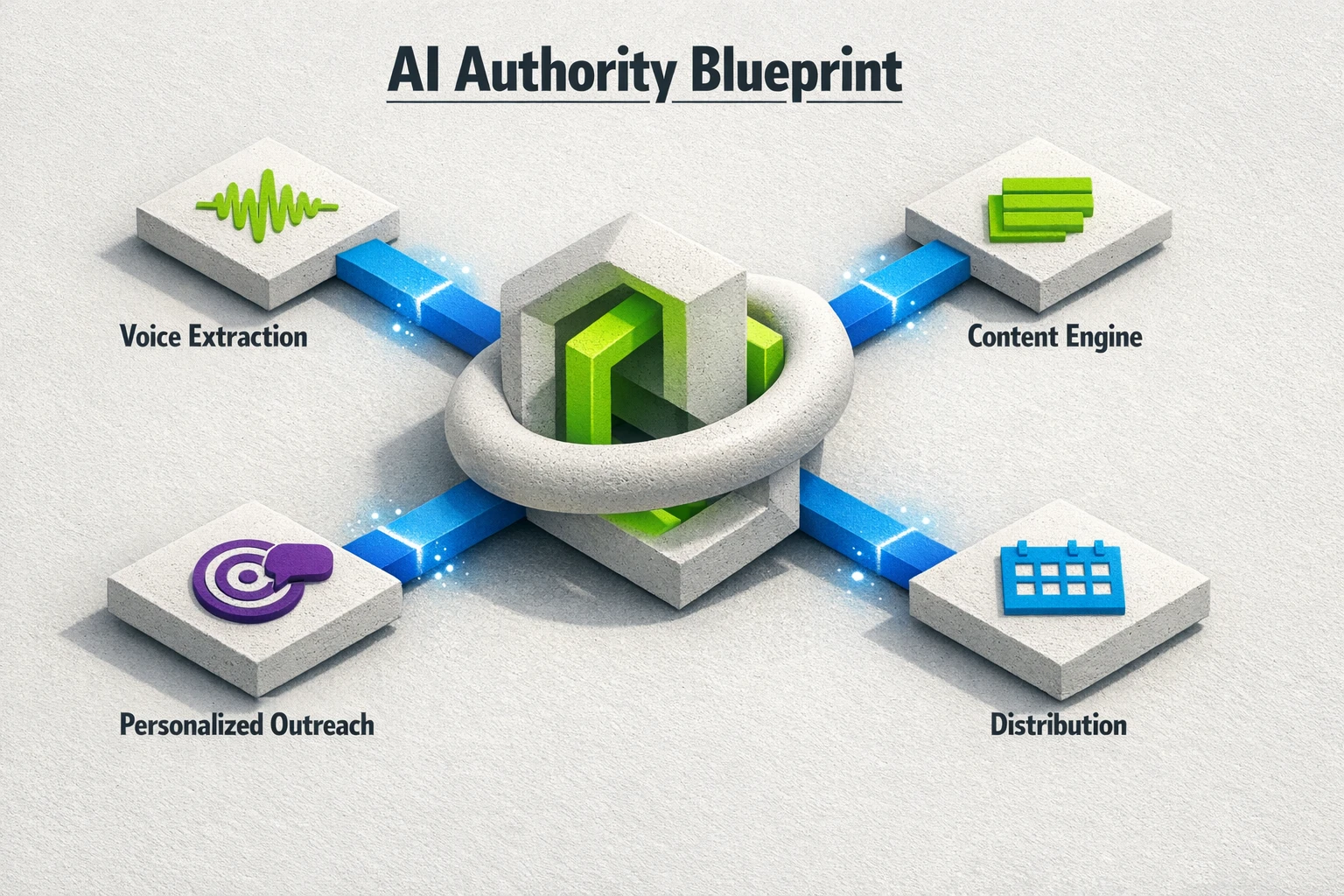
A scalable system requires a repeatable process. Generic AI writing tools can't deliver this because they lack strategic context. A true authority framework uses AI as an engine to execute a human-led strategy, ensuring quality and consistency across every client account.
Phase 1: Client Voice and Expertise Extraction
The biggest risk of using AI is producing generic content that sounds robotic and lacks a unique point of view [2]. To avoid this, the first step is creating a "voiceprint" for each client. This involves using AI to analyze and codify their unique expertise, tone, and perspective from existing assets:
- Interview transcripts
- Website copy and case studies
- Sales decks and webinar recordings
- Past articles and presentations
This process transforms raw material into a structured knowledge base that an AI can use to generate content that sounds authentically like your client, not like a generic language model.
Phase 2: Scalable Content Generation
With a client voiceprint established, you can scale content production without sacrificing quality. One core idea from a client interview can be systematically transformed into a dozen different assets.
- Text Posts: Short, punchy posts that deliver a single, powerful insight.
- Carousels: Visually engaging posts that can achieve 11x more impressions than other formats [3].
- Infographics: Data-driven visuals that can drive 5x higher engagement [3].
- Video Scripts: Short-form video scripts ready for your client to record.
This multi-format approach maximizes the reach of each core idea while catering to different audience preferences, all managed from a central content calendar.
Phase 3: Targeted Outreach and Engagement
Authority isn't just built by broadcasting content. It’s solidified through meaningful engagement. AI can accelerate this by identifying ideal prospects and crafting hyper-personalized outreach messages. Used correctly, AI-driven personalization can significantly estimate LTV from prompt-driven lead sources by focusing efforts on high-potential connections. Using AI for personalized messages can boost response rates from a typical 8% to as high as 27% [4]. This isn’t about spammy automation. It's about using technology to do research at scale and open doors for genuine human conversation.

The Ghostwriter's Edge: Managing Multiple Voices
For ghostwriters, the challenge of maintaining distinct client voices is acute. An AI-driven framework provides the necessary guardrails. By creating a separate, secure voiceprint for each client, you ensure there is no cross-contamination of style, terminology, or proprietary insights.
Your role evolves from writer to "Authority Strategist." You direct the AI, refine its output, and provide the critical human layer of nuance and strategic oversight. This allows you to serve more clients at a higher level of quality, transforming your personal capacity from a bottleneck into a competitive advantage.
Smart Outreach: Balancing AI Efficiency with Human Connection
Effective LinkedIn outreach operates within specific constraints. The platform limits connection requests to around 100 per week to prevent spam [5]. This makes every request valuable. Generic, automated messages waste this limited inventory.
The goal is to use AI to make your outreach more human, not less. For B2B agencies, a system of automated lead identification followed by AI-assisted personalized requests can generate 40% more leads while saving 25 hours per week [6]. A personalized InMail, for example, is three times more likely to get a reply than a cold call, with average response rates hitting 18-25% [5]. The AI handles the data analysis and initial drafting, freeing you up to focus on building real relationships.

Measuring What Matters: From Vanity Metrics to Authority Signals
Likes and comments feel good, but they don't pay client invoices. True authority generates tangible business outcomes. To prove the value of your service, you must shift the measurement conversation from vanity metrics to authority signals. The right strategy requires understanding the different tools for analyzing expert content impact on AI brand authority and focusing on what drives revenue.
Key Authority Indicators:
- Inbound DMs from Ideal Client Profiles (ICPs): When the right people start the conversation, the strategy is working.
- Unsolicited Demo or Consultation Requests: This is a direct line from authority to pipeline.
- Mentions by Industry Peers: Your client is being recognized as a key voice in their space.
- Increased Profile Views from Target Companies: Prospects are actively seeking your client out.
These metrics prove you are successfully reaching the 95% of the market that isn't buying today, building the trust that ensures they buy from your client tomorrow.

Frequently Asked Questions
How do I prevent AI-generated content from sounding generic for all my clients?
The key is the "Client Voice and Expertise Extraction" phase. Before generating any content, you must build a unique knowledge base and style guide for each client. This involves feeding the AI their specific case studies, interviews, and terminology. Your role is to then refine the output, ensuring every post is sharp, authentic, and strategically sound.
Is using AI for LinkedIn outreach against their terms of service?
LinkedIn's policies prohibit the use of software that automates actions without their consent, especially those that send high volumes of spammy messages. However, using AI as an assistant to research prospects and draft personalized messages that you review and send is a different matter. The focus should be on "AI-assisted," not "fully automated," ensuring a human is always in control to maintain authenticity and compliance.
How do I price an AI-driven LinkedIn authority service for my clients?
Price based on the value and outcomes delivered, not the hours spent. An AI framework allows you to deliver higher quality and consistency at scale. Your pricing should reflect this increased value. Consider tiered packages based on content volume, outreach intensity, and strategic oversight. Focus the conversation on business outcomes like qualified leads and brand authority, not just content deliverables.
What's a realistic timeline to see results for a client?
Building genuine authority is a marathon, not a sprint. While you can see early indicators like increased engagement and profile views within the first 30-60 days, tangible business results like a consistent flow of inbound leads often take 4-6 months of consistent execution. Set clear expectations with clients based on the 95-5 rule: the goal is to build a long-term asset, not just score a few quick wins.
Sources:
- Open Industry- An explanation of LinkedIn's 95-5 rule for B2B marketing.
- Numero Uno Web - Discusses common myths and limitations of AI-generated content, such as its lack of emotional depth.
- CXL - Provides data-driven tactics for LinkedIn, including statistics on the performance of different content formats like carousels and infographics.
- HeroHunt.ai - Details how AI can significantly improve outreach response rates and reduce administrative time.
- HeroHunt.ai - A comprehensive guide to LinkedIn outreach, covering platform limits, InMail statistics, and best practices.
- Pattrn Data - A case study showing the lead generation and time-saving benefits of AI-assisted LinkedIn outreach for B2B agencies.