3 Steps to a Website Competitor Analysis Using AI
AI Summary
A website competitor analysis with AI reveals more than missing keywords — it exposes the structural weaknesses that can make established rankings vulnerable. By examining topical authority, internal link flow, and content silos, you can build a stronger SEO system instead of copying isolated tactics.
- Compare topical coverage and AI citation visibility instead of relying on backlink counts or domain ratings.
- Trace hub pages, internal links, and 8 to 15 supporting articles to uncover authority gaps.
- Use AI to group sitemap URLs into content silos and prioritize the clusters most likely to improve rankings.
For teams publishing consistently but struggling to rank, this framework turns competitor research into an actionable content blueprint.
Most teams approach competitive intelligence backward. They look for surface-level keyword gaps, assuming a missing phrase is the reason they lag behind in the rankings. This legacy checklist approach ignores the actual mechanics of modern search. A rigorous competitor analysis of a rival website abandons those basic keyword lists entirely. Instead, you need to use AI to deconstruct the internal linking structure and domain authority of your rivals. Understanding how a competitor engineers their topical relevance gives you a blueprint to build your own advantage.
When you stop looking at individual keywords and start looking at the entire domain infrastructure, the gaps in your opponent's armor become obvious. They might rank for a high-volume term today, but if that term is unsupported by a dedicated cluster of related content, their position is fragile. You can take that position by deploying a superior content ecosystem. Evaluating an opponent today requires recognizing that AI-driven search engines prioritize structural clarity over generic domain age. You are not just looking for topics they missed. You are uncovering the architectural blueprint they use to signal authority. By shifting your focus from isolated keywords to complete ranking asset packages, you take control of your SEO roadmap. You stop guessing what to publish and start executing a mathematically sound strategy.
Evaluating Domain Authority with AI
The era of relying on raw backlink counts to assess a competitor is over. Legacy tools train you to fear high-authority domains, creating a false sense that entrenched industry leaders are impossible to beat. This causes teams to abandon highly profitable topics before they even write a single word. They shoot blindly into low-competition keywords because they assume the main battles are unwinnable. But AI search models operate differently. They bypass chronological advantages to find the most structurally sound answers.
When you evaluate a competitor, your first step is measuring their topical footprint rather than their link profile. Traditional SEO authority shows an r² of 0.05 against citation behavior [1]. This statistical reality proves that legacy metrics barely move the needle for modern AI visibility. You must evaluate how deeply a rival covers a specific entity, not just how much generic authority their domain holds.
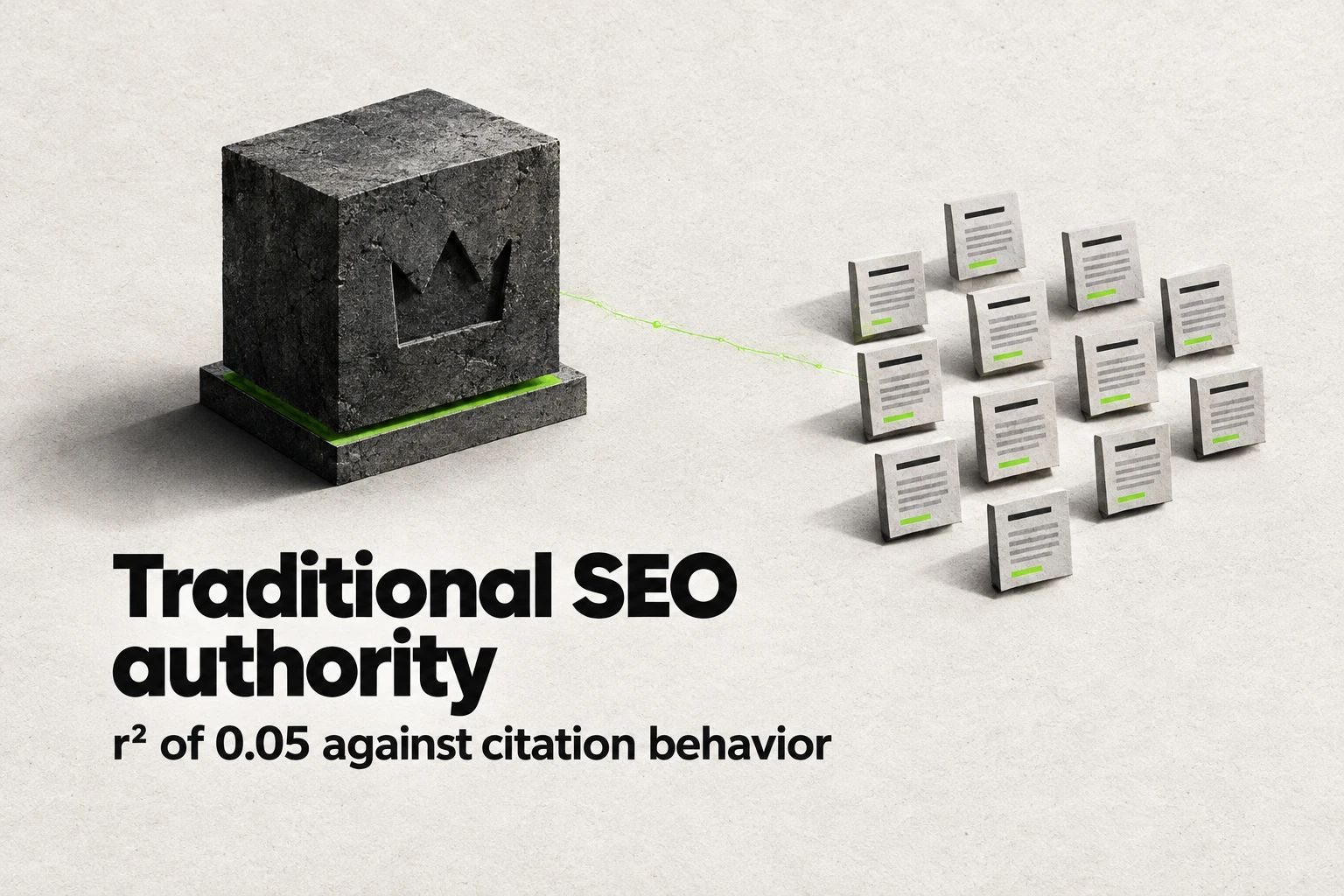
Traditional SEO authority shows an r² of 0.05 against citation behavior. Use that signal alongside a rival’s topical coverage and site structure, not as a complete measure of AI visibility.
Rethinking this evaluation changes the playing field. Many domains dominate traditional search simply because they accumulated links. AI retrieval mechanisms ignore that static equity to find the best structural architecture. 55.2% of top-10 AI citations did not rank in the traditional top 10 [2]. You can outmaneuver an established giant by simply organizing your knowledge better than they do.
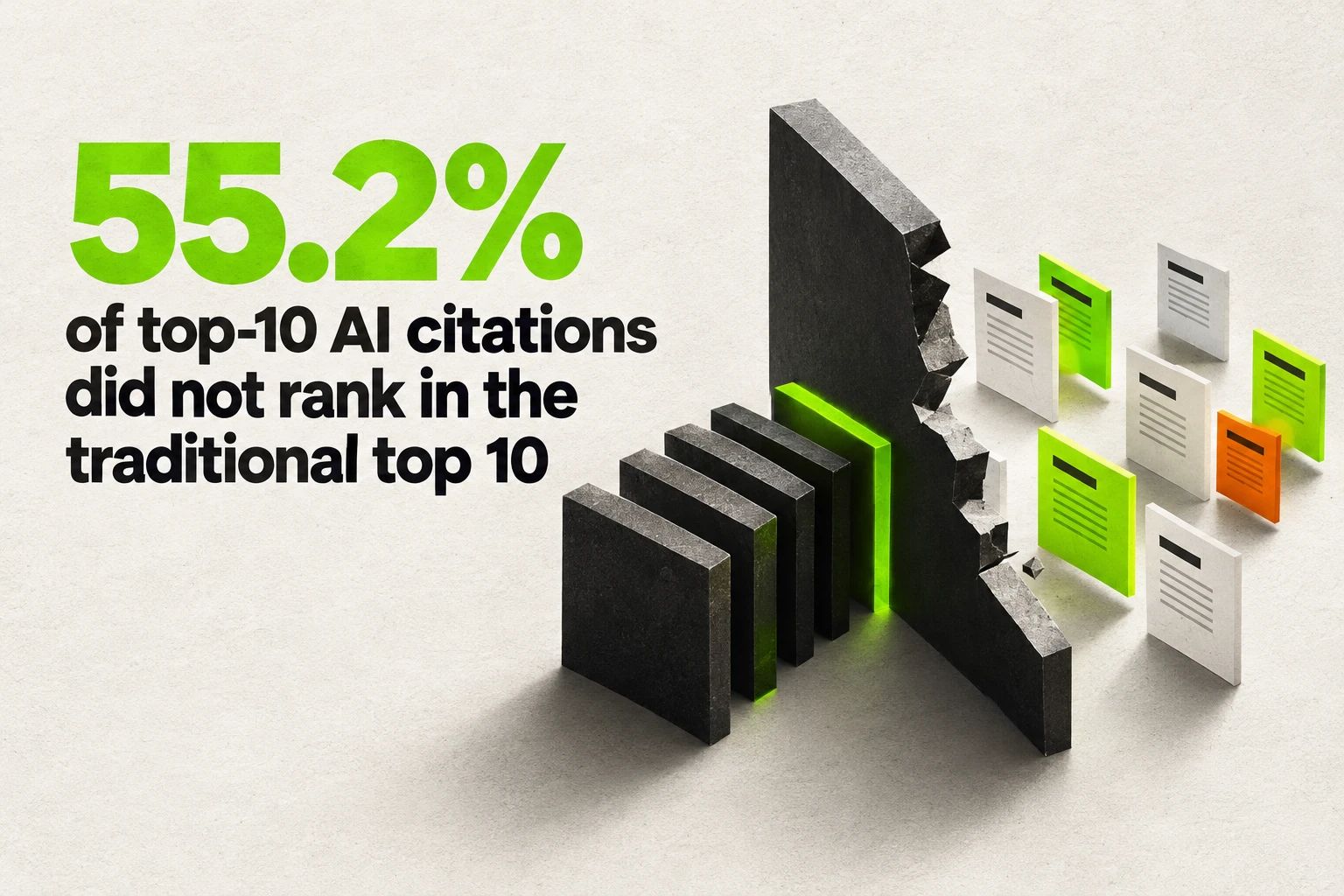
55.2% of top-10 AI citations did not rank in the traditional top 10. Check AI citation visibility as well as traditional rankings when assessing a competitor.
Do not let a high domain rating deter you from entering a valuable topic. Mapping authority signals across winning pages gives you a clearer picture of their strategy than a single backlink score ever could. You are looking for the intent behind their content, finding the gaps in their architecture, and preparing to deploy your own authority assets.
Analyzing Site Architecture and Internal Link Flow
Authority is worthless if it remains trapped on a single page. The most successful competitors build an internal link graph that distributes value systematically across their entire site architecture. Think of internal linking as the circulatory system of a website. Most brands treat internal links as an afterthought, pasting them randomly into articles right before publishing. Successful organizations treat internal links as deliberate paths of authority.
To beat them, you have to inspect this graph and reverse-engineer their flow of topical equity. Look at how their top-performing URLs pass authority to conversion pages. Evaluating rival content strategies using AI reveals exactly which internal links support their most critical business offerings. You will notice that their most visible assets are never isolated articles floating without context. They are heavily connected nodes within a broader ecosystem.
A topic cluster is supported by 8 to 15 cluster articles [3]. This specific support structure is what creates a dominant hub. When you map a competitor's architecture, you are looking for these precise clusters to understand how they connect broad concepts to highly specific long-tail answers.
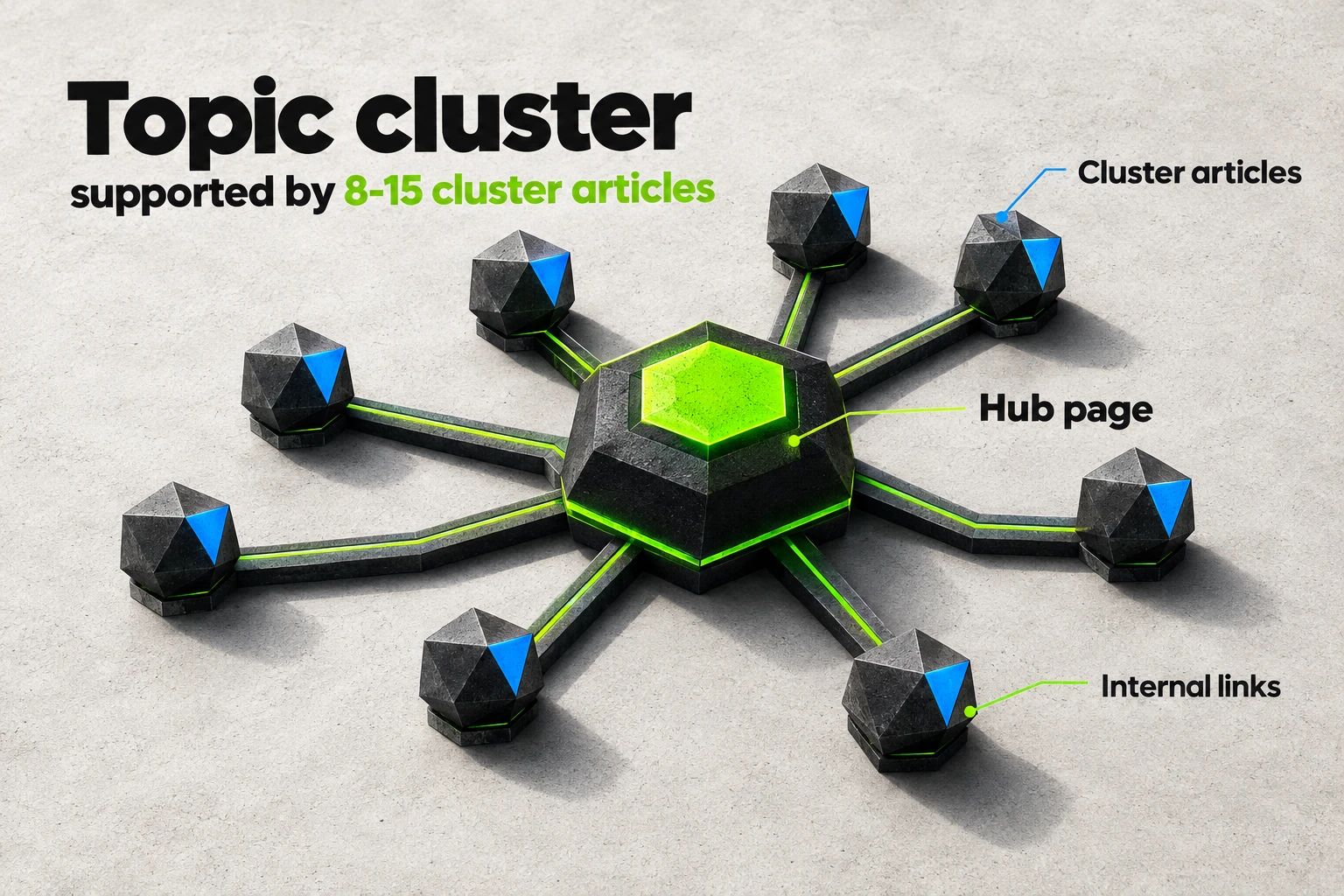
A topic cluster is supported by 8-15 cluster articles. Trace a rival’s hub page, cluster articles and internal links to understand how its site is organized.
If a competitor has a hub page but only links to three supporting articles, they have left a structural vulnerability. You exploit this by building out the full cluster. Your goal is to identify these weak points in their internal linking graph. By establishing a more comprehensive matrix of links, you capture the authority they failed to consolidate.
Mapping Content Silos for SERP Dominance
Finding a competitor's clusters manually is an administrative nightmare. You end up staring at sitemap URLs in a spreadsheet, trying to guess their organizational logic based on URL slugs. This manual approach drains resources and delays execution. You build authority by leaving no question unanswered within a specific domain of knowledge, which requires operational leverage rather than endless manual sorting.
Manual topical map extraction typically takes two to four days [4]. You can eliminate this bottleneck by feeding their sitemap into an AI agent designed to group the URLs. The AI categorizes related pages by semantic relevance, exposing the exact content silos the rival uses to secure their rankings.
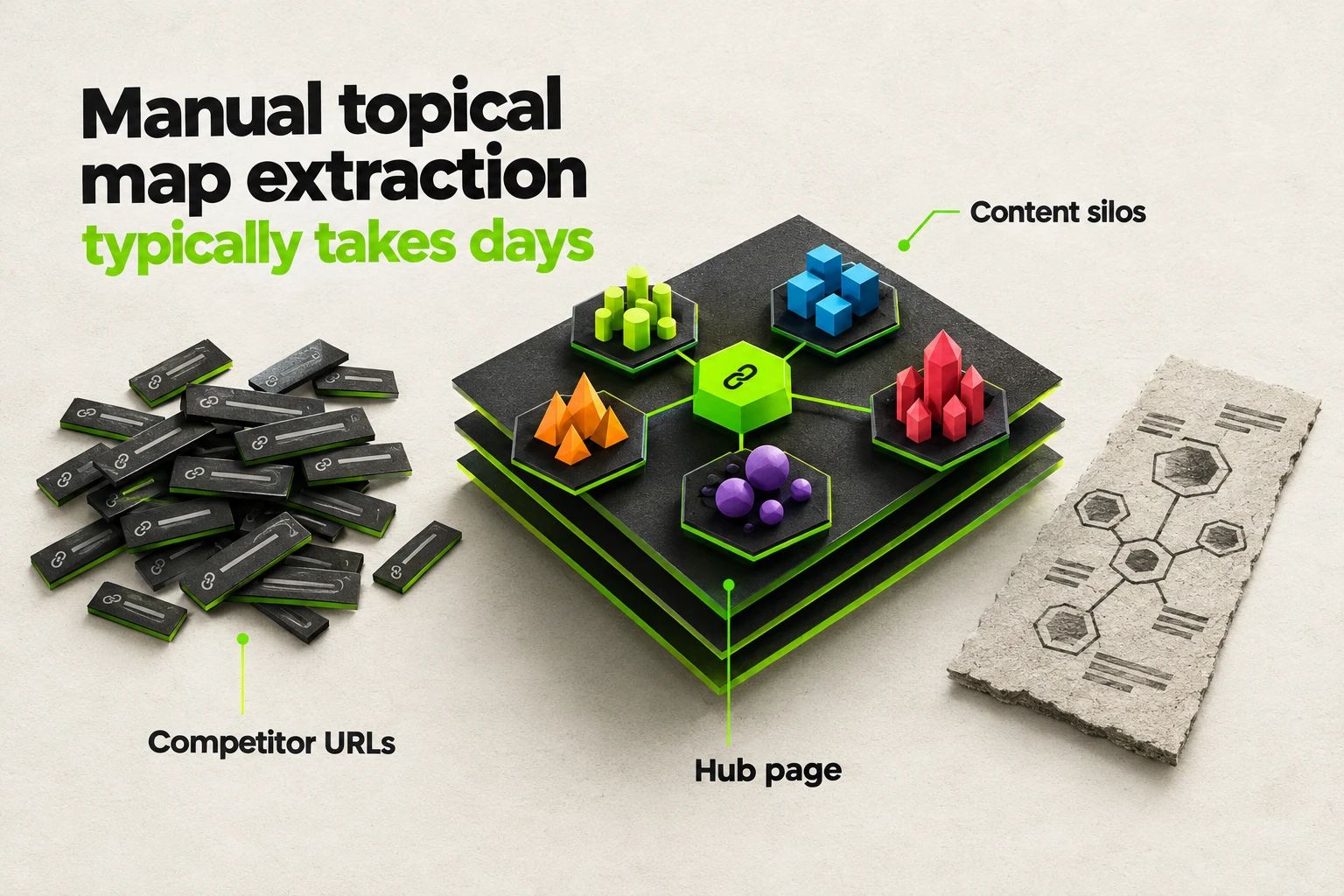
Manual topical map extraction typically takes days. Use AI to group a rival’s URLs into content silos.
Deep SERP analysis becomes much easier once you see the architectural pillars behind a competitor's presence. Once the AI visualizes their silos, you immediately see where they have invested heavily and where their coverage is remarkably thin. You see which topics they treat as foundational pillars and which ones they only mention in passing.
By extracting these silos, you move from guessing what to write next to executing a definitive structural plan. You build your own authority by engineering a better, more complete cluster than the one your rival relies on. The objective is to replace their fragmented efforts with your own comprehensive authority intelligence blueprints, ensuring your site becomes the definitive answer engine for your niche.
Frequently Asked Questions
Do we need a massive domain rating to outrank established competitors in AI search?
No, because traditional SEO authority shows an r² of 0.05 against citation behavior [1]. AI models prioritize the structural depth of your content over raw link equity. By building comprehensive content silos, you bypass the need for legacy backlink metrics and win on architectural superiority.
How many supporting pages does a central hub require to function properly?
A topic cluster is supported by 8 to 15 cluster articles [3]. This volume of supporting content provides the necessary depth to cover all subtopics thoroughly. You must connect these pieces through clear internal links to build actual domain-level authority.
Does entity richness directly improve our chances of being cited by AI models?
Yes, entity richness provides a 267% citation lift [1]. Including highly relevant entities in your architecture signals comprehensive coverage to AI retrieval systems. You achieve this by mapping the exact concepts your competitors miss in their silos and detailing them in your own content.
Your next step in the competitor analysis of their website is to export their sitemap into a spreadsheet. Feed those URLs into an AI agent with a prompt to categorize them by topic, and use that output to identify which cluster you need to build out first. Create your own structural blueprint and deploy your ranking asset packages to capture the authority your rivals left on the table.
Sources:
- Fahlout - AI search citation behavior research
- Rankability - Statistics on AI search visibility
- Clustea - SEO standards for topic clusters
- Worksbuddy - Benchmarks for topical map extraction