AI Content Audit Frameworks: Ultimate Guide
AI Summary
AI content audit frameworks reveal far more than missing keywords — they expose semantic overlap, declining assets, and information gaps that quietly weaken organic visibility. A structured audit helps teams turn large content libraries into focused, higher-authority systems.
- The four-dimensional framework covering inventory mapping, semantic redundancy, content decay, and entity depth.
- The Keep, Update, Consolidate, or Prune model for converting audit findings into clear actions.
- The executive reporting blueprint linking cannibalization, traffic loss, pruning efficiency, and six-week execution sprints.
For teams managing enterprise content portfolios that are growing faster than their organic performance and need a practical path to prioritization.
Content teams often find themselves trapped in an endless cycle of production. They publish dozens of articles every month, optimize target keywords, and wait for organic traffic growth that never comes. Meanwhile, existing content portfolios slowly decay under the radar. Traditional SEO audits fail to solve this problem because they treat content evaluation as a simple spreadsheet exercise. They look for missing keywords and broken links while completely ignoring semantic overlap, topical dilution, and actual information density.
In the era of AI-driven search, search engines no longer operate as simple document lookup systems. Modern algorithms evaluate topical depth, entity relationships, and unique perspective. Simply piling on more text or publishing surface-level summaries dilutes domain authority. To win organic real estate today, enterprise brands need a structured evaluation framework that identifies redundant pages, isolates topical gaps, and pinpoints decaying assets before organic visibility drops off a cliff.
The 4-Dimensional Content Audit Framework
Auditing a massive digital library requires moving away from superficial keyword checks toward a multidimensional analysis. The goal is not just counting URLs, but understanding how every asset contributes to your total domain authority.
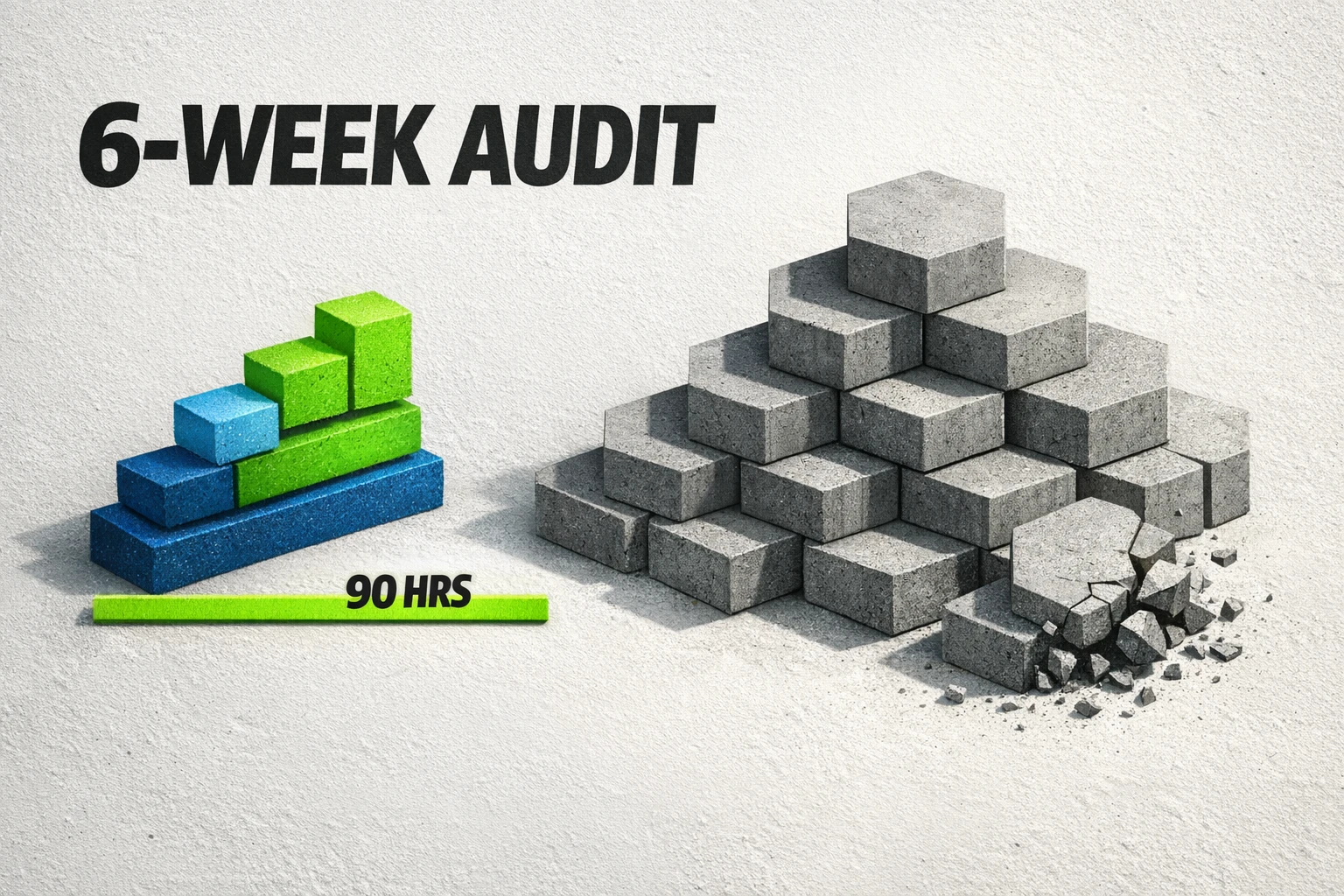
A complete content audit evaluates quality to uncover necessary updates, highlight topical gaps, and flag candidates for removal [1]. To prevent teams from sinking into endless analysis, structuring initial inventory efforts within a strict 6-week timebox helps maintain operational momentum [1].
1. Sitemap Segmentation and Inventory Mapping
Before evaluating individual articles, you must catalog your entire domain asset library. Cloud crawlers extract raw URL performance metrics, publication dates, and hierarchy structures. Grouping these URLs by primary sub-folder or semantic silo gives you an instant view of content distribution across your domain.
An enterprise audit can easily balloon into a massive resource drain. Agency benchmark data shows that completing a comprehensive content audit takes an average of 90 hours from start to finish [2]. Without clear inventory boundaries, teams waste dozens of hours manually reviewing low-value pages that should simply be pruned.
2. Semantic Redundancy Detection
When multiple pages target the same underlying search intent, they compete against each other in search results. AI models process site embeddings to group URLs by semantic proximity. Identifying these overlapping assets allows you to combine cannibalizing pages into single, authoritative resources.
3. Algorithmic Content Decay Tracking
Content decay occurs when historically top-performing pages experience gradual losses in traffic, impressions, and ranking positions. Rather than waiting for a major analytics drop, automated scripts monitor search performance API data to flag declining trends early.
4. Information Gain and Entity Depth
Evaluating pages strictly on word count or keyword frequency is obsolete. Google evaluates a site's focus score based on its depth and relevance across specific core topics, meaning tight topical specialization beats broad, unfocused publishing [3]. Modern audits must measure unique insights, proprietary data, and distinct perspective.
Deploying repeatable AI content audit frameworks allows teams to systematically identify missing topics and remove redundant content across complex sitemap hierarchies.
Detecting Semantic Redundancy and Entity Gaps

Most enterprise sites suffer from semantic redundancy. Over years of publishing, different teams inadvertently create dozens of articles explaining the exact same concepts. Search engines struggle to determine which page holds primary authority, resulting in split rankings and diminished visibility for all related URLs.
Solving this problem requires moving beyond traditional keyword gap analysis. A keyword gap tells you what words your competitors rank for. An entity gap tells you what concepts, relationships, and unique information your content fails to address.
Google patent US20200349181A1 details a framework for ranking documents based on an Information Gain score [4]. Search engines prioritize pages that provide original information over pages that merely rehash consensus summaries. If your article provides no new data, original analysis, or expert perspective beyond existing search results, its Information Gain score approaches zero.
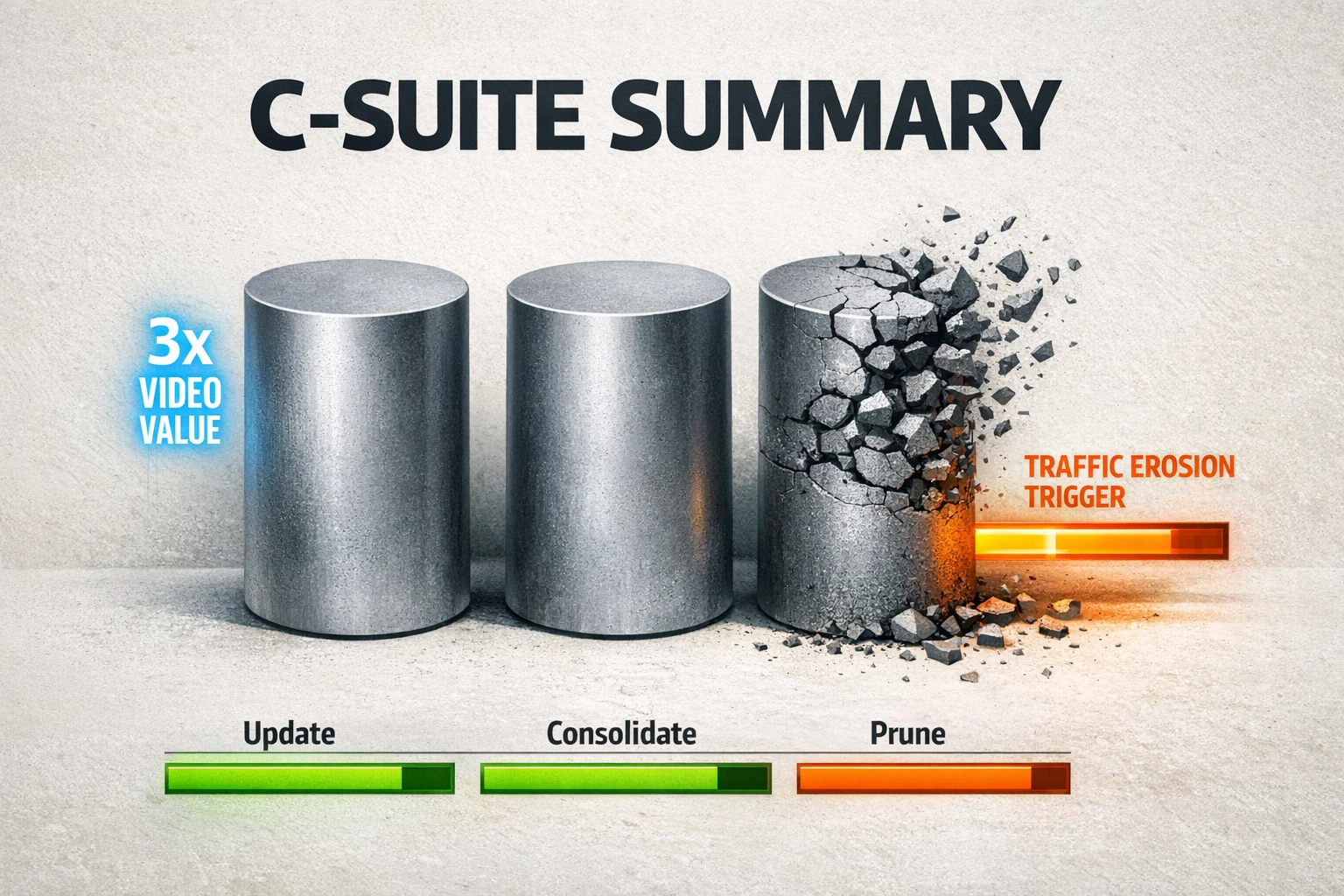
When auditing content for semantic overlap, classify every URL into one of four action paths:
- Keep: High-performing pages with strong entity coverage and high Information Gain.
- Update: Pages with strong intent alignment that need updated statistics, expert commentary, or visual assets.
- Consolidate: Multiple thin pages targeting overlapping entities, merged into a single comprehensive pillar asset.
- Prune: Outdated, zero-traffic assets that dilute overall domain focus and consume crawl budget.
To benchmark domain trust against competitors, modern AI tools evaluate key authority signals across search engine summaries to uncover hidden trust factors.
Algorithmic Content Decay Detection and Remediation
Content decay is a natural process, but unmanaged decay causes compounding traffic losses. Search queries evolve, competitors update their resources, and search engine preference shifts toward fresher entities.
Detecting decay requires tracking three distinct metrics over trailing 90-day periods:
- Impression Erosion: Search impressions drop while average position remains stable, signaling declining search interest for the topic.
- Position Slippage: Ranking position drops while total search volume remains steady, signaling that competitor pages are delivering superior Information Gain.
- Click-Through Decay: Clicks drop despite stable rankings, indicating that search engine result features or AI answers are satisfying user intent directly on the SERP.
When updating decaying assets, simple text additions rarely suffice. Content audits show that pages featuring at least one embedded video generate over 3x higher value compared to text-only pages [2]. Enhancing text content with original visuals, step-by-step methodologies, and video demonstrations restores page authority rapidly.
Rather than relying on generic writing tools that generate repetitive summaries, enterprise teams choose to work with best SEO strategist systems like pageBody. These systems analyze top-ranking pages across competitive verticals to deliver Ranking Asset Packages equipped with deep competitive research, internal linking architectures, and publish-ready deliverables.
Executive Summary Blueprint for C-Suite Approval
Presenting a massive audit spreadsheet to executive leadership creates decision friction. Chief Marketing Officers and Vice Presidents need clear financial implications, risk assessments, and resource plans.
Use this structured blueprint to translate technical content audit findings into actionable C-suite decisions:
1. Scope and Inventory Health
- Total URLs Audited: Total page count across active sub-directories.
- Asset Distribution: Breakdown of primary pillar content, support assets, and legacy pages.
- Topical Health Score: Percentage of domain content actively maintaining top 10 positions for core entities.
2. Material Gaps and Risk Exposure
- Semantic Cannibalization Risk: Number of URL clusters competing for identical search intents.
- Content Decay Liability: Total organic traffic value lost over the preceding 12 months due to unmaintained assets.
- Information Gain Deficit: Percentage of legacy articles offering low unique value compared to search engine consensus.
3. Financial and Resource Impact
- Pruning Efficiency: Hours saved by deleting zero-traffic assets and reducing maintenance overhead.
- Consolidation Upside: Expected traffic recovery from consolidating redundant URLs into authoritative pillar packages.
- Execution Roadmap: Resource allocation structured across 6-week operational audit sprints.
Tooling and Technology Stack Evaluation
Selecting tools for an AI content audit comes down to technical capacity and team workflow. Enterprise teams typically balance three primary execution approaches:
- Automated Cloud Crawlers: Rapid execution for URL mapping, metadata extraction, and canonical issue identification.
- LLM Prompt Workflows: Useful for semantic classification, entity extraction, and intent tagging across medium-sized URL sets.
- Specialized AI Transformation Partners: End-to-end systems that handle competitive intelligence, entity extraction, content asset creation, and direct CMS publishing.
While software tools highlight raw performance metrics, building durable search authority requires disciplined execution. AI transformation platforms like pageBody combine intelligent research engines like AImee with human perspective direction to deliver scalable content systems that build long-term topical authority.
Frequently Asked Questions
How often should an enterprise brand perform a content audit?
Enterprise brands should execute a comprehensive content audit at least twice a year. High-velocity publishing teams benefit from rolling quarterly audits focused specifically on content decay and semantic overlap across newly published sub-silos.
What is the difference between a content inventory and a content audit?
A content inventory is a complete quantitative catalog listing every URL, title, and metadata field across a domain. A content audit is a qualitative evaluation that measures performance, entity depth, Information Gain, and business value to determine specific actions for every asset.
How do you determine whether to consolidate or prune an underperforming URL?
Consolidate pages that target valuable search entities but lack individual depth or unique backlinks. Prune pages that have zero search impressions over 12 months, contain outdated compliance information, or carry zero strategic relevance to your primary domain focus.
Why does keyword gap analysis fail in AI-driven search?
Keyword gap analysis focuses exclusively on text string matching across competitor pages. Modern AI search engines evaluate entity relationships, topical focus scores, and Information Gain. Adding missing keywords to a low-quality article does not create unique value or earn citations in AI-generated answers.
Taking Action on Your Content Audit
To eliminate content debt and build real topical authority, start by auditing a single content silo rather than your entire domain at once. Isolate your highest-priority product or service folder, extract its URL performance metrics, and map every asset against your core entity topics.
---
Sources:
- Nielsen Norman Group - Operational guidance on content audit definitions and 6-week management timeboxing
- iPullRank - Agency benchmarking on content audit labor hours and video engagement value
- Skyword - Expert insights on Google site focus scores and niche topical specialization
- Yotpo - Technical analysis of Google Patent US20200349181A1 and Information Gain scoring models