Beyond the Prompt: Architecting AI Outlines for 5,000-Word Expert Guides
AI Summary
Beyond the Prompt: Architecting AI Outlines for 5,000-Word Expert Guides explains how to create authoritative long-form content with AI by designing human-guided, strategic outlines rather than simple prompts.
Who: Content creators, marketers, and AI users aiming to produce expert guides and whitepapers.
What: A five-stage human-AI collaborative framework to build comprehensive, nuanced AI content outlines.
When: Applied when preparing to create extensive, 5000+ word expert guides or whitepapers.
Where: In digital marketing, content strategy, and industries requiring authoritative long-form content.
Why: To generate cohesive, deep, and credible AI-assisted content that avoids generic or repetitive output and establishes thought leadership.
This article covers the full outlining process from strategic human blueprinting, AI structural generation, human refinement for authority, content type-specific application, to final validation checkpoints ensuring depth, originality, and reader engagement.</p>
You’ve seen it happen. You task an AI with writing a 5,000-word expert guide on a complex topic. You give it a solid prompt, and it starts generating text. But as you review the draft, a sense of disappointment creeps in. The sections feel disconnected, the arguments are repetitive, and the "expert" insights are just surface-level summaries.
The problem isn't the AI's writing ability. The problem is the blueprint. A generic outline creates generic content. To build a definitive, authoritative resource that establishes you as a thought leader, you need to stop thinking like a prompter and start thinking like an architect. The secret to exceptional long-form AI content lies not in the final draft, but in a meticulously crafted, human-guided outline.
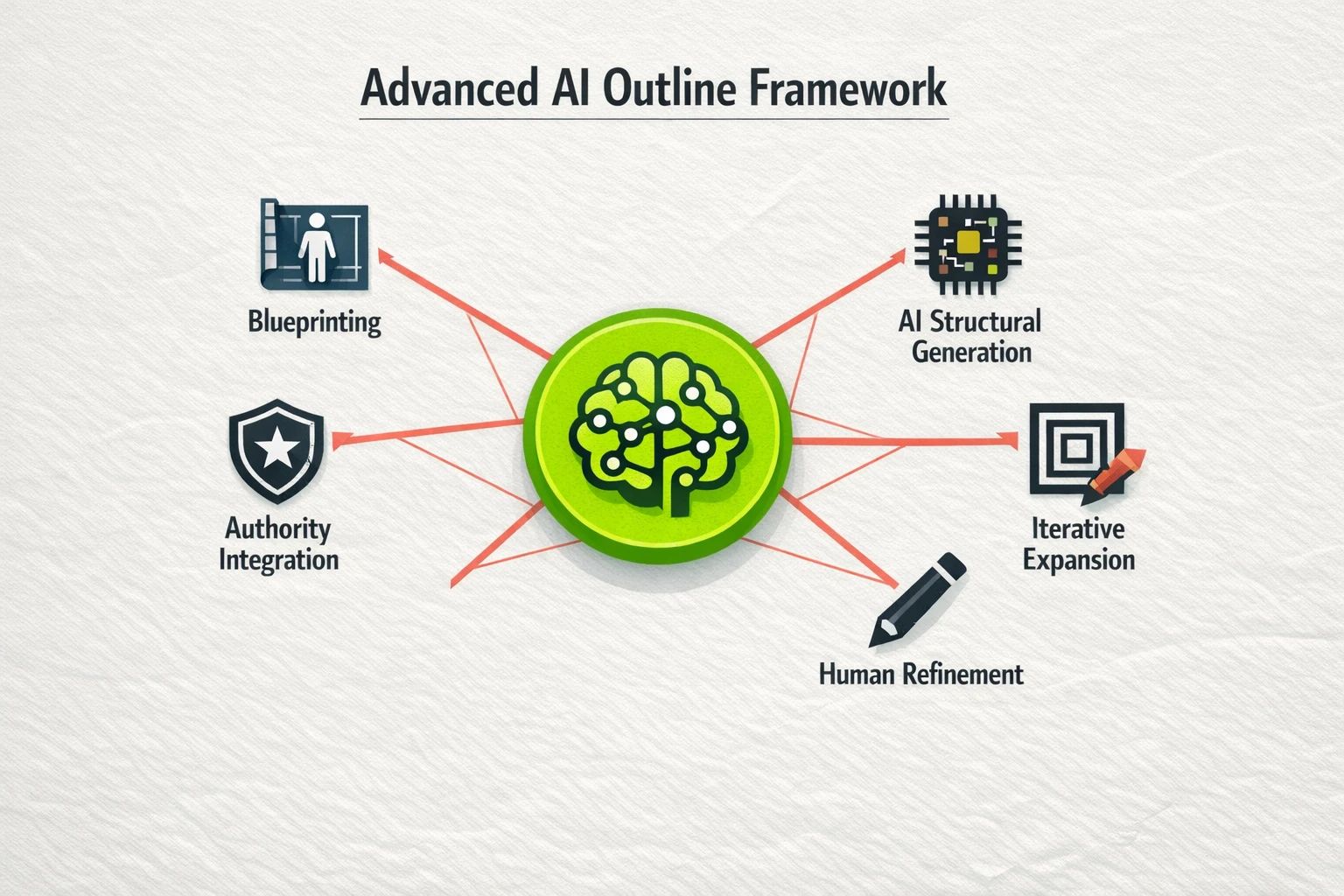
From Instruction to Architecture: Rethinking AI's Role
A basic outline tells an AI what to write about. An architectural outline tells an AI how to think about the topic. It provides structure, logical flow, nuance, and a clear path to build a comprehensive argument. For expert guides and whitepapers, this distinction is critical. You are not just listing topics; you are building a knowledge journey for your reader.
This advanced approach relies on a powerful partnership. Human expertise provides the strategic direction, unique insights, and critical thinking. AI provides the speed, structural generation, and ability to process information at scale. It’s a synergistic relationship where your knowledge is amplified, not replaced.
The 5-Stage Framework for Authoritative AI Outlines
Creating a truly robust outline for a 5,000+ word piece is a systematic process. It moves from high-level strategy to granular detail, ensuring every section serves a purpose and contributes to the overall authority of the content.
Stage 1: Strategic Blueprinting (The Human-Led Foundation)
Before you write a single prompt, you must define the strategic core of your content. AI cannot invent your unique perspective or understand your audience's deepest needs without your guidance. This stage is entirely human-led.
- Define Your Core Thesis: What is the single, powerful idea you want your reader to walk away with? This is your North Star.
- Map Your Audience: Who are you writing for? What do they already know? More importantly, what are their primary objections or questions? Answering this is key to developing a resource with a deep semantic understanding of business content.
- Identify Your Unique Angle: What proprietary data, unique experiences, or expert opinions can you bring to the table? This is what separates your content from the generic information already available.
- Gather Your Raw Materials: Collect key research, internal data, case studies, and expert quotes that will form the backbone of your arguments.
Stage 2: AI-Assisted Structural Generation
With your strategic blueprint in hand, you can now bring in your AI partner to build the skeleton. This is where advanced prompting comes into play. Instead of a simple request, you’ll craft a "Master Prompt" that provides comprehensive instructions.
Your Master Prompt should include:
- The Core Thesis and Target Audience: Give the AI context.
- The Desired Tone and Voice: Is it academic, instructional, or persuasive?
- A High-Level Structure: Propose the main sections (e.g., Introduction, Problem Analysis, Solution Framework, Case Studies, Conclusion).
- Key Arguments and Data Points: Instruct the AI to incorporate your specific data and arguments within the relevant sections.
- Anticipated Objections: Ask the AI to create sections or sub-points that proactively address the reader objections you identified in Stage 1.
The AI will generate a first-pass outline. Now, the process becomes iterative. Use follow-up prompts to refine and deepen each section. For example: "Expand section 2.1 to include three sub-points that compare solutions A, B, and C, referencing the efficiency data I provided."
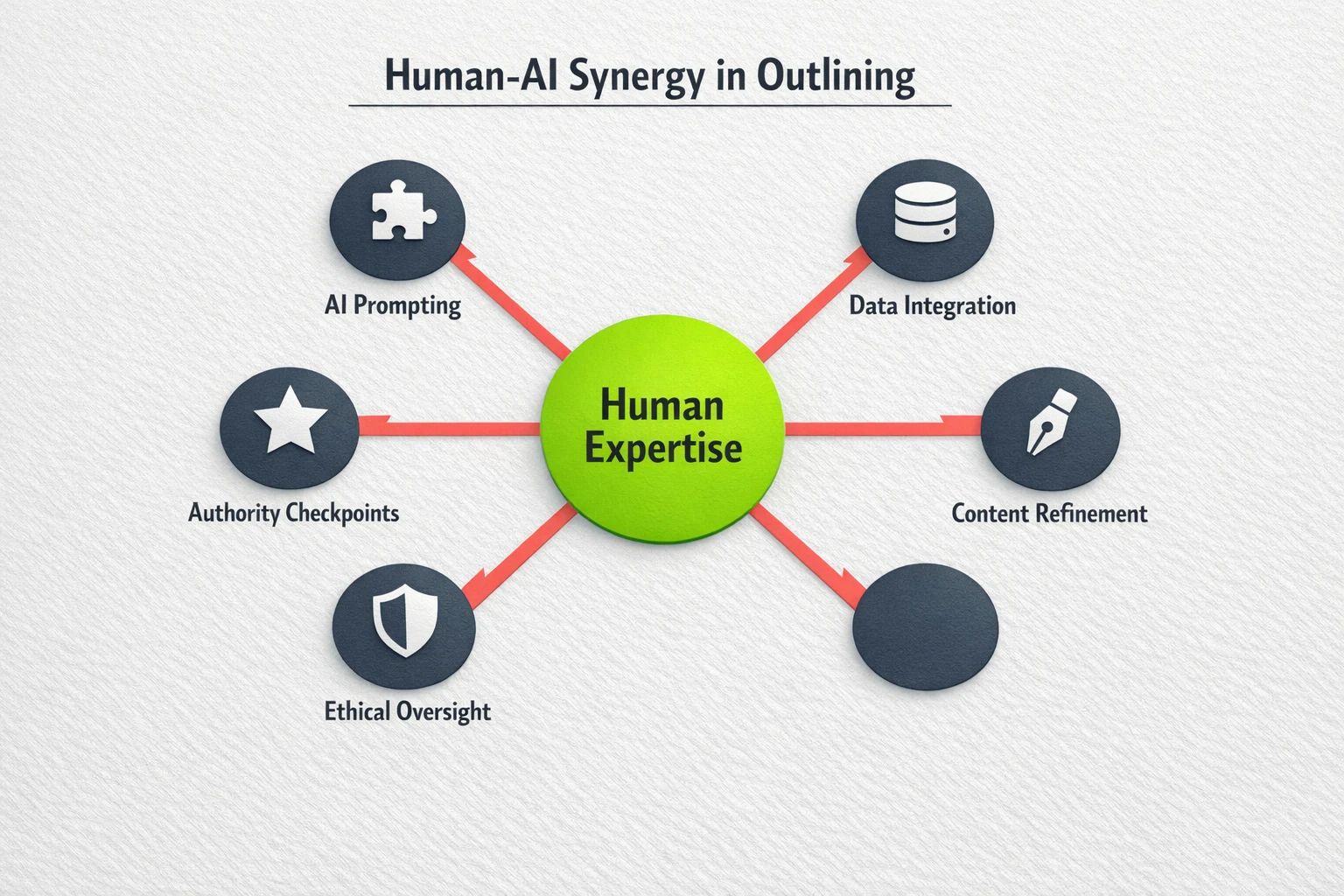
Stage 3: Injecting Authority and Expertise (The Human-Refinement Loop)
The AI has built a strong structure, but now you must infuse it with genuine authority. This is a critical human-in-the-loop stage that prevents your content from feeling generic.
- Placeholders for Originality: Review the AI-generated outline and insert specific placeholders like
[Insert proprietary data chart on Q3 customer trends]or[Include quote from CEO on the future of this technology]. - Refine Arguments for Nuance: AI-suggested points can sometimes be black and white. Your job is to add the shades of gray. Refine the arguments to reflect the complexities and nuances of the topic.
- Ethical Oversight: Fact-check any data points or claims suggested by the AI. Ensure the outline promotes a balanced and unbiased perspective. Understanding how expert content is contributing to AI perception of brand authority is vital for long-term success.
Stage 4: Mastery Through Application
Let's see how this works for two common types of long-form content.
- For a Data-Driven Whitepaper: Your Master Prompt would heavily emphasize the research methodology, data visualization sections, and a conclusion that presents clear, evidence-backed recommendations. You would prompt the AI to structure the argument around your key datasets.
- For a Comprehensive Expert Guide: The outline would focus on a progressive learning curve. You'd instruct the AI to build chapters that move from foundational concepts to advanced applications, ensuring a logical flow that doesn't overwhelm the reader.
Stage 5: Validation and Authority Checkpoints
Before you begin writing the final content, review your completed outline against a set of "authority metrics."
- Originality: Does the outline include placeholders for unique data and expert insights?
- Depth: Does it go beyond surface-level topics to address nuanced arguments and reader objections?
- Structure: Is the logical flow seamless? Does it guide the reader on a clear journey of discovery?
- Citatability: Does the outline incorporate elements like original research and expert quotes that make the final piece a citable resource? Knowing which brand narratives resonate and are retained by AI engines starts with building them into your content's DNA.
Avoiding Common Pitfalls of AI Outlines at Scale
When creating outlines for 5,000+ words, certain AI tendencies can become major problems. A strategic framework helps you avoid them.
- The Repetitive Loop: Without a detailed, hierarchical structure, AI can repeat the same core ideas in different sections. Your detailed blueprint forces it to build new arguments, not just rephrase old ones.
- Weak Transitions: A simple list of topics results in jarring transitions. An architectural outline, which defines how sections connect, allows the AI to create smooth, logical bridges between ideas.
- Lack of Progressive Depth: AI may present all information with the same level of importance. Your human-guided structure ensures the content builds in complexity, respecting the reader's learning journey. Continuously refining your approach is key to creating content tuned for AI and user engagement.
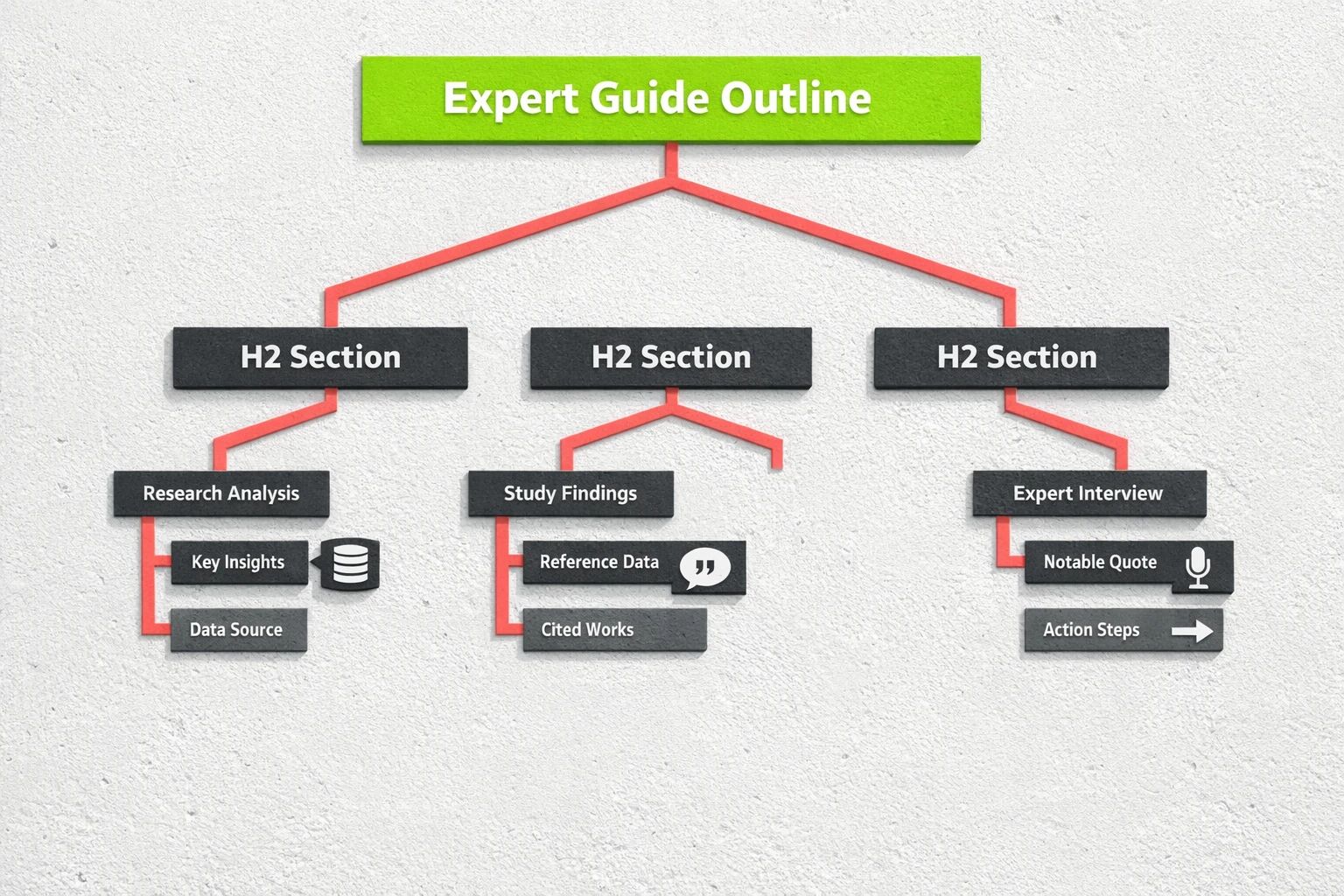
Your Path to Becoming a Content Architect
Creating truly authoritative long-form content with AI is not about finding the perfect prompt. It's about adopting a new role. You are the architect, and the AI is your master builder. By providing a detailed, strategic, and human-refined blueprint, you empower your AI to construct an expert guide or whitepaper that stands as a definitive resource in your industry.
This methodical approach transforms content creation from a game of chance into a predictable process for generating excellence. It ensures that your final 5,000-word piece is not just long, but deep, coherent, and genuinely valuable.
Frequently Asked Questions
What is AI content outlining?
AI content outlining is the process of using artificial intelligence tools to help generate a structured plan or framework for a piece of content. In its advanced form, it involves a strategic partnership where a human provides the core thesis, audience insights, and unique data, while the AI helps build out a detailed, hierarchical structure with logical flow.
How can AI help me create outlines?
AI can accelerate the outlining process significantly. It can brainstorm potential sub-topics, organize your ideas into a logical structure, create different outline variations for you to choose from, and ensure comprehensive coverage of a topic by identifying potential gaps in your initial plan.
What are the basic steps to create a content outline with AI?
The basic steps include: 1. Define your primary topic and target audience. 2. Provide the AI with a prompt that includes your topic, key points you want to cover, and the desired format (e.g., blog post, guide). 3. Review the initial outline generated by the AI. 4. Use follow-up prompts to refine, expand, or reorganize sections until you are satisfied.
What AI tools are available for outlining?
Many general large language models (LLMs) like those from OpenAI, Anthropic, and Google are excellent for outlining when given detailed prompts. Additionally, many specialized AI writing platforms have built-in outlining features designed specifically for content creation workflows. The best tool often depends on your specific needs and existing software stack.
How do I avoid repetitive or inaccurate AI output in my outlines?
To avoid repetition, provide a highly detailed and hierarchical prompt that specifies the unique purpose of each section. This prevents the AI from defaulting to the same core ideas. To avoid inaccuracies, always treat the AI as an assistant, not an expert. The human-led blueprinting and refinement stages are crucial for fact-checking and injecting verified, authoritative information into the outline.