Stop Counting Keywords How AI Reveals Your Competitor's Real Content Strategy
AI Summary
AI deconstructing competitor content clusters reveals not just keyword counts but the strategic web connecting topics that builds authority. This approach exposes how competitors create comprehensive semantic topic clusters instead of isolated keywords.
- How AI maps competitor pillar pages and related clusters to show true topical authority
- Identifying content gaps using AI combined with human insight to avoid automated traps
- Understanding the tone and audience focus hidden within competitor ecosystems for targeted strategy
Your advantage comes from interpreting AI findings to craft a superior content blueprint that drives lasting SEO authority.
Your competitor just published five new articles. Your instinct is to run them through a tool, pull the keywords, and see what you missed. It’s a familiar, frantic cycle. You’re playing a game of whack-a-mole, chasing individual search terms while your rival seems to be building something bigger, something that attracts traffic without fighting for every single keyword.
Here’s the problem: you’re counting the bricks while they’re building a fortress. The real strategy isn't hidden in the keywords. It’s in the connections between them. It’s the topical architecture, the invisible web of ideas that proves their authority to search engines and users alike.
The good news is that you can finally see this blueprint. AI gives us the power to deconstruct a competitor’s entire content ecosystem, not as a list of terms, but as a strategic map. This isn't about writing more content. It's about seeing the battlefield clearly for the first time.
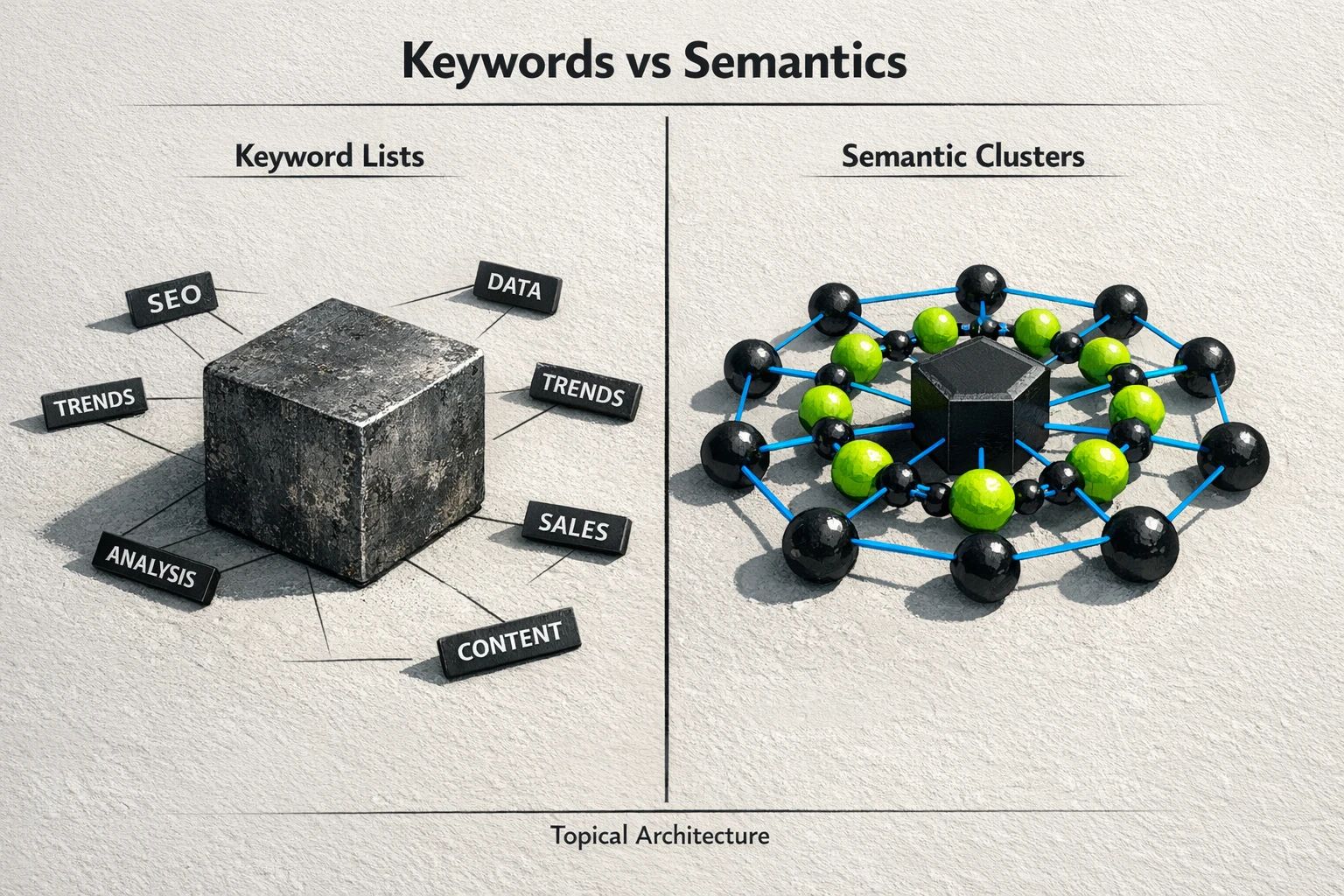
Beyond the Keyword: What AI Is Actually Looking For
For years, SEO has been a game of lists. Keyword lists, backlink lists, checklist audits. But search engines have moved on. They no longer just match words; they understand concepts. This is the world of semantic search, and the winners are those who build topical authority.
Think of it like this. A keyword is a single ingredient, like "flour." A topic cluster is the whole recipe, like "how to bake sourdough bread." The recipe uses flour, but also water, salt, and yeast. It explains techniques like folding and proofing. It connects all these related concepts into a single, authoritative guide. Someone who only writes about "flour" has no authority. Someone who publishes a comprehensive collection of bread recipes becomes the go-to resource.
This is what your competitors are doing. They are building out these clusters, connecting a central "pillar" page (the main recipe) with dozens of supporting articles (tips on ingredients, techniques, and variations). This interconnected structure signals to Google that they have deep expertise on a subject, making them a more reliable source to recommend to searchers. The goal isn't just to rank for one term, but to own the entire conversation.
The Human-AI Workflow: A New Kind of Competitive Intelligence
AI is incredibly fast at reading everything your competitor has ever published and mapping these relationships. It uses technologies like Natural Language Processing (NLP) to understand the meaning and context of words, grouping related articles into the clusters we just discussed. It can do in minutes what would take a human analyst weeks.
But speed is not the same as strategy. Most companies treat AI like an oracle. They feed it data and blindly trust what comes back. This is a massive mistake. AI has a critical blind spot: it finds patterns without understanding purpose. It can tell you what your competitor wrote, but not why.
This is where you gain your advantage. The most effective approach is a human-AI collaboration. The AI is your analyst, processing terabytes of data. You are the strategist, interpreting the output and making the critical decisions.

Your role is to sanity-check the machine. AI models are notorious for "hallucinations," where they confidently invent facts or relationships that do not exist. In competitive analysis, this is dangerous. Generative AI often fabricates details when dealing with complex hypotheticals like the semantic relationships in a competitor's content strategy [1]. Without a human expert to validate the map, you could end up chasing ghosts and building your strategy on flawed data. A page like this one, on AI-driven competitor authority analysis, further explores how to identify the real signals of authority that AI can surface.
How to Deconstruct Their Strategy in Four Steps
- Map the Territory: Use an AI tool to ingest your competitor's sitemap and blog content. Ask it to identify their primary topic pillars and the cluster content that supports each one. The output should look like a mind map, not a spreadsheet.
- Find the Unfinished Roads: Now, look at the map with a critical eye. Where are the clusters thin? Which pillars have only one or two supporting articles? Where does a logical connection between two topics exist on the map, but they haven't written the content to bridge it? These are your entry points.
- Identify the Voice: Ask the AI to analyze the tone, vocabulary, and common arguments used within each cluster. Are they technical and academic? Casual and story-driven? Do they target beginners or experts? This reveals the audience they are trying to own. Your opportunity might be to serve the audience they are ignoring.
- Create a Better Blueprint: Your goal is not to copy their map. It is to draw a better one. Use the gaps you found not just to "fill in the blanks," but to create a pillar page that is more comprehensive, address a more specific audience, or introduce a contrarian point of view that they have missed.
More Than an SEO Tactic: A Proven Analytical Method
This method of mapping conceptual relationships is not a niche marketing trick. It is a cornerstone of data science used in fields that demand absolute rigor. Researchers use these same techniques to make sense of massive datasets, from legal documents to medical journals.
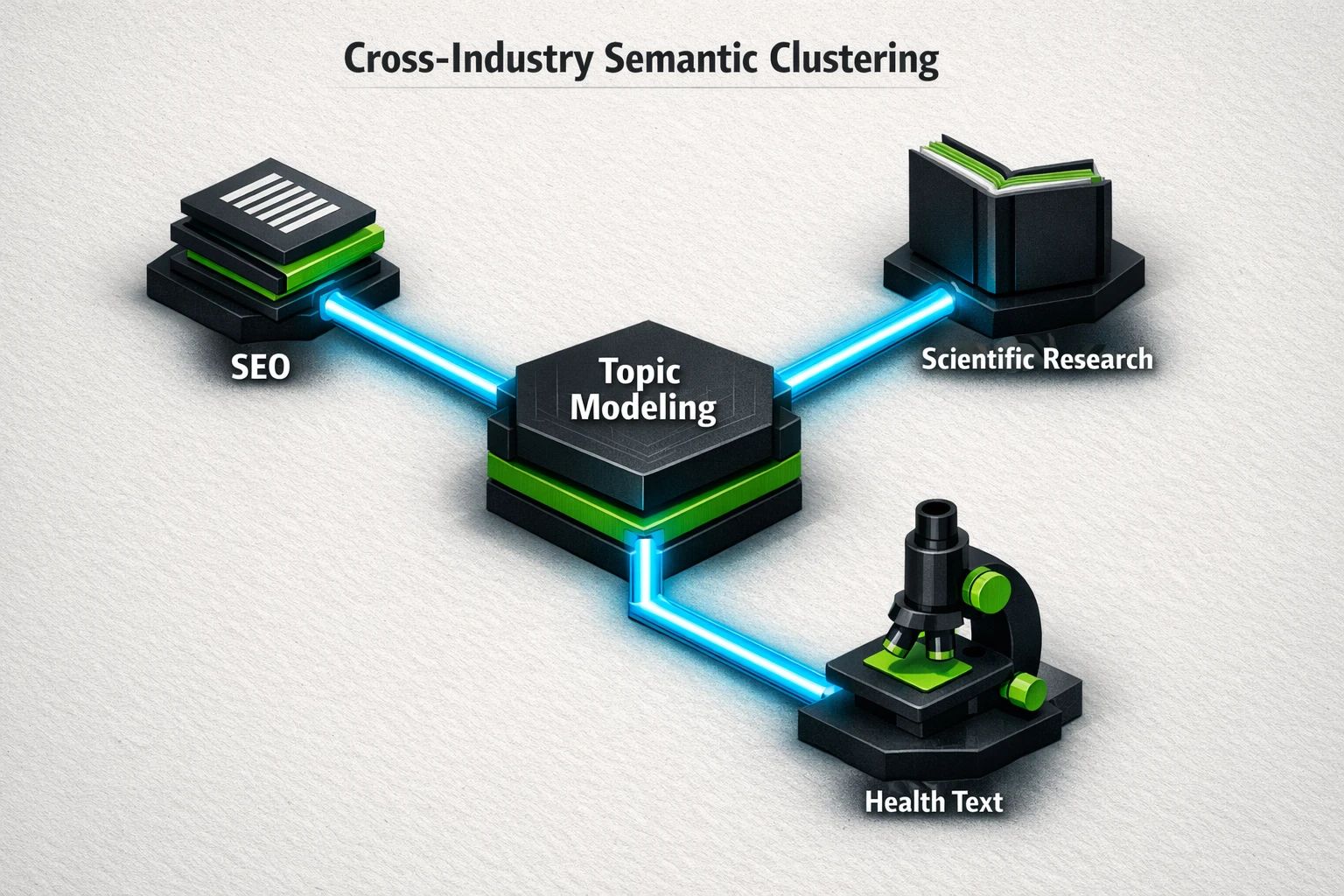
In scientific research, for example, semantic clustering is employed to organize and interpret huge volumes of text, with one study finding that topic modeling was the most comprehensive way to identify subjects within the data [2]. When you use AI to map a competitor’s content, you are deploying the same powerful analytical lens that scientists use to find patterns in complex information. This brings a level of strategic depth that simple keyword tracking can never match, turning your marketing from a guessing game into a repeatable science. This is the new foundation of any modern SEO intelligence agency.
From Theory to Traffic: The Proof Is in the Results
This strategic approach to content gets real, measurable results. It is not theoretical. By focusing on building authority through comprehensive topic clusters, companies are driving significant organic growth that is far more durable than rankings for a few scattered keywords.

Consider the results from real-world execution. In one case, a single well-structured topic cluster for the company Viral Loops resulted in rankings for over 1,100 organic keywords [3]. This demonstrates the compounding power of a cluster; you are not just ranking for the terms you target, but for hundreds of long-tail variations as well.
The impact on business goals is even more direct. Dr. David McInnis Orthodontics used AI-powered tools to restructure their site around high-intent topics identified through this type of analysis. The outcome over six months was a 472% increase in organic traffic and a 380% growth in patient inquiries [4]. This is the ultimate validation. A better content strategy does not just win rankings; it builds the trust that drives revenue. Understanding how you can measure marketing ROI when AI is changing search behavior is crucial, as it shifts focus from keyword volume to authority and influence.
Frequently Asked Questions
What are topic clusters and why do they matter for SEO?
A topic cluster is a group of interlinked articles and pages centered around a core topic. It consists of a main "pillar" page covering the topic broadly, linked to multiple "cluster" pages that dive into specific sub-topics in detail. This structure signals to search engines that you have deep expertise on a subject, which can improve your rankings for all related terms.
Can AI really find content gaps my competitors are missing?
Yes, but with an important caveat. AI is excellent at spotting explicit gaps, meaning sub-topics that are logically related to a competitor's main pillar but have no corresponding content. However, it requires a human strategist to identify the implicit gaps: the unique angles, different audiences, or contrarian viewpoints that AI, focused on existing patterns, would never suggest.
What is the biggest mistake people make when using AI for this?
The biggest mistake is "strategy by automation." This is when you let the AI identify a competitor's cluster and then simply command it to "write articles to fill the gaps." This leads to generic, "me-too" content that has no unique voice or value. The AI is a research assistant, not the chief marketing officer. Your job is to take its analysis and build a differentiated strategy on top of it.
The game has changed. Your competitors are not just writing articles; they are building ecosystems of authority. Chasing their keywords is a losing battle.
Your next step is not to find a better AI tool. It is to change your perspective. Pick one major competitor and manually sketch out what you believe their three main content pillars are. Then, use an AI tool to do the same analysis. The difference between those two maps, between what you assumed and what the data reveals, is where your real strategy begins.
Sources
- Competitive Intelligence Alliance - An overview of the primary limitations of generative AI in competitive intelligence analysis.
- Arxiv - An academic paper comparing text analysis methods for interpreting large corpora in scientific research.
- Minuttia - A case study detailing the SEO performance of a topic cluster for the company Viral Loops.
- Lasse Rouhiainen - A guide on AI competitor research that includes a case study on Dr. David McInnis Orthodontics.