Beyond Keywords: A Guide to AI-Driven Competitor Authority Analysis
AI Summary
Beyond Keywords: A Guide to AI-Driven Competitor Authority Analysis explores how AI enhances competitor analysis by revealing deeper trust and authority signals missed by traditional SEO tools.
Bottom Line: Gain a strategic edge by understanding why competitors rank well, enabling you to create superior content and authority.
What You'll Learn:
- How to benchmark E-E-A-T signals using AI at scale
- Identifying content gaps and untapped opportunities through semantic analysis
- Reverse-engineering top content structures for better SEO results
Best For: Marketers and SEO professionals seeking actionable ways to build genuine authority and outperform competitors efficiently.
You've done the keyword research. You've analyzed backlink profiles and tracked rankings until the charts blur. Yet, your competitors continue to dominate the top positions, seemingly untouchable. You know what they're ranking for, but you're missing the most critical piece of the puzzle: why.
Traditional SEO tools are excellent at showing you the surface level. They count links, track positions, and identify keyword gaps. But they can't tell you how your competitors build trust, demonstrate expertise, or establish authority in the eyes of Google and their audience. To win, you need to go deeper. This is where AI changes the game, moving you from simply counting keywords to truly understanding and outmaneuvering your competition's authority.
The Limits of Traditional Competitor Analysis
For years, competitor analysis has been a manual, time-consuming process. Marketers spend hours sifting through SERPs, manually reviewing top pages, and trying to reverse-engineer success from a handful of data points. This approach is not only slow but fundamentally incomplete. It overlooks the subtle, yet powerful, signals of trustworthiness and experience that search engines now prioritize.
You can see a competitor has more backlinks, but you don't know the contextual relevance of those links. You can see they rank for a topic, but you don't understand the semantic depth of their content cluster. This is the gap where opportunity is lost. AI-driven analysis automates this entire process and adds layers of insight that are impossible to achieve manually, giving you a clear roadmap to building genuine authority.
A Modern Framework: Deconstructing Authority with AI
An effective competitive strategy isn't about copying what works. It's about understanding why it works and then building something better. AI provides the tools to dissect your competitors' authority across three critical layers: E-E-A-T signals, topical depth, and content structure.
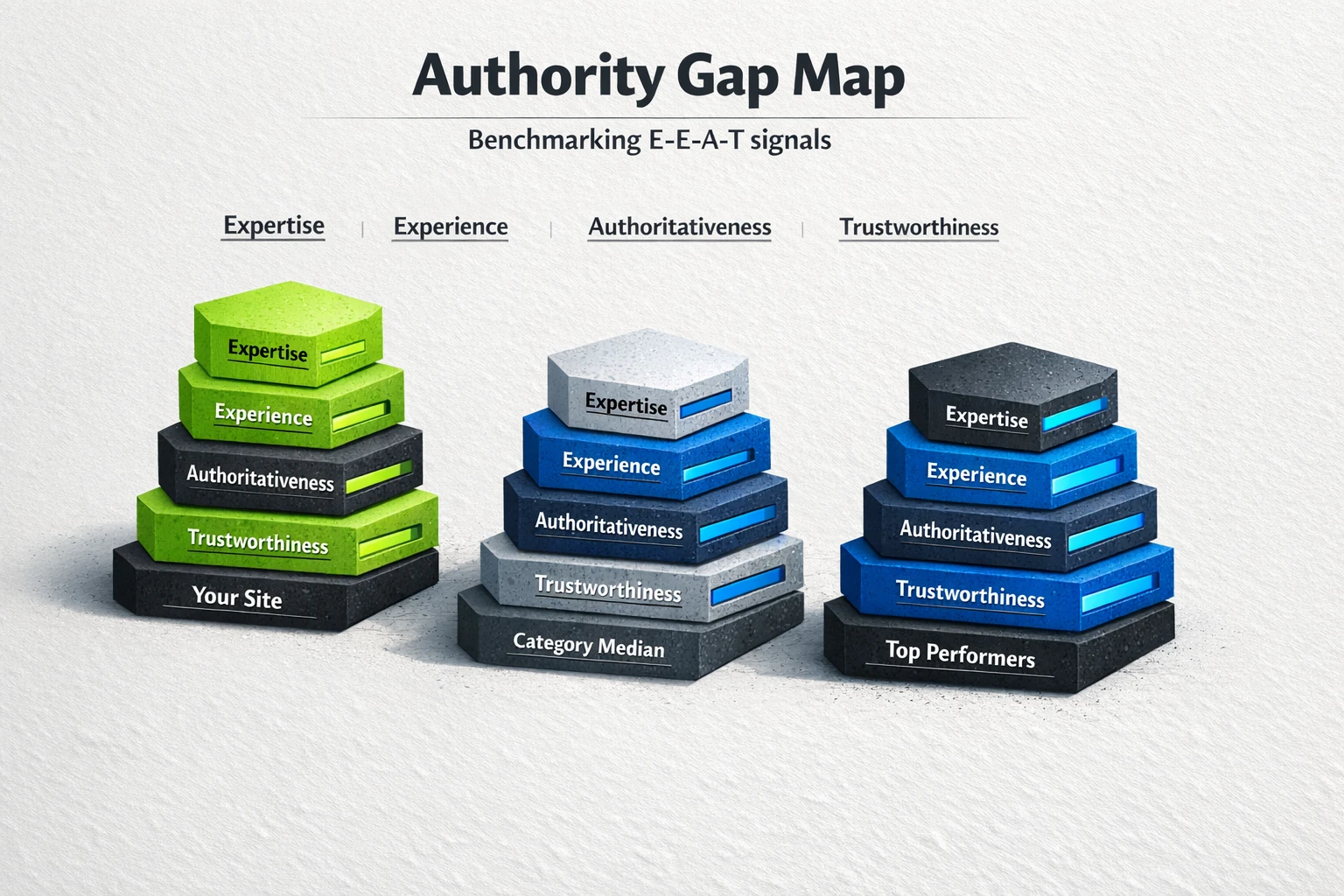
1. Benchmark E-E-A-T Signals at Scale
Experience, Expertise, Authoritativeness, and Trustworthiness (E-E-A-T) are the foundation of modern SEO. Instead of treating these as abstract concepts, AI allows us to measure them. By analyzing thousands of data points, an AI system can create a comprehensive benchmark of your competitors' perceived authority.
This involves looking beyond simple domain ratings. AI models can analyze the sentiment of brand mentions across the web, evaluate the expertise of authors cited in competitor content, and assess the contextual relevance of their backlink profiles. This process moves beyond guesswork, providing a visual map of where your competitors are strong and, more importantly, where their authority is weak. Understanding E-E-A-T in the AI era is the first step to building a content strategy that search engines and users trust.
2. Uncover Untapped Opportunities with Semantic Analysis
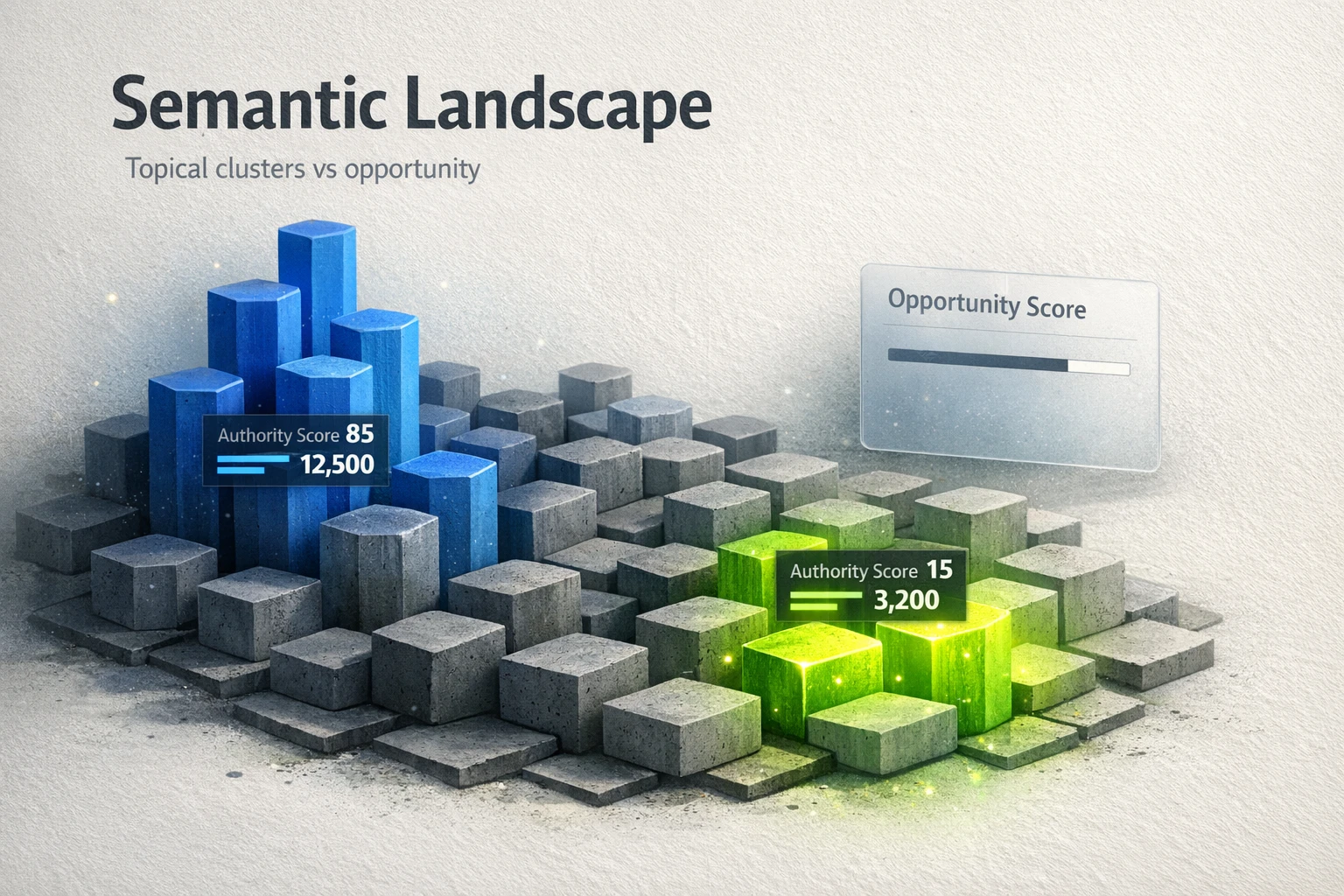
Your competitors may rank for obvious head terms, but where is their topical coverage thin? A simple keyword gap analysis won't tell you this. It might show you a list of terms you're missing, but it won't reveal the underlying strategic opportunities.
Semantic analysis maps out your entire competitive landscape. Instead of focusing on individual keywords, AI identifies the core concepts and subtopics your competitors cover. It visualizes their content as interconnected clusters of information. This reveals the strategic gaps in their knowledge base. You can pinpoint entire subject areas they've neglected or only covered superficially, giving you a clear path to establish your own expertise and capture valuable, low-competition traffic.
3. Reverse-Engineer Winning Content Structures
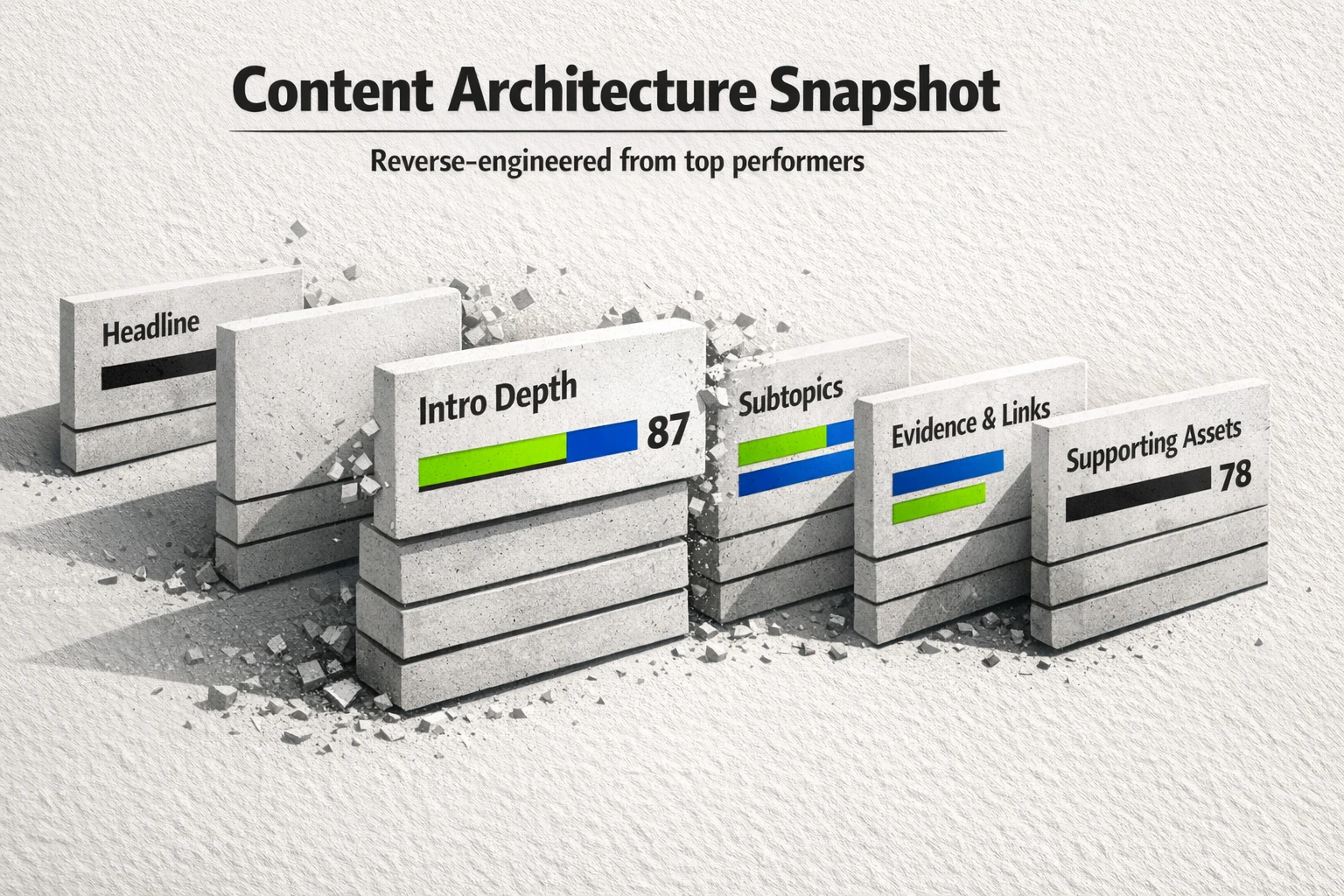
Why does one article outperform another, even when they target the same keywords? The answer often lies in its structure. A top-ranking article isn't just a block of text; it's a carefully constructed asset designed to answer user questions comprehensively.
AI can deconstruct any competitor's article into its fundamental building blocks. It can identify the types of headings they use, the questions they answer in their FAQ sections, the data points they cite, and the internal linking patterns they employ. This provides you with a quantitative blueprint for success. You no longer have to guess what makes a piece of content great. You can see the exact components, improve upon them, and build an asset that is structurally superior. This tactical advantage is especially powerful for developing AI SEO solutions for small businesses that need to make every piece of content count.
From Insight to Action: Choosing Your AI Toolkit
The market for AI-powered analysis tools is growing rapidly. Platforms like Quantilope and GWI offer broad market research capabilities, while specialized tools like Visualping monitor specific website changes. The key is to find a solution that doesn't just give you data, but translates that data into an actionable strategy.
When evaluating your options, ask these questions:
- Is it specialized? Does the tool focus specifically on competitive authority and SEO, or is that just one feature among many?
- Is it actionable? Does it provide a prioritized content plan, or does it leave you with dashboards of raw data to interpret?
- Is it integrated? Does it combine E-E-A-T analysis, semantic mapping, and content deconstruction into a single, cohesive workflow?
This is precisely where our focus lies. A truly effective AI SEO strategist moves beyond isolated metrics. It synthesizes intelligence from every angle of your competitors' presence to build a content plan that is designed to win from day one.
Frequently Asked Questions
How is AI-driven analysis different from using standard SEO tools?
Standard SEO tools are excellent for quantitative data like backlink counts, keyword rankings, and traffic estimates. They show you what is happening. AI-driven analysis focuses on the qualitative aspects, helping you understand why it's happening. It analyzes content structure, semantic relevance, and trust signals to reveal the strategic foundation of your competitor's success.
Is the data from these AI tools accurate and reliable?
The most reliable AI systems ground their analysis in verifiable data. Instead of generating insights from a black box, they process and synthesize information from the live web, SERPs, and known data sources. This ensures the recommendations are based on real-world performance, not just abstract predictions.
This seems complex. How much technical skill do I need?
The goal of a great AI solution is to simplify complexity, not add to it. Leading platforms are designed to do the heavy lifting for you. They automate the data collection and analysis, presenting the findings as clear, actionable recommendations. You don't need to be a data scientist, you just need to be ready to execute a winning strategy.
Can AI really understand something as nuanced as E-E-A-T?
AI doesn't "understand" E-E-A-T in a human sense. Instead, it measures the digital proxies for it. It can analyze an author's publication history, identify mentions from authoritative sources, track sentiment around a brand, and map the citation network within a niche. By aggregating these signals at scale, it provides a highly accurate model of a brand's E-E-A-T profile.
What's the ROI of investing in AI-driven competitor analysis?
The return on investment comes from efficiency and effectiveness. You spend less time on manual research and more time creating content that is strategically designed to rank. This leads to higher-quality traffic, better resource allocation, and a sustainable competitive advantage built on true authority, not just temporary ranking tricks.
Ready to stop guessing and start building a content strategy based on deep competitive intelligence? Learn how the PageBody AI SEO Strategist can transform your approach.
---
Sources:
- Harvard Business Review - Provided strategic context on AI's role in market and product analysis.
- Quantilope - Information on AI co-pilots and automated research methods.
- GWI - Insights on leveraging proprietary data panels with AI for consumer analysis.
- Visualping - Details on AI-powered website change monitoring for tactical intelligence.
- Socialinsider - Framework for using AI to analyze social media performance and sentiment.
- Datagrid - Conceptual background on the use of AI agents for data integration and analysis.