Beyond Compliance: An Actionable Guide to AI Governance as a Strategic Advantage
AI Summary
This guide explores how to move beyond compliance and leverage AI governance as a strategic business asset. It lays out clear steps for building a robust internal framework aligned with global regulations like the EU AI Act and NIST RMF.
Bottom line: Implementing effective AI governance not only mitigates risk but drives innovation and builds customer trust, giving your organization a competitive edge.
What you'll learn:
- How to define ethical AI principles that guide safe deployment
- Practical ways to audit and monitor AI systems continuously
- Strategies to navigate evolving regulatory landscapes and future-proof AI risk management
Best for: Business leaders and risk managers aiming to adopt responsible AI practices while ensuring compliance and accelerating growth.
Navigating the world of artificial intelligence often feels like trying to build a skyscraper on shifting ground. You see the incredible potential for growth and efficiency, but you're also acutely aware of the risks. New regulations are emerging, ethical questions are becoming more complex, and the consequences of getting it wrong are significant. You're past asking "what is AI governance?" and are now facing the real challenge: how do you build a framework that not only protects your business but also accelerates its success?
This isn't just about avoiding fines. It's about building trust, fostering innovation, and creating a sustainable competitive advantage. Yet, a staggering 54% of organizational boards still don't list AI governance among their top five priorities. This creates a critical gap, leaving companies lagging in AI capabilities and exposed to unnecessary risk. This guide provides the practical, step-by-step clarity you need to move from policy to practice, transforming AI governance from a compliance burden into a core business enabler.
Developing Your Internal AI Governance Framework: A Step-by-Step Playbook
A robust AI governance framework isn't a restrictive document. It is an operational blueprint that aligns your AI initiatives with your core business values. It provides clarity for your teams and confidence for your customers.
Define Your Core AI Principles
Start by establishing the ethical pillars that will guide every AI project. These are not abstract ideals but concrete commitments. Common principles include:
- Fairness: Actively work to identify and mitigate harmful bias in your AI models and data sets.
- Transparency: Ensure you can explain how your AI systems make decisions, especially in high-stakes scenarios.
- Accountability: Clearly define who is responsible for the development, deployment, and outcomes of your AI systems.
- Privacy: Uphold stringent data protection standards, ensuring user consent and data minimization.
- Security: Protect your AI models and the data they process from internal and external threats.
Establish a Cross-Functional AI Governance Team
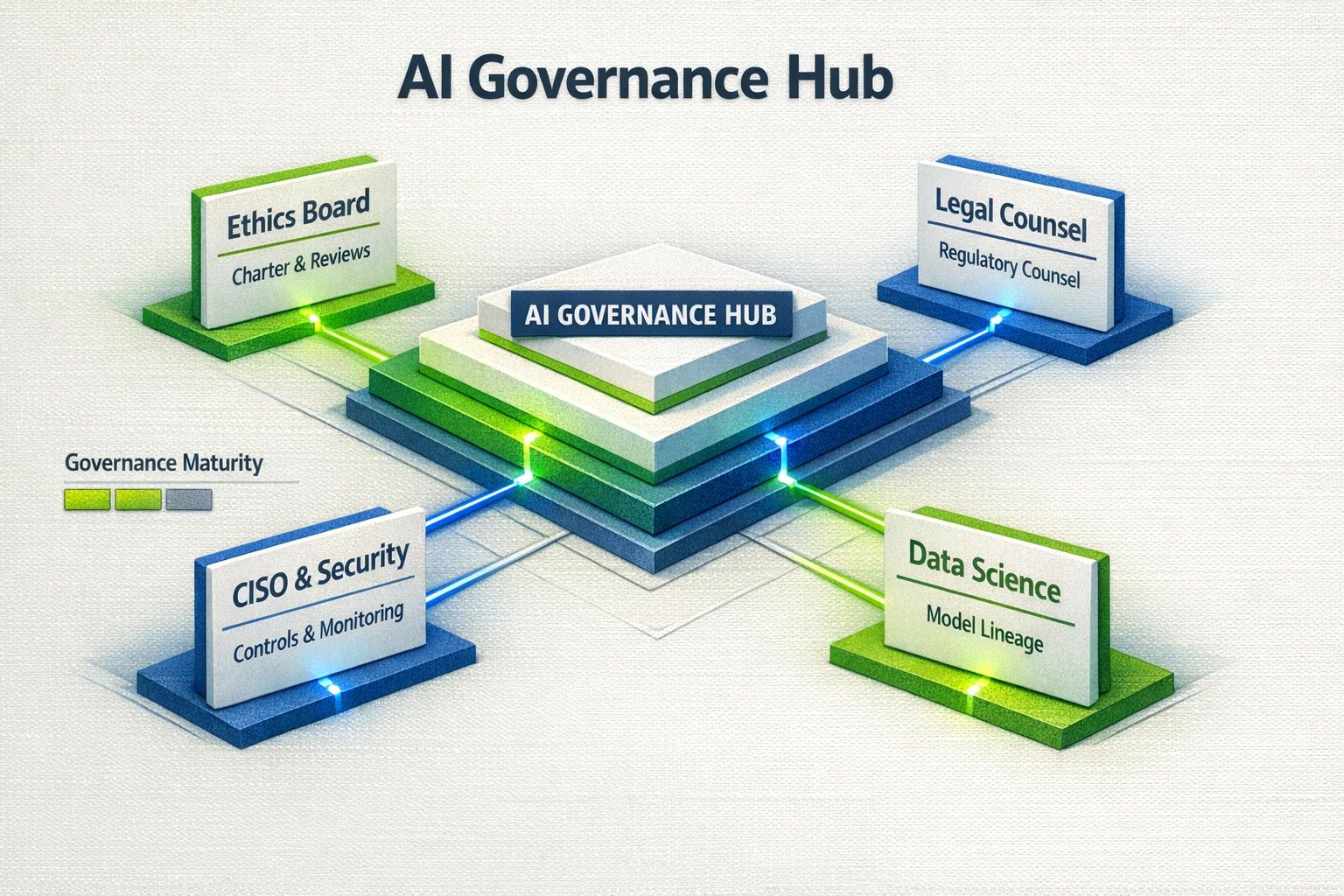
Effective governance cannot exist in a silo. It requires a collaborative effort from across the organization. Your team should include representatives from legal, IT, data science, and key business units. This structure ensures that diverse perspectives are considered and that policies are both technically sound and practically feasible. Many organizations find success with a hub-and-spoke model, where a central governance body sets standards and empowers individual teams to implement them within their specific contexts.
Address the "Shadow AI" Problem
One of the biggest risks is the AI you don't know you have. Employees using unauthorized generative AI tools or teams deploying models without oversight create significant security and compliance vulnerabilities. Your first step is to conduct a comprehensive inventory of all AI systems in use. Implement clear policies and technical controls to manage the acquisition and deployment of new AI tools, ensuring every system is accounted for and aligned with your governance framework.
A Practical Deep Dive into Global Regulations: EU AI Act & NIST AI RMF
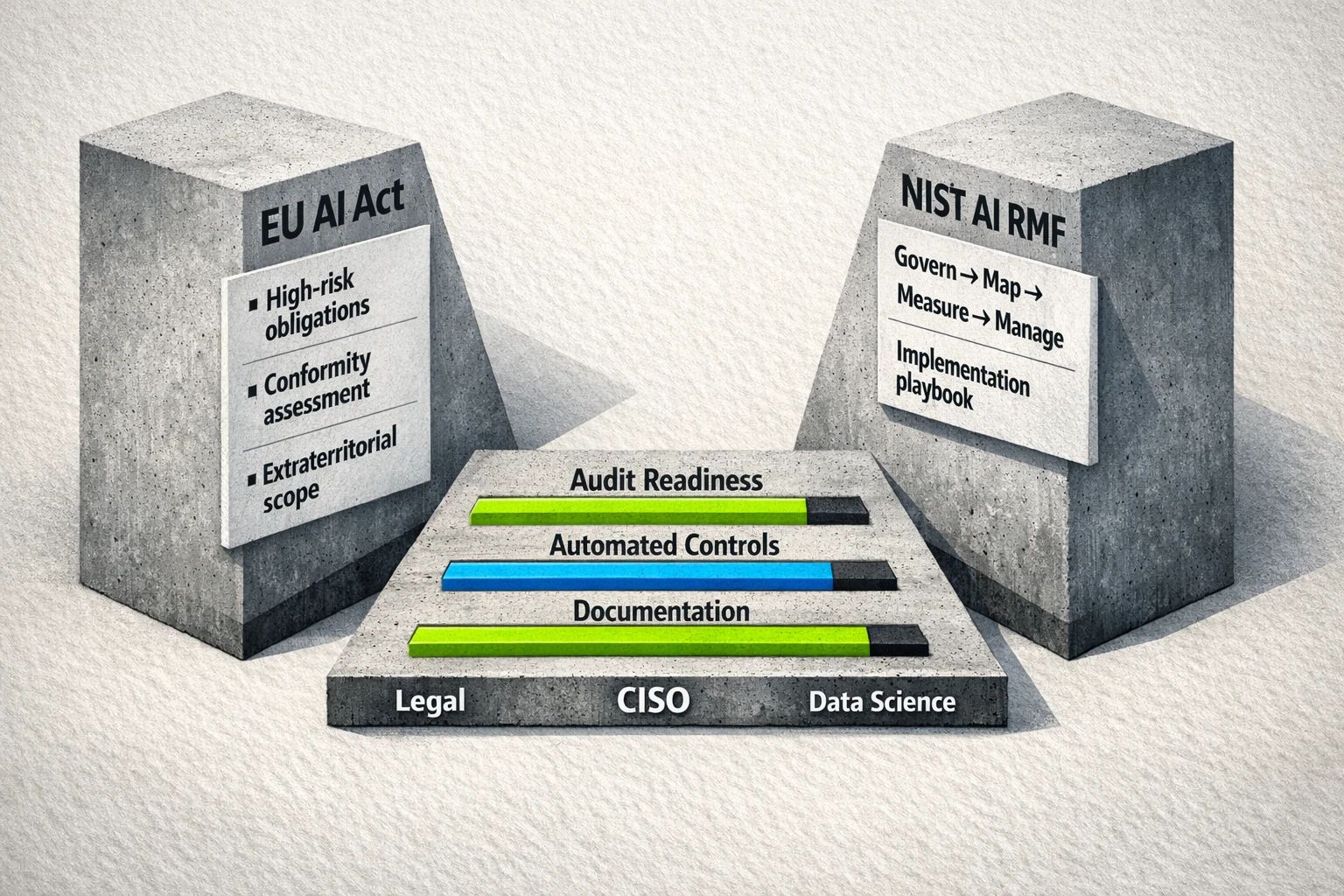
The regulatory landscape is evolving quickly, but two frameworks have emerged as global benchmarks: the EU's AI Act and the US's NIST AI Risk Management Framework (RMF). Understanding both is crucial for any organization operating on a global scale. Research shows that organizations aligning with the EU AI Act outperform their peers on major AI controls by 22 to 33 points, highlighting its role as a de facto global standard.
Understanding the EU AI Act
The EU AI Act is a comprehensive legal framework that categorizes AI systems based on their level of risk:
- Unacceptable Risk: Systems that pose a clear threat to safety and rights are banned (e.g., social scoring).
- High-Risk: AI used in critical sectors like healthcare, finance, and employment. These systems face strict requirements for risk management, data governance, transparency, and human oversight.
- Limited Risk: Systems like chatbots that must be transparent about their AI nature.
- Minimal Risk: AI applications like spam filters with no specific obligations.
For businesses, compliance means identifying which category your AI systems fall into and implementing the corresponding controls and documentation.
Implementing the NIST AI Risk Management Framework
The NIST AI RMF is a voluntary framework designed to help organizations manage AI risks. It is not a law but a set of best practices that are gaining widespread adoption. The framework is organized around four core functions:
- Govern: Establish a culture of risk management.
- Map: Identify the context and risks associated with your AI systems.
- Measure: Test, evaluate, and analyze AI risks.
- Manage: Allocate resources to mitigate identified risks.
The NIST framework is highly practical, providing actionable steps that can be integrated into your existing risk management processes. It complements the EU AI Act by providing a flexible "how-to" guide for achieving the Act's "what-to-do" requirements.
Advanced AI Auditing: Building Trust Through Technical Rigor
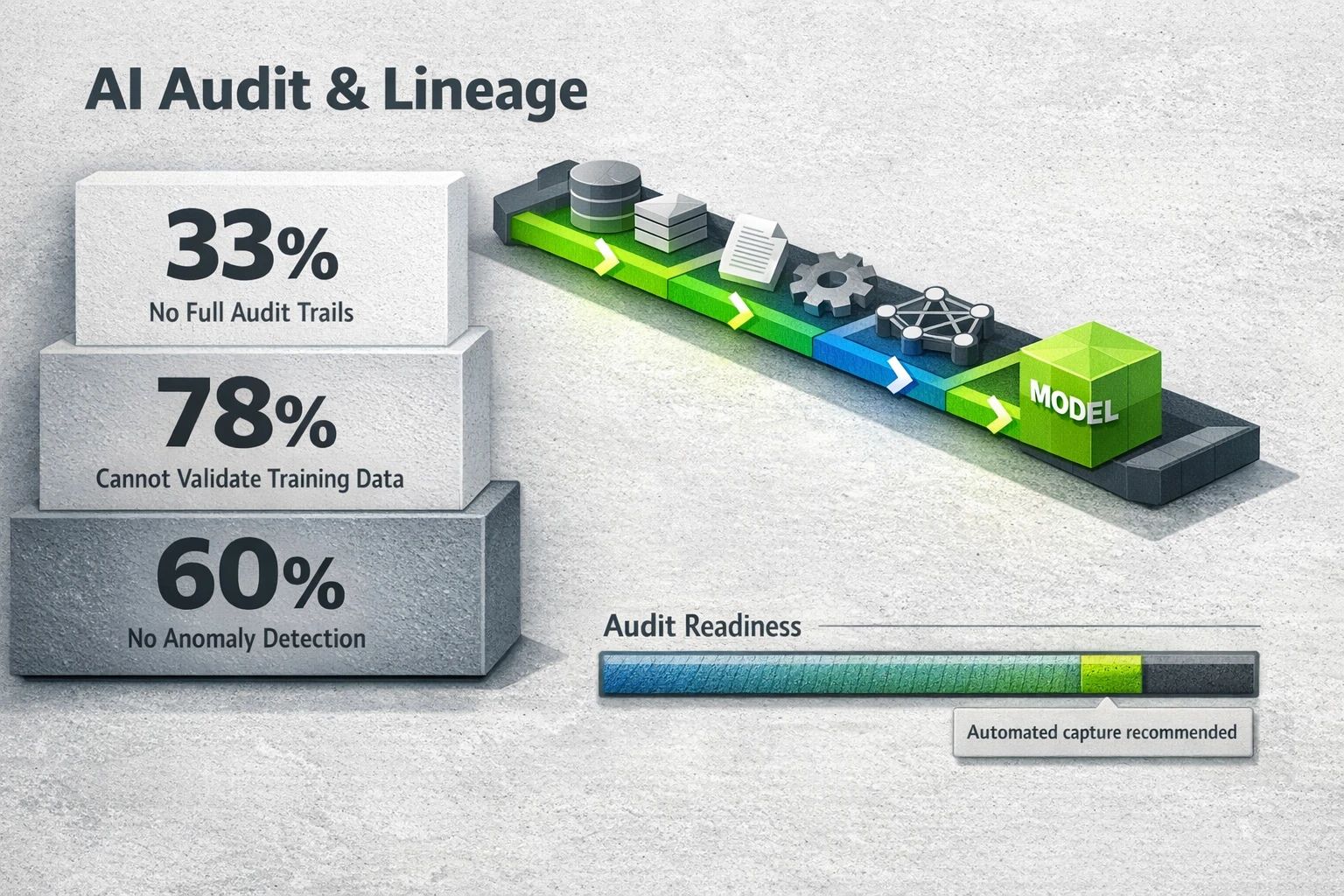
Proving compliance requires more than just policies. It demands robust, continuous auditing of your AI systems. Unfortunately, many organizations are unprepared. Current data reveals that 33% of companies lack comprehensive AI audit trails, and a concerning 78% cannot validate their AI training data.
The Power of Granular Model Lineage
To pass regulatory scrutiny, you must be able to trace every decision your AI makes back to the data that influenced it. This requires granular data and model lineage, tracking data transformations at the column or feature level. Without this traceability, explaining an unexpected or biased outcome becomes nearly impossible. Implementing automated systems to capture this lineage is no longer a best practice. It is a fundamental requirement for responsible AI. These systems can be enhanced with an ai internal linking agent to automatically connect audit logs, policy documents, and risk assessments, creating a fully integrated and navigable governance knowledge base.
Continuous Monitoring for Bias, Drift, and Performance
An AI model is not a static asset. Its performance can degrade over time, a phenomenon known as model drift. Biases can also emerge as it processes new data. Effective governance requires continuous, automated monitoring to detect these issues in real time. This includes tracking key performance metrics, running regular bias detection tests, and setting up alerts for anomalies. This proactive approach allows you to address problems before they cause significant business or reputational harm.
Navigating the Legal Landscape: AI Liability, Risk, and Future-Proofing
As AI becomes more autonomous, questions of liability and accountability become more urgent. Who is responsible when an AI system makes a mistake? The developer, the deployer, or the user? The legal frameworks are still catching up, but proactive risk management is essential.
Managing AI Supply Chain Risk
Your AI governance framework must extend beyond your own walls. If you use third-party AI models or data sets, you are inheriting their risks. You need a rigorous vendor assessment process that evaluates their data sourcing ethics, security practices, and compliance with regulations. Your contracts should clearly define liability and require transparency into their models and processes.
The Quantum Threat and Post-Quantum Cryptography (PQC)
Looking ahead, the emergence of quantum computing poses a significant threat to current encryption standards. A future quantum computer could easily break the encryption protecting your sensitive training data and proprietary models. This is why 29% of organizations already cite cross-border data exposure as a key concern. Proactively implementing Post-Quantum Cryptography (PQC) is a critical step in future-proofing your AI governance. While 84% of organizations have not yet adopted PQC, getting ahead of this threat demonstrates a mature approach to long-term risk management.
Your Roadmap to Mature AI Governance
Achieving mature, automated AI governance is a journey. Most companies today are at Level 1 (ad-hoc) or Level 2 (policy-driven). The goal for scaling AI responsibly is to reach Level 3, where governance is embedded into your platforms with automated guardrails.
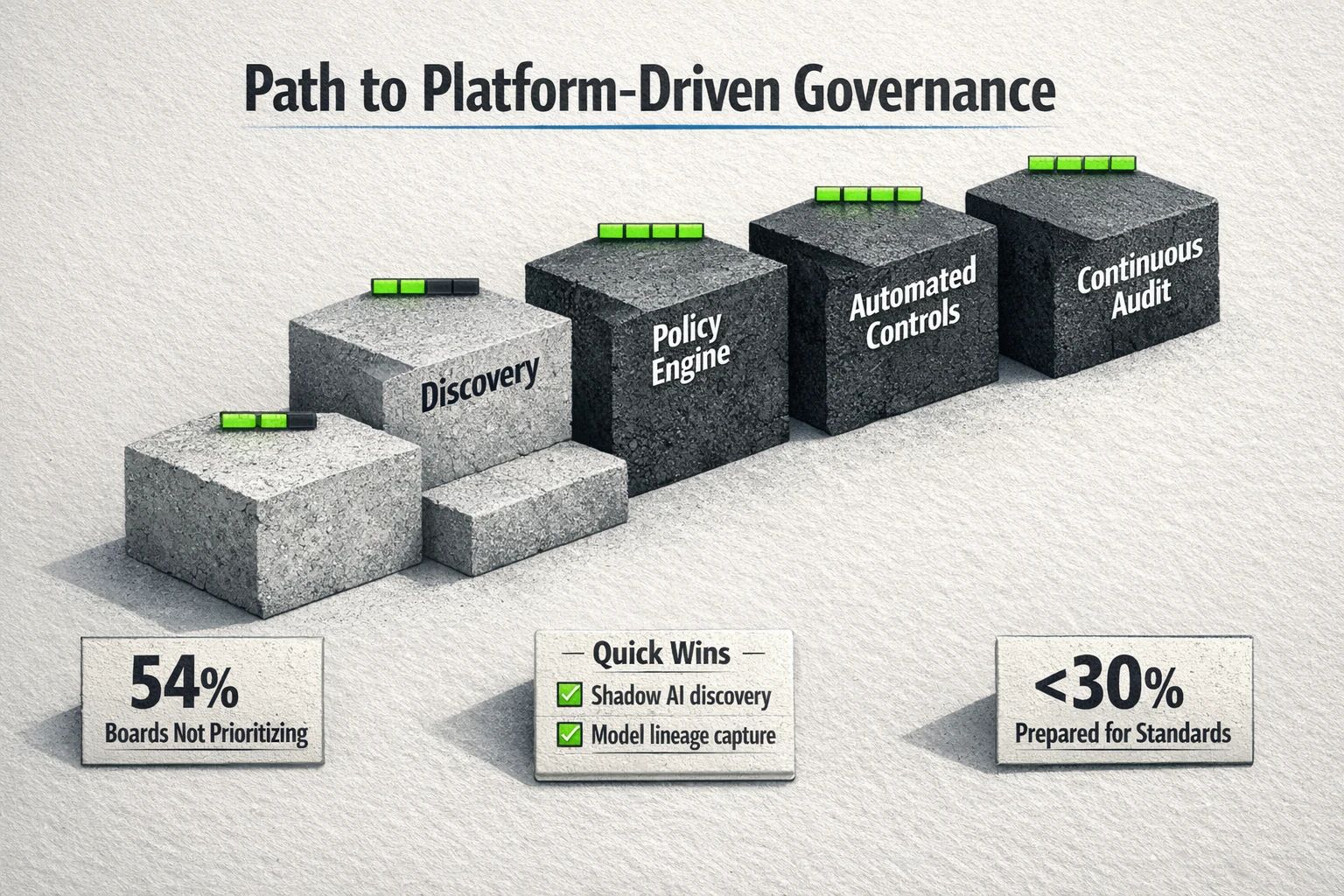
This roadmap involves moving from manual reviews to automated compliance checks, from periodic audits to continuous monitoring, and from reactive problem-solving to proactive risk management. By investing in the right tools and processes, you can build a scalable framework that supports innovation while maintaining control.
PageBody AI specializes in helping businesses like yours implement these advanced AI systems. Our solutions are designed to automate the complexities of governance, from ensuring regulatory compliance to providing the deep technical insights needed for robust auditing. We help you build the foundation for responsible and successful AI adoption.
Frequently Asked Questions about AI Governance
What's the difference between AI ethics, governance, and compliance?
AI ethics are the high-level moral principles that guide your approach to AI. AI governance is the operational framework, including the policies, roles, and processes you create to put those principles into practice. AI compliance is the outcome of good governance, representing your adherence to specific laws and regulations like the EU AI Act.
Our company is small. Do we really need a formal AI governance framework?
Yes. The risks associated with AI are not limited to large enterprises. A data breach, a biased hiring algorithm, or misuse of customer data can be devastating for a small business. A scalable governance framework protects you from these risks and builds a foundation of trust with your customers from day one. You can start small by defining principles, assigning clear responsibilities, and creating a simple inventory of your AI tools.
Where is the best place to start with AI governance?
The best starting point is an AI inventory. You cannot govern what you cannot see. Conduct a thorough audit to identify every AI system and tool currently in use across your organization, including any "shadow AI." This assessment will help you understand your risk exposure and prioritize your governance efforts.
How can we justify the cost of implementing a robust AI governance program?
Frame it as a strategic investment, not just a cost. The ROI of good governance comes from several areas. It helps you avoid massive regulatory fines and reputational damage. It accelerates innovation by giving your teams clear, safe guidelines to work within. It builds customer trust, which is a powerful competitive differentiator. Finally, it improves decision-making and reduces operational risks associated with flawed or biased AI systems.
Sources:
- Perplexity AI Research Compilation - Provided key statistics on AI governance prioritization, audit trail gaps, and maturity levels.
- IBM's Guide to AI Governance - Offered foundational concepts and the importance of the human element in AI.
- NIST AI Risk Management Framework - The primary source for the official framework and its core functions.
- The EU AI Act Official Information - Provided the basis for the risk-tier breakdown and compliance obligations.
- IANS Research AI Governance Policy - Gave practical insights into detailed policy components like addressing public generative AI use.
- WitnessAI's Guide to AI Compliance - Highlighted the importance of "AI Privacy" and the risk of "Shadow AI".
- FairNow's Policy Development Guide - Provided the valuable distinction between aspirational AI policy and practical governance.
- NIST Post-Quantum Cryptography Standards - Offered official information on the future of encryption standards relevant to AI data protection.