The Hidden Pages How AI Finds and Fixes Content That’s Hurting Your SEO
AI Summary
The Hidden Pages How AI Finds and Fixes Content That’s Hurting Your SEO explains how artificial intelligence identifies and resolves orphan pages and indexability gaps that negatively impact SEO performance.
Who: Website owners, SEO professionals, digital marketers
What: Identifying and fixing orphan pages and indexability gaps using AI
When: Immediately and ongoing for site optimization
Where: Websites and digital content platforms</li><li><strong>
Why: To improve crawlability, increase site authority, and enhance search engine rankings
This article explores how AI-powered tools conduct comprehensive audits combining multiple data sources to detect hidden orphan pages and related issues. It describes strategies for reintegration, redirection, consolidation, or removal based on content value. AI's semantic linking capabilities automate internal linking to build a strong site architecture, while continuous monitoring helps prevent future problems, preparing sites for evolving AI-driven search environments. Ultimately, this process enables smarter SEO management by augmenting human expertise with machine intelligence.
Imagine you’ve written the most insightful, valuable page on your entire website. It has the potential to attract new customers and establish your authority. There's just one problem. It’s invisible. It exists on your server, but no other page on your site links to it. To search engines and users navigating your site, it’s like a house with no doors. This is an orphan page, and it's a more common problem than you might think, quietly draining your site's potential for traffic and revenue.
These disconnected pages, along with other indexability gaps, can prevent search engines from understanding the full scope of your expertise. But what if you could systematically find every hidden corner of your website and intelligently connect it to the whole? This is where Artificial Intelligence is transforming technical SEO, turning a complex manual chore into a strategic advantage.
What Are Orphan Pages and Indexability Gaps?
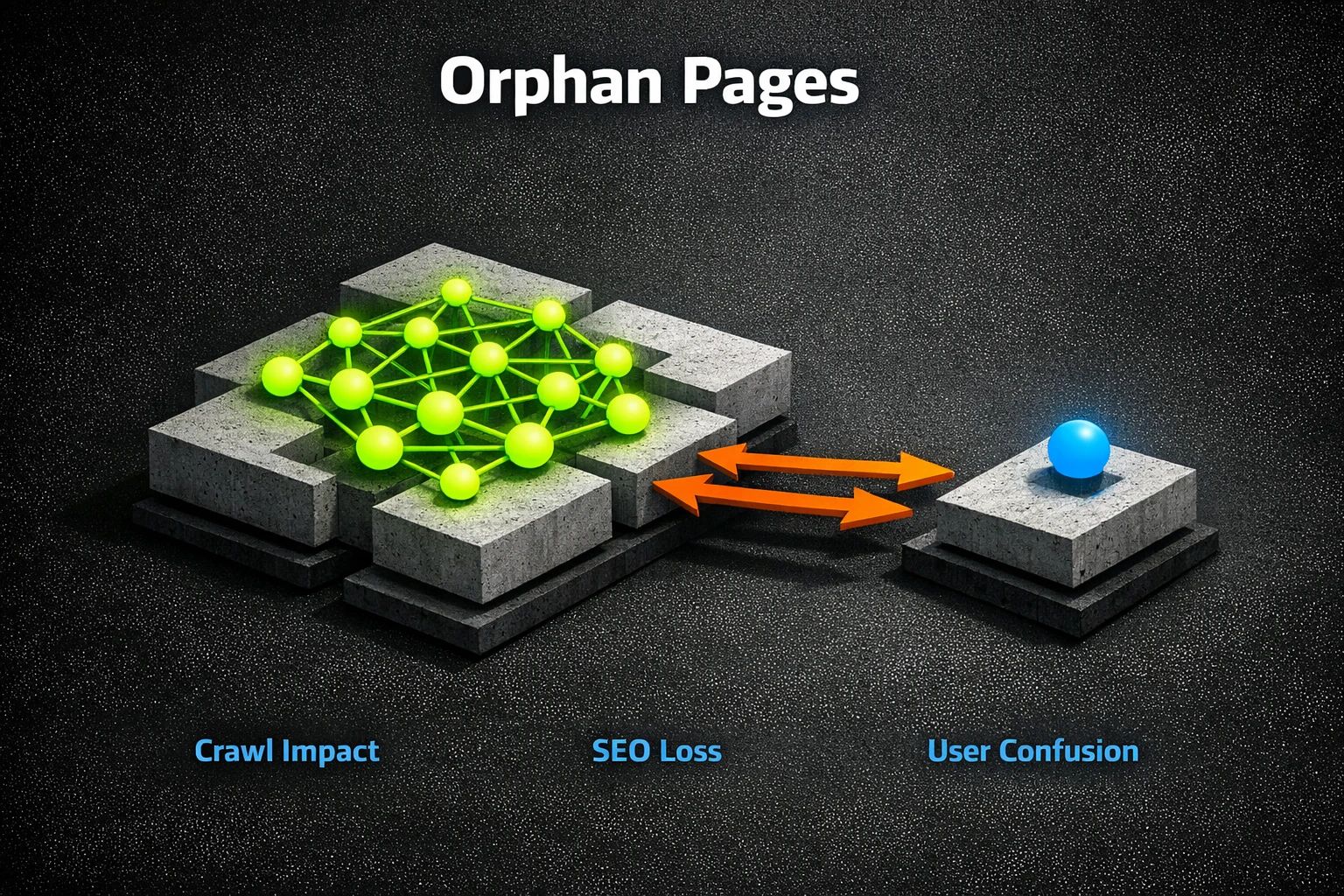
At its core, an orphan page is any page on your website that has no incoming internal links from other pages on your site. Search engine crawlers navigate the web by following links. If a page has no links pointing to it, crawlers have a very difficult time discovering it. Even if they find it through an XML sitemap or an external link, the lack of internal links signals that the page may not be important.
Indexability gaps are a broader category of issues that prevent search engines from properly crawling, understanding, and ranking your content. This includes orphan pages, but also common culprits like:
- Incorrect
noindextags: Telling search engines not to index a page you actually want to rank. robots.txtblocks: Accidentally preventing crawlers from accessing important sections of your site.- Faulty redirects: Sending users and crawlers to the wrong pages or into redirect loops.
- Duplicate content: Confusing search engines about which version of a page is the authoritative one.
These issues directly harm your SEO performance by wasting your crawl budget, diluting the flow of authority (often called PageRank or link equity) throughout your site, and creating a confusing experience for users.
The AI Advantage: A Smarter Way to Find Hidden Pages
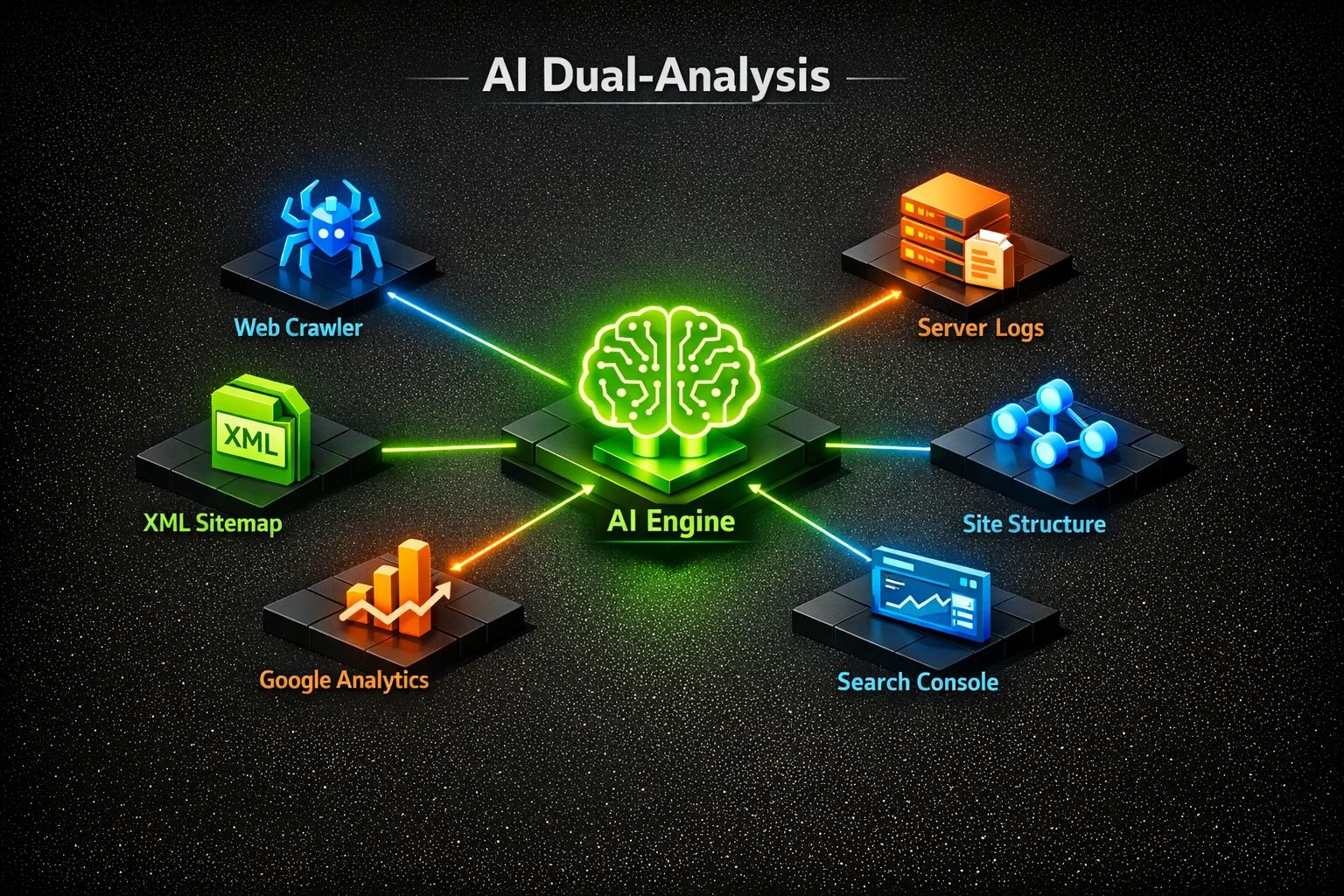
Traditionally, finding orphan pages required a painstaking process of cross-referencing multiple data sources. You would crawl your website to get a list of all linkable pages, then compare that list against your XML sitemaps, Google Analytics data, and server logs to find discrepancies. This is time consuming and prone to human error, especially for large websites.
AI-powered systems revolutionize this discovery process through what we can call a "dual-analysis" framework. Instead of just one data source, AI integrates and analyzes several at once to build a complete picture of your website.
Here’s how it works. The AI performs a traditional crawl to map out your known site structure. Simultaneously, it pulls data from Google Search Console, server logs, and analytics to see which URLs are receiving traffic or impressions, even if they weren't found in the crawl. By comparing these datasets, the AI can instantly pinpoint pages that are getting traffic but have no internal links. This is something a simple crawler could never do. It leverages machine learning to recognize patterns and anomalies, flagging not just clear orphans but also pages that are underlinked or poorly integrated into your site's architecture.
From Found to Fixed: AI-Powered Resolution Strategies
Identifying orphan pages is only half the battle. The real value comes from intelligently reintegrating them into your website. Once an orphan page is identified, you have a few options:
- Integrate: If the page has valuable content, the best solution is to add relevant, contextual internal links from other pages.
- Redirect: If the page is outdated but has valuable backlinks, a 301 redirect can pass its authority to a more relevant page.
- Consolidate: If you have multiple thin pages on a similar topic, they can be combined into one comprehensive resource.
- Remove: If the page offers no value, it can be removed and either 410’d (permanently gone) or noindexed.
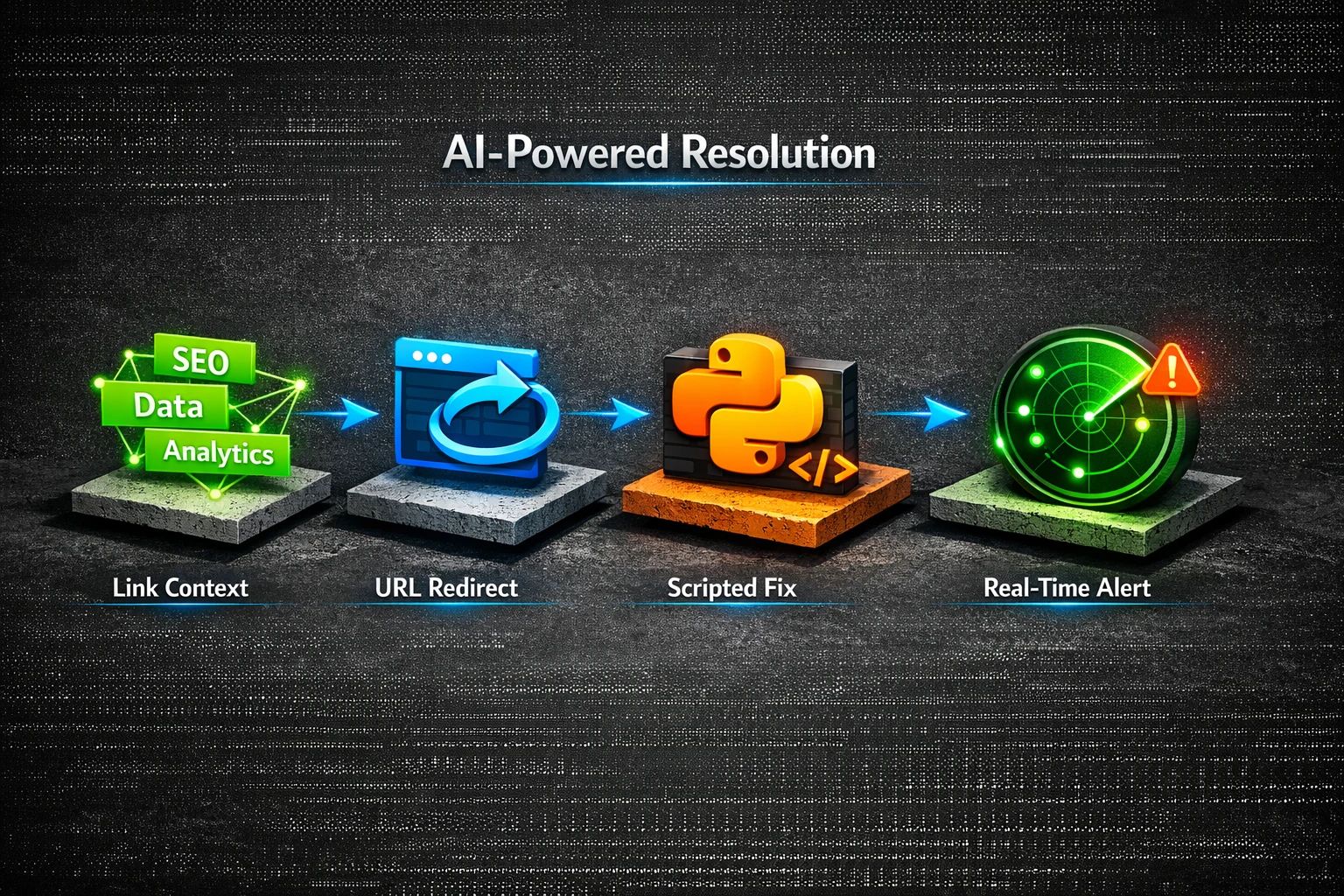
AI excels at the integration step. Instead of just randomly adding links, an advanced ai internal linking agent uses semantic analysis to understand the meaning of your content. It identifies the most topically relevant pages to link from, suggesting natural anchor text that helps both users and search engines understand the context. This approach builds true semantic authority, creating a web of connections that reinforces your expertise on a given topic. This is a leap beyond simple keyword matching.
For large websites, AI-powered automation can suggest thousands of these contextually relevant links, a task that would take a human team months to complete. This allows you to build a resilient, interconnected site architecture, or "Silk-Road Links," that strengthens your entire digital presence.
Beyond the Fix: Proactive Prevention and Future-Proofing
The most advanced AI systems move beyond one-time fixes. They provide continuous monitoring to prevent orphan pages from appearing in the first time. By learning your site's normal crawl patterns, an AI can detect anomalies in real time and alert you to potential indexability gaps before they impact your rankings.
This proactive approach is critical as we move into an era of AI-first search. With tools like Google’s AI Overviews, having a well-structured, fully discoverable website is more important than ever. Search engines rely on a clear understanding of your site's architecture to source information for these generative answers. By mastering your site's technical health, you are directly preparing for the future of search and Mastering Google’s AI Overviews.
This process isn't about replacing human experts. It's about augmenting their skills. The ideal workflow is a human and AI partnership. The AI handles the massive data analysis to identify issues and suggest solutions at scale. The human SEO strategist then applies critical thinking and business context to make the final decision. This combination of machine efficiency and human expertise is the new frontier of technical SEO, ensuring that the strategies align with broader goals like building trust and demonstrating E-E-A-T in the AI era. Ultimately, a technically sound website allows you to accurately measure your marketing metrics in the AI era and prove the value of your content efforts.
Your Roadmap to a Fully Discoverable Website
Tackling orphan pages and indexability gaps doesn't have to be overwhelming. By leveraging AI, you can follow a clear, strategic path to improve your site’s health and visibility.
- Audit: Begin with a comprehensive, AI-powered audit that uses the dual-analysis method to find every page on your site, not just the ones a simple crawler can see.
- Prioritize: Use AI-driven insights to determine which orphan pages offer the most potential value and should be addressed first.
- Integrate: Reconnect high-value pages using AI-suggested, semantically relevant internal links to boost their authority.
- Prune: Clean up low-value orphan pages by redirecting, consolidating, or removing them to focus your crawl budget on what matters most.
- Monitor: Implement an ongoing, automated monitoring system to prevent new indexability gaps from emerging as your site evolves.
By transforming your approach from reactive fixes to proactive strategy, you build a website that is not only technically sound but also more intelligent, resilient, and prepared for the future of search.
Frequently Asked Questions About Orphan Pages and AI
What are orphan pages?
An orphan page is a webpage that has no internal links pointing to it from other pages on the same website. This makes it very difficult for search engine crawlers and users to discover the page.
Why are orphan pages bad for SEO?
They are bad for several reasons. First, they waste crawl budget because search engines may struggle to find and index them. Second, they don't receive any authority or link equity from other pages on your site, which hurts their ability to rank. Finally, they create a poor user experience for any visitor who happens to land on them, as there is no clear path to navigate to the rest of the site.
How do I find orphan pages?
The most effective method is to use an AI-powered tool that cross-references data from a website crawl, XML sitemaps, Google Analytics, and server log files. This comprehensive approach identifies pages that are receiving traffic or exist in a sitemap but have no internal links pointing to them.
Can orphan pages still be indexed?
Yes, an orphan page can still be indexed if a search engine discovers it through other means, such as an XML sitemap, an external link from another website, or if it was previously linked and has since been orphaned. However, without internal links, it will struggle to rank for competitive keywords because it lacks the contextual support and authority passed from other pages on your site.