The Silent Killer of SEO: How AI Prevents Technical Regressions
AI Summary
The Silent Killer of SEO How AI Prevents Technical Regressions explains the critical role of AI in identifying and alerting on technical SEO issues before they damage your site's performance.
Who: Website owners, SEO professionals, and digital marketers
What: AI-driven continuous monitoring of technical SEO regressions and real-time alerts
When: Immediately after website changes or updates
Where: Across websites in any industry relying on search engine rankings
Why: To prevent traffic drops, maintain rankings, and ensure consistent website health with proactive detection rather than reactive fixes
Before diving into the solution, let's get on the same page. A technical SEO regression isn't just any technical issue. It's a specific type of problem where a previously healthy aspect of your site's technical foundation degrades or breaks, usually right after a change or update.
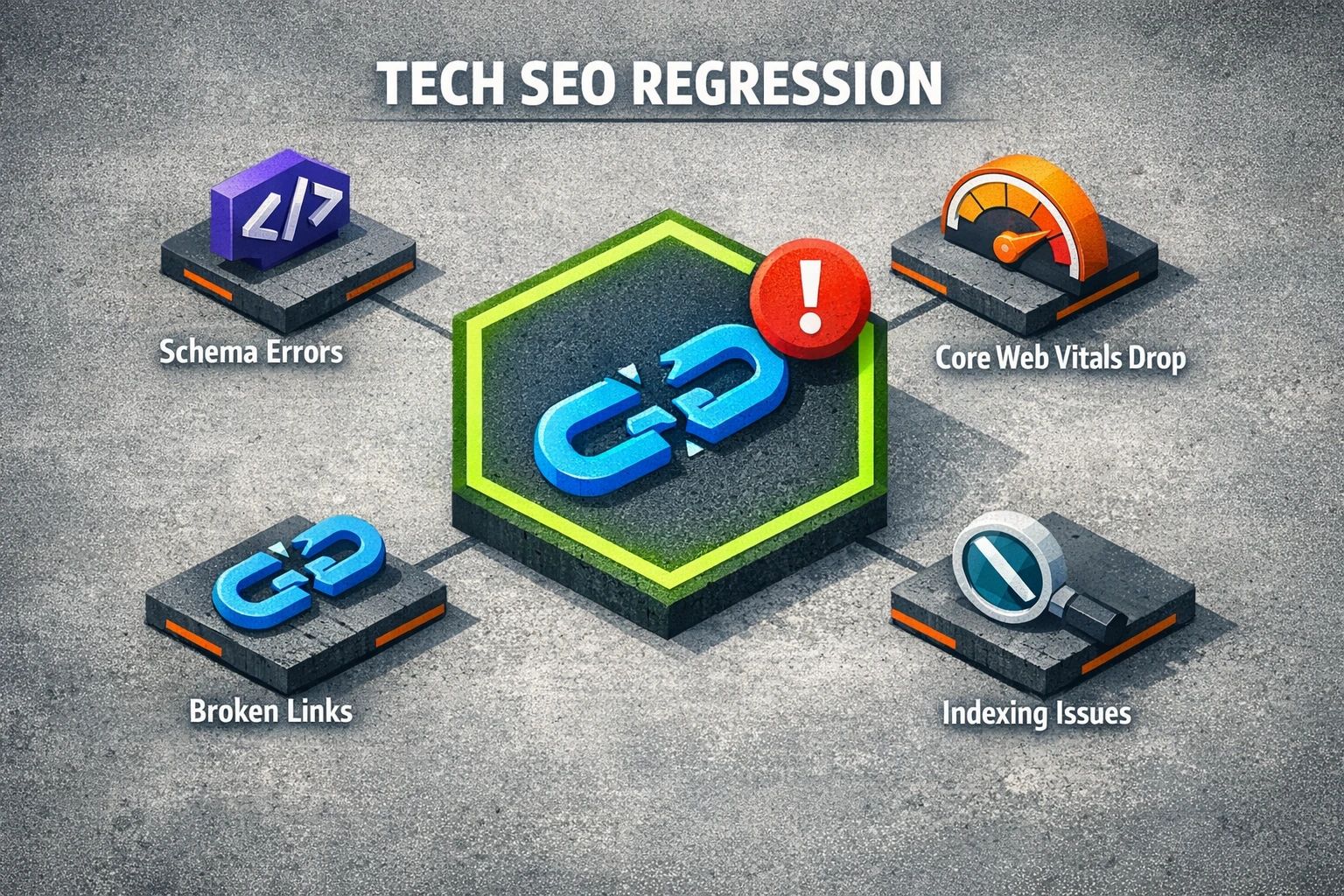
Think of it like this. Your website passes its annual health checkup with flying colors. Then, a minor software update accidentally causes a problem with its foundation. A regression is that newly introduced problem. Common examples include:
- Core Web Vitals Drop: Your previously fast pages suddenly become slow and clunky.
- New Broken Links: A change in your URL structure creates a wave of 404 errors, damaging both user experience and crawlability. An effective ai internal linking agent can help manage link structures, but regressions can still break them.
- Schema Errors: Your structured data, which helps Google understand your content, becomes invalid after an update.
- Indexability Issues: A change to your robots.txt file accidentally blocks search engine crawlers from important pages.
These issues are subtle but destructive. They erode user trust, harm your rankings, and can be a nightmare to diagnose after the fact.
Shifting from Reactive to Proactive: The AI Advantage
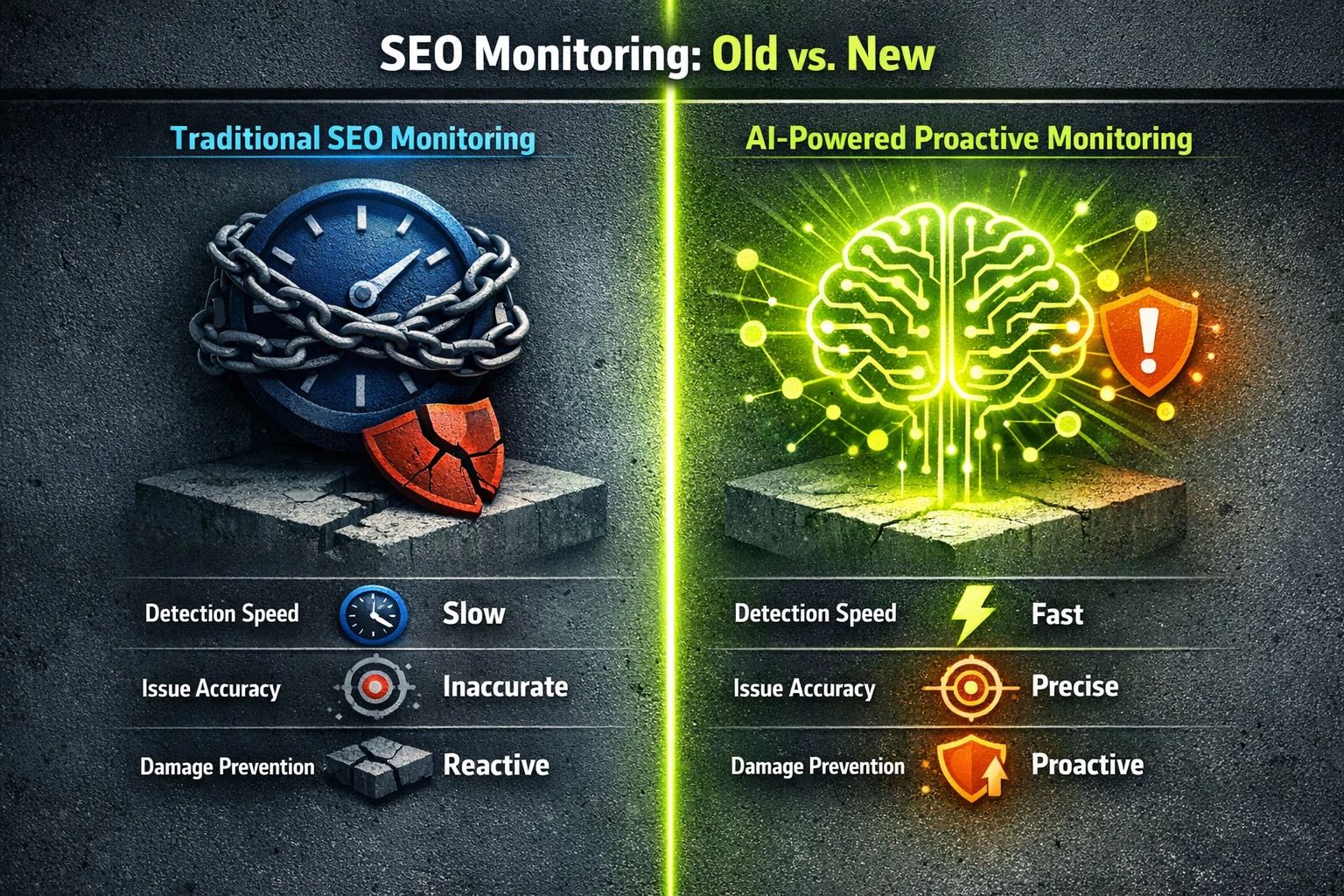
Traditionally, finding technical SEO regressions has been a manual, reactive process. You notice a drop in traffic, so you start digging. You might run a site audit, manually check core pages, or sift through server logs. This process is slow, inefficient, and happens long after the damage has begun.
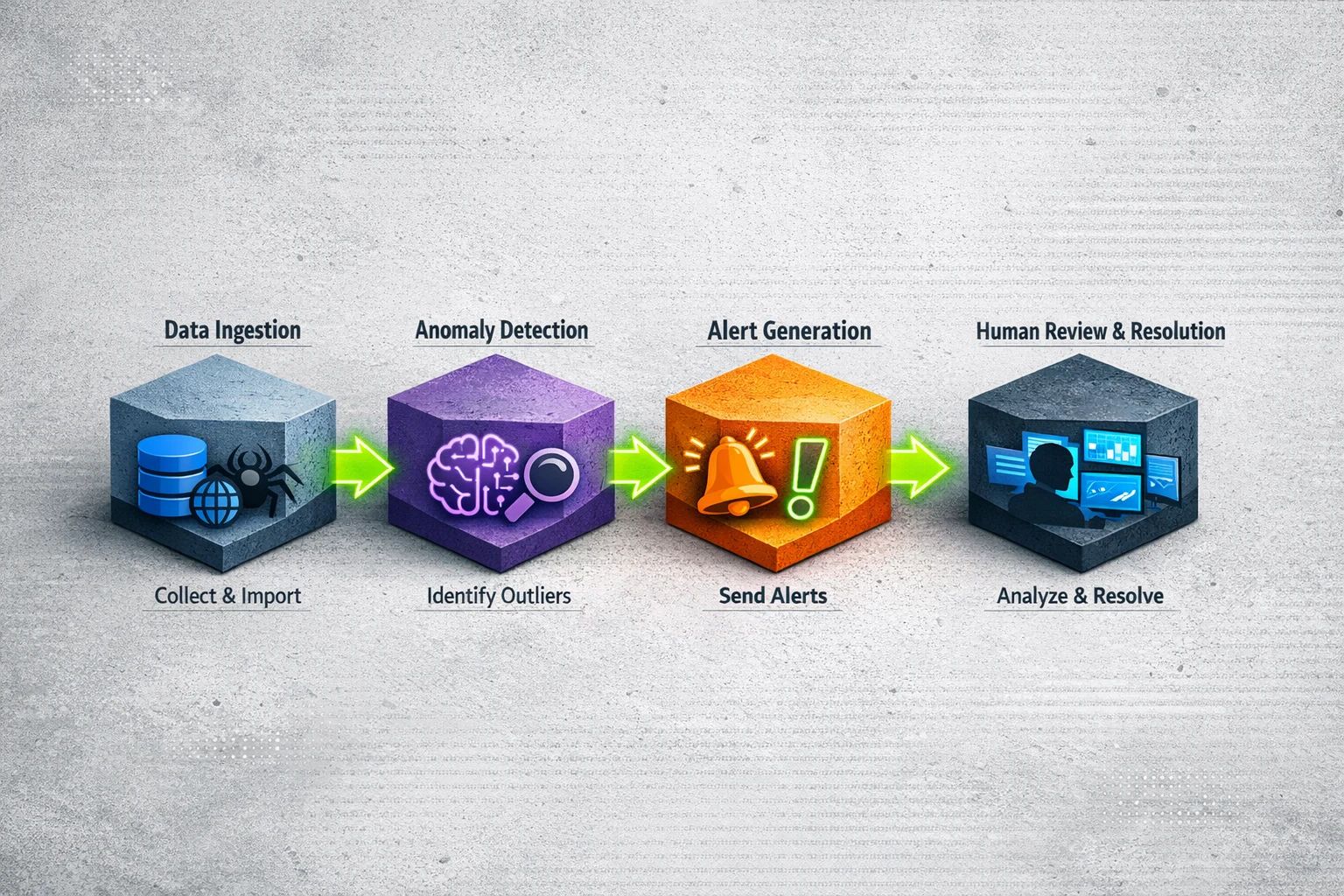
AI transforms this entire process. Instead of waiting for disaster, AI systems act as a proactive, always-on monitoring solution. Here’s how it works.
1. Learning Your Website’s Normal
First, an AI system establishes a baseline. It continuously analyzes key technical metrics across your website to learn what "normal" looks like. It tracks hundreds of data points, such as:
- Page load times (LCP, FID, CLS)
- Server response codes (200s, 404s, 500s)
- Crawl rates and errors from Google Search Console
- The number of indexed pages
- Schema markup validity
- SSL certificate status
This baseline becomes the benchmark for your site's health.
2. Detecting Deviations with Anomaly Detection
Once a baseline is established, the AI's real power comes from anomaly detection. The moment a new deployment goes live, the system watches for any significant deviation from the established normal.
For example, if your average Largest Contentful Paint (LCP) time is 1.8 seconds, the AI will instantly flag a sudden jump to 3.5 seconds post-deployment. If a group of important pages suddenly returns a 404 error, the system knows this is a critical anomaly. This is much more sophisticated than simple threshold alerts. The AI understands context and can differentiate between a minor fluctuation and a genuine regression.
3. Providing Real-Time, Intelligent Alerts
When an anomaly is detected, the AI doesn't just raise a generic flag. It sends a specific, actionable alert to the right people. These alerts are often categorized by severity, so your team knows what to prioritize.
- Critical Alert: A change to the robots.txt file is blocking Googlebot from the entire site.
- Warning Alert: Core Web Vitals have dropped by 20% on key product pages.
- Informational Alert: Three new, low-priority redirect chains have been detected.
This allows your team to pinpoint and fix the problem immediately, often before it has any measurable impact on your SEO performance.
The Real-World Impact of Proactive Monitoring
The difference between traditional, reactive auditing and AI-driven proactive monitoring is stark. A manual approach means you are always playing catch-up, trying to recover lost rankings and traffic. An AI-powered approach keeps you ahead of the curve, preserving your hard-won SEO gains.
This proactive stance is more than just a technical advantage. It builds a foundation of reliability and trust. A technically sound website is crucial for establishing authority, a key component of what experts call E-E-A-T in the AI era. This technical health ensures your pages are consistently accessible and usable, which is vital for getting your content onto llm‑indexed pages in modern search engines.
A modern seo intelligence agency understands that preventing problems is far more valuable than fixing them. AI-driven regression monitoring embodies this principle. It moves technical SEO from a periodic checklist item to a continuous, automated process that safeguards your digital presence.
Frequently Asked Questions
What is AI for technical SEO?
AI for technical SEO uses artificial intelligence, primarily machine learning, to automate and enhance tasks like site audits, performance monitoring, and error detection. Instead of manually checking for issues, AI systems continuously analyze your site to identify problems and opportunities at a scale humans cannot match.
How can AI help me with technical SEO tasks?
AI can automate many time-consuming technical SEO tasks. It can find broken links, detect duplicate content, monitor page speed and Core Web Vitals, check for schema errors, and ensure your sitemaps are correct, all in real time.
What are the basic AI tools for SEO monitoring?
Many modern SEO platforms now incorporate AI features. Tools like Siteimprove, BrightEdge, and others use AI for technical health monitoring. There are also dedicated AI monitoring systems that can be integrated into your existing workflows to provide continuous analysis and alerts.
Does AI replace the need for a human SEO expert?
No, it empowers them. AI is exceptional at monitoring data and flagging anomalies, but it still requires human expertise to interpret complex issues, make strategic decisions, and implement the fixes. The best approach is a collaboration where AI handles the detection, and humans handle the strategy.
How does AI know what's a real problem versus a small fluctuation?
AI models are trained on vast amounts of data to understand patterns. They can distinguish between normal, minor fluctuations (like a slight change in server response time) and a statistically significant deviation that indicates a real problem, known as an anomaly. This reduces the noise of false positives.
Your First Step Towards a Healthier Website
Technical SEO regressions are a serious threat to your online visibility, but they don't have to be. By embracing AI-driven monitoring, you can shift from a reactive, stressful cycle of damage control to a proactive, confident strategy of prevention. This protects your rankings, ensures a great user experience, and allows your team to focus on growth instead of fixing what’s broken.