Beyond "Humanizing": A Framework for E-E-A-T in AI-Powered SEO
AI Summary
Embedding E-E-A-T into AI-powered SEO content is no longer about making text sound human, but about building a verification-first system that proves real expertise and experience. By borrowing rigor from investigative journalism, you can turn cheap AI drafts into reliable, conversion-driving assets instead of risky, generic noise.
- Use the Journalistic E-E-A-T Framework—Draft, Annotate, Verify, Enhance—to shift from quick edits to a repeatable authenticity workflow.
- Layer in concrete experience signals like product walkthroughs, customer stories, and proprietary data to satisfy Google’s experience requirement and win trust.
- Treat verification and transparent sourcing as your competitive moat in an AI-saturated landscape, directly tying E-E-A-T signals to sign-ups and lead quality.
For teams relying on AI content but seeing plateaued rankings and weak trust signals, and who need a durable system instead of another "humanizer" pass.
The promise of AI content was speed and scale. The reality is an authenticity crisis. With AI systems now responsible for nearly 90% of newly indexed content, the strategic advantage has shifted from production volume to demonstrable quality [1]. Generic, rephrased content is no longer an asset. It's a liability.
Most advice on this topic misses the point. It tells you to "humanize" your text by tweaking sentence structure and adding personality. This is a tactical fix for a strategic problem. According to Google's leadership, the key to ranking is not just sounding human. It's demonstrating "expertise and unique perspective." Content that merely repeats what is already known, no matter how well it's written, will be down-ranked [2].
You need a new approach. One that moves beyond stylistic editing and focuses on substantive, verifiable value.
The Authenticity Crisis: Why Sounding Human Isn't Enough
The flood of AI-generated content has made users and search engines skeptical. Consumer trust drops by nearly 50% when content feels machine-made, and that distrust hurts your brand [3]. Brands advertised alongside content perceived as AI-made see a significant decline in purchase consideration [3].
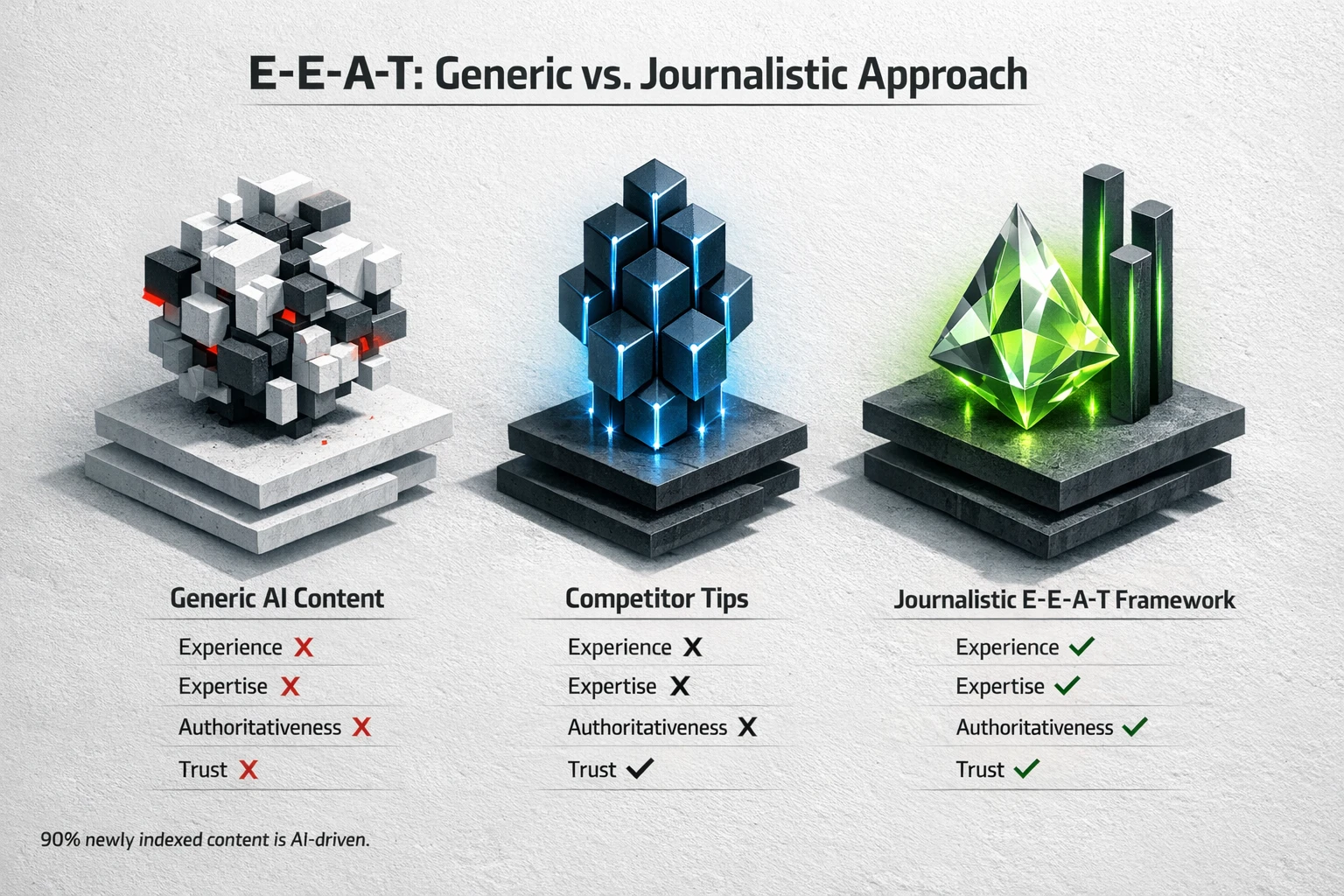
Simply running a draft through a "humanizer" tool doesn't build trust or authority. It just papers over the cracks. Google's quality systems, and your customers, are looking for signals that go deeper than prose. They are looking for genuine Experience, Expertise, Authoritativeness, and Trust (E-E-A-T).
Redefining E-E-A-T for the AI Era
E-E-A-T isn't just a checklist. It's a framework for proving your content is helpful and reliable. Understanding its principles in the context of AI reveals a clear path forward. Learning about E-E-A-T in the AI era is the first step toward building a durable content strategy.
- Experience: This is what AI cannot fake. It's the first-hand use of a product, the practical knowledge from solving a problem, or the unique perspective gained from real-world events.
- Expertise: This is the human layer of nuance. It's the ability to connect disparate ideas, provide insightful commentary, and go beyond surface-level explanations.
- Authoritativeness: This comes from being a recognized, trusted source. It's built through consistent, high-quality information that others cite and reference. Understanding how to measure brand mindshare on AI search engines is critical for tracking this.
- Trust: This is the final output of the other three pillars. It's earned through accuracy, transparency, and reliability. The goal is building unshakeable trust for your small business, making your content a go-to resource.
The Journalistic E-E-A-T Framework: From Generation to Verification
To solve the AI authenticity problem, we looked to an industry that has battled misinformation for centuries: journalism. Investigative journalism relies on a rigorous, structured fact-checking process. A writer annotates every single fact with a source, and a dedicated fact-checker verifies each one line-by-line before publication [4].
This process provides a battle-tested model for building a verification layer into your AI content workflow. We call it the Journalistic E-E-A-T Framework. It reframes the task from simple editing to a structured, four-step process.
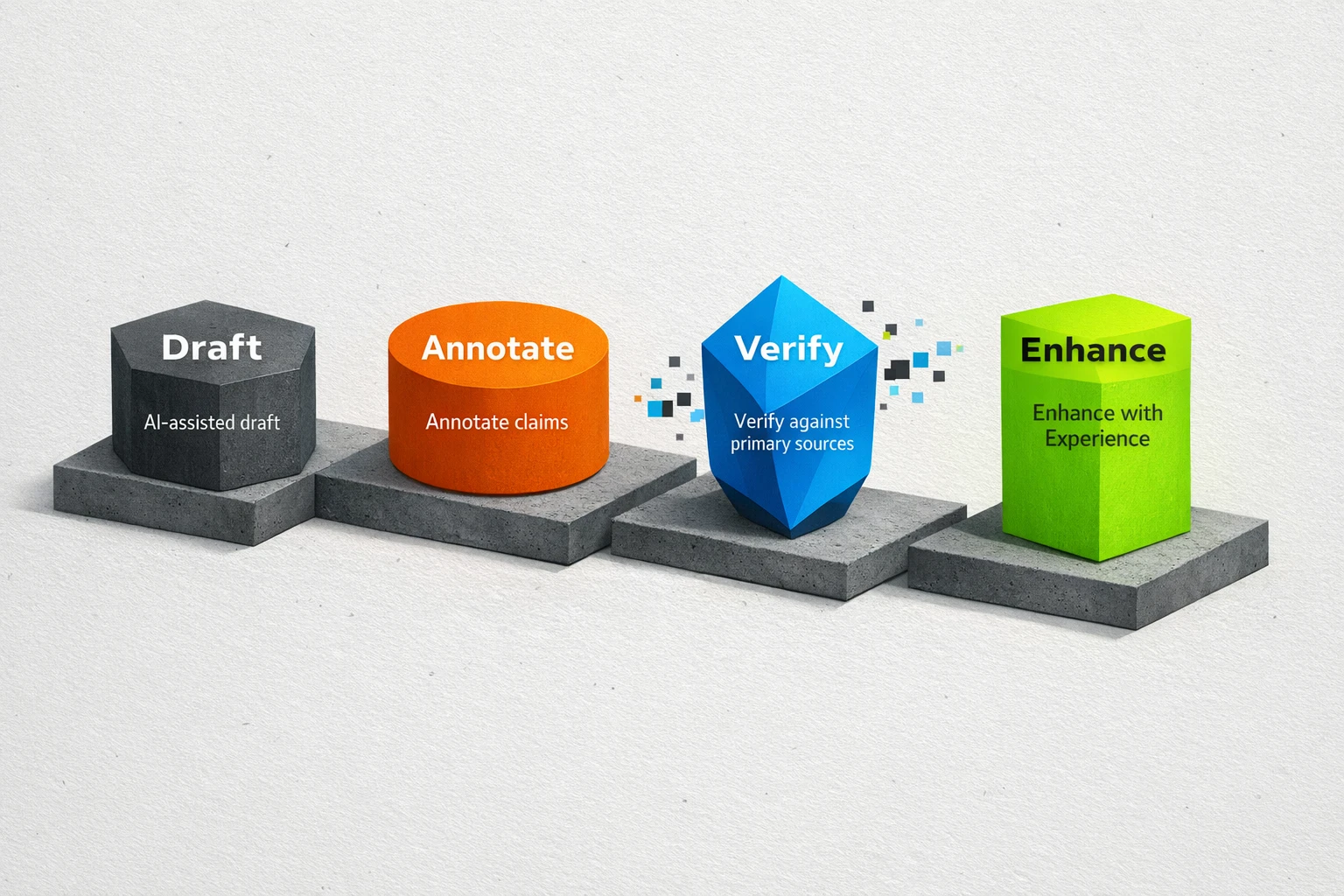
Use AI for its strengths. Generate outlines, conduct initial research, and produce first drafts. This is where you capture the efficiency gains. AI tools can reduce content production costs by 30% to 50% while dramatically increasing output [1]. This draft is your raw material, not the final product.
Step 2: Annotate (The Editor's First Pass)
This is the journalist's mindset. Your internal editor or subject matter expert goes through the AI draft and marks every single claim that requires proof. Every statistic, every assertion, every "fact" gets flagged for verification. This step forces you to identify the specific claims that underpin your article's credibility.
Step 3: Verify (The Fact-Checker's Mandate)
Now, your team acts as the fact-checker. Go through the annotated claims and validate each one against primary sources, internal company data, or expert interviews. If a claim cannot be verified, it is removed or rephrased. This step is non-negotiable for building trust.
Step 4: Enhance (The Expert's Final Polish)
With a verified factual base, your expert can now enhance the content. This is where you weave in the critical E-E-A-T signals. Add proprietary data, customer stories, first-hand anecdotes, and nuanced opinions that only a human expert can provide. This final polish transforms a generic draft into a valuable, authoritative asset.
Putting the Framework into Action
This framework isn't just theoretical. It has direct, practical applications.
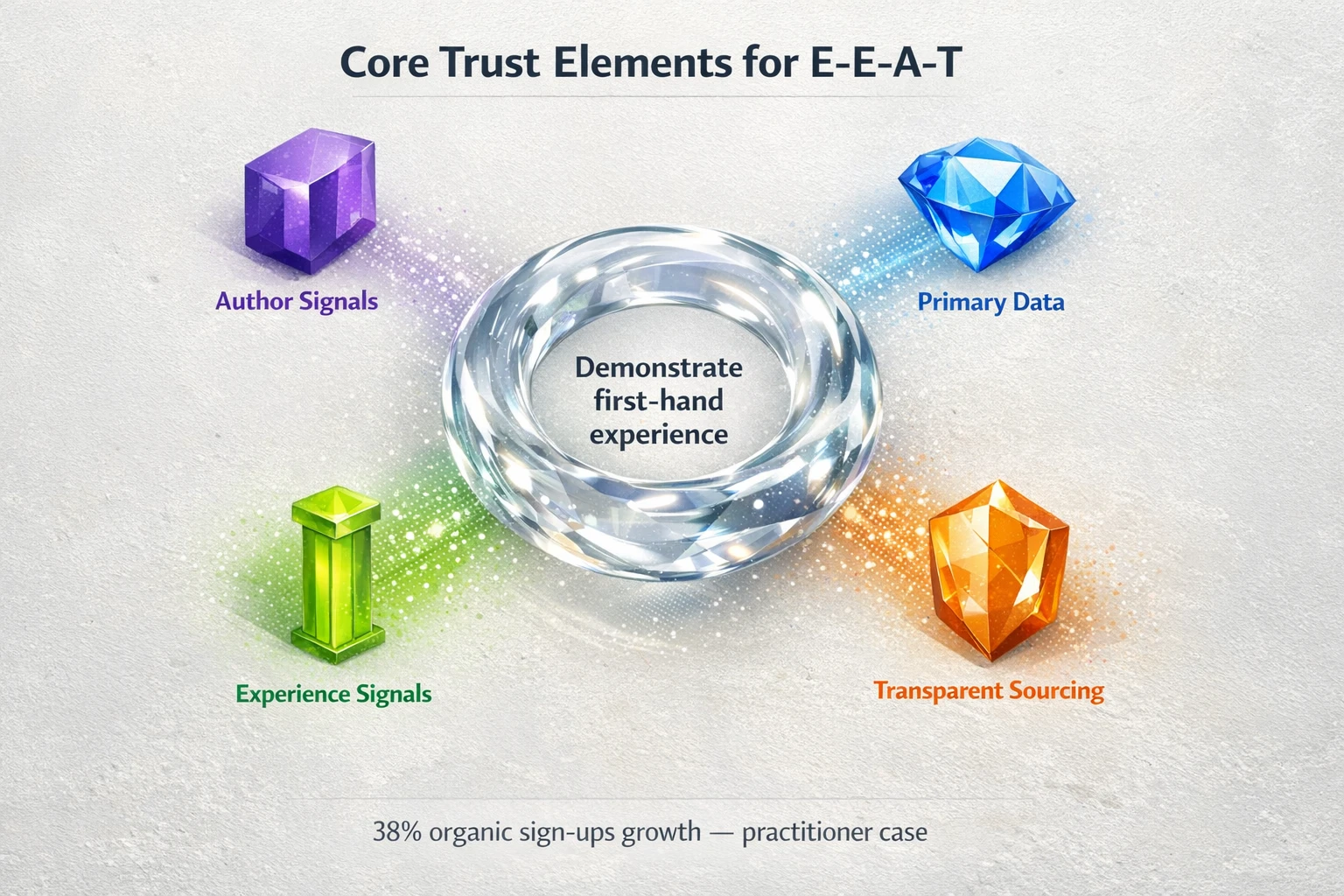
According to Google’s Search Quality Evaluator Guidelines, creators must demonstrate first-hand experience where applicable [5]. The "Enhance" step is your opportunity to do exactly that.
- Enhancing for 'Experience': Involve your product team. Add screen recordings of your software in use. Interview customers and include their specific use cases and quotes. Share stories of problems you solved.
- Enhancing for 'Expertise': Don't just state facts. Explain what they mean. Add a "Our Take" section with your unique analysis. Discuss counterarguments or alternative approaches to show you've considered the topic deeply.
- Building 'Authoritativeness' & 'Trust': Create detailed author bios that showcase credentials. Be transparent about your methodology and sources with a "How we wrote this" section. Improving your content quality will directly impact the marketing metrics in the AI era that signal authority.
Your Competitive Moat in an AI-Saturated World
When every competitor has access to the same AI tools, your process becomes your advantage. The Journalistic E-E-A-T Framework provides a durable moat. It ensures your content is not just faster or cheaper to produce, but that it is fundamentally more valuable, trustworthy, and effective.
The future of SEO isn't about choosing between humans and AI. It's about building a human-led, expert-driven system that leverages AI as a powerful but properly managed assistant. This is how you win.
Frequently Asked Questions
Isn't this process slower than just using AI?
Yes, it requires more rigor than hitting "publish" on a raw AI draft. But the goal is ROI, not just speed. A single, high-ranking article that drives qualified leads is infinitely more valuable than a hundred generic posts that nobody reads or trusts. This framework optimizes for business impact, not just output volume.
Can I just use an "AI humanizer" tool instead?
AI humanizer tools focus on stylistic changes like varying sentence length and word choice. They cannot add real experience, verify facts, or provide unique expert insights. They address the symptoms of generic content, not the root cause. Google wants unique perspective, and a humanizer tool cannot create it [2].
How do I prove 'Experience' if I'm writing about a topic I haven't personally done?
You channel it. The goal is to feature first-hand experience in your content, even if it's not your own. You can achieve this by interviewing subject matter experts, featuring customer case studies, quoting primary research participants, or embedding user-generated content like product reviews.
How does this apply to regulated industries like finance or healthcare?
The framework is even more critical in these fields. The "Verify" step becomes your primary defense against compliance risks and misinformation. For these sectors, ensuring strict E-E-A-T compliance is essential, and a formal verification process is non-negotiable for maintaining trust and authority.
Does Google penalize AI-generated content?
Google penalizes low-quality, unhelpful content, regardless of how it was created. Their guidance is clear: content created for people, not for search engines, is what they reward. The Journalistic E-E-A-T Framework is designed specifically to ensure your AI-assisted content is high-quality, helpful, and valuable to your audience.
---
Sources:
- Virtuosity Digital - Statistics on AI content volume and production efficiency.
- Position Digital - Insights on Google's ranking criteria for AI-assisted content.
- OWDT - Data on consumer trust and brand perception of AI-generated content.
- KSJ Handbook - A detailed overview of the fact-checking process used in professional journalism.
- Digital Synopsis - Reference to Google's Search Quality Evaluator Guidelines regarding first-hand experience.