Beyond the Algorithm: A Practical Guide to Identifying, Measuring, and Mitigating AI Bias
AI Summary
This article explains methods for identifying measuring and mitigating AI bias effectively. It offers a structured approach to creating fair and accountable AI systems.
Bottom Line: Understanding and addressing AI bias protects your brand reputation reduces legal risks and improves decision-making fairness.
What You’ll Learn:
- Diagnostic frameworks for detecting bias at all AI lifecycle stages
- Key fairness metrics and how to manage trade-offs
- Practical mitigation strategies including pre-processing, in-processing, and post-processing techniques
Best For: Organizations using AI who want to ensure ethical fairness reduce bias risks and build trustworthy AI applications.
Your AI system is a powerful engine for decision-making, but it has a hidden vulnerability. It learns from data that reflects a world full of human biases, and it can amplify those biases at a scale and speed never seen before. Public concern is high, with 55% of people and AI experts fearing biased AI decisions. This isn't just an ethical issue. It's a direct threat to your customer trust, legal standing, and bottom line.
The challenge is that bias isn't a simple bug you can patch. It's a complex, systemic issue that requires a deliberate, multi-faceted strategy. You're not just looking for a technical fix. You need a comprehensive framework for building responsible, trustworthy AI.
This guide provides that framework. We'll move beyond the surface-level definitions and give you the actionable insights needed to identify, measure, and mitigate bias throughout your AI's entire lifecycle.
Decoding AI Bias: Where It Comes From and How It Spreads
AI bias is a systemic error that results in unfair outcomes, privileging certain groups while discriminating against others. It's not a single problem but a collection of issues that can arise at any stage of development. Understanding its origins is the first step toward dismantling it.
Bias typically enters the AI lifecycle in several key stages:
- Data Collection: If your training data underrepresents certain demographics or overrepresents historical inequalities, the model will learn these disparities as fact. This is often called selection bias or historical bias.
- Data Labeling: Human annotators who label data for supervised learning can introduce their own conscious or unconscious prejudices. For example, labeling images of people in professional settings as "competent" can create associations that penalize those who don't fit a narrow stereotype.
- Model Training: The algorithms themselves can introduce or amplify bias. An algorithm optimized purely for accuracy might learn to use sensitive attributes like race or gender as proxies for other factors, leading to discriminatory predictions.
- Deployment and Feedback: Once deployed, an AI model can create a feedback loop that reinforces existing biases. A biased hiring tool that favors male candidates will lead to more men being hired. Their successful performance data is then fed back into the model, further strengthening the initial bias.
These entry points result in several common types of bias, including algorithmic bias, measurement bias, and systemic bias, each requiring a different diagnostic approach.
The Business Case for Fair AI: From Risk Mitigation to Strategic Advantage
Addressing AI bias is no longer optional. It's a critical business imperative driven by significant risks and emerging regulations. Biased systems can lead directly to flawed business decisions, lost market share, and severe reputational damage. The legal landscape is also catching up, with frameworks like the EU AI Act and NIST's AI Risk Management Framework establishing clear expectations for fairness and accountability.
The consequences are real. In healthcare, biased diagnostic tools carry immense legal and human costs. In finance, discriminatory lending algorithms can lock entire communities out of economic opportunities, inviting regulatory scrutiny. For marketers, biased generative AI producing inaccurate or offensive content is a top concern, second only to flawed data itself.
But beyond avoiding risk, there is a powerful strategic advantage. Building fair and transparent AI systems fosters deep customer trust, enhances brand reputation, and unlocks new market opportunities. It signals that your organization is not just technologically advanced but also ethically responsible.
Identifying AI Bias: A Step-by-Step Diagnostic Framework
You cannot fix a problem you cannot find. Identifying bias requires a systematic audit of your data, models, and processes. It’s a proactive investigation, not a passive check.
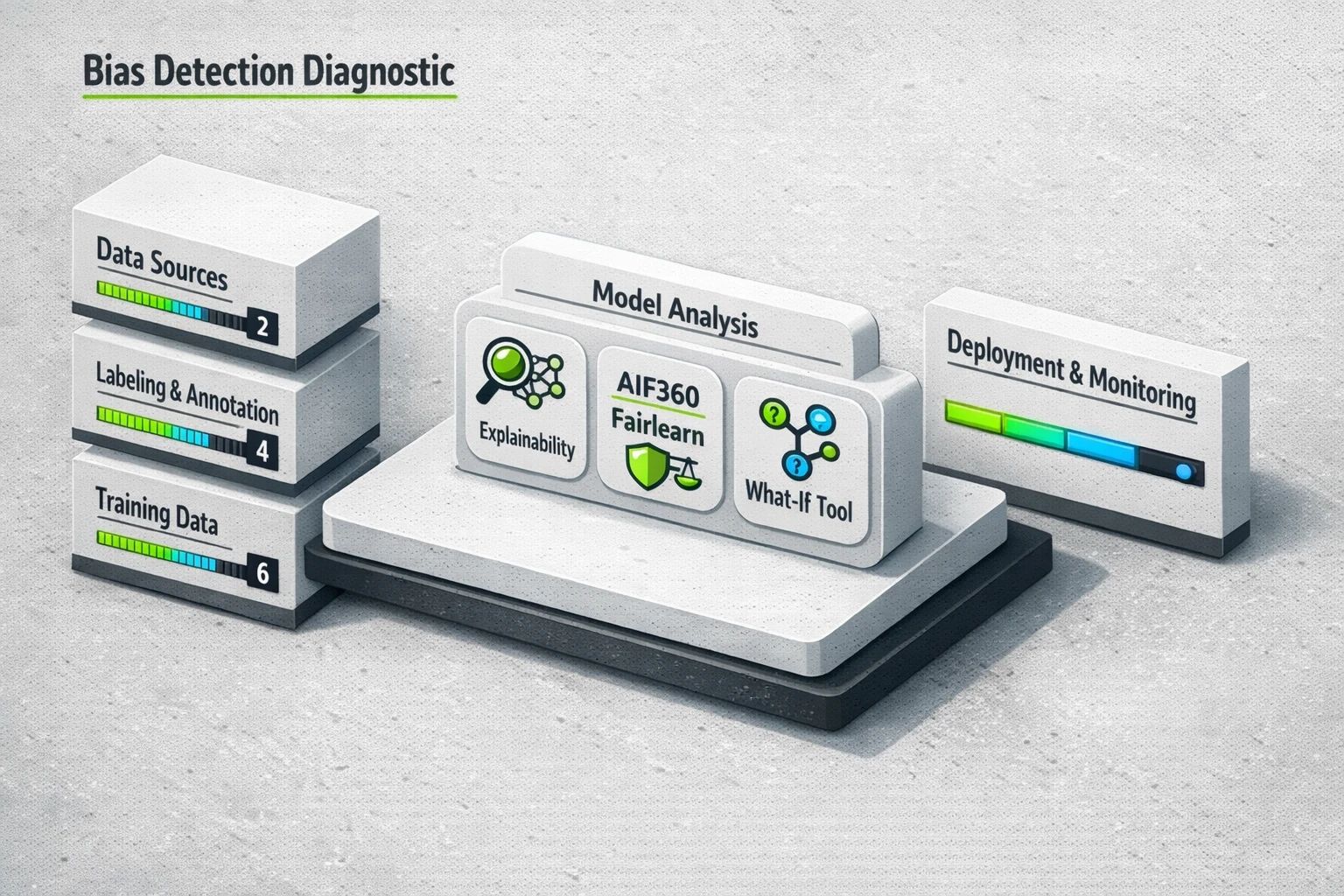
Here is a practical framework to guide your investigation:
- Define Protected Attributes and Outcomes: Clearly identify the sensitive attributes you need to protect against bias, such as race, gender, age, or disability. Then, define what constitutes a "fair" outcome for your specific use case. Is it an equal opportunity for a loan approval, or an equally accurate medical diagnosis for all groups?
- Analyze Data Distributions: Scrutinize your training data. Are all demographic groups adequately represented? Look for skews and imbalances that could lead to underperformance for minority groups. This is a crucial first step in catching selection and historical bias.
- Leverage Bias Detection Tools: A growing ecosystem of tools can help automate parts of this audit. Open-source libraries like IBM's AI Fairness 360 and Microsoft's Fairlearn provide robust toolkits for quantifying bias in datasets and models. Commercial platforms like Fiddler AI and Credo AI offer more comprehensive governance solutions. The key is choosing the right tool for your specific model type and industry context.
- Employ Explainable AI (XAI) Techniques: Use XAI methods to understand why your model is making certain predictions. Techniques like SHAP (SHapley Additive exPlanations) can reveal which features are most influential, helping you uncover if the model is relying on inappropriate proxies for protected attributes.
Measuring AI Fairness: Metrics, Conflicts, and Trade-offs
Once you've identified potential bias, you need to quantify it. Fairness metrics are the statistical tools that allow you to measure the extent of disparity in your model's outcomes across different groups.
However, there is no single, universal metric for fairness. Choosing the right one depends entirely on your ethical goals and the context of your application. What is considered "fair" in hiring might be different from what is fair in medical diagnostics.
Here are some of the most common group fairness metrics:
- Demographic Parity (Statistical Parity): This metric requires that the likelihood of a positive outcome is the same for all groups. For example, a hiring model would satisfy this if it recommends male and female candidates at the same rate, regardless of their qualifications. Its limitation is that it ignores whether the individuals were actually qualified.
- Equal Opportunity: This metric is more nuanced. It requires that individuals who are truly qualified have an equal chance of receiving a positive outcome. In our hiring example, this means that qualified male and qualified female candidates should have the same probability of being recommended.
- Equalized Odds: This metric is even stricter. It combines Equal Opportunity with the requirement that unqualified individuals also have an equal chance of being correctly rejected, regardless of their group. It aims for fairness in both positive and negative classifications.
- Predictive Parity: This metric focuses on the precision of the model's predictions. It requires that for the group of individuals who received a positive prediction, the proportion of those who were truly positive is the same across all demographic groups.
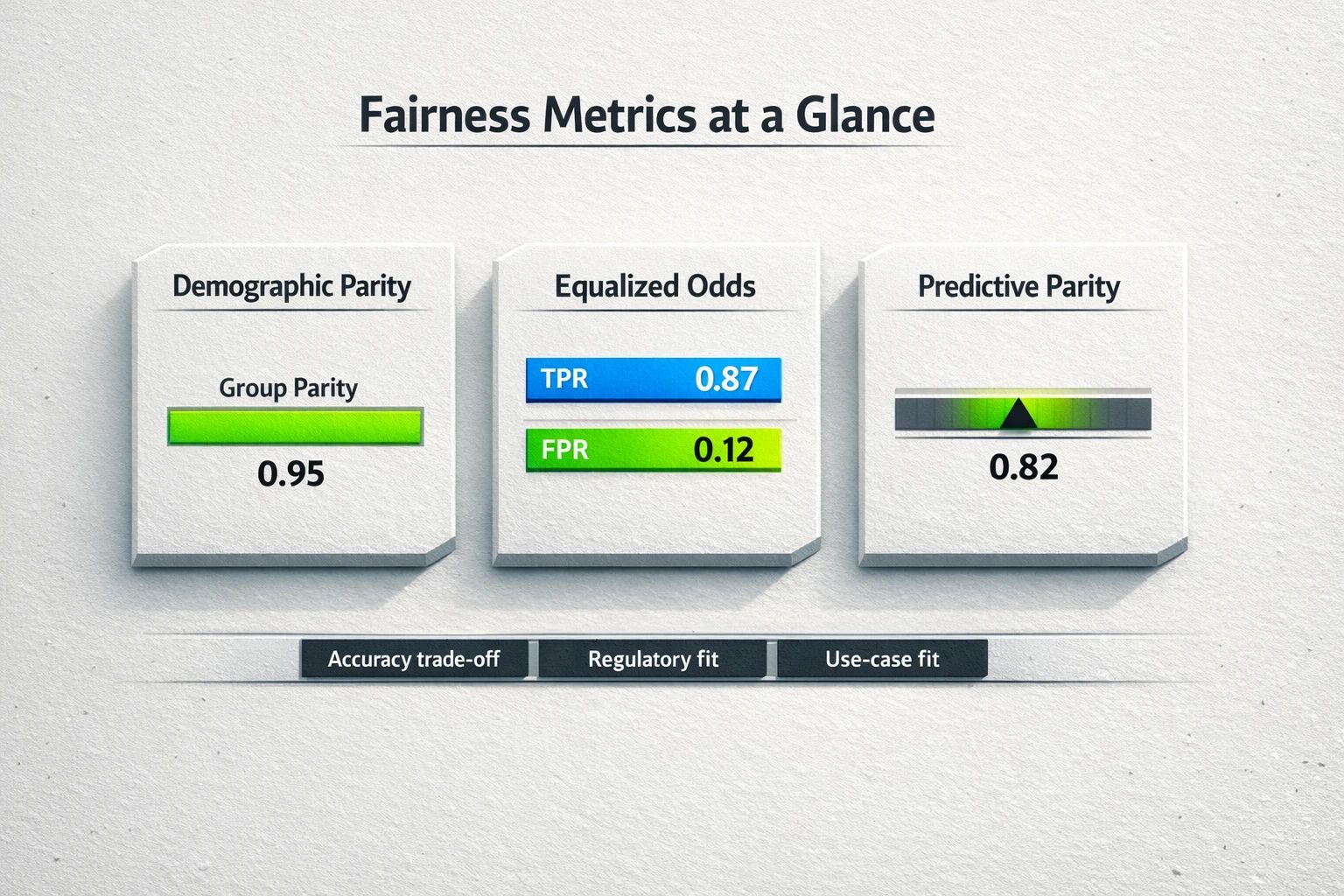
Crucially, these metrics are often in conflict. Optimizing for one can negatively impact another. For instance, enforcing Demographic Parity might reduce the overall accuracy of your model. Navigating these trade-offs is one of the central challenges of building fair AI. It requires a thoughtful discussion among stakeholders to define and prioritize the most important fairness goals for your organization.
Mitigating AI Bias Across the Lifecycle: A Three-Pronged Approach
Mitigation is not a one-time fix. It is a continuous process integrated throughout the AI development lifecycle. Effective strategies can be grouped into three categories: pre-processing, in-processing, and post-processing.
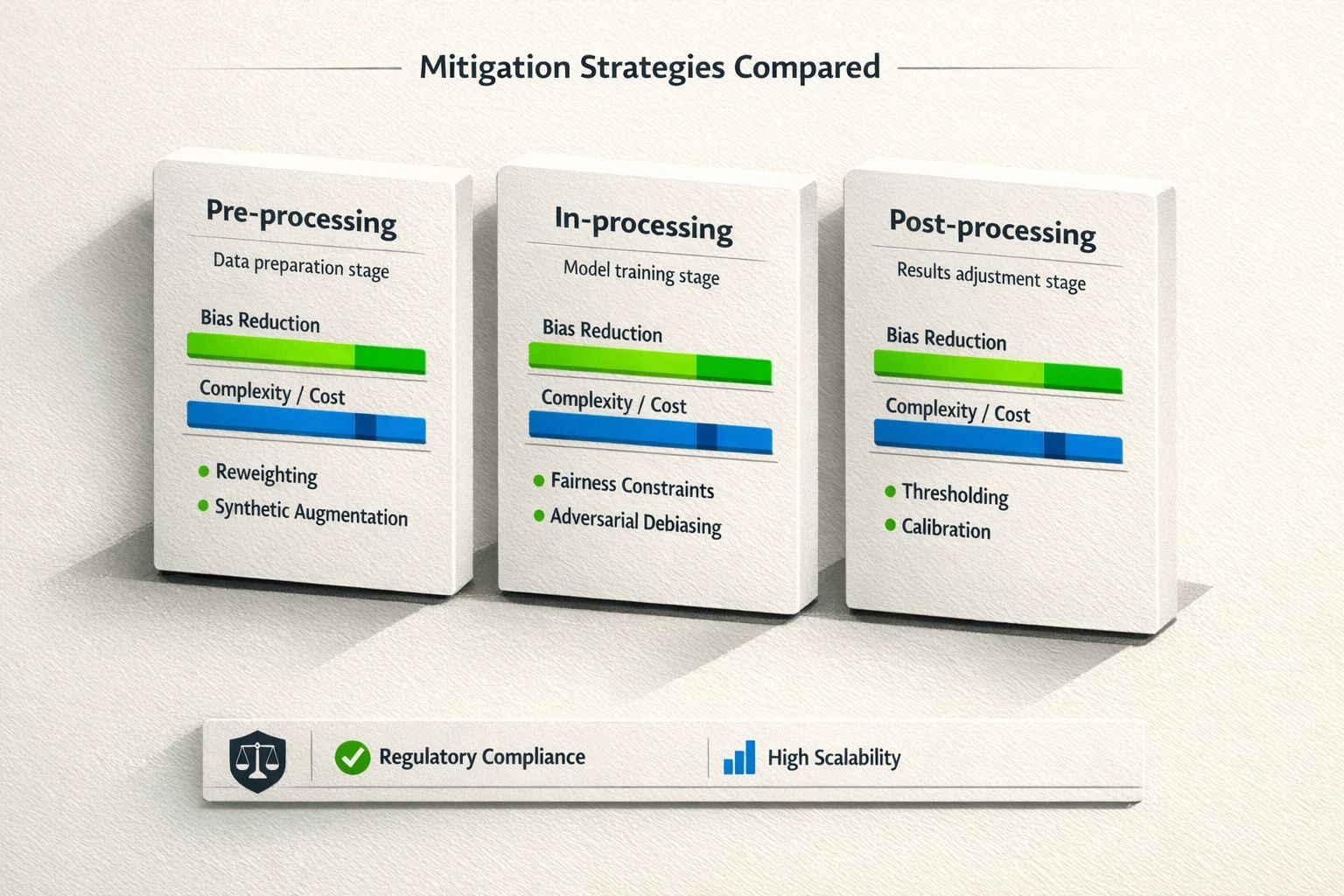
1. Pre-processing (Fixing the Data)
This is often the most effective approach. By addressing bias at its source, you prevent it from ever entering your model.
- Data Augmentation: Collect more data for underrepresented groups.
- Reweighing: Assign higher weights to data points from minority groups to signal their importance to the learning algorithm.
- Synthetic Data Generation: Use techniques to create new, artificial data points for underrepresented groups to balance the dataset.
2. In-processing (Modifying the Algorithm)
These techniques modify the model's learning process to incorporate fairness constraints directly.
- Adversarial Debiasing: This involves training a second model that tries to predict a protected attribute from the first model's predictions. The primary model is then penalized for making it easy for the adversary to succeed, effectively "unlearning" the biased correlation.
- Fairness Constraints: Add fairness metrics directly into the model's optimization function, forcing it to balance accuracy with fairness goals during training.
3. Post-processing (Adjusting the Output)
These methods adjust the model's predictions after they have been made, without retraining the model itself.
- Calibrating Thresholds: Modify the decision threshold for different demographic groups to achieve more equitable outcomes. For example, you might lower the loan approval score threshold for a historically disadvantaged group to satisfy a fairness metric like Equal Opportunity.
Beyond these technical fixes, a truly robust mitigation strategy is socio-technical. It involves establishing strong AI governance, creating diverse development teams to challenge assumptions, and implementing human-in-the-loop oversight for high-stakes decisions. Improving internal processes and linking disparate data systems can also be critical, a task where an advanced ai internal linking agent can provide systemic visibility and control.
Case Study: Tackling Bias in AI-Powered Recruitment
Let's consider a common application: using AI to screen resumes for a software engineering role.
The Problem: An initial audit reveals the model disproportionately flags male candidates for advancement. An investigation into the training data shows it was based on a decade of hiring records from a male-dominated industry. The model learned that "maleness" was a strong predictor of a "good hire."
Identification & Measurement: The team uses the Equal Opportunity metric, defining the goal as "all qualified candidates should have an equal chance of being passed to a human recruiter." The measurement confirms a significant disparity. Qualified female candidates are being overlooked at a much higher rate.
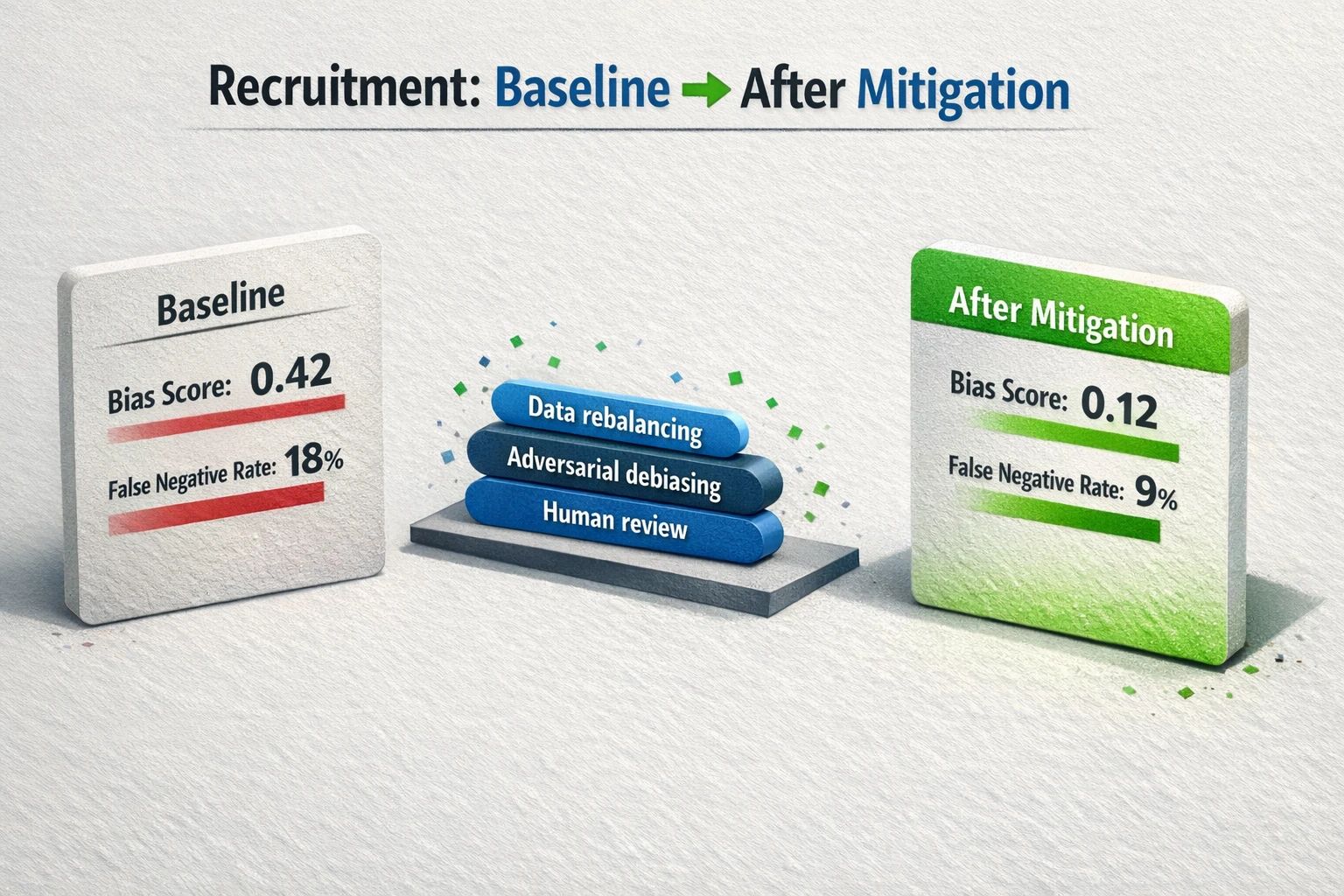
Mitigation & Results: The team implements a two-part strategy. First, they use a pre-processing technique to reweigh the training data, giving more importance to qualified female candidates from the historical data. Second, they apply a post-processing adjustment, calibrating the model's output thresholds differently for male and female applicants to ensure Equal Opportunity is met. After implementation, the disparity is significantly reduced, and more qualified female candidates are passed to recruiters, without a major drop in overall candidate quality. The result is a fairer process and access to a wider talent pool.
The Future of Responsible AI is Proactive
The field of AI fairness is rapidly evolving. Emerging trends like causal inference are helping us move from correlation to causation, providing a deeper understanding of discriminatory mechanisms. The rise of generative AI introduces new challenges, requiring automated tools to detect and prevent the creation of biased text and images.
Ultimately, building responsible AI is not about achieving a perfect, bias-free state. It's about committing to a continuous process of vigilance, measurement, and improvement. It requires a combination of technical tools, robust governance, and a culture that prioritizes ethical outcomes. By adopting this holistic approach, you can transform AI from a potential liability into a powerful force for fair, equitable, and sustainable growth.
Frequently Asked Questions
Isn't AI supposed to be objective and free from human bias?
No, this is a common misconception. AI models learn from data created by humans and reflecting human history. If the data contains historical or societal biases, the AI will learn and often amplify them. Objectivity is a goal to be achieved through careful design and mitigation, not an inherent property of AI.
Can I completely eliminate all bias from my AI system?
Completely eliminating all forms of bias is often mathematically and practically impossible. Different fairness metrics can be in direct conflict with each other and with model accuracy. The goal is not absolute elimination but responsible management. This involves identifying the most harmful biases for your specific application and mitigating them to an acceptable level defined by your ethical and business standards.
How much does implementing bias mitigation slow down the development process?
Integrating fairness checks and mitigation strategies does require an initial investment of time and resources. However, treating it as an integral part of the development lifecycle, much like security or quality assurance, is far more efficient than trying to fix a biased model after it has been deployed and caused damage. Proactive fairness measures save significant time and cost in the long run by preventing legal issues, reputational harm, and the need for emergency redesigns.
What is the difference between explainable AI (XAI) and bias mitigation?
They are related but distinct concepts. Explainable AI focuses on making a model's decision-making process transparent and understandable to humans ("Why did the AI make this decision?"). Bias mitigation focuses on making a model's outcomes more fair and equitable ("Is the AI's decision fair?"). XAI is a powerful tool used within the bias identification process to diagnose why a model might be biased, but it does not fix the bias on its own.
Where is the best place to start if my team has limited resources?
Start with your data. A thorough audit of your training data is the most high-impact, low-cost first step you can take. Analyze it for representation gaps and historical skews. Even simple pre-processing techniques like reweighing or collecting more diverse data can make a significant difference before you invest in more complex algorithmic solutions.
Sources:
- Crescendo.ai - Provided recent, real-world examples of AI bias and legal cases.
- IBM - Offered an authoritative overview of bias types and principles for AI governance.
- Chapman University - Contributed a strong academic breakdown of where bias enters the AI lifecycle.
- Shelf.io - Gave a deep dive into fairness metrics, their definitions, and their trade-offs.
- Onix-Systems - Provided a useful framework for mitigation strategies across different AI lifecycle stages.
- NIST Special Publication 1270 - Offered context on the official AI Risk Management Framework and regulatory expectations.
- Perplexity AI (via AIMultiple & Clarifai) - Supplied key statistics on bias prevalence and business concerns.