Reverse-Engineering Competitor Content with AI: A Guide to Distribution and Engagement
AI Summary
The rules of ranking have changed. Your content now needs to earn citations from AI models, not just clicks from Google. This guide shows how to reverse-engineer why competitors win in this new landscape.
Bottom Line: The shift from SEO to Generative Engine Optimization (GEO) means content structure and trust signals matter more than brand size. What AI already cites from your competitors reveals your biggest opportunities.
What You'll Learn:
- How to find competitor "Power Pages" — the specific content AI models consistently cite
- Four elements that make content AI-citable: semantic clarity, data-rich formatting, trust signals, and schema markup
- How to uncover off-site distribution and promotion tactics with AI analysis
Best For: marketers who see competitors getting cited by AI assistants and want a systematic framework to close that gap.
Your competitors are getting cited by AI assistants, and you are not. You publish high-quality content. You follow all the traditional SEO rules. Yet, they seem to have an invisible advantage, showing up in AI-generated answers while your content remains undiscovered.
This is the new reality of digital marketing. The game has shifted from just ranking on Google to being the trusted source for AI models. This is not about keywords. It is about authority. The old playbook of more content and more backlinks is not enough. You need to understand how your competitors win in this new landscape and reverse-engineer their success.
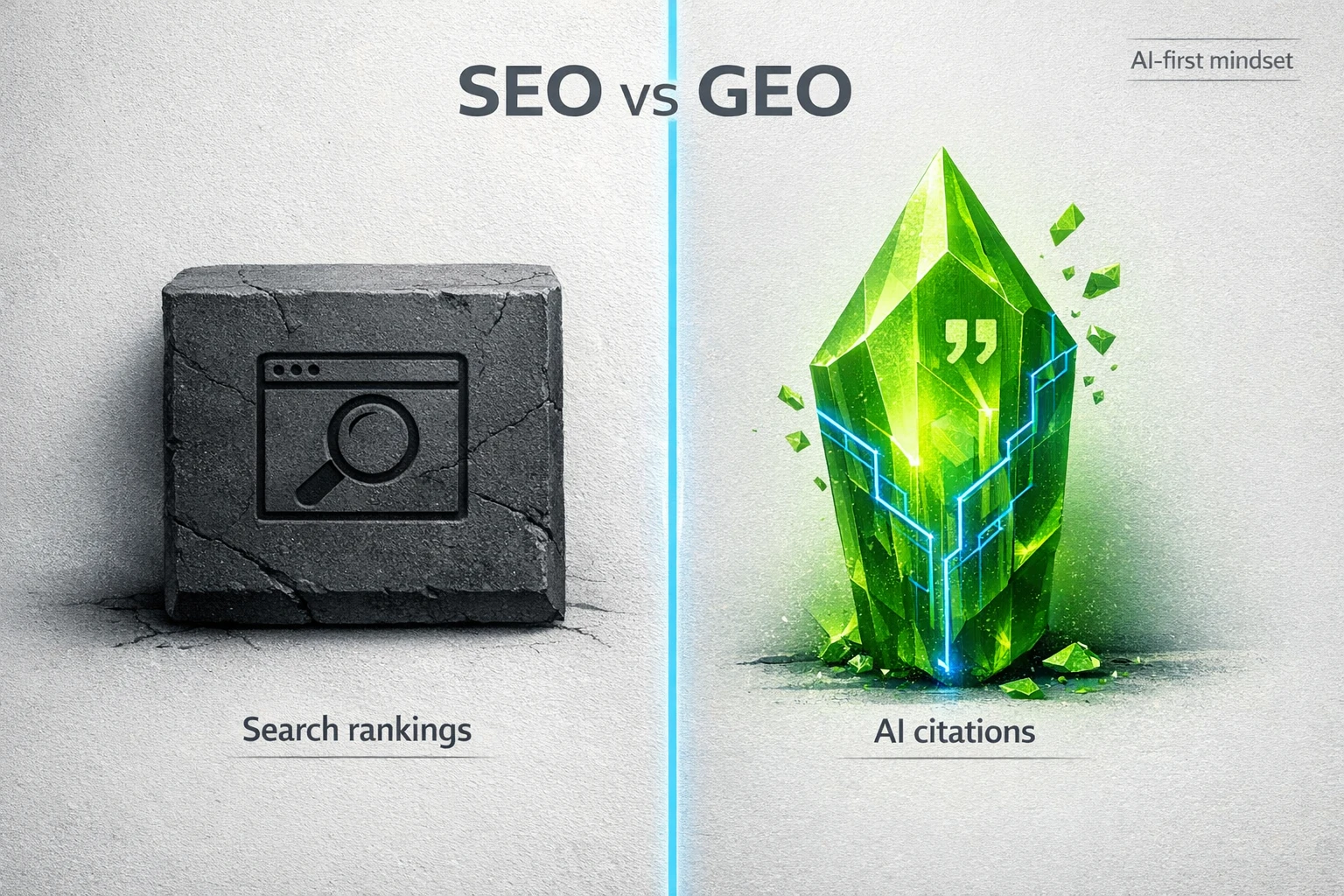
A quick mental model: SEO focuses on search rankings, while GEO focuses on earning AI citations—driven by structure, quality, and authority signals, not just brand size.
The New Battlefield: From SEO to Generative Engine Optimization (GEO)
For years, Search Engine Optimization (SEO) was the primary goal. You optimized for crawlers to get clicks. Now, you must optimize for large language models (LLMs) to get citations. This is Generative Engine Optimization (GEO).
GEO is a strategy focused on making your content the most logical, authoritative, and citable source for an AI to use in its answers. Unlike traditional SEO, brand size is less important. AI prioritizes content quality, structure, and authority signals [1]. This creates a massive opportunity for smaller, agile businesses to outmaneuver larger competitors who have not adapted. The first step is learning how to measure brand mindshare on AI search engines, because the old metrics no longer tell the whole story.
Reverse-engineering in this context means systematically deconstructing why a competitor's content gets chosen by AI. It involves analyzing their content structure, distribution channels, and audience engagement patterns to build a superior strategy.
A 4-Phase Framework for Reverse-Engineering Competitor Strategy
Stop guessing what works. A systematic approach reveals the patterns behind your competitors' success. This four-phase framework uses AI to uncover what they publish, where it spreads, and why it resonates.
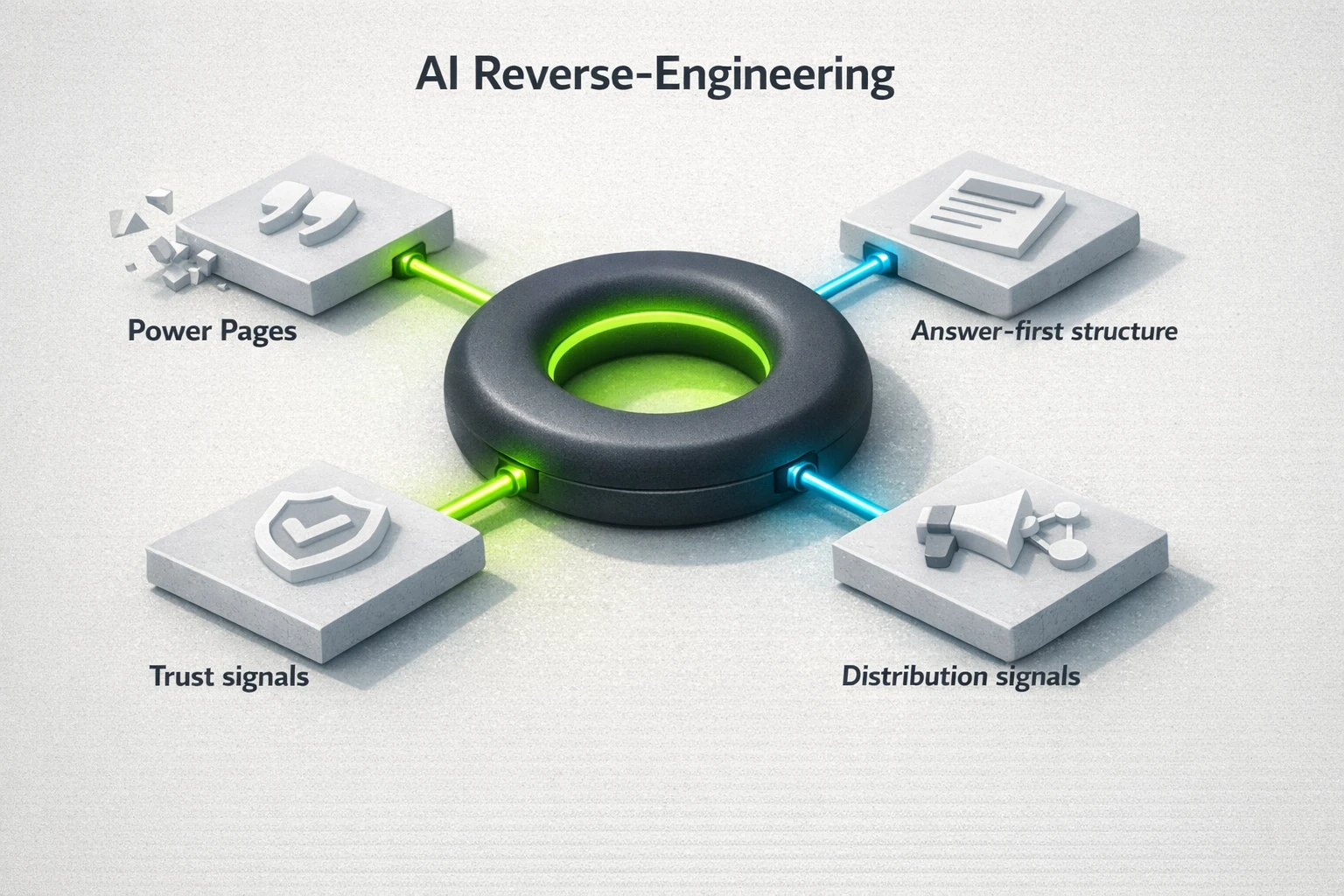
This framework ties AI-citable content elements to off-site distribution analysis, helping you reverse-engineer what competitors publish, what gets cited, and where it spreads.
Phase 1: Identify What AI Already Prefers
Before you can build, you must analyze. The first step is to find your competitors' "Power Pages". These are the specific articles, guides, or reports that AI models consistently cite.
You can start this manually by asking generative AI tools questions you want to rank for and see which competitors get mentioned. However, this is slow and inconsistent. Automated tools give you a much clearer picture, but you need to be aware of a critical blind spot. A significant number of websites, about 35% of the top 1000, actively block AI crawlers like GPTBot [2]. This means their content is invisible to ChatGPT, creating an opportunity for you to become the default source if you optimize correctly.
Phase 2: Deconstruct the Anatomy of AI-Citable Content
Once you identify the Power Pages, you need to dissect them. AI models do not choose sources randomly. They are programmed to find content that is clear, trustworthy, and easy to parse.
Look for these four elements:
- Semantic Clarity: Successful content often uses the inverted pyramid principle. It places the direct answer to a query at the very top of the page [3]. No long intros, just the solution.
- Data-Rich Formatting: AI prefers structured information. Look for lists, tables, blockquotes, and clear headings. This formatting makes data easy to extract and present.
- Explicit Trust Signals: AI models weigh authority signals heavily to avoid misinformation. They look for original data, authoritative outbound links to research or academic sources, and clear E-E-A-T (Experience, Expertise, Authoritativeness, Trustworthiness) signals [3].
- Machine-Readable Structure: Technical elements like schema markup help AI understand the context of your content. By mastering how to get your llm‑indexed pages, you give AI a clear roadmap to your information.
Phase 3: Uncover Distribution Channels Beyond Their Website
A great piece of content is useless if no one sees it. Your competitors are not just publishing and praying. They have a distribution strategy. AI tools can analyze thousands of competitor blog posts, social media content, and web pages to identify their patterns [4].
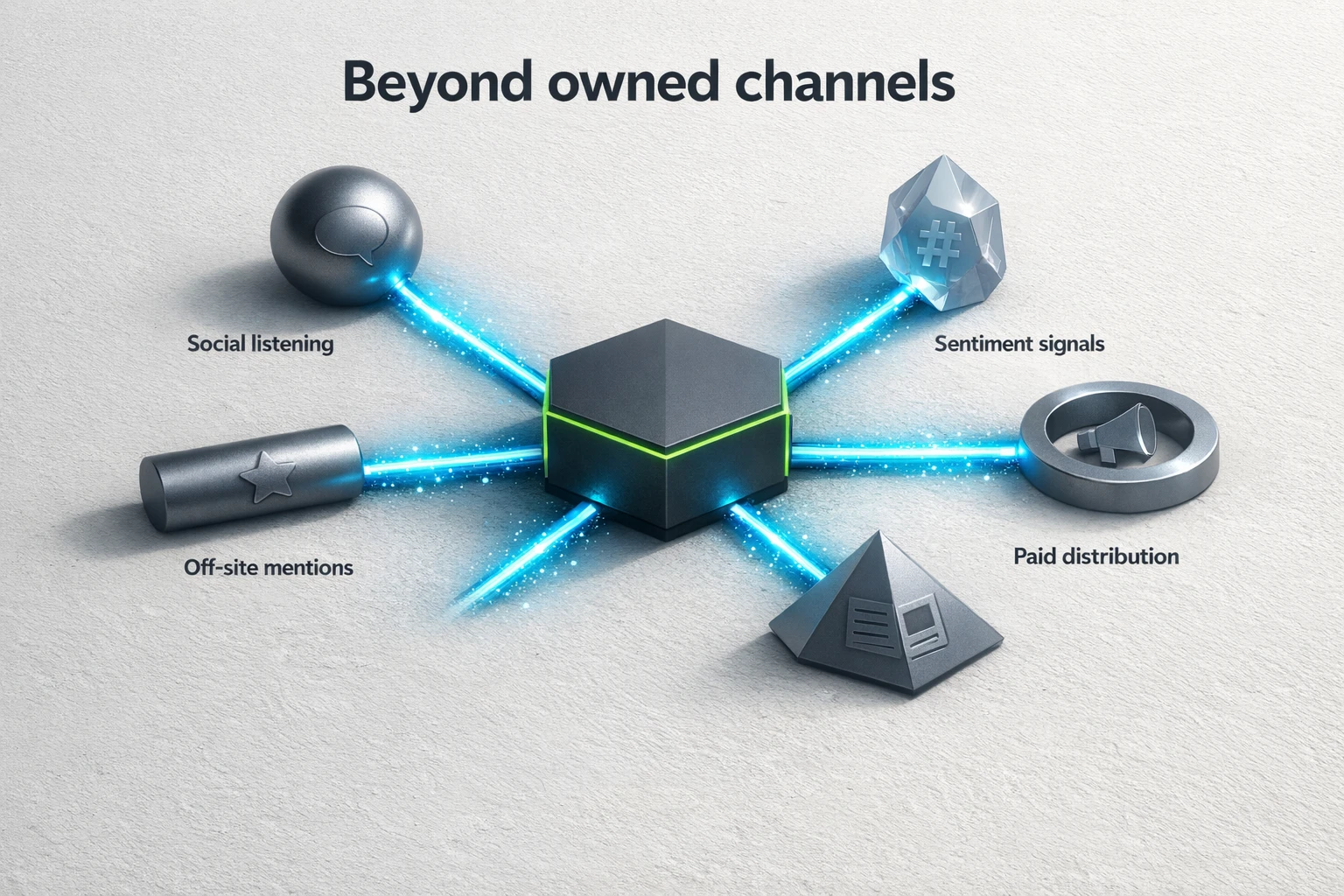
AI can reveal where competitor content travels off-site—tracking social listening, sentiment, mentions, and paid distribution signals to uncover hidden reach beyond their website.
This is where you look beyond their owned properties:
- Social Media: What platforms do they use? What content formats get the most engagement? AI can track user sentiment and emotional responses to competitor content, revealing how their audience actually feels [5]. This kind of analysis becomes even more critical on platforms like LinkedIn, where knowing the intricacies of the
"360brew" linkedin algorithmcan completely change your B2B strategy. - Paid Channels: AI can identify patterns in paid advertising, sponsorships, and promoted content to show you where your competitors are spending money to reach new audiences.
- Off-Site Mentions: Find out where their content is discussed on forums, communities like Reddit, and news sites. These conversations are powerful indicators of true influence.
This process is a core part of modern SEO and competitive intelligence, a guide that explains how AI goes beyond keywords to uncover true authority.
Phase 4: Decode Promotion Tactics and Audience Engagement
Distribution gets the content out there. Promotion is what creates momentum. Companies that use AI-powered competitive intelligence respond to competitor moves 60% faster than those using traditional methods [6].
Use AI to analyze:
- Backlink Velocity: How quickly are they acquiring backlinks after publishing a new piece of content? Which sites link to them? This reveals their PR and outreach strategy.
- Influencer Collaboration: Identify the key influencers and partners who share their content. This shows you who holds sway in your niche.
- Content Repurposing: Do they turn blog posts into videos, infographics, or social media threads? Understanding their content lifecycle helps you predict their next move and create a more comprehensive content plan.
Putting It Into Action: Common Pitfalls and Ethical Lines
Reverse-engineering is about learning, not plagiarism. The goal is to understand the strategy, not to copy the content. As you implement this framework, be aware of the lines you should not cross.
Ethical competitive intelligence means gathering data from publicly available sources like websites, social media, and financial reports [7]. It is not about corporate espionage. The data is out there. AI just helps you connect the dots faster.
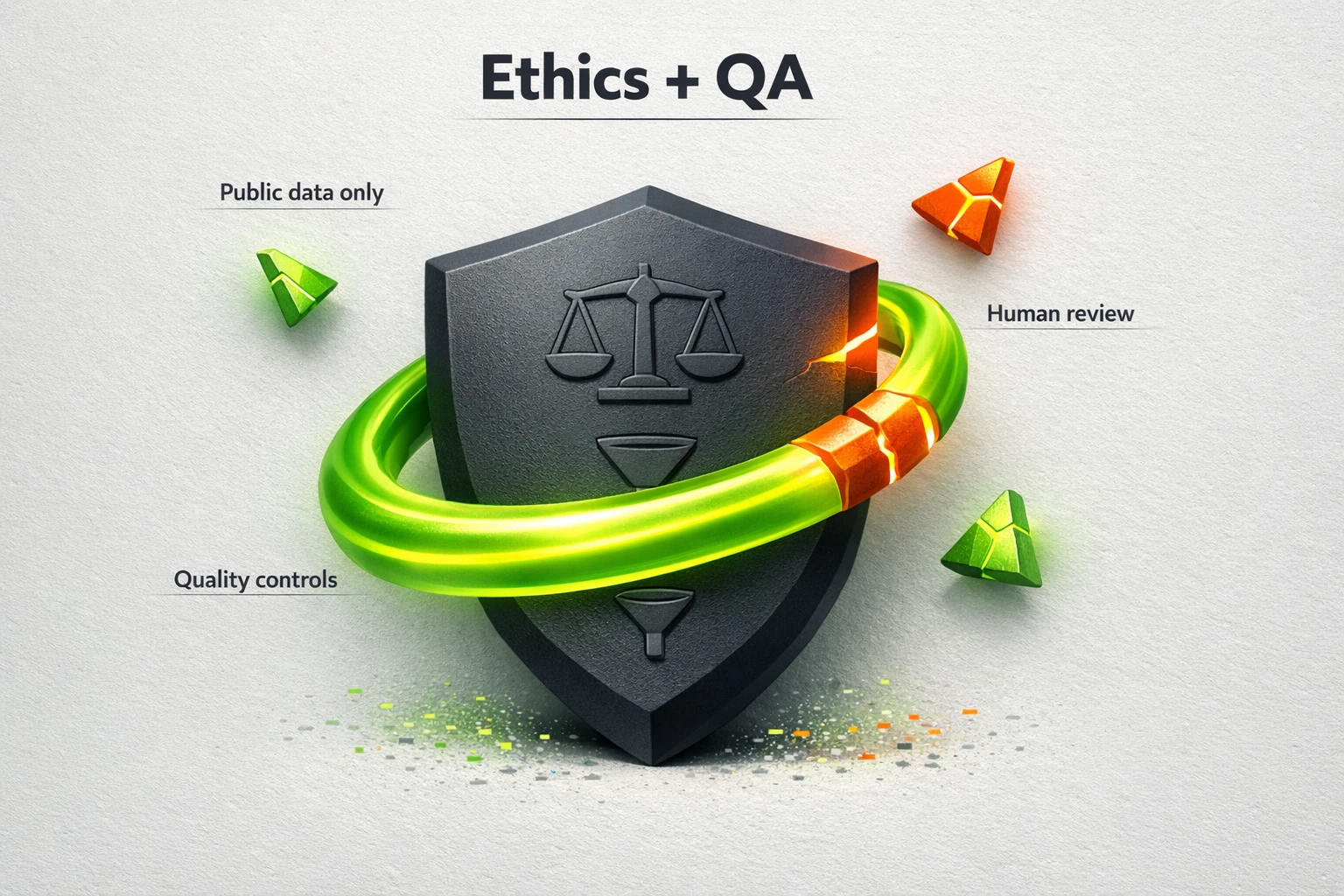
AI can spot patterns, but ethical boundaries and quality controls matter. Use public data, keep human review for nuance, and prevent unreliable automation from creating false signals.
Also, remember AI is a tool, not a replacement for human expertise. It is great at spotting patterns but can easily misread sarcasm or miss cultural nuance [8]. Always apply a layer of human review to the insights AI provides. This prevents you from acting on false signals generated by unreliable automation.
Frequently Asked Questions
What is the main difference between traditional competitor analysis and AI-driven reverse-engineering?
Traditional analysis often focuses on surface-level metrics like keywords, backlinks, and social media follower counts. AI-driven reverse-engineering goes deeper. It analyzes the structure of content to see why it is citable by AI, tracks sentiment across dozens of platforms to measure true engagement, and identifies distribution patterns across owned, paid, and earned media.
How do I get started with reverse-engineering a competitor's content strategy?
Start small. Pick one major competitor and one key topic you want to own. Use AI prompts to ask generative search engines questions related to that topic and note which competitor pages are cited. Then, manually analyze the structure, formatting, and trust signals of that single "Power Page" against your own content. This initial comparison will reveal immediate gaps and opportunities.
Is it ethical to use AI to analyze competitor strategies?
Yes, as long as you operate within ethical boundaries. Ethical competitive intelligence relies on publicly available information. You are analyzing data that competitors have willingly published on their websites, social media channels, and in press releases. The line is crossed when methods involve hacking, stealing proprietary information, or other illegal activities. Stick to public data sources.
From Analysis to Authority
Reverse-engineering your competitors' content strategy is not a one-time task. It is an ongoing process of analysis, adaptation, and execution. By understanding why AI models prefer their content, you can build a strategy that makes you the definitive authority in your niche.
The insights you gather are worthless without action. Use them to create better content blueprints, refine your distribution channels, and measure what truly matters. The world of digital marketing is changing, and understanding the new marketing metrics in the AI era is essential for proving value and building brand authority.
---
Sources:
- Amivisibleonai.com - Analysis of AI content citation preferences and crawler blocking statistics.
- GetPassionfruit - Research on content structures and authority signals preferred by AI models.
- Miro - Frameworks for using AI to analyze large volumes of competitor content.
- Meltwater - Insights on using AI for tracking user sentiment and emotional responses.
- Rajiv Gopinath - Data on the speed and accuracy benefits of AI-powered competitive intelligence.
- Watch My Competitor - A guide to the principles and practices of ethical competitive intelligence.
- Socialinsider - Discussion on the limitations of AI in understanding social media nuance.
- Frase.io - A guide to conducting SEO and AI competitor analysis.
- Averi.ai - Best practices for analyzing competitor engagement with AI.