How Do Digital Transformation and Leadership Align on AI?
AI Summary
Choosing how digital transformation and leadership align around AI reveals a hard truth: faster tasks mean little when broken handoffs keep margins flat. A workflow-first operating model connects vision to measurable leverage by redesigning verification, reconciliation, and routing rather than collecting more tools.
- How digital strategy converts leadership intent into owned, repeatable processes.
- Why redesigned workflow handoffs can outperform identical AI tools used inside existing steps.
- How confidence thresholds, exception routing, vendor portability, and GDPR controls protect scale.
For founder-led teams stuck with disconnected tools and stalled AI returns, this framework turns strategic vision into practical operational leverage.
Every growing business with repeatable processes eventually hits a structural wall in its digital transformation when leadership does not reshape how work flows. The team buys subscriptions to modern AI tools, individuals finish their isolated tasks faster, and yet the company's bottom-line margins barely move. You are left weighing a critical operational choice: continue adding disconnected software tools to your existing steps, or step in to redesign the architecture of how work moves across your business. Connecting your long-term vision to real AI operational leverage hangs on this exact distinction. True alignment requires moving away from isolated tool adoption and toward reconfiguring the handoffs between your core processes, while retaining full ownership of your business logic.
Why Vision Without Workflow Redesign Fails to Deliver ROI
Buying software licenses and handing them to a team without changing how work flows is an expensive trap. When a business treats AI as an IT procurement task rather than an operating-model shift, individual staff members might draft emails or summarize notes faster, but the bottlenecks between steps remain untouched. Waiting for approvals, copying data between systems, and fixing formatting errors eat up all the time saved inside the individual task.
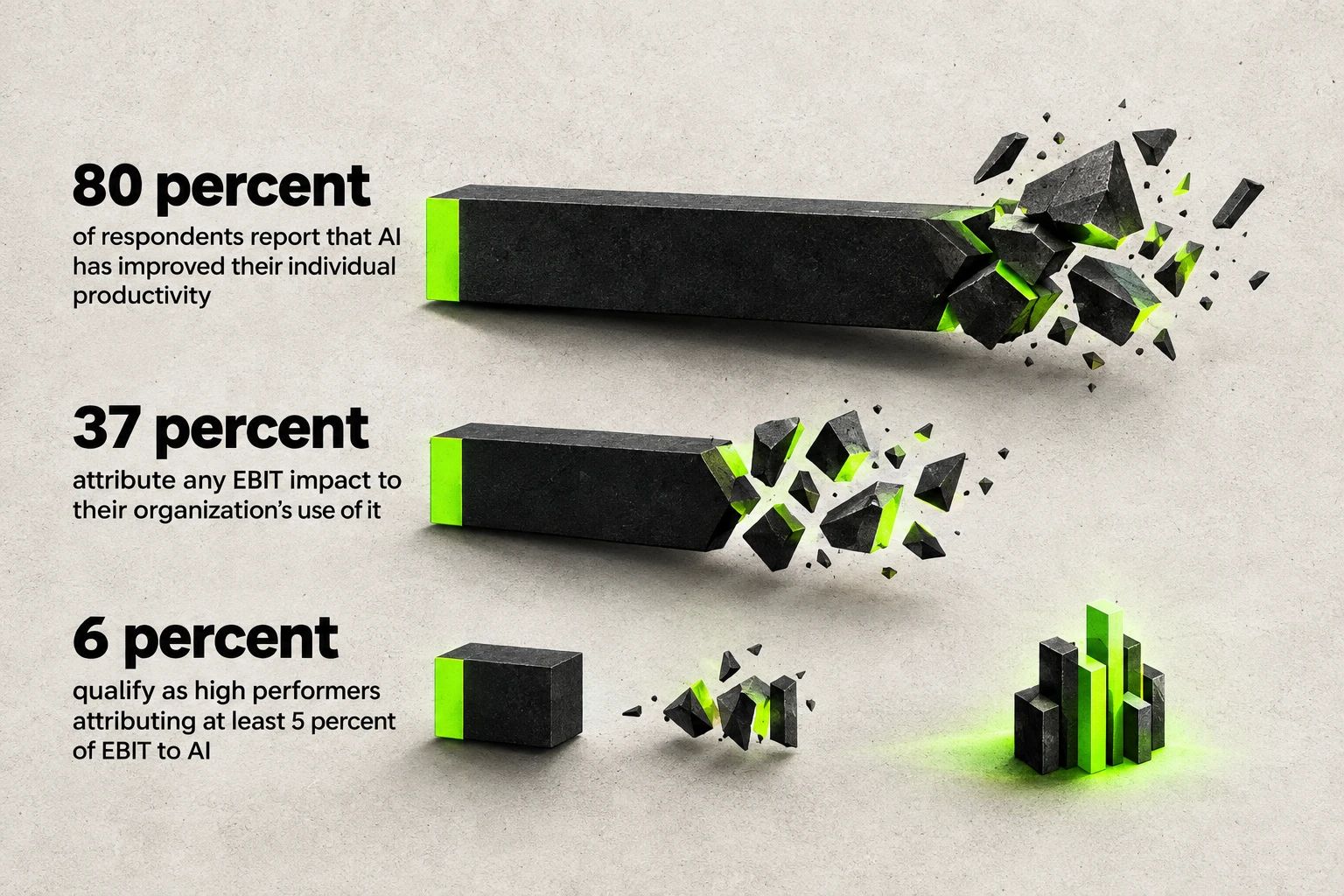
Reported individual productivity gains are broader than reported organizational EBIT impact.
In the McKinsey Global Survey on AI, 80 percent of respondents report that AI has improved their individual productivity, yet only 37 percent attribute any EBIT impact to their organization’s use of it, and only 6 percent qualify as high performers attributing at least 5 percent of EBIT to AI [1]. That gap between personal speed and organizational profit is where unaligned initiatives stall. If your strategy stops at giving people access to generic AI writing or point tools, you are paying for local convenience rather than business leverage.
To close this gap, your evaluation criteria must separate surface-level tool usage from structural change. Nanda Kumar Karippur, in a systematic literature review of 73 peer-reviewed studies and 13 practitioner, policy, and regulatory sources, distinguishes between two approaches [2]:
- AI adoption: Implementing AI applications within existing processes without fundamentally altering the operating model [2].
- AI-driven digital transformation (AIDT): Using AI as the primary driver of changes to an organization’s strategy, operating model, and value creation processes [2].
When you evaluate where to invest your time and capital, ask whether a proposed initiative merely speeds up an existing step or restructures the operating model itself. Only the second path turns high-level ambition into measurable return on investment.
Translating Ambition into Repeatable Processes
A compelling vision does not improve company performance by decree. Setting a high-level goal to automate operations and expecting the team to figure out the mechanics on top of their daily workload leaves the business stuck in endless testing. Ambition only creates operational leverage when it travels through a formal digital strategy that restructures repeatable business processes.
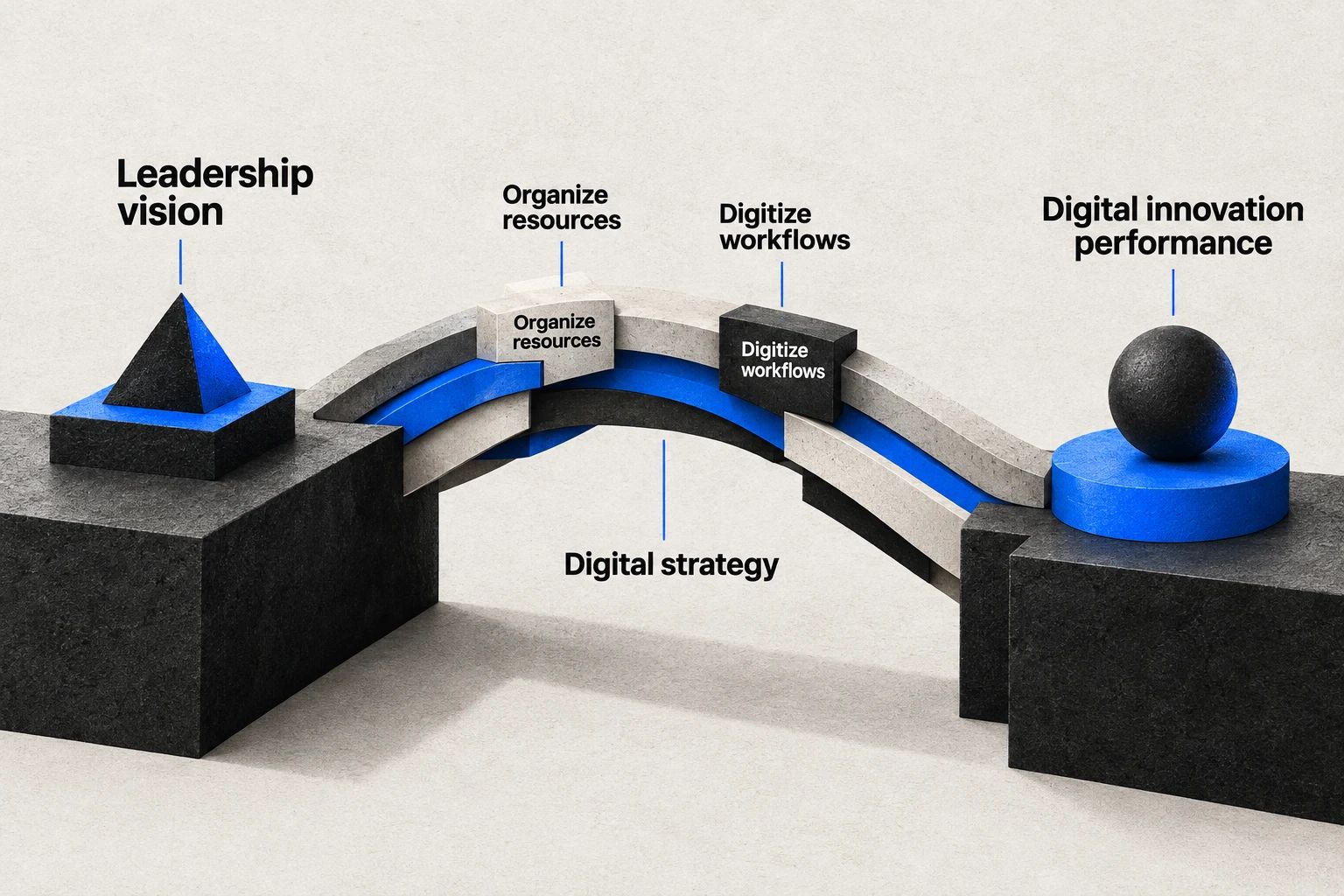
Digital strategy bridges leadership vision and operational execution.
Empirical research confirms that direction must be paired with a concrete operational bridge. In an empirical study of 348 employees in manufacturing firms implementing digital transformation, Zhihao Chen, Yongkang Wang, and Jonghyuk Park found that digital transformational leadership has a significant positive impact on digital innovation performance (B = 0.146, p < 0.05) and that digital strategy significantly mediates this relationship (B = 0.203, p < 0.001), acting as a bridge between leadership vision and operational execution [3]. Without that mediating strategy to organize resources and digitize workflows, vision remains an abstract target.
Building that bridge in a lean operation with repeatable processes requires clear ownership and relentless directional control. You cannot treat process architecture as a side project. You can establish this operational bridge through three deliberate mechanisms:
- Assign dedicated operational ownership: Designate clear accountability for process redesign so workflow engineering does not get buried under daily client delivery.
- Map repeatable processes before automating: Document the exact inputs, decision rules, and outputs of your core revenue-generating workflows before writing a single prompt or buying a tool.
- Protect strategic momentum: Keep directional control over milestones to clear roadblocks and prevent the operation from reverting to manual workarounds when friction appears.
Eliminating the Coordination Tax Across Workflow Interfaces
Once your strategy targets repeatable processes, the next decision is choosing where inside those processes to deploy AI. The default instinct is to automate isolated tasks, such as generating a sales script, drafting an SEO article, or summarizing a customer ticket. Yet inside a lean operation, the real drag on speed-to-value is rarely the task itself. It is the coordination tax between tasks.
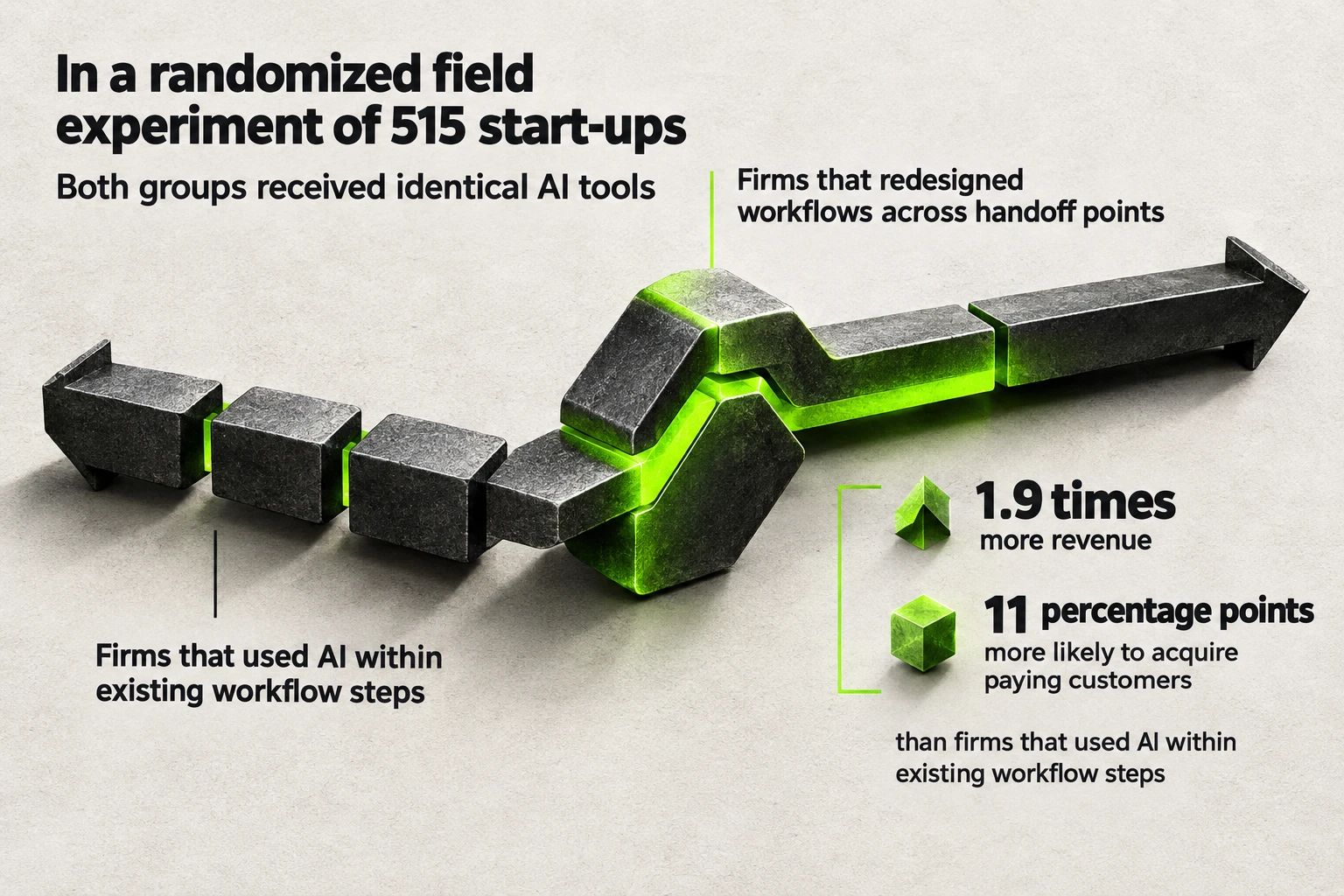
The experiment compares redesigned workflow handoffs with AI use in existing steps.
Every time a piece of work moves from one step or person to the next, your operation pays a hidden tax. Someone has to verify that the incoming data is complete, reconcile differences between two tools, and route the package to the next step. If you speed up Task A with AI but leave the manual handoff to Task B untouched, work simply piles up at the border. True operational leverage comes from integrating AI into human workflows right at those handoff interfaces.
In a randomized field experiment of 515 start-ups by researchers at INSEAD and Harvard Business School where both groups received identical AI tools, firms that redesigned workflows across handoff points generated 1.9 times more revenue and were 11 percentage points more likely to acquire paying customers than firms that used AI within existing workflow steps [1]. Both groups had the exact same technology. The revenue difference came entirely from where they pointed it.
To capture this leverage in your own systems, focus your redesign on the three coordination mechanisms that govern every workflow handoff:
- Verification: Automate the check that confirms an output from one step meets the exact formatting, completeness, and quality rules required by the next step.
- Reconciliation: Deploy AI to cross-reference and align data across separate systems, such as matching an incoming client intake form against CRM records and billing terms.
- Routing: Use automated logic to send the verified, reconciled work package directly to the right execution queue or specialist without waiting for manual triage.
Designing Human-in-the-Loop Confidence Thresholds
Automating workflow interfaces does not mean surrendering quality control to a black box. When businesses hesitate to move past manual handoffs, the hesitation usually comes from a fear of unmonitored AI errors reaching customers or breaking production systems. Conversely, requiring a human to review and approve every single automated step recreates the exact bottleneck you tried to remove.
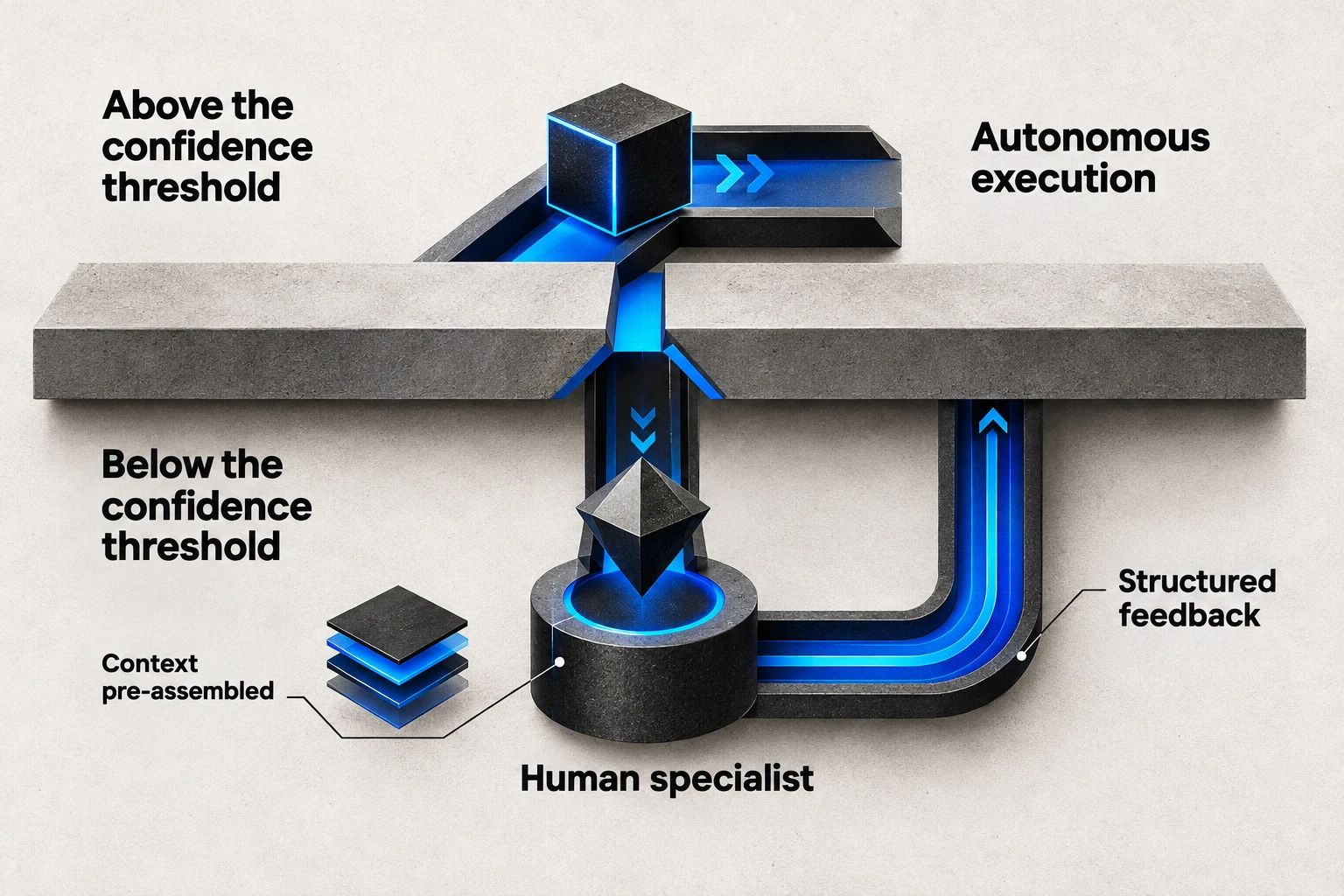
Confidence thresholds separate routine automation from human review of exceptions.
The solution is a structured human-in-the-loop architecture built around explicit confidence thresholds and decision rights. Instead of treating automation as an all-or-nothing switch, you define the exact mathematical or rule-based boundary between machine speed and human judgment. This structure keeps your operation fast on routine runs while protecting quality on edge cases, which is essential when evaluating AI-accelerated software development or custom business pipelines.
You can structure human-in-the-loop oversight across your core workflows using three operational rules:
- Autonomous execution above the threshold: When an incoming handoff passes all verification checks and matches standard parameters, the system reconciles and routes the work without human intervention.
- Context-assembled exception routing: When an item falls below the confidence threshold or triggers an ambiguity rule, the system pauses autonomous routing and sends the item to a human specialist with all relevant context pre-assembled.
- Threshold calibration loops: Every human resolution of an exception is logged as structured feedback, allowing you to refine the routing rules and reduce false alarms over time.
Avoiding Vendor Lock-In, Governance Debt, and GDPR Risks
Moving from isolated pilots to core workflow automation exposes a second evaluation dilemma: how to build fast today without trapping your business tomorrow. When lean teams want rapid speed-to-value, it is tempting to plug core company data into closed third-party SaaS platforms or hand the entire build over to external agencies without retaining architectural control. Similarly, teams often skip data privacy and compliance boundaries during early testing just to get a prototype running.
Both shortcuts carry heavy compounding costs. If your proprietary process logic lives inside a closed vendor's platform, you face severe vendor lock-in: you cannot switch LLM providers, adjust the underlying routing code, or migrate your workflows without rebuilding from scratch. At the same time, ignoring GDPR compliance and data residency during prototyping creates a backlog of compliance vulnerabilities that will block you from scaling the system into production. Establishing an ethical AI development framework early prevents this bottleneck.
Nanda Kumar Karippur warns that transformation must be staged so that governance capacity grows alongside the expansion of AI use rather than trailing behind it, because governance debt accumulated during rapid piloting tends to constrain later scaling, and notes that while external partnerships can accelerate transformation for enterprises without in-house AI depth, dependence on external providers can hollow out internal capability over time [2].
To achieve fast speed-to-value while keeping full ownership of your systems, weigh every build, buy, or partner decision against three autonomy criteria:
- Retain full architectural and code ownership: Ensure that your workflow logic, prompt structures, and integration pipelines belong to your business and can run independently of any single vendor's proprietary interface.
- Keep model and vendor portability: Build your systems so you can swap underlying LLM providers or APIs as costs and capabilities shift in the adaptive AI market.
- Embed GDPR compliance from day one: Enforce strict data residency, zero-data-retention API agreements, and clear access permissions during the initial workflow design so governance capacity scales in lockstep with your automation.
Frequently Asked Questions
What proportion of digital transformations meet their target value and achieve sustainable change?
Only about one-third of digital transformations meet or exceed their target value and achieve sustainable change, based on a Boston Consulting Group survey of 860 senior executives (VPs and CxOs) and an analysis of 30 transformations [4]. You can improve your odds by tying every AI workflow investment directly to handoff redesign and measurable operational outputs rather than open-ended tool experimentation.
Can you delegate digital transformation to someone as a side responsibility?
No, you cannot ask someone to run transformation on the side because it is a full-time job. Based on interviews with 23 global CEOs, Deloitte Insights reports that leaders must assign full-time ownership to digitization while keeping their hand on the wheel; as Marc Huffman, CEO of BlackLine, states, "Digital transformation is a full-time job, so you need people to work on it full time. You can’t just ask someone to do it on the side" [5]. Even in a lean operation, you must dedicate focused operational blocks or specialized system builders to process redesign while you steer the strategic milestones.
How does prioritizing ethical governance affect progress in digital transformation?
Prioritizing ethical governance early correlates with being further along in the transformation journey. In a survey of more than 1,500 senior executives from over 90 countries, Harvard Business School Professor Linda A. Hill and colleagues found that only 18 percent of survey participants deemed ethical governance critical to success, yet those 18 percent were significantly further along in the digital transformation process than those who reported otherwise [6]. Setting clear data privacy, GDPR, and human-in-the-loop boundaries upfront lets you deploy automated workflows into production without stopping later to fix compliance gaps.
Your Next Step to Capture Operational Leverage
When you align leadership and digital transformation around workflow architecture rather than point-solution tools, your path forward becomes concrete. You do not need a multi-year corporate committee to capture asymmetric value from AI. Take one repeatable, revenue-critical process in your operation this week and audit its handoffs: identify the exact border where work moves from one step to the next, document the verification, reconciliation, and routing rules required at that border, and define the confidence threshold that separates a routine run from a human exception. By redesigning that single interface under your own architectural ownership and GDPR boundaries, you turn executive vision into immediate operational leverage.
Sources:
- McKinsey & Company - Survey data on AI productivity versus EBIT and startup workflow handoff experiment
- Administrative Sciences - Systematic review distinguishing AI adoption from transformation, governance debt, and vendor dependency
- Scientific Reports - Empirical study on the mediating role of digital strategy in innovation performance
- Boston Consulting Group - Executive survey data on the share of transformations meeting target value
- Deloitte Insights - Interviews with 23 global CEOs on full-time ownership and leadership direction
- Harvard Business School Working Knowledge - Global executive survey on ethical governance and transformation progress