Is Your AI Content Actually Working? The New Framework for Measuring Visibility
AI Summary
Measuring and optimizing AI visibility performance means shifting from chasing clicks to proving your content is actually shaping AI answers and buying decisions, which exposes how misleading traditional SEO metrics have become in a zero-click world. This framework shows how to turn vague “AI content” efforts into trackable influence and revenue.
- Map AI visibility across four KPI layers, from brand mention frequency in AI answers to AI-assisted conversions tied back to pipeline.
- Build a core prompt set, run quarterly AI checks, and use branded search growth as the attribution bridge from AI recommendation to revenue.
- Replace efficiency vanity metrics with effectiveness metrics so each article is designed to become a definitive source that AI models cite, not just another fast-published post.
For teams producing AI content at scale but unable to prove whether it’s driving demand, authority, or revenue.
Everyone is creating content with AI. The real question is, does any of it work? Most teams are flying blind, celebrating how fast they can publish articles while having no idea if those articles are influencing customers or generating revenue.
The core problem is simple. We are trying to measure a new kind of search with old rules. Traditional SEO metrics like traffic, rankings, and click-through rates are becoming less relevant in a world of AI-generated answers. Your content can be the primary source for an AI recommendation without ever getting a single click.
Most teams get this wrong because they measure AI's efficiency, not its effectiveness. They track content velocity instead of brand visibility. The path forward is not to produce more content faster. It is to build a measurement system that proves your content is shaping opinions and driving business in this new zero-click environment.
.jpeg)
The Mindset Shift: From Clicks to Influence
You have to stop thinking about being found and start thinking about being cited. For years, SEO was about winning a spot on a list of blue links to earn a click. In the world of generative AI, success means your brand's perspective becomes the answer itself.
This requires a fundamental shift in how you think about your content's job. It is no longer just a doorway to your website. It is an ambassador for your point of view, training the models that answer your customers' questions. As one analysis aptly puts it, AI visibility is about being recommended, not just being seen [1]. The goal is to integrate your brand's expertise into an AI's decision-making process. Learning to measure true brand influence is the new critical marketing skill.
Think of it like this: traditional SEO is like having a store on a busy street, hoping for foot traffic. AI visibility is being the one restaurant that every hotel concierge recommends by name. One generates anonymous traffic; the other creates qualified customers based on trusted authority.
The AI Visibility Measurement Framework: 4 Layers of KPIs
A proper measurement framework moves from surface-level vanity metrics to bottom-line business impact. Instead of a flat list of KPIs, think in layers. Each layer answers a more important question than the one before it.
Layer 1: Visibility Metrics (Are we showing up?)
This is the most basic layer. Before you can measure quality or influence, you need to know if you are even present in AI-generated answers.
The single most important metric here is Brand Mention Frequency. The goal is simple: when a user asks a question about your industry, product category, or core problem, does your brand get mentioned in the response? This is the North Star metric for AI search [2]. Everything else builds on this foundation.
Layer 2: Quality Metrics (Are the mentions good?)
Being mentioned is not enough. The context of that mention is what matters. A mention that misrepresents your product is worse than no mention at all.
Here, you track qualitative KPIs like Citation Sentiment (is the mention positive, neutral, or negative?) and Information Accuracy (does the AI correctly describe what you do?). This layer ensures your brand's reputation is being built, not damaged.
Layer 3: Influence Metrics (Is it changing behavior?)
This is where you connect AI visibility to tangible user action. An AI might not send a user to your site via a direct link, but a strong recommendation will inspire them to search for you directly.
The key KPI is Branded Search Volume Growth. If your AI visibility efforts are working, you will see a measurable lift in people searching for your company name, products, and key people. This is the strongest indicator that unseen influence is translating into active interest.
Layer 4: Business Metrics (Did it make money?)
Ultimately, every marketing effort must answer to revenue. This final layer connects the influence you have built to the pipeline your business depends on.
Track AI-Assisted Conversions by correlating the lift in branded search traffic to demo requests, trial sign-ups, and closed deals. You can set up specific funnels in your analytics to track users who arrive via a branded search term and then convert. Answering the question of "how can I measure marketing ROI when AI is changing search behavior?" becomes possible when you connect these dots.
How to Implement Your Measurement Strategy
A framework is only useful if you put it into practice. Here is a five-step process for building your AI visibility dashboard and reporting rhythm.
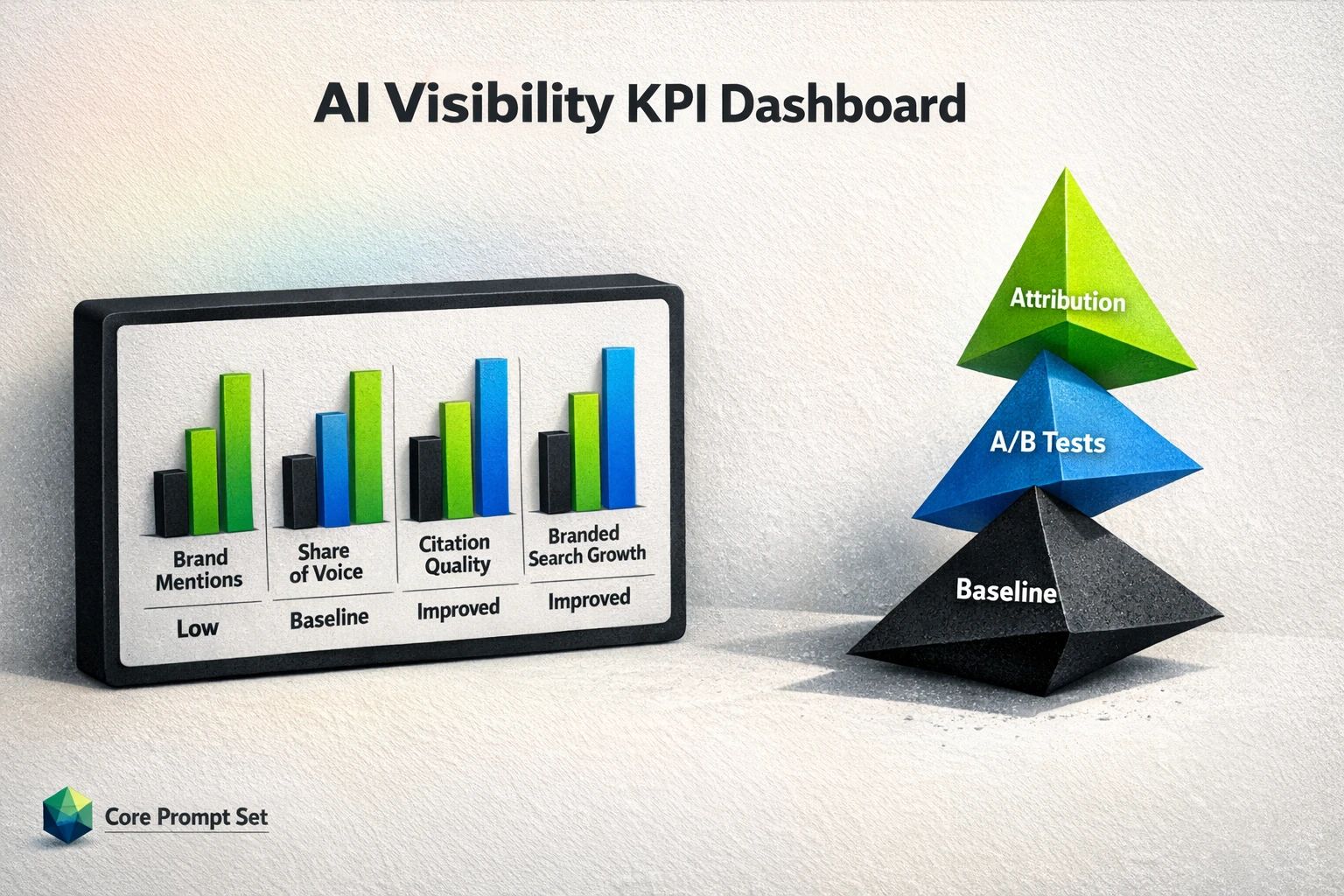
Step 1: Define Your Core Prompt Set
Forget keywords for a moment. Instead, map out the top 15-20 conversational questions your ideal customer would ask an AI assistant when researching solutions like yours. These prompts, not isolated keywords, are your new measurement baseline. Group them by intent, from early-stage problem awareness to late-stage brand comparisons.
Step 2: Establish Your Baseline
Before you can show improvement, you must document your starting point. For each prompt in your set, run it through the major AI chat models (ChatGPT, Gemini, etc.) and document the results. Does your brand appear? What is the context? Are competitors mentioned? A simple spreadsheet is all you need to get started. Do this quarterly to track progress.
Step 3: Set Up Tracking & Dashboards
Use free tools to monitor the metrics in the framework.
- Google Search Console: Filter for your brand name and track impressions and clicks over time to measure branded search lift (Layer 3).
- Google Analytics 4: Create a segment for users who land on your site from a branded organic search. Monitor their conversion rates (Layer 4).
- Manual Checks: Use your core prompt set for quarterly manual checks to track mentions and sentiment (Layers 1 and 2).
Step 4: Connect to Business Outcomes (Attribution)
Attribution is the hardest part for most teams. You have to draw a clear line from an AI mention to a closed deal. The key is using branded search as the bridge.
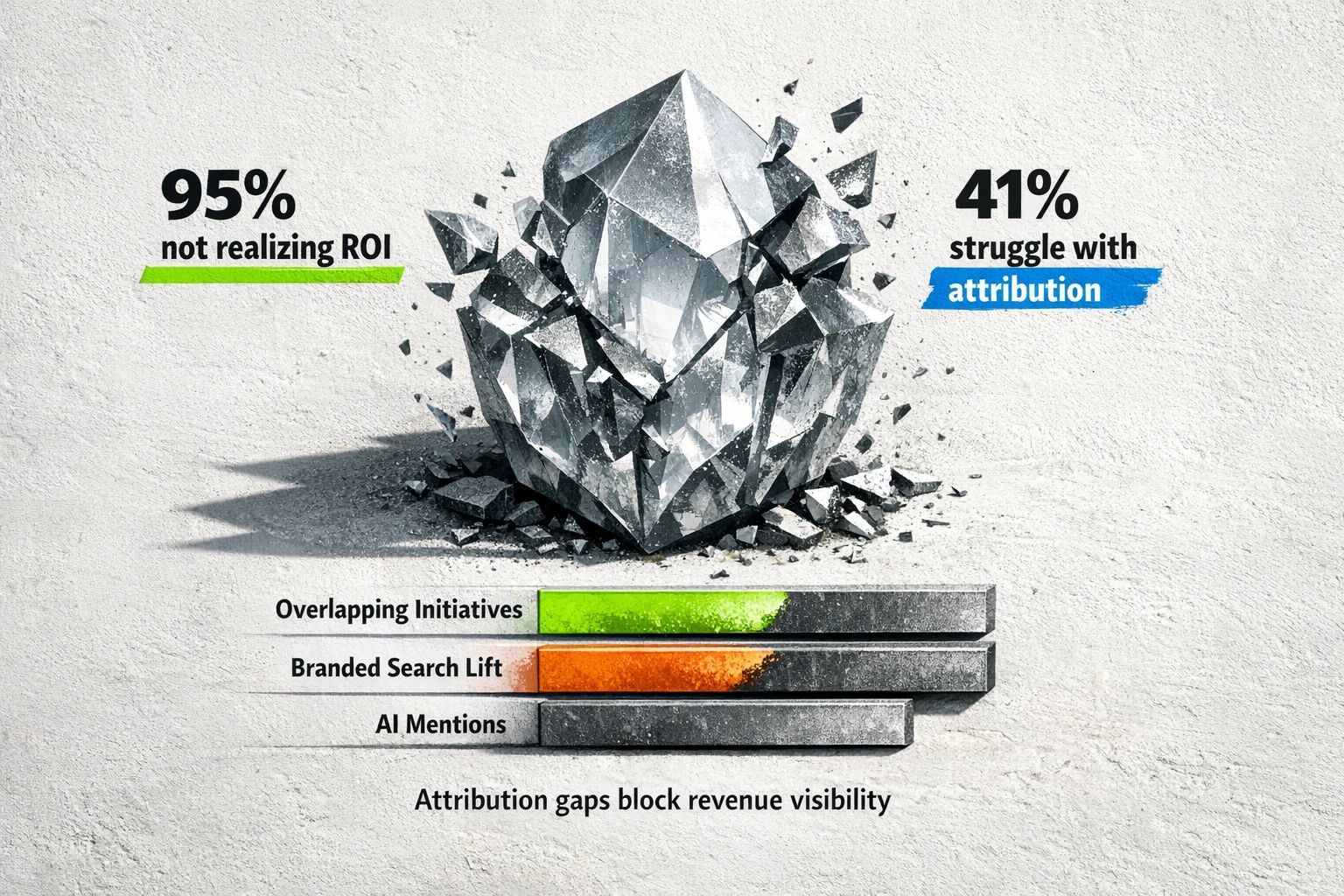
The challenge is real, with research showing that 41% of companies struggle to pinpoint if their AI projects are truly driving results [3]. A simple attribution model looks like this: AI Mention → User Searches Brand Name → User Visits Site → User Converts. By tracking the growth in conversions from your branded search segment, you can credibly attribute that new revenue to your AI visibility efforts. This requires understanding how to improve ROI predictability using AI-driven simulators and other advanced attribution methods.
Step 5: Create a Monthly Reporting Rhythm
Review your dashboard monthly. Look for trends. Which prompts are you gaining visibility on? Which ones are you losing? Is your branded search volume increasing? Are conversions from that segment going up? This rhythm turns data into insights that guide your next content decisions.
The Biggest Mistake: Chasing Efficiency Over Effectiveness
The market is obsessed with using AI to produce content faster. This is a trap. It leads to a flood of mediocre, undifferentiated content that adds to the noise without building any real authority. Faster failure is not a business goal.
The most common mistake teams make is focusing only on efficiency metrics like content production speed, not effectiveness metrics that track business goals [4]. The right approach involves integrating AI into human workflows to elevate quality and strategic impact, not just to automate typing. A strategy based on publishing 100 average articles will lose to a strategy that publishes 10 exceptional articles that become the definitive source for AI models.
Measurement is what enforces this discipline. When you are accountable for brand mentions and pipeline, you stop asking "How fast can we write this?" and start asking "Will this article make us the undeniable authority on this topic?" That shift changes everything.
Frequently Asked Questions
How is this different from traditional SEO measurement?
Traditional SEO focuses on metrics that imply visibility, like rankings and traffic. This new model measures direct influence, such as brand mentions within AI answers and the resulting impact on branded search queries. It prioritizes being the source of the answer over being a link in a list.
What's a realistic timeline to see results from an AI visibility strategy?
Building authority takes time. You should expect to see early indicators, like an increase in brand mentions for long-tail prompts, within 3-6 months. A measurable lift in broader branded search volume and attributable conversions can take 6-12 months of consistent effort.
Can I measure this without expensive, specialized tools?
Yes. While specialized tools can automate prompt checking, you can build a robust system using Google Search Console, Google Analytics, and a disciplined manual process. The framework is tool-agnostic. It is about what you measure, not how you measure it.
How does pageBody's SEO Strategist help with this measurement framework?
Our entire SEO Strategist service is built around this principle of effectiveness over efficiency. We create Ranking Asset Packages designed to establish your authority on specific topics, which directly increases the likelihood of being cited by AI. We focus on building the foundational content that fuels all four layers of the measurement framework, from initial visibility to business impact.
Sources:
- CMSWire - Analysis of the shift from traditional SEO to AI Visibility Optimization (AIVO).
- Column Five - Expert commentary on establishing brand presence as the North Star metric for AI search.
- Magai.co - Data on the challenges companies face with AI project attribution.
- Content Science Review - Report on common barriers to achieving ROI from AI, including the focus on efficiency over effectiveness.