How Do Agentic Workflows Transform Repeatable Processes?
AI Summary
Agentic workflows can transform repeatable processes, but adaptive automation creates value only when the process truly needs dynamic decisions rather than fixed rules. The key is redesigning operations around controlled autonomy, accessible data, and human oversight.
- The three automation tiers that distinguish deterministic rules, predefined AI workflows, and agent-driven loops.
- The five execution stages covering planning, tool use, state tracking, approvals, and stopping conditions.
- Decision criteria for choosing linear automation or agentic loops, including exception volume, data readiness, GDPR tracing, and vendor portability.
For SMBs whose teams spend too much time resolving process exceptions and need a safer path to operational leverage.
Every growing business eventually hits a ceiling with standard automation before turning to agentic workflows. You connect your software tools with if-this-then-that rules, and everything runs smoothly until an unexpected input arrives. A slightly different data format, a missing field, or an unresponsive external system breaks the sequence. You are then forced to choose between paying your team to manually fix exceptions or spending weeks coding endless conditional branches.
Your decision on whether to upgrade from linear automation to continuous AI loops hangs on a single trade-off: do you need the predictable simplicity of fixed rules, or the operational leverage of a system that dynamically plans and adjusts to exceptions on its own? Upgrading is not about plugging an LLM into a broken task. It requires weighing the gain in autonomous exception handling against the need to redesign your repeatable process around strict human-in-the-loop guardrails, unified data access, and clear stopping conditions.
The Shift from Linear Rules to Continuous Loops
Most operations rely on deterministic pathways where a human defines the exact sequence of actions in advance. Moving beyond these rigid pipelines requires understanding what actually changes when you give an AI system the freedom to decide its own steps. The confusion in the market comes from treating every system that uses an LLM as an autonomous agent.
You can separate modern process automation into three distinct tiers based on who controls the execution path:
- Deterministic non-AI automation: Software follows fixed, rule-based code paths without an LLM. If condition A occurs, the system executes action B every time.
- Predefined AI workflows: An LLM processes text or data inside a fixed pipeline, but predefined code paths still dictate the exact sequence of steps and tool calls.
- Agent-driven continuous loops: An AI agent receives a goal and dynamically directs its own process, planning its steps, selecting tools, observing the output, and adjusting its next move until the goal is met.
Anthropic defines this architectural boundary by separating workflows, where LLMs and tools are orchestrated through predefined code paths, from agents, where LLMs dynamically direct their own processes and tool usage while maintaining control over how they accomplish tasks [1]. That distinction is the foundation of your evaluation. If a repeatable process never changes its sequence of steps, a predefined path is enough. You only need an agentic loop when the path to the goal cannot be mapped in advance because it depends on what the system discovers along the way.
Core Mechanics of Linear Automation and Agent-Driven Loops Compared
Evaluating an upgrade requires looking directly at how traditional pipelines and autonomous loops behave under operational pressure. When an input deviates from the norm, linear scripts and agentic loops react in fundamentally different ways.
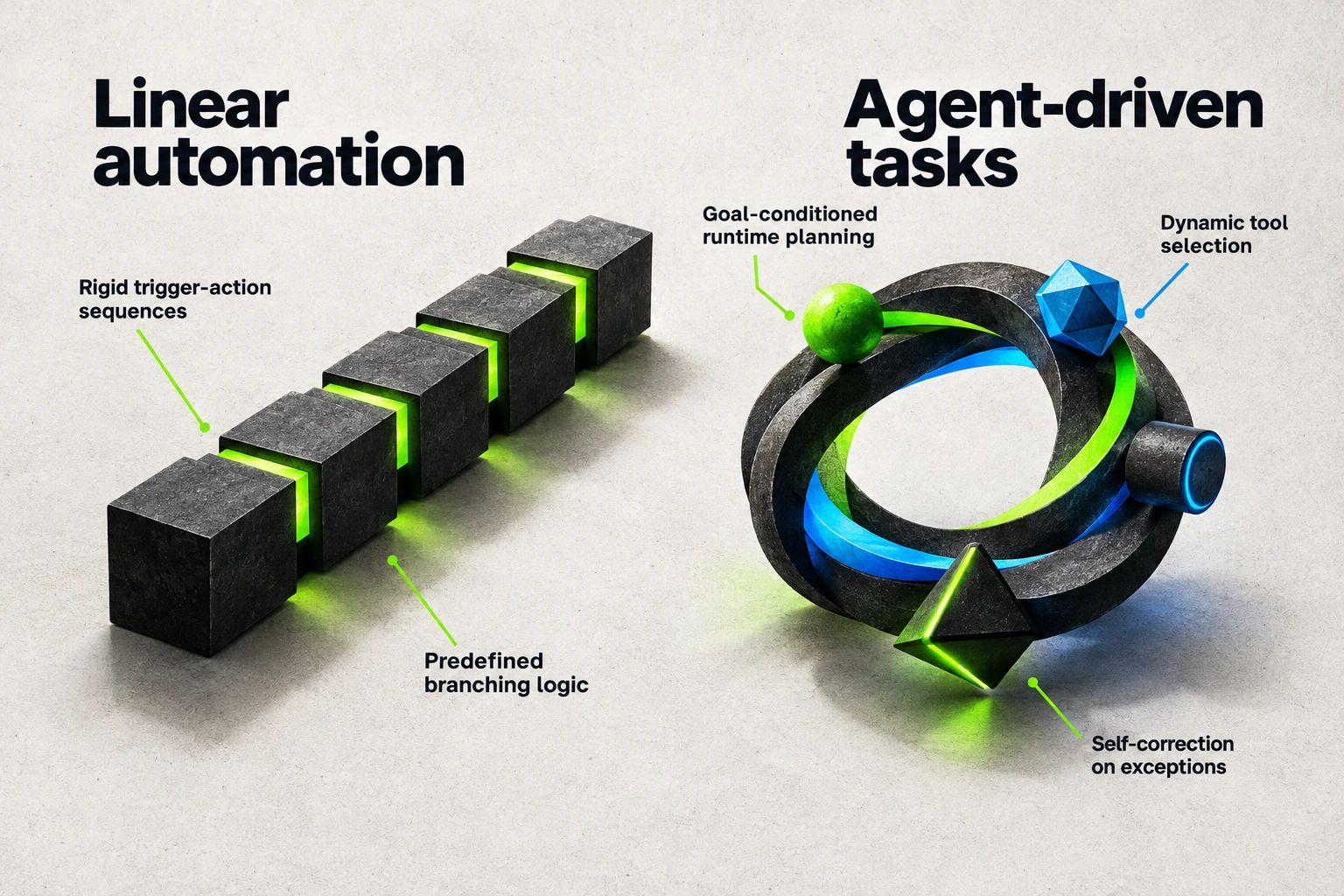
Fixed paths and adaptive loops handle exceptions differently.
Linear automation operates on fixed execution mechanics:
- Rigid trigger-action sequences: Every step must be explicitly programmed before the system goes live.
- Predefined branching logic: The system only handles exceptions that you anticipated and coded as if-else rules.
- Fragile exception handling: When an unexpected input or API timeout occurs, the pipeline halts and waits for human troubleshooting.
- Stateless execution: Each run starts from zero without retaining context from previous adjustments or edge cases.
Agent-driven tasks operate on adaptive loop mechanics:
- Goal-conditioned runtime planning: You define the outcome and the boundaries, and the agent determines the step-by-step sequence at runtime.
- Dynamic tool selection: The agent evaluates which connected database or API to call based on the real-time state of the task.
- Self-correction on exceptions: When a step produces an error or incomplete data, the agent reflects on the failure and formulates an alternative path.
- Short-term and long-term memory: The system tracks its current session state across multiple turns and retains structured context across separate runs.
These adaptive capabilities come with a real operational cost. Weaviate defines an agent-driven workflow as a series of connected steps dynamically executed by an agent or series of agents to achieve a specific goal, combining planning via task decomposition, tool execution with granted permissions, reflection, and short-term and long-term memory, while warning that introducing AI agents into straightforward workflows where deterministic, rules-based automation is sufficient can add unnecessary complexity, extra expense, and reduced reliability [2]. Never replace a working linear rule just to use newer technology. Reserve continuous loops for repeatable processes where exception handling consumes your team's capacity.
Inside the Continuous Loop Across Five Execution Stages
An autonomous loop does not run on magic. In a production environment, it moves through a structured execution lifecycle that bounds how the LLM reasons, acts, and hands off results. Understanding these five operational stages lets you see where data context and governance gates fit into the architecture.
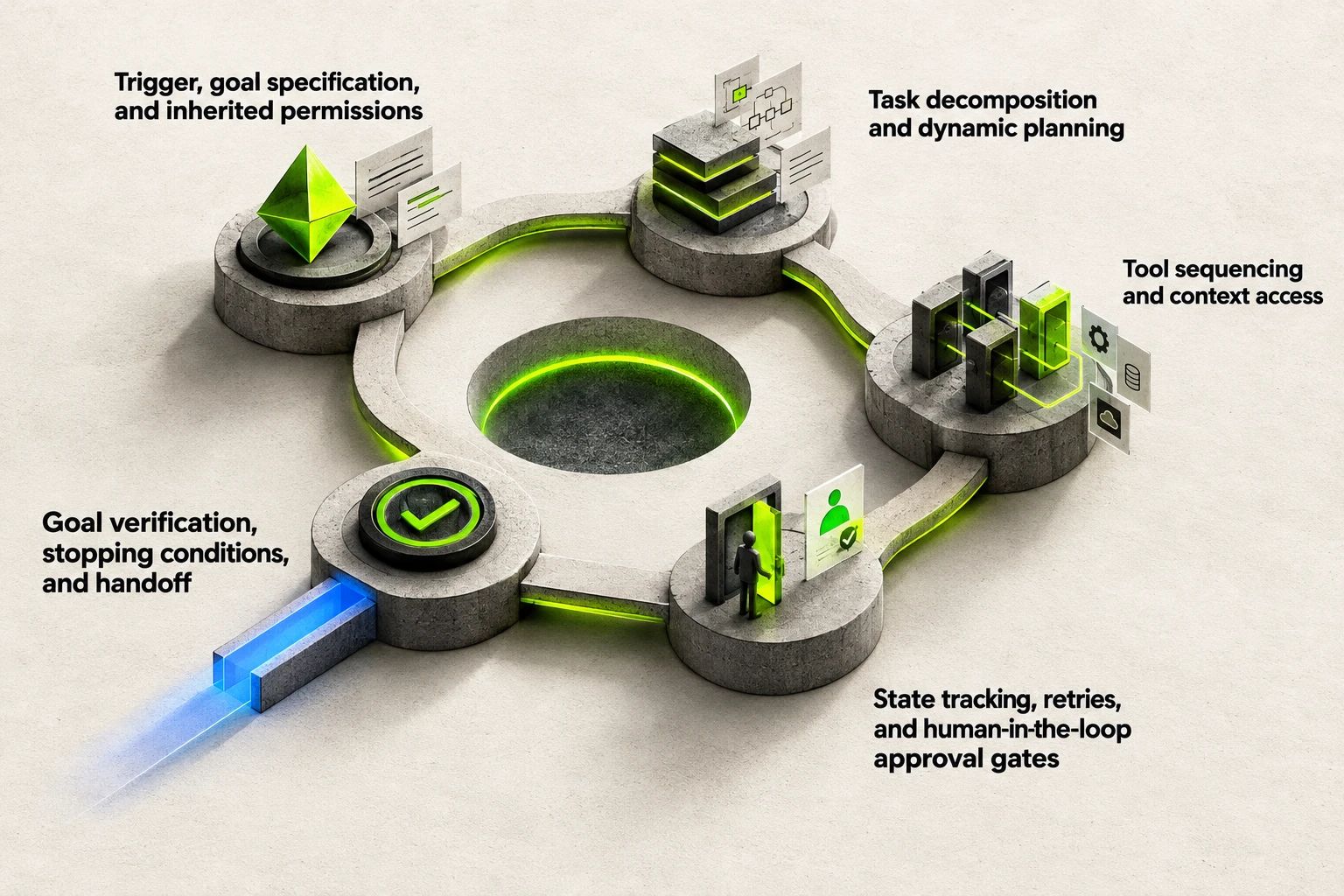
The loop moves from a defined goal to a controlled handoff.
- Trigger, goal specification, and inherited permissions: An external event, schedule, or user request starts the run. Instead of passing a rigid script, the system passes a defined objective along with strict, role-based access permissions that limit what data and tools the agent is allowed to touch.
- Task decomposition and dynamic planning: The agent analyzes the objective and breaks it down into smaller, sequential subtasks. This step creates an initial execution plan tailored to the specific inputs of the current run.
- Tool sequencing and context access: The agent executes the first subtask by querying structured databases, searching knowledge bases, or calling external APIs. After each call, it observes the returned data and decides whether its current plan still holds or needs adjustment.
- State tracking, retries, and human-in-the-loop approval gates: As the loop progresses across multiple steps, the system records the state of every action. If a tool call fails, the agent retries or adjusts its parameters. Before executing any consequential action, such as modifying records or triggering external communications, the loop pauses at a mandatory approval gate for human verification.
- Goal verification, stopping conditions, and handoff: After each cycle, the system checks the current output against explicit stopping conditions, such as goal completion, a maximum number of loop iterations, or a token budget limit. Once verified, the loop terminates cleanly and hands the final deliverable to the designated system or team member.
Structuring the loop across these five stages prevents an agent from spinning in endless retries. It gives you predictable control over runtime behavior and token consumption.
The Four Foundational Design Patterns Behind Agent-Driven Tasks
You do not need complex software libraries or opaque architectures to build reliable loops. Based on working with dozens of teams building LLM agents across industries, Anthropic researchers Erik Simonsen and Barry Zhang report that the most successful implementations were not using complex frameworks or specialized libraries, but instead were building with simple, composable patterns [1].
Four foundational design patterns give agent-driven loops their reliability in daily operations:
- Planning and task decomposition: Asking an LLM to solve a multi-part operational problem in a single jump invites errors. Task decomposition forces the system to break a broad goal into verifiable substeps, reducing cognitive load at each turn and making every intermediate decision easy to inspect.
- Tool use and context retrieval: An LLM on its own is isolated from your live business operations. Tool use grants the agent controlled access to query internal data stores or trigger specific software actions within strict permission boundaries, ensuring decisions are grounded in live company context rather than guesswork.
- Reflection and evaluator-optimizer loops: Rather than passing the first draft of an output downstream, a reflection loop instructs an evaluator step to critique the intermediate result against explicit quality and compliance rules. If the output falls short, the loop feeds the specific flaw back to the generator to revise before moving forward.
- Orchestrator-worker coordination: When a repeatable process spans distinct domains, a single agent prompt becomes bloated and brittle. An orchestrator pattern uses a central controller agent to break down the job and delegate specialized subtasks to focused worker agents, synthesizing their outputs once each worker passes its local check.
Combining these modular blocks lets you start small. You can add a single reflection loop or tool call to a repeatable process today and expand orchestration only when the operational return justifies it.
The Upgrade Decision Between Linear Automation and Agentic Loops
Deciding where to deploy continuous loops requires an honest audit of your current operational readiness. Many leadership teams assume they can achieve quick speed-to-value by dropping an agent on top of an existing task. That assumption is the primary reason early pilots stall before delivering operational leverage.
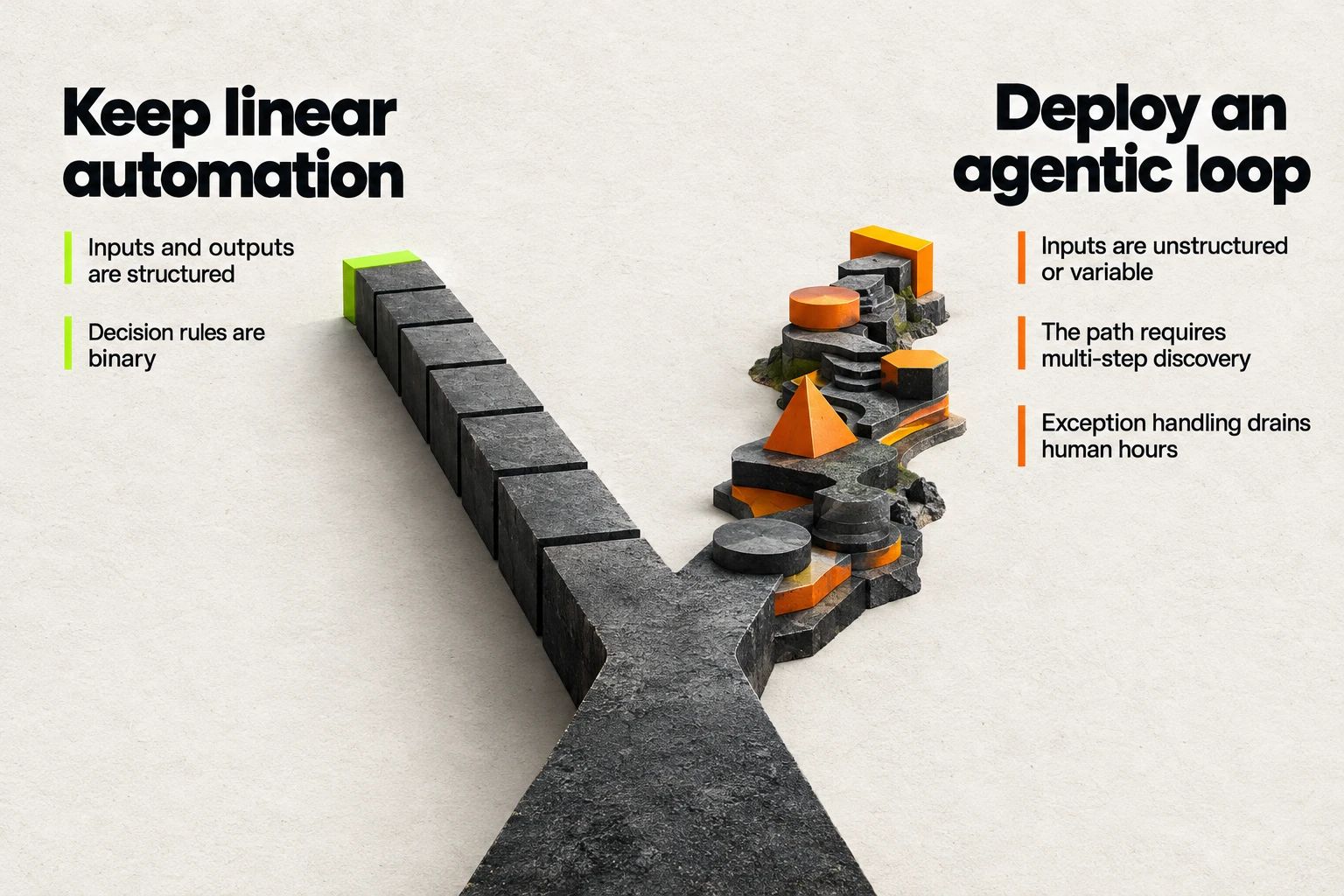
Process traits guide the choice between fixed and adaptive automation.
In Deloitte's 2026 survey of 501 U.S. senior manager- to C-suite-level respondents, only 21% of surveyed leaders say their business processes are prepared for agentic AI adoption (with only 5% saying their business processes are highly prepared for AI agents), while 72% say they lack unified, accessible data, 70% do not feel they can trust and govern agents, and 67% say integration is too costly and complex [3]. If your underlying data is scattered across disconnected silos with unclear permissions, an autonomous loop will simply hit roadblocks faster.
True operational leverage comes from process redesign, not surface patching. Teams that succeed start by integrating AI into human workflows through structured redesign rather than bolting tools onto legacy steps. Use clear operational criteria to decide how to handle any repeatable process:
Keep linear automation when the process meets these conditions:
- Inputs and outputs are structured: The data arrives in a predictable schema every time.
- Decision rules are binary: Every branch can be expressed with clear numerical thresholds or exact keyword matches.
- Zero latency and fixed cost are mandatory: The task runs at high volume where multi-turn LLM token usage would erode your margins.
- No discretionary judgment is required: Any deviation from the exact rule should immediately halt the line rather than trigger an improvised workaround.
Deploy an agentic loop when the process meets these conditions:
- Inputs are unstructured or variable: The task requires interpreting natural language, inconsistent documents, or shifting external context.
- The path requires multi-step discovery: The system cannot know step three until it observes and evaluates the result of step two.
- Exception handling drains human hours: Your team spends its day manually researching context, cross-checking sources, and fixing edge cases that break linear scripts.
- You are prepared to redesign the end-to-end flow: You have mapped the data context and defined where human judgment collaborates with the agent.
Building adaptive AI systems for market change works only when you align the architecture with the actual complexity of the work. If a simple script solves the problem, keep the script.
Operational Guardrails for Governance, GDPR Compliance, and Avoiding Vendor Lock-In
Deploying autonomous loops inside a lean or European operation introduces strict requirements around compliance, reliability, and long-term ownership. You cannot afford a black-box system that makes unaudited decisions with customer data or locks your entire operational logic into a single software vendor.
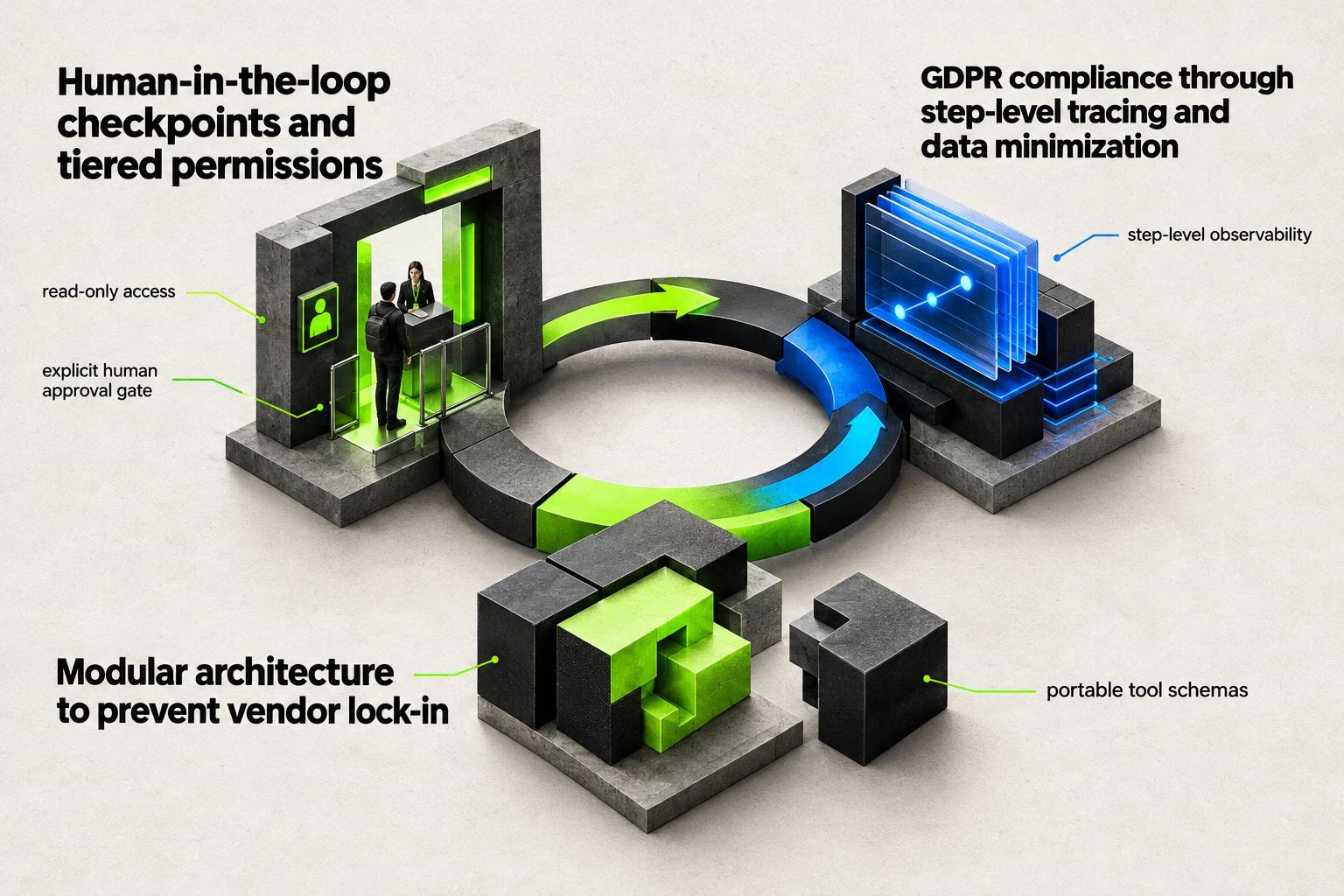
Guardrails make oversight, traceability, and portability visible.
Udo Sglavo, VP of applied AI and modeling at SAS, states that the hardest problem in agentic AI is not the modeling, but putting agents into the operational environment where partial failures, delayed integrations, and edge cases compound, requiring human-in-the-loop design so systems handle routine cases and surface exceptions rather than making high-severity decisions independently [4]. Embedding human-in-the-loop governance from day one ensures that when an edge case falls outside normal thresholds, the loop pauses and hands the decision to an operator with full context attached.
To run continuous loops safely, build three operational guardrails into your architecture:
- Human-in-the-loop checkpoints and tiered permissions: Never grant an autonomous agent unrestricted write or delete permissions across your core databases. Default the agent to read-only access for context gathering and planning. Require an explicit human approval gate before the loop executes any external communication, financial transaction, or permanent record change.Applying an ethical AI development framework ensures accountability stays with human operators at every critical junction.
- GDPR compliance through step-level tracing and data minimization: Under GDPR rules, you must control what personal data is processed and maintain clear auditability over automated decisions. Because a continuous loop makes multiple intermediate decisions, you need step-level observability that logs every prompt, tool call, data retrieval, and state transition. Restrict the agent's context window through strict data minimization so personally identifiable information is masked or excluded unless legally required for that specific step.
- Modular architecture to prevent vendor lock-in: If you build your continuous loops inside a closed, proprietary platform that hides its prompts and state logic, you lose control over your unit economics and portability. Mitigate vendor lock-in by owning custom AI systems built on portable tool schemas, decoupled state storage, and model-agnostic routing. When your prompts, memory layer, and API integrations belong to you, you can swap the underlying LLM whenever a faster, cheaper, or locally hosted European model becomes available.
Treating governance as part of the loop design turns compliance from a blocker into a stabilizer. Scaling ai-accelerated software development and process automation becomes repeatable when every step is bounded, logged, and reversible.
Frequently Asked Questions
Does plugging an AI agent into an existing process deliver immediate business value?
No, simply plugging an AI agent into an existing process without changing the workflow does not secure business value [5]. As IBM Consulting's Francesco Brenna warns, gaining business value from agentic AI means re-architecting how the process is executed, redesigning the user experience, orchestrating agents end-to-end, and integrating the right data to provide context, memory, and intelligence throughout [5]. Andrew Ng likewise notes that real business value comes not from optimizing a single isolated step for a 3% or 5% efficiency gain, but from rethinking the entire workflow [6]. Before building an agent loop, map your repeatable process end-to-end and remove legacy steps that only existed to support manual handoffs.
How long does it take to make an agent-driven workflow reliable after building a proof of concept?
A proof of concept can be thrown together in a week, whereas making an agent-driven workflow reliable and enterprise grade takes months [6]. In operational environments, partial failures, delayed integrations, and edge cases compound [4]. Plan your rollout by budgeting dedicated engineering and testing time to define stopping conditions, permission boundaries, and exception recovery paths before putting a loop into production.
Does full automation create more value than human collaboration with AI agents?
No, 75% of surveyed leaders in Deloitte's 2026 study agree that human collaboration with AI agents creates more value than AI agent-powered automation alone [3]. In parallel, PwC's 2026 Digital Trends in Operations Survey found that just 37% of surveyed operations executives and supply chain officers are comfortable assigning AI agents to execute full end-to-end processes in operations [7]. Design your continuous loops around human-in-the-loop checkpoints where the agent handles routine research, planning, and drafting while a human operator approves consequential actions.
Your Next Operational Step
You can now decide which of your repeatable processes belong in deterministic linear pipelines and which justify the transition to continuous agent-driven loops. Do not start by shopping for orchestration frameworks. Start by auditing one high-friction repeatable process in your operation today. Write down every point where an unexpected input forces a human to intervene, verify whether the data required to resolve those exceptions is unified and accessible, and mark the exact step where a human-in-the-loop approval gate must sit before any external action is taken. If the exceptions require multi-step discovery and your data is accessible, you have found your first candidate to re-architect around a continuous loop.
Sources:
- Anthropic - Architectural distinctions between predefined workflows and dynamic LLM agents
- Weaviate - Core components, memory mechanics, and complexity trade-offs of agentic loops
- Deloitte - 2026 survey on business process readiness, governance barriers, and human-agent collaboration
- CIO - Production scaling challenges and human-in-the-loop operational design requirements
- IBM - Executive survey data and end-to-end process re-architecture requirements for AI agents
- Bain & Company - Andrew Ng interview on production reliability timelines and end-to-end workflow redesign
- PwC - 2026 operations survey on functional silos and end-to-end autonomous execution comfort