4 Ways Brand Voice Governance Protects 20% of Revenue
AI Summary
Brand voice governance can protect 20% of revenue, but effective AI content control requires more than a longer style guide. A machine-readable system turns brand identity into enforceable rules that prevent generic output, compliance failures, and costly inconsistency.
- The four-stage Encode Inject Verify Block pipeline for controlling AI content before publication.
- How a concise BRAND_VOICE.md uses tone scales, kill lists, sentence limits, and paired examples to improve consistency.
- How data classification, bias audits, and human sign-off support privacy, ethical AI, and EU AI Act readiness.
For teams scaling AI content while struggling with voice drift, regulatory exposure, or unclear editorial ownership.

Marketing teams across every sector are hitting a wall with generative AI. You deploy generative models to scale output, but within weeks your brand identity starts to blur. Every article sounds like it was drafted by the same generic agency copywriter.
The evaluation dilemma you face is not about finding a faster AI writer. It is about control. Traditional brand guidelines fail when fed into Large Language Models because human brand bibles rely on subjective adjectives like "innovative," "approachable," or "bold." To a statistical text engine, those adjectives translate directly into generic clichés.
Most teams get AI brand voice wrong because they treat governance as an editorial afterthought rather than a structural operating system. When content lacks explicit behavioral constraints, AI defaults to the mathematical mean of its massive training data. You do not need a longer style guide. You need machine-readable governance that translates identity into strict operational rules. Inconsistent publishing across channels directly impacts your bottom line, costing companies an average of 10% to 20% of annual revenue according to a survey of over 200 brand management professionals [1].
Building a durable brand voice requires replacing surface-level prompts with systematic governance. At pageBody, our AI Transformation Agency designs custom business systems that embed brand security, compliance, and voice precision directly into automated content pipelines.
The 4-Stage Governance Pipeline: Encode, Inject, Verify, Block
Scaling content output without losing your distinctive identity requires moving past loose prompt tips. You must implement a continuous pipeline that governs text before, during, and after generation. This framework relies on four distinct stages.
1. Encode
Traditional brand bibles fail in AI workflows because 50-page PDFs dilute model attention. You must encode your identity into a compact, machine-readable format. At pageBody, our SEO Strategist service packages brand logic into structured configuration files like BRAND_VOICE.md. This step converts subjective personality traits into concrete syntax rules, numerical tone dials, and explicit vocabulary limits.
2. Inject
How you feed context into an LLM determines how closely it adheres to your standards. Simply pasting a brand guide above a prompt leads to context drift. You need a systematic prompting structure such as the Context-Constraint-Contrast model. You provide the background context, define hard constraints, and present contrasting on-brand versus off-brand examples.
3. Verify
Automated generation must always connect to structured human review. Verification is not about fixing typos. It is about evaluating lexical density, structural rhythm, and factual authority. Incorporating clear verification protocols ensures your team maintains control over published narratives, especially when integrating AI into human workflows to handle high-volume publishing without sacrificing standards.
4. Block
The final stage is an automated quality gate. Before any draft reaches an editor, system filters scan the draft for unverified claims, sensitive customer details, and banned terms. If a draft contains forbidden phrasing or unmasked data, the pipeline blocks it automatically.
Building the Machine-Readable BRAND_VOICE.md Standard
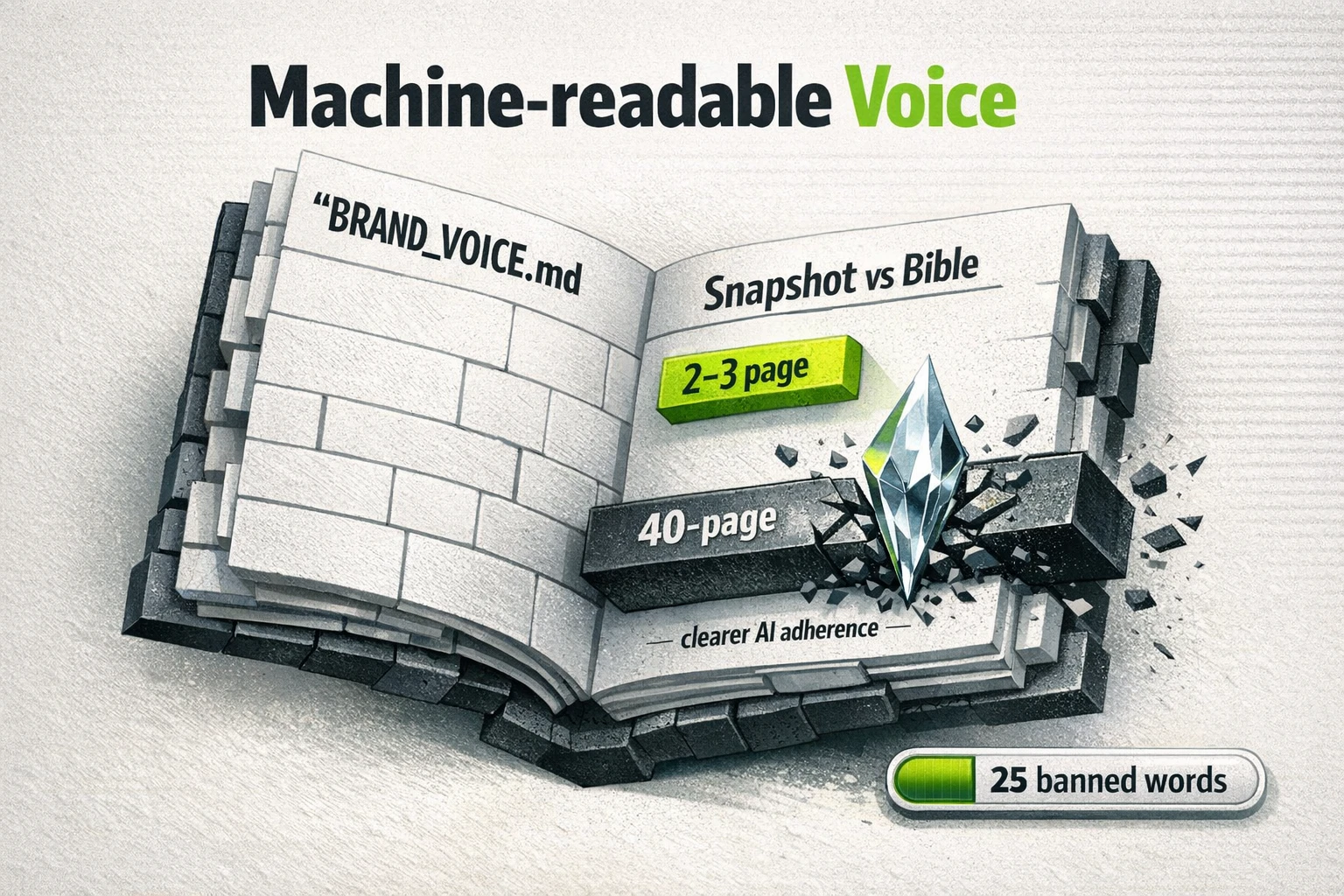
If you hand an LLM a traditional 40-page brand guide, performance degrades. Large models struggle with long, unfocused context windows that contain irrelevant history or vague mission statements. For AI brand voice guidelines, a focused 2-3 page voice snapshot outperforms a 40-page brand bible because long documents dilute AI attention [2].
A proper BRAND_VOICE.md standard uses Markdown header structures to establish clear, unambiguous parameters for text generation.
Tone Calibration Matrix
Vague tone descriptors leave too much room for statistical averaging. Use a 1 to 5 numerical scale to define exact tone settings across your content formats:
- Formality: 4 / 5 (Professional, direct, authoritative; avoids casual slang)
- Enthusiasm: 2 / 5 (Calm, confident, urgent; avoids cheerleading and exclamation marks)
- Technical Depth: 4 / 5 (Industry terminology expected; clear operational explanations)
- Directness: 5 / 5 (Lead with core thesis immediately; eliminate fluff)
Banned Terms and Default Kill List
AI models default to specific words when trying to sound authoritative. To make your content sound human, you must explicitly ban overused AI clichés.
Your configuration file must include a strict vocabulary policy:
- Never use: "delve," "testament," "tapestry," "beacon," "realm," "game-changer," "cutting-edge," "unlock."
- Replacement rule: Use direct action verbs and active voice. Instead of saying "a testament to efficiency," state "delivers measurable efficiency."
- Sentence structure limit: No sentences over 25 words. Vary sentence length to create natural reading rhythm.
Paired Example Training
Adjectives explain what you want, but contrast proves it. Including paired examples inside your context configuration gives the model a clear boundary. Show the exact wrong way to write a sentence alongside the correct version, complete with an explanation of why the change was made. Annotated on-brand and off-brand example pairs teach AI tools more about replicating brand voice than any combination of adjectives and rules alone [3].
Our AImee system within pageBody utilizes these exact pairing structures when assembling publish-ready content. By pairing targeted rules with structural blueprints, our team produces content that maintains brand integrity without sounding automated.
Ethical Guardrails: Privacy, Bias, and EU AI Act Compliance
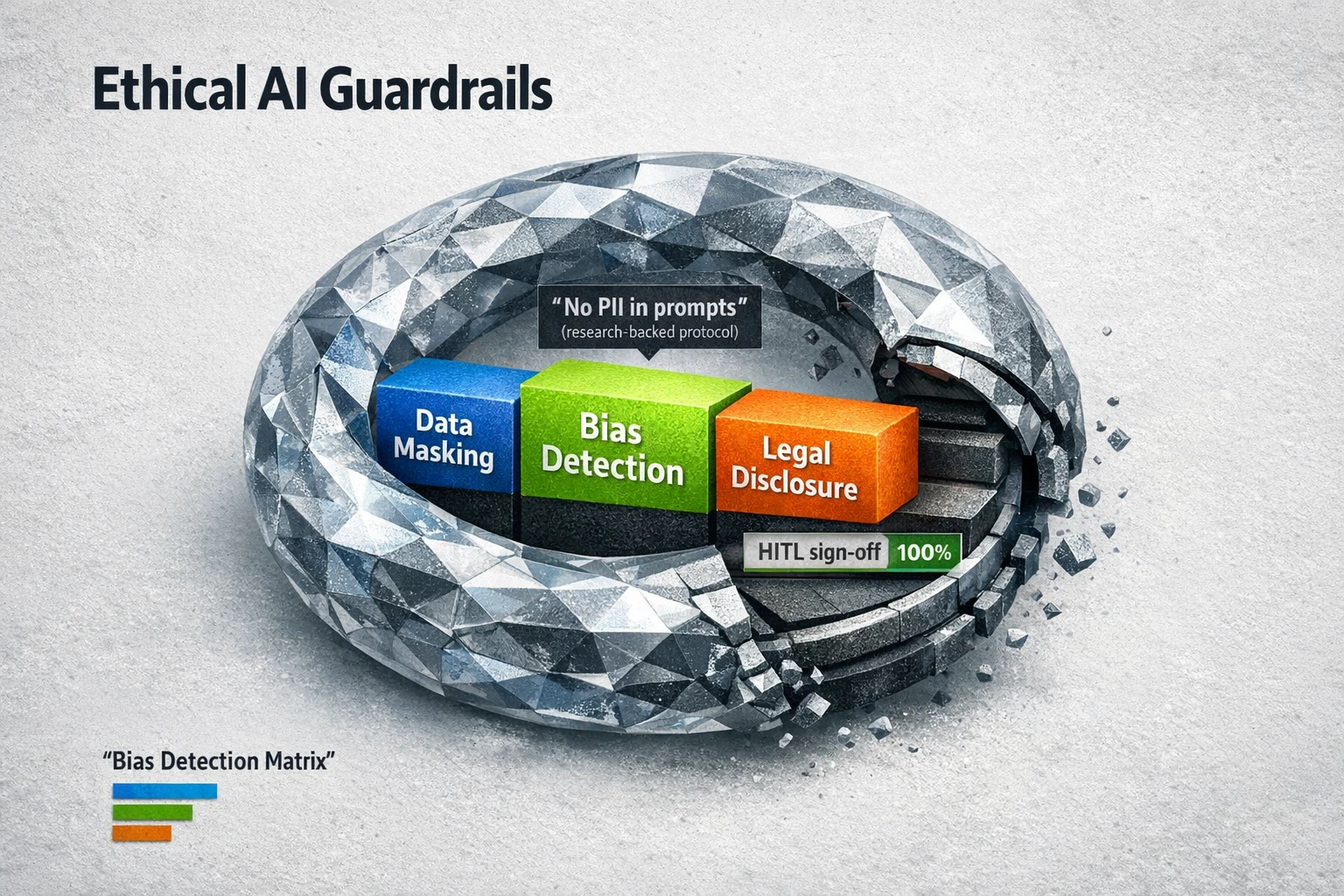
Brand governance goes beyond syntax and tone. Protecting your organization requires clear data privacy boundaries and ethical oversight. Pushing unmasked customer data or confidential intellectual property into public AI models creates severe legal liabilities.
Establishing robust protocols for data privacy and security in AI ensures your content engine complies with regional regulations like GDPR and the EU AI Act.
Data Masking Protocol
Your content production rules must strictly define what is allowed inside a prompt. Establish a three-tier classification system for data inputs:
- Public Data: Approved product specifications, published case studies, and official press releases. Free to process.
- Internal Operational Data: Internal outlines, unpublished drafts, and strategic messaging notes. Allowed only within secured, non-training enterprise environments.
- Restricted Data: Customer personally identifiable information (PII), unreleased financial records, proprietary source code, and client credentials. Strictly banned from all prompts.
Bias Detection and Mitigation
Generative text models inherit demographic, regional, and cultural biases from their training datasets. In commercial content generation, bias often manifests as subtle stereotyping, exclusionary language, or skewed industry assumptions.
To prevent bias from damaging your reputation, build audit steps directly into your review pipeline:
- Run automated sweeps across drafts to detect gendered assumptions in professional roles.
- Audit synthetic voice scripts (TTS) to ensure diverse, natural tone representation without forced accents.
- Verify that industry examples reflect global perspective rather than regional monocultures.
Transparency and Regulatory Compliance
Consumers and regulators increasingly demand clarity regarding synthetic media. Hiding AI involvement builds distrust, whereas clear operational standards reinforce brand authority. According to research cited by the World Federation of Advertisers, 78% of global brands are actively using AI in marketing, yet 80% are calling for clearer global guidance on when and how to disclose that use [4].
Establishing transparent guidelines around synthetic content protects your brand from reputation risks. Organizations that prioritize ethical disclosures build stronger long-term customer relationships while maintaining regulatory readiness. Reviewing established frameworks for AI governance compliance helps position your compliance posture as a competitive advantage rather than a administrative burden.
Operational Workflows and Human-in-the-Loop Integration

Technology alone cannot protect your brand voice. Human judgment remains the critical link in high-performing content engines. Treating AI as an automated vending machine that outputs finished copy leads directly to poor reading experience and generic positioning.
Institutional standards demand strict editorial responsibility. For example, Purdue Brand Studio requires that AI-generated text must be revised for brand voice, edited, and approved by an accountable human before publication [5].
The Brand Voice Guardian Role
To maintain operational standards across growing teams, assign explicit ownership over your governance assets. A Brand Voice Guardian manages your configuration files, updates banned-word lists based on recent outputs, and monitors tone drift across channels.
This role oversees three core tasks:
- Updating
BRAND_VOICE.mdconfiguration files as product messaging evolves. - Auditing published assets weekly to calculate voice match scores.
- Conducting quarterly prompt adjustments based on editorial feedback.
Editorial Verification Checklist
When reviewing AI-generated drafts, editors should avoid spending time fixing basic syntax. The AI handles basic grammar. The editor's job is to elevate the argument, refine cadence, and inject domain expertise.
Editors should evaluate every draft against four criteria:
- Rhythm and Cadence: Does the text vary sentence structure, or does it follow predictable AI paragraph lengths?
- Domain Truth: Are claims backed by primary experience, proprietary frameworks, or verified statistics?
- Perspective Alignment: Does the piece take a firm, confident stance, or does it hedge with passive language?
- Banned Word Removal: Did any generic clichés bypass the automated block stage?
At pageBody, our hybrid model pairs perspective direction from human experts with specialized drafting tools, followed by final human approval. This process allows brands to build organic search authority through structured content packages without losing authentic human direction.
Frequently Asked Questions
Why do standard corporate brand guides fail when used with generative AI tools?
Standard style guides are written for human interpretation, relying on subjective adjectives like "innovative" or "friendly." Large Language Models interpret these terms statistically, which leads them to default to overused clichés found across their training data. AI requires machine-readable configurations with explicit behavioral rules, numerical tone scales, and concrete negative constraints.
How long should an AI brand voice guide be for optimal performance?
A focused 2 to 3 page voice snapshot outperforms lengthy brand manuals. Long documents dilute model attention within the prompt context window. Distill your guide down to essential tone dimensions, clear vocabulary boundaries, active constraints, and 4 to 6 annotated on-brand versus off-brand example pairs.
What data security steps are necessary when prompting public AI models?
Never enter customer personally identifiable information (PII), proprietary source code, unreleased product plans, or sensitive financial data into public AI prompts. Establish a clear data classification protocol and deploy automated data masking filters to block sensitive inputs before prompts reach model endpoints.
How does brand voice governance impact search engine rankings and content authority?
Search engines reward original analysis, strong structural depth, and clear entity expertise. AI content that sounds generic often lacks original insight, leading to lower engagement and weak authority signals. Structuring your content workflows with human oversight ensures every asset delivers genuine domain value while satisfying search depth expectations.
Who should be responsible for managing AI brand governance within an organization?
Assign a dedicated Brand Voice Guardian, such as a senior editor or brand strategist. This person maintains the machine-readable voice configuration files, audits published copy for voice drift, updates vocabulary kill lists, and ensures all published material undergoes mandatory human sign-off.
Step-by-Step Implementation Guide
To move your marketing team from loose prompting to structured brand voice governance, execute these four actions:
- Audit your recent published content to identify the top 20 AI clichés and overused terms currently creeping into your drafts.
- Create a standardized
BRAND_VOICE.mdconfiguration file containing a 1-to-5 tone calibration matrix and 5 annotated on-brand versus off-brand example pairs. - Establish a strict data classification protocol that explicitly bans PII, confidential IP, and unreleased company metrics from all prompt inputs.
- Implement a mandatory Human-in-the-Loop review checklist requiring human sign-off on rhythm, authority, and voice match before any draft goes live.
---
Sources:
- Glean - Survey data on the revenue cost of inconsistent branding
- Atom Writer - Research on concise voice snapshot performance over long brand bibles
- Atom Writer - Analysis on using annotated example pairs for AI prompt training
- The Brand Algorithm - World Federation of Advertisers research on AI adoption and global transparency demand
- Purdue Brand Studio - Institutional policy guidelines for human oversight in AI publication