How Do You Structure AI Workflows for Reliable Output?
AI Summary
Structuring AI workflows for reliable output is less about writing a perfect prompt and more about controlling what the model can do, where failures surface, and when humans intervene.
- The derive, infer, and approval framework for separating deterministic logic, bounded LLM judgment, and human authorization.
- How normalized JSON inputs, GDPR-focused data minimization, and shared retrieval context prevent early errors from spreading.
- Why schema validation, model-specific routing, exception queues, and review checkpoints protect business systems from unverified outputs.
For SMBs automating repeatable processes that need lower token costs, fewer silent errors, and dependable operational results.
Handing an entire repeatable process to a single prompt instead of building structured AI workflows invites operational overload. You expect operational leverage, yet you end up manually fixing broken formatting, chasing silent data errors, and watching token costs climb. Your architectural decision hangs on one structural boundary: separating deterministic rules that move and validate data from bounded LLM nodes that handle language reasoning. When you wrap an LLM inside strict input schemas, coded orchestration, and human-in-the-loop checkpoints, you turn erratic text generation into dependable business output.
What Defines an AI Workflow Architecture in Practice
Treating a workflow and an autonomous agent as interchangeable architecture leads directly to production failures. When a repeatable process requires consistent execution across dozens of steps, letting a language model invent its own execution path introduces unnecessary failure points and financial waste. You need an architecture where code controls the path and the model performs only bounded cognitive tasks.
Erik Schluntz and Barry Zhang at Anthropic define workflows as systems where LLMs and tools are orchestrated through predefined code paths, while agents are systems where LLMs dynamically direct their own processes and tool usage to maintain control over how they accomplish tasks [1]. For a lean operation running repeatable processes, predefined code paths provide the predictability required to scale without adding headcount to babysit the system.
Real-world business processes contain too many conditional branches and action steps for a standalone model to manage in a single pass. You gain operational leverage by keeping control logic in deterministic code and calling the model only when unstructured judgment is required. Two structural realities explain why predefined paths beat open-ended runtime loops for repeatable processes:
- Deterministic control planes cut token waste. On the Berkeley Function-Calling Leaderboard across 400 instances, researchers from XY.AI Labs, Stanford University, Cornell University, and Harvard Medical School found that compiling workflow orchestration into deterministic static code with zero runtime LLM tokens in the control plane achieves 96% task completion (384/400), breaks even against direct LLM calls at approximately 17 transactions, and reduces token consumption by 57x at 1,000 transactions (and 84x versus AutoGen) [2].
- Fixed orchestration prevents step-count collapse. Rather than hoping a single prompt remembers twenty sequential business rules, coded orchestration breaks the process into discrete, verifiable stages.
- Bounded calls isolate failures. When a workflow fails inside a predefined path, you know the exact step, input schema, and rule that rejected the payload.
Stage 1 Structuring Business Inputs for Normalization and GDPR Compliance
Raw business inputs are messy. Emails, webhook payloads, form submissions, and uploaded documents arrive with inconsistent formatting, extraneous noise, and sensitive personal data. Feeding raw inputs straight into an LLM degrades reasoning quality and creates immediate compliance liabilities.
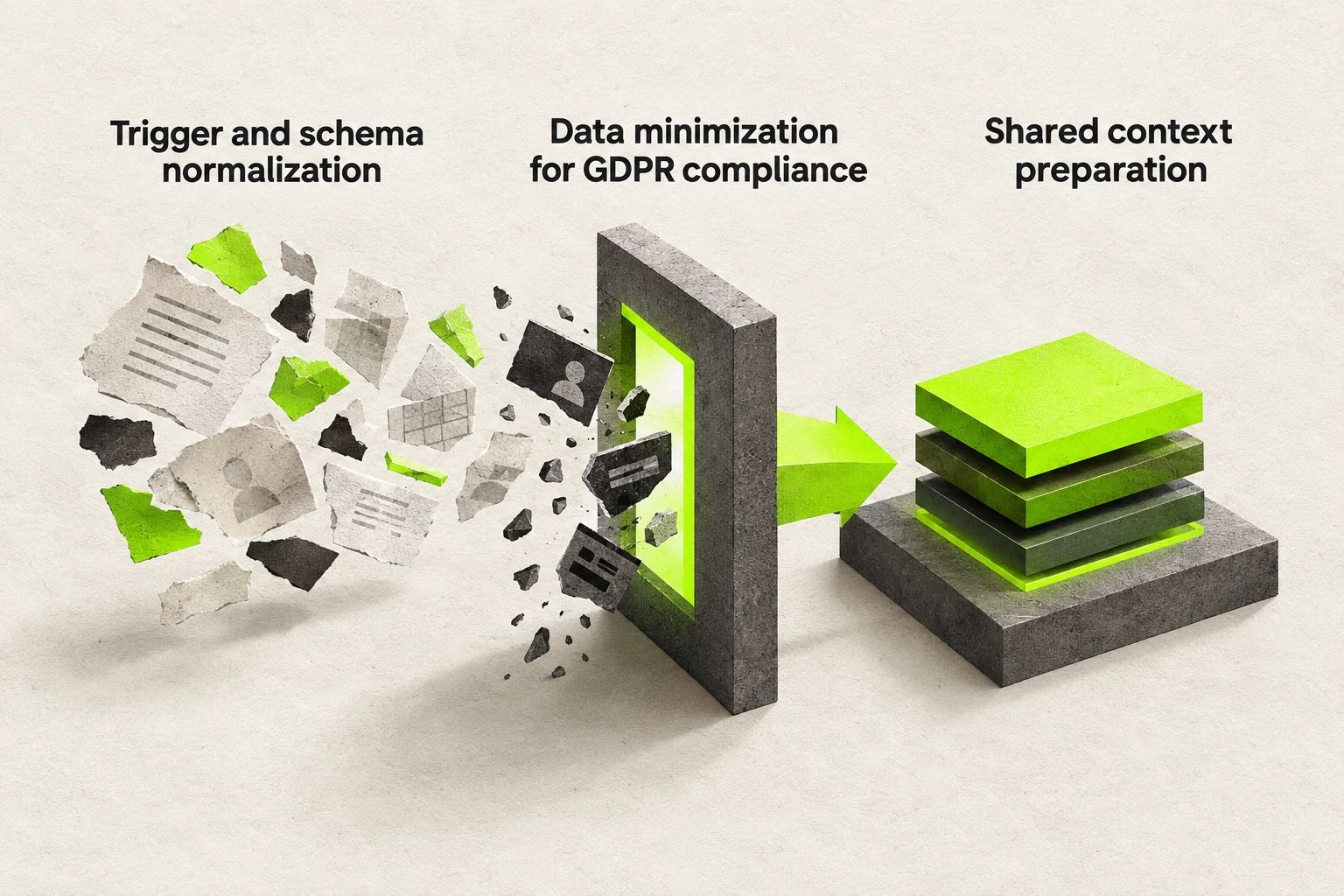
Raw inputs become structured data for shared context.
An effective input layer acts as a strict filter and translator before any model call fires. It normalizes raw triggers into structured schemas and strips or masks personal identifiers to maintain GDPR compliance. If an upstream step does not require a customer's personal details to classify a ticket or extract an order item, those fields should never enter the model context.
Structuring the input layer requires three operational steps:
- Trigger and schema normalization. Convert incoming documents, emails, or API events into standardized JSON payloads with fixed field names and data types so downstream nodes receive uniform structures.
- Data minimization for GDPR compliance. Run deterministic regex and field-level filtering to strip personally identifiable information before constructing the prompt context, preventing unauthorized data transmission to external model providers.
- Shared context preparation. Build a clean retrieval layer so every stage of a multi-step pipeline reads from the same verified source data rather than passing degraded summaries down the chain.
When teams apply AI for audience research or multi-document synthesis, standardizing how raw data enters the pipeline determines whether downstream analysis holds up. Standardizing inputs into structured JSON over a shared retrieval layer stops early formatting quirks from corrupting later reasoning stages.
Stage 2 The LLM Processing Layer and Model-Agnostic Routing
Once clean, structured data reaches the LLM node, the architectural challenge shifts to task decomposition and avoiding vendor lock-in. Relying on one massive prompt inside one vendor's model creates a fragile bottleneck. Different models excel at different cognitive tasks, and chaining smaller, focused calls together gives you programmatic control over every intermediate result.
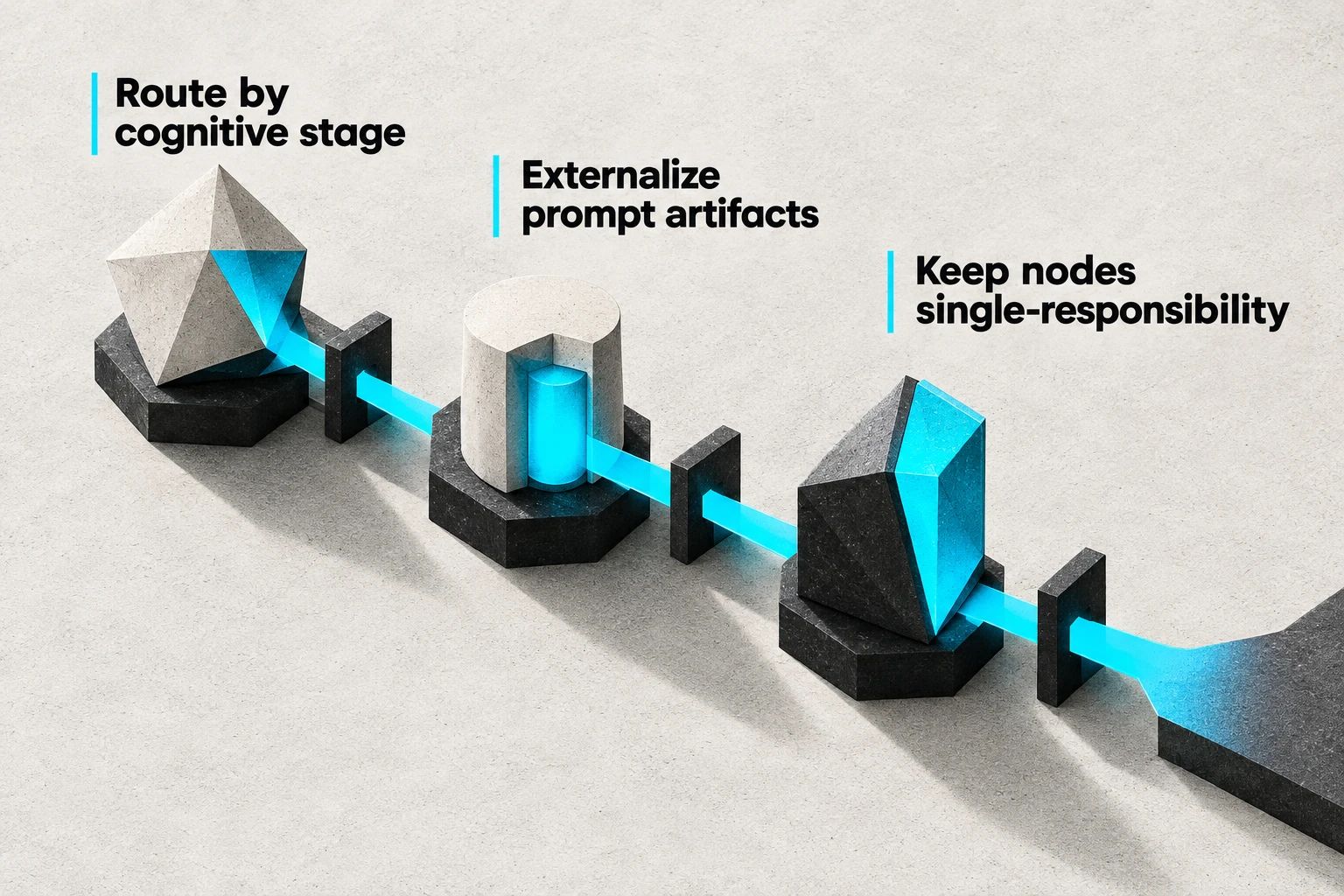
Focused model nodes separate distinct cognitive tasks.
In prompt chaining workflows, Anthropic notes that a task is decomposed into a sequence of steps where each LLM call processes the output of the previous one, and teams can add programmatic checks ("gates") on intermediate steps to ensure the process stays on track [1]. Decomposing a complex process into chained steps also lets you route each step to the model best suited for that specific task.
Hard-coding your entire pipeline to a single model forces you to accept its specific blind spots across every step of your operation. In a 2026 benchmark of four LLM systems (GPT-5, Claude Sonnet 4, Gemini 2.5 Pro, and NotebookLM) across a four-stage human-in-the-loop workflow (screening, extraction, analysis, and synthesis) on 244 documents against expert reviewers (92.2% agreement, kappa = 0.804), researchers at Toronto Metropolitan University, Queen's University, and Stellenbosch University found that no single system led on all workflow tasks, with Claude Sonnet 4 achieving the highest overall screening accuracy at 82.8% while GPT-5 achieved the highest recall at 91.8% (with specificity on policy briefs collapsing to 53.3%), and in structured metadata extraction all models exceeded 90% match rates on titles and publishing sources while up to 40% of attempts on author attribution and reference identification yielded partial matches or failures [3].
To build a modular processing layer that prevents vendor lock-in and maximizes task accuracy, structure your LLM nodes around three practices:
- Route by cognitive stage. Assign high-accuracy models to initial screening gates and high-recall models to broad extraction steps, rather than forcing one model to handle screening, extraction, analysis, and synthesis.
- Externalize prompt artifacts. Store system prompts as standalone Markdown or plain-text files outside your application code so domain experts can refine instructions, test new models, and roll back versions without redeploying the pipeline.
- Keep nodes single-responsibility. Give each LLM node one clear job, such as classifying intent or extracting structured entities, and demand a typed output schema before moving to the next step.
Teams that produce long-form assets already apply this modular decomposition when building an AI content outline strategy before generating section drafts, separating structural planning from prose generation.
Stage 3 Orchestration and Validation Gates Between Probabilistic Models and Deterministic Logic
An LLM output is a probabilistic guess, not a verified business fact. The most common architectural mistake in workflow design is allowing a model's output to directly trigger an external side effect, such as writing to a database, sending an invoice, or updating a CRM record. Every model response must cross a deterministic validation gate before it affects your systems of record.
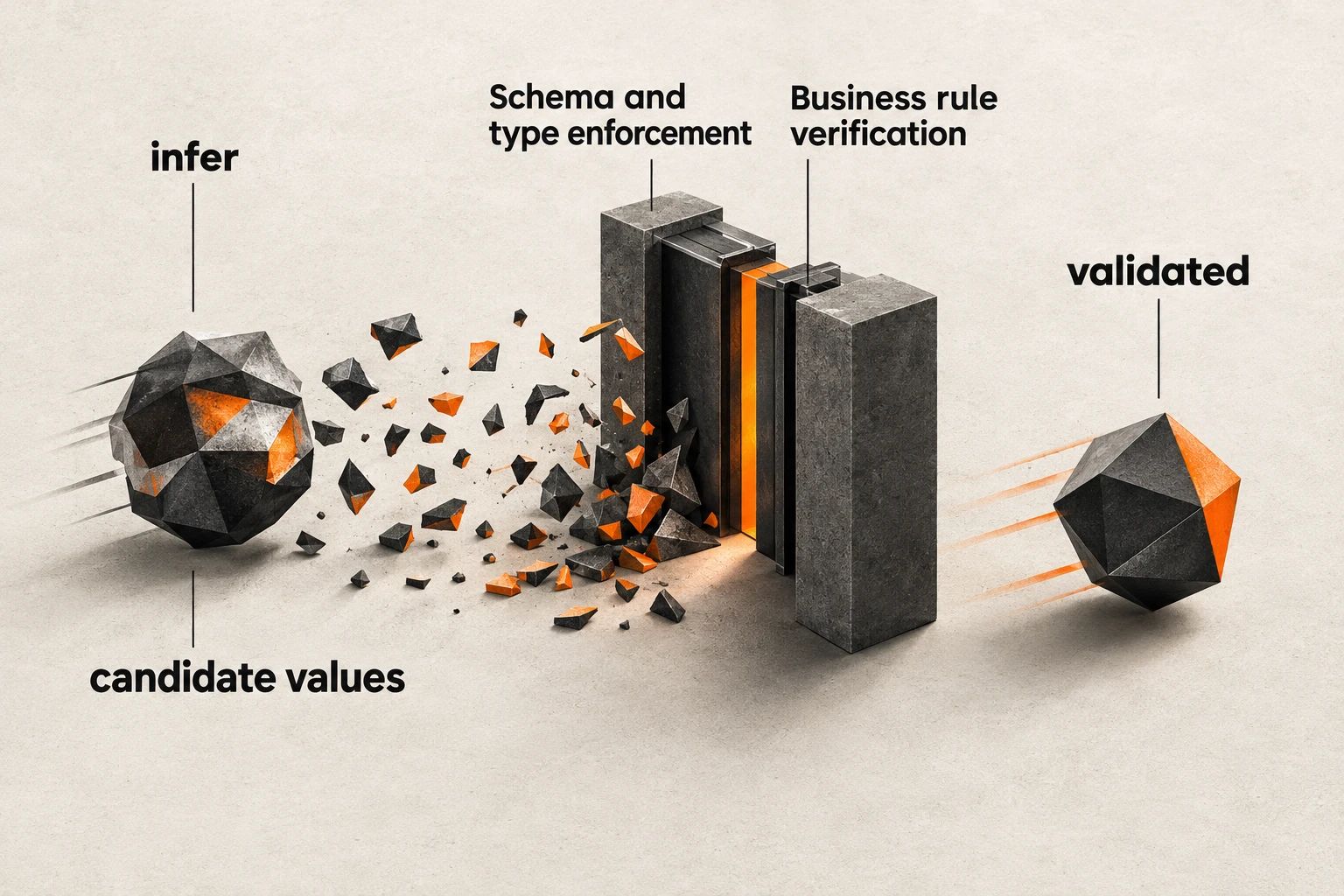
Candidate outputs pass deterministic checks before affecting systems.
You must draw a hard line between computations that derive state from known rules and steps that infer judgments through an LLM. Operations that do not require language reasoning, such as generating timestamps, formatting dates, posting payloads to an API, or writing to a database, belong in deterministic code. Executing non-reasoning tasks as pure functions in the orchestration layer keeps them fast, cheap, and testable.
Emanuele Quinto, Carlo Andrea Rozzi, and Francesco Zanitti at UNHCR, CNR, and ZeLe & F ApS propose structuring LLM-mediated workflows with an explicit semantic and architectural boundary between derive (deterministic, testable, replayable computation over available workflow state) and infer (mediated LLM judgment under a declared context snapshot and executor-controlled capability policy), where model responses are returned to the executor as candidate values that cannot trigger workflow transitions or external side effects until validated by the executor and, where required, authorized via human approval or deliberative panel records [4].
Treating every LLM output as an unverified candidate value changes how you build the handoff between stages:
- Schema and type enforcement. The executor parses the candidate output against a strict JSON schema, rejecting malformed responses or missing required keys immediately.
- Business rule verification. Deterministic
derivelogic checks extracted numbers, dates, or category tags against allowed database ranges and capability policies. - Scoped retry or fallback routing. If a candidate value fails validation, the orchestration layer either re-prompts the model with the specific validation error or routes the item to an exception queue.
Applying strict programmatic gates is essential when deploying AI-accelerated software development or automated production pipelines, where an unvalidated model output can break downstream builds.
Stage 4 Human-in-the-Loop Checkpoints and Reliable Business Outputs
Automated validation gates catch structural and rule-based errors, yet they cannot catch subtle semantic hallucinations or complex domain misinterpretations. As the multi-model benchmark from Toronto Metropolitan University, Queen's University, and Stellenbosch University showed on those 244 documents, even when structured metadata extraction exceeded 90% match rates on titles and publishing sources, up to 40% of attempts on author attribution and reference identification yielded partial matches or failures [3]. If those partial matches flow unchecked into final reports or client deliverables, early extraction errors distort every downstream stage.
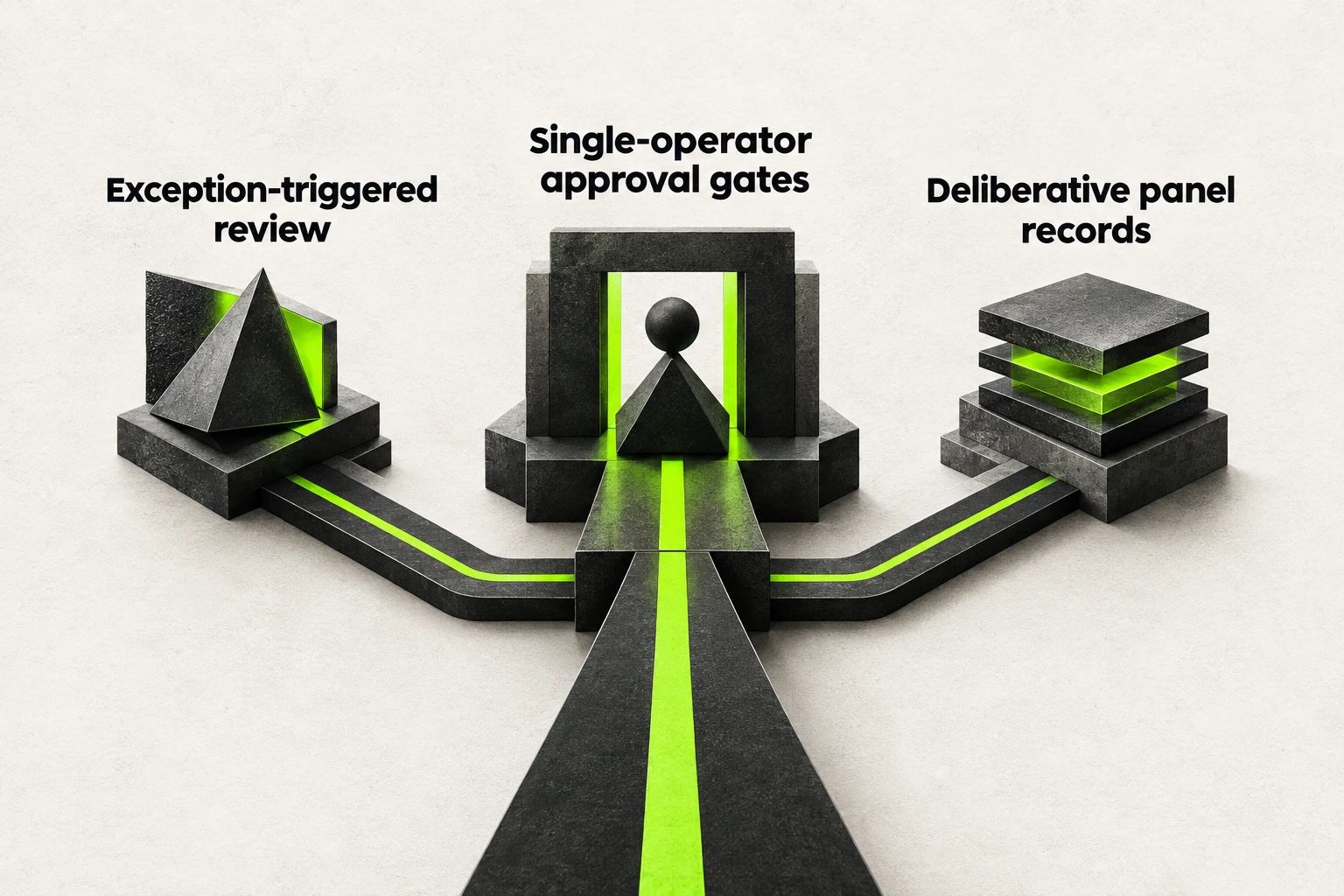
Human checkpoints guard high-risk workflow transitions.
Human-in-the-loop checkpoints are not a temporary patch for immature models. They are permanent architectural controls placed at high-leverage transitions where ambiguity or business risk is high. Rather than reviewing every single low-risk step, you place human review gates right after high-failure extraction steps and right before irreversible external actions fire.
Wafa Shafqat, Mark Patterson, and Steven Liss report that in multi-stage LLM workflows, supplying JSON-formatted inputs over a shared ChromaDB retrieval-augmented generation (RAG) layer and embedding human-in-the-loop review checkpoints throughout every stage prevents early screening and extraction inaccuracies from propagating into and distorting downstream analysis and synthesis [3].
To prevent review fatigue while protecting output reliability, structure human checkpoints into three distinct tiers:
- Exception-triggered review. Route items to a human operator only when deterministic validation flags a low confidence score, a partial field match, or a schema violation.
- Single-operator
approvalgates. Require a rapid sign-off from a designated owner before a validated candidate value updates a system of record or sends an external communication. - Deliberative
panelrecords. For high-stakes policy or financial exceptions, log the structured opinion of multiple reviewers as a persistent record before authorizing the workflow transition [4].
Embedding structured review gates is the foundation of integrating AI content creation into existing workflows without losing editorial authority, and it provides the verified feedback data required to keep content tuned for AI performance over time.
Operational Design Checklist for Structuring Repeatable Workflows Without Overload
Bolting an LLM onto an unchanged, messy process only automates the mess. Achieving reliable business outputs requires redesigning the process around a clear division of labor between deterministic code, bounded models, and human operators.
Use this five-step sequence to audit and structure a repeatable workflow before writing orchestration code:
- Map and classify every step. List all actions in your current repeatable process and label each one as either deterministic state computation (
derive), bounded language judgment (infer), or human authorization (approval) [4]. - Strip non-reasoning tasks from the LLM. Move all data formatting, API calls, database writes, and routing math into deterministic code so the control plane consumes zero runtime tokens [2].
- Standardize the input boundary. Define strict JSON input schemas and deterministic PII filtering rules at Stage 1 to guarantee data uniformity and GDPR compliance before any model call executes.
- Decouple prompts and assign task-specific models. Store prompts externally as versioned text files and test different models for screening, extraction, and synthesis steps to eliminate vendor lock-in [3].
- Lock external outputs behind validation and review gates. Configure your executor to treat all LLM responses as candidate values that must pass schema validation and human-in-the-loop checkpoints before updating business systems [4].
Frequently Asked Questions
Should an LLM execute API calls and database writes directly inside a workflow?
No, workflow operations that do not require language reasoning should run as pure functions directly in the orchestration layer rather than through the LLM. Executing tasks like posting data to an API, committing a file to GitHub, performing database writes, or generating timestamps in deterministic code is side-effect controlled, cheaper, faster, and fully testable. Reserve the LLM exclusively for steps that require language interpretation or unstructured judgment.
How do you update workflow prompts without redeploying application code?
You decouple prompt logic from application code by storing prompts externally as Markdown or plain-text artifacts and loading them dynamically at runtime. This architecture allows non-technical stakeholders, such as policy teams, domain experts, and content reviewers, to refine behavior, version-pin specific instructions, and roll back changes without triggering code redeployments.
Why do standalone LLMs struggle to orchestrate complex multi-step workflows on their own?
Standalone LLMs fail to manage the action scale and conditional branching depth found in real-world business processes. In an empirical analysis of 14,771 human-annotated Apple Shortcuts workflows across 28 workflow categories, researchers at Renmin University of China, Tsinghua University, The University of Manchester, and Wuhan University found that real-world workflows average 70.4 actions, 12.0 conditional (IF) branches, 0.7 loops, and a nested branch/loop logical structure depth of 2.6, whereas OpenAI GPT-4 is capable of managing workflows with an average of only 6.1 actions [5].
Your Next Operational Step
Pick one repeatable process in your operation that currently runs over 20 transactions a month. Draw a three-column list and sort every step of that process into deterministic derive computations, bounded infer LLM calls, and human approval gates [4]. Any step that moves data, formats fields, or checks a mathematical threshold comes out of your prompts immediately and moves into deterministic code, giving you a clean architectural blueprint for your workflows before you scale transaction volume.
Sources:
- Anthropic - Architectural definitions of predefined workflows, dynamic agents, and prompt chaining gates
- XY.AI Labs, Stanford University, Cornell University, and Harvard Medical School - Benchmark telemetry on compiled deterministic workflow orchestration versus runtime LLM execution
- Toronto Metropolitan University, Queen's University, and Stellenbosch University - Task-level LLM benchmark across four-stage human-in-the-loop workflows and RAG input schemas
- UNHCR, CNR—Istituto Nanoscienze, and ZeLe & F ApS - Architectural framework separating deterministic derive computations, mediated infer judgments, and human approvals
- Renmin University of China, Tsinghua University, The University of Manchester, and Wuhan University - Empirical study of action scale and branching complexity in 14,771 real-world workflows