How Do You Plan an Intelligent Automation Strategy?
AI Summary
Planning an intelligent automation strategy is less about buying AI tools and more about redesigning workflows before automation accelerates the wrong problems. A focused roadmap helps lean teams convert operational overload into measurable speed, revenue protection, and scalable execution.
- The four-part discovery audit for rule-based logic, structured inputs, clear boundaries, and redundant loop elimination.
- The Triple-A framework for deciding what to abandon, augment with human judgment, or automate end to end.
- How 14-day quick wins, GDPR safeguards, modular architecture, ownership, and a 20% maintenance baseline support sustainable scale.
For founder-led teams stuck with disconnected tools, manual handoffs, and fragile scripts, this provides a practical sequence for choosing what to automate first.
Operational overload and leaky revenue rarely come from a lack of software. Instead, without an intelligent automation strategy, a growing business often stacks disconnected scripts, manual workarounds, and ad-hoc tools onto existing bottlenecks. Planning an AI roadmap to fix this requires a clear decision: whether to treat automation as a technology purchase or as a sequence of business process redesigns.
Why Most Intelligent Automation Efforts Stall Without a Roadmap
Deploying isolated scripts without an operating plan turns manual chaos into automated chaos. A strategy for intelligent automation is not a shopping list of software tools. It is a business-led operating plan that sequences process redesign, data governance, and AI deployment around measurable commercial outcomes.
When operations teams skip this planning phase, they fall into predictable implementation traps across three common categories:
- Traditional strategy-only agencies: These engagements consume months in discovery interviews to deliver static slide decks, delaying speed to value while daily operational bottlenecks continue to leak revenue.
- Generic AI writing tools: Surface-level prompting tools generate text or isolated snippets of code, but they fail to connect across core business systems or move a transaction from intake to completion.
- Brittle DIY tools: Point-to-point scripts built on the fly break whenever an underlying data field changes, creating hidden maintenance debt and operational dependency on whoever built the original workaround.
This gap between deploying tools and planning for commercial impact shows up in executive research. In a 2022 Deloitte survey of 479 executives across 35 countries, four in ten organizations (41 per cent) did not have an enterprise-wide strategy for intelligent automation, and 70 per cent had not calculated the increase in revenue expected from their implementation [1]. Moving forward without a roadmap leaves a business unable to connect technical tasks to revenue recovery.
Phase 1 Initial Discovery and Auditing Repeatable Processes
Every effective AI roadmap begins by mapping how work actually flows across the business before writing a single line of logic. Whether this starts in an initial discovery call or an internal audit, the objective is to trace a transaction from the moment it enters the business to the moment it finishes. You cannot automate a process that exists only as tribal knowledge inside someone's head.

Four criteria frame the audit of candidate workflows.
Practitioner Ian Barkin emphasizes going back to the core principles of what a company needs out of a process and how to define it, cutting out inefficiency or "do loops" before applying automation technology to processes that are rule-based, routine, structured, definable, and mappable [2]. Automating a convoluted approval chain simply executes bad habits faster. Standardizing these workflows is the foundation of Workforce Automation in Lean Operations, where process clarity precedes technical deployment.
Use four criteria during initial discovery to audit candidate workflows:
- Rule-based logic: Does the task follow explicit "if-this-then-that" rules rather than subjective judgment on every single step?
- Structured inputs: Does the data arrive in a predictable format, such as a standardized intake form or invoice, rather than unstructured voice notes?
- Definable boundaries: Can you name the exact trigger that starts the process and the exact output that closes it?
- Loop elimination: Have you stripped out redundant sign-offs and back-and-forth status checks before designing the future workflow?
Phase 2 Filtering the Backlog with the Triple-A Prioritization Framework
Once your discovery audit exposes a list of candidate workflows, the next challenge is deciding what to build first. Treating every internal annoyance as an automation project drains capacity and stalls momentum. You need a triage filter that separates noise from operational leverage.

The Triple-A framework separates work to abandon, augment, or automate.
Author and practitioner Pascal Bornet states that intelligent automation is a business transformation rather than a technology project, and his "Triple-A artifact" identifies three levers to transition employee activities [3]. Instead of forcing every task into a software workflow, pass your audit backlog through those three operational levers:
- Abandon: Eliminate activities that do not fit with leading practices for efficient work [3]. If a weekly reporting document or manual status update serves no commercial decision, stop doing it rather than automating it.
- Augment: Support employee work with insights to help decision-making [3]. When a task requires human nuance, such as reviewing a complex client proposal or handling an escalated account, use AI to prepare the context while keeping the final decision in human hands. This separation of duties is central to Integrating AI Content Creation Into Existing Workflows without sacrificing quality.
- Automate: Hand over routine, repeatable processes from end to end [3]. Reserve full automation for the structured, rule-based tasks that survived your Phase 1 audit and directly impact speed to value or revenue protection.
Phase 3 Defining 14-Day Quick Wins for Speed to Value
Long transformation horizons kill operational buy-in. Pascal Bornet recommends a "Think big, start small, and scale fast" approach that begins with a company-wide vision, roadmap, and business case, starts small with a pilot, and implements the broader scope in stages to manage risks [3]. For lean operations, starting small means scoping a constrained 14-day sprint that delivers an immediate quick win in production.
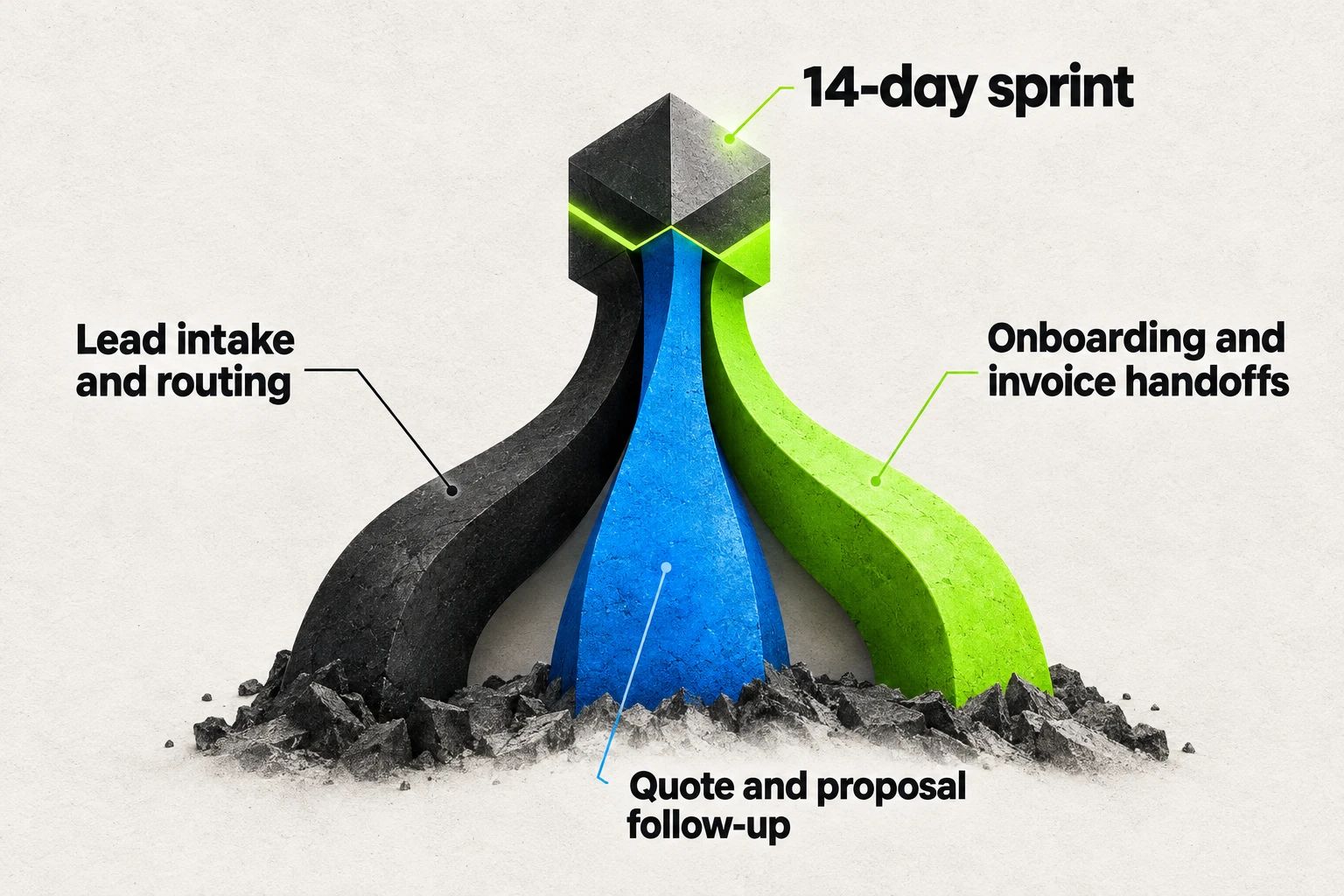
A 14-day sprint targets lead routing, proposal follow-up, or onboarding handoffs.
The goal of a 14-day quick win is not to overhaul the entire company at once. It is to isolate one high-frequency repeatable process where manual handoffs cause delays or leaky revenue, and solve that workflow end to end. Notice how broader executive context reflects this distinction between surface-level assistants and end-to-end execution: in a Q3 2025 Bain Generative AI Survey of 197 executives, respondents using AI for agentic workflow automation were twice as likely to say it exceeded goals as those who use it as an assistant, and only half as likely to report disappointment [4].
Scope your first 14-day sprint around workflows with immediate commercial feedback:
- Lead intake and routing: Capture inbound inquiries, enrich the company profile, and route qualified opportunities to the right calendar without manual copy-pasting.
- Quote and proposal follow-up: Trigger structured follow-up sequences and CRM stage updates when a prospect views an estimate, plugging revenue leaks caused by forgotten manual reminders.
- Onboarding and invoice handoffs: Connect signed agreements directly to billing generation and project workspace setup so delivery starts without administrative lag.
Phase 4 Designing for GDPR Compliance and Preventing Vendor Lock-In
Moving from a 14-day sprint to a sustainable system requires architectural guardrails. When teams wire together ad-hoc tools without a central plan, customer records end up scattered across unauthorized third-party servers. At the same time, building core logic inside closed, proprietary platforms creates severe vendor lock-in.
As context from a 2026 Deloitte global survey of 3,500 senior leaders shows, 74% say data residency and in-region compute are at least moderately important to their AI strategy [5]. Furthermore, Ian Barkin warns that while democratized automation tools allow non-IT subject matter experts to turn ideas into actionable code, it can become a risk and exposure collapse if organizations do not design, plan, and run it well to ensure employees are not exposing customer data to unauthorized places [2].
Protect your operations by embedding four architectural rules into your roadmap:
- Strict GDPR compliance and data residency: Verify where every connected LLM and orchestration server processes data, and disable model training on your proprietary business and customer payloads.
- Modular system design: Separate your business logic and data storage from the underlying AI model so you can swap models without rebuilding your entire operation. Avoiding a Black Box Defended by Vendor Lock-In Transparency keeps your intellectual property under your own control.
- Role-based access and audit logs: Maintain a clear record of which automated workflow accessed which customer record and when.
- Human-in-the-loop checkpoints: Require explicit human approval before any automated system sends external financial commitments or modifies sensitive client records, aligning with an Ethical AI Development Framework.
Phase 5 Ongoing Optimization, Maintenance Economics, and Team Adoption
Launching a workflow into production is the beginning of its lifecycle, not the finish line. Business conditions shift, data schemas evolve, and APIs update. Treating automation as "set and forget" guarantees system degradation.
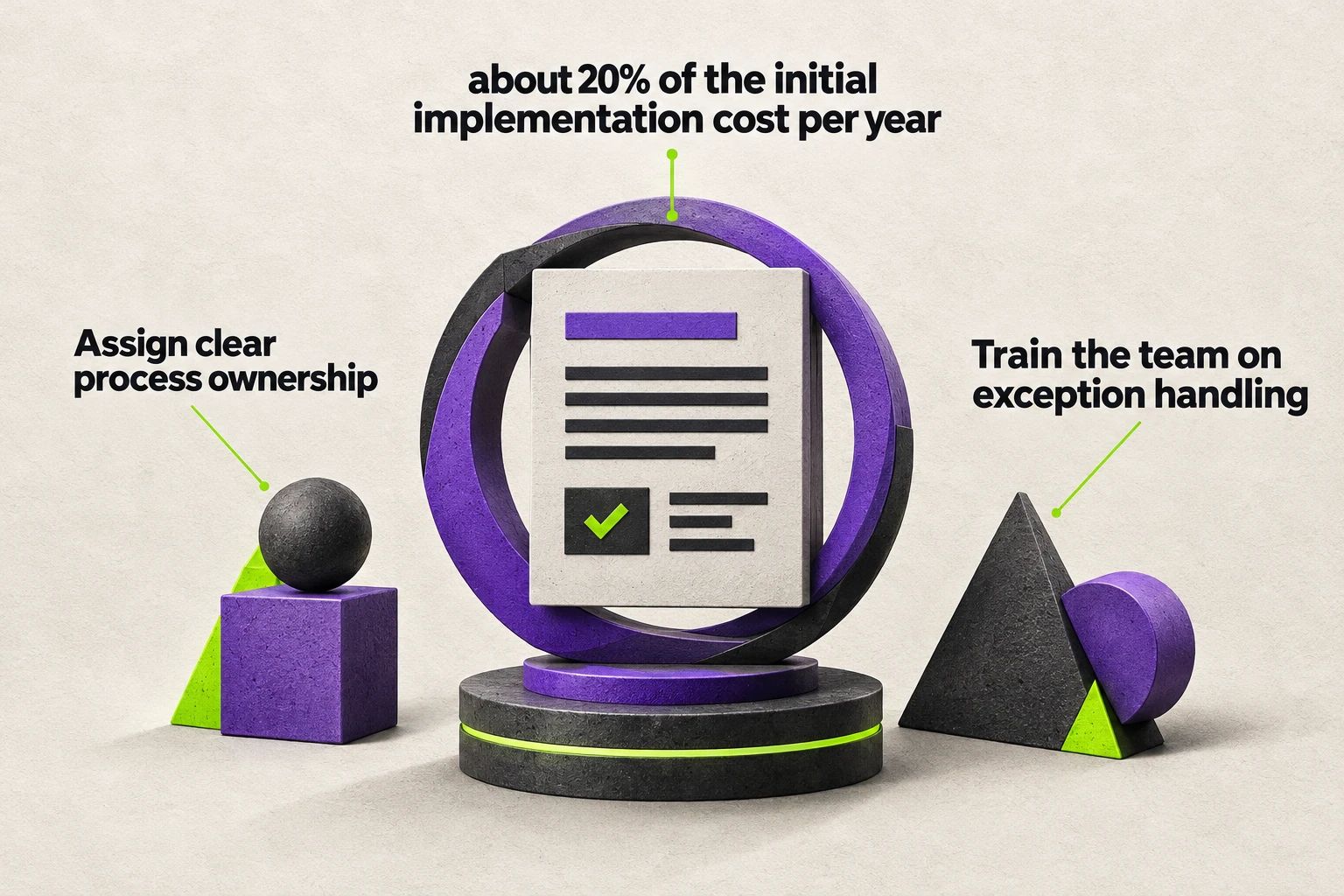
Ongoing automation planning includes a qualified maintenance estimate, process ownership, and exception training.
Your roadmap must account for both technical upkeep and human adoption. Pascal Bornet notes that maintaining an automated process is estimated to be about 20% of the initial implementation cost per year [3]. On the human side, a 2020 Bain & Company report noted that before the pandemic, nearly half of automation projects failed to deliver the expected savings according to a 2019 Bain survey, and only 10% of surveyed companies believed they were highly prepared to address the personnel and change management challenges that automation would create [6]. Preparing your operation for these shifts is a core function of Lean Tech Team Scaling.
Build ongoing optimization into your monthly operating rhythm with three habits:
- Budget for the 20% maintenance baseline: Allocate dedicated time and budget each quarter to review error logs, update API connections, and refine prompts as your offerings evolve.
- Assign clear process ownership: Every automated workflow needs a named internal owner who monitors its output metrics and knows how to pause or override the system if an exception occurs.
- Train the team on exception handling: Shift team training from executing repetitive tasks to managing edge cases, reviewing augmented insights, and improving the underlying process rules.
Frequently Asked Questions
Do most organizations already have an enterprise-wide strategy before piloting automations?
No, most organizations begin piloting without an enterprise-wide strategy in place. In Deloitte's 2020 survey, only 26 per cent of respondents piloting automations and 38 per cent of those implementing and scaling had an enterprise-wide strategy for intelligent automation [7]. Documenting your roadmap before scaling prevents your team from accumulating disconnected pilots that cannot scale together.
Why do automated workflows fail to scale past the initial pilot phase?
Workflows fail to scale when teams automate broken processes, neglect change management, or build pilots that cannot integrate with production systems. In the Q3 2025 Bain Generative AI Survey of 197 executives, about 33% of unsatisfied respondents said the technology worked at the pilot level but did not scale [4]. You can avoid this trap by stripping out inefficiency loops during discovery and designing modular architecture from day one.
How much should a business budget for ongoing maintenance of an automated process?
You should budget approximately 20% of the initial implementation cost per year for ongoing maintenance, as estimated by Pascal Bornet [3]. This annual allocation covers API updates, data structure adjustments, and ongoing monitoring so your workflows continue to protect revenue as your business changes.
Next Step for Your AI Roadmap
Your decision hangs on sequencing: fixing and filtering repeatable processes before deploying technology. Before scheduling a discovery call or writing a single automation script, audit three recurring workflows in your operation this week. Map every step from initial trigger to final delivery, cross out the redundant loops you can abandon immediately, and select the single highest-leverage process where a 14-day quick win will recover lost time or leaky revenue.
Sources:
- Deloitte Insights - 2022 global executive survey on strategy adoption and revenue tracking
- MIT Sloan School of Management - Interview with Ian Barkin on process definition and data governance
- Pascal Bornet via Goodreads - Excerpts from Intelligent Automation on Triple-A framework and maintenance costs
- Bain & Company - 2025 executive survey on agentic workflow automation and pilot scaling
- Deloitte - 2026 global enterprise survey on AI transformation and data residency
- Bain & Company - Report on automation savings outcomes and organizational change readiness
- Deloitte Insights - 2020 global survey on strategy maturity across piloting and scaling organizations