How Do You Structure an Automation Workforce?
AI Summary
Structuring an automation workforce is less about adding AI tools and more about redesigning work before routine volume overwhelms human specialists. A hybrid operating model creates leverage only when ownership, judgment, and escalation paths are explicit.
- How to classify activities as agent-led execution, hybrid collaboration, or human-led judgment.
- When to use human-in-the-loop approval gates versus human-on-the-loop supervision.
- How unified workflow metrics, exception pacing, and root-cause feedback prevent rework and burnout.
- Why internal domain truth and workflow logic protect lean teams from agency lock-in.
For teams scaling repeatable operations and comparing ways to expand capacity without hiring for every bottleneck.
Scaling a business with repeatable processes past six-figure revenue forces a structural choice. You can keep hiring human specialists for every operational bottleneck, you can outsource execution to external agencies that hold your logic hostage, or you can structure a hybrid automation workforce of human staff and AI agents. Most teams try a fourth path that stalls out: buying standalone AI tools and expecting existing staff to magically work faster.
That fourth path fails because tools do not fix broken workflows. Your decision does not hang on which software subscription you buy next. It hangs on whether you layer generic AI onto legacy processes or intentionally redesign your operating model around task decomposition, human-in-the-loop decision rights, and encoded domain truth.
From Bolted-On Tools to Digital Colleagues in a Hybrid Workforce
Handing logins for generic AI writing orDIY tools to a busy team creates individual friction rather than operational leverage. Every person prompts differently, quality fluctuates wildly, and nobody owns the final output. True speed to value requires treating AI agents and automation loops as managed digital colleagues inside a unified operating model.
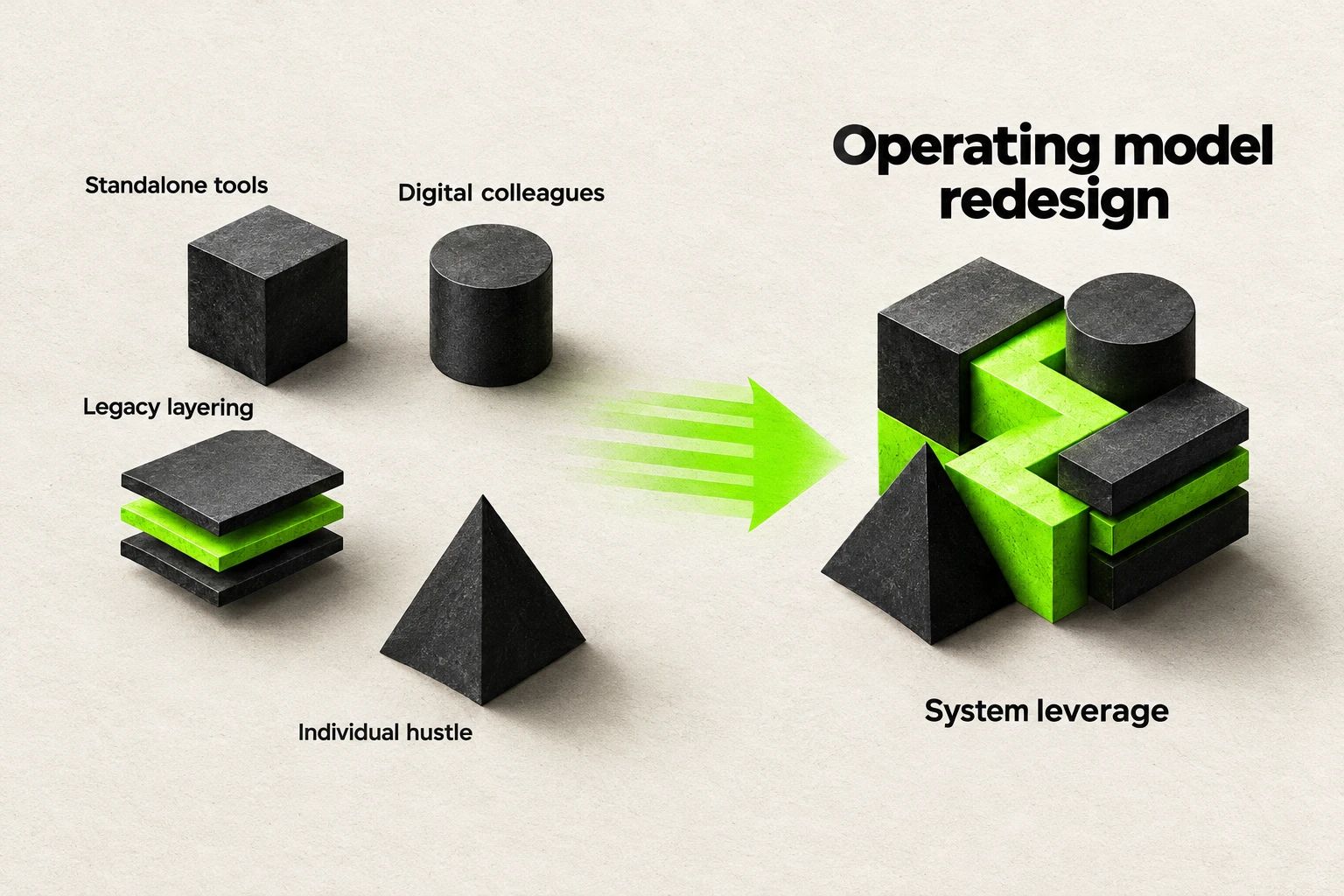
Standalone tools contrast with a unified system of digital colleagues.
Instead of asking how an individual can use a chatbot to save ten minutes, you redesign the repeatable process itself so the system carries the load. According to Deloitte research, 59% of organizations are taking a tech-focused approach to AI by layering AI onto legacy systems and processes, rather than reimagining how humans and AI interact, collaborate, and make decisions [1]. When you simply bolt tools onto old routines, you scale the mess alongside the output.
Redesigning the workflow around clear interaction rules separates the teams that get stuck piloting from those that extract real capacity. When integrating AI into human workflows, the structural difference comes down to three operational shifts:
- Standalone tools vs. digital colleagues: Tools wait for ad-hoc prompts from individual users, whereas digital colleagues execute defined stages of a repeatable process on a trigger.
- Legacy layering vs. operating model redesign: Layering speeds up isolated tasks without fixing handoffs, while redesigning restructures who does what across the entire delivery pipeline.
- Individual hustle vs. system leverage: Relying on staff to figure out AI on their own creates inconsistent output, whereas encoding standards into the workflow builds repeatable capacity.
Splitting Repeatable Processes Across Humans and Agents
You cannot build a hybrid team by telling an AI agent to "run marketing" or "handle operations." Whole job titles do not automate cleanly. Activities do. When you try to automate at the role level, you get generic slop because the agent lacks the context required for nuanced judgment.
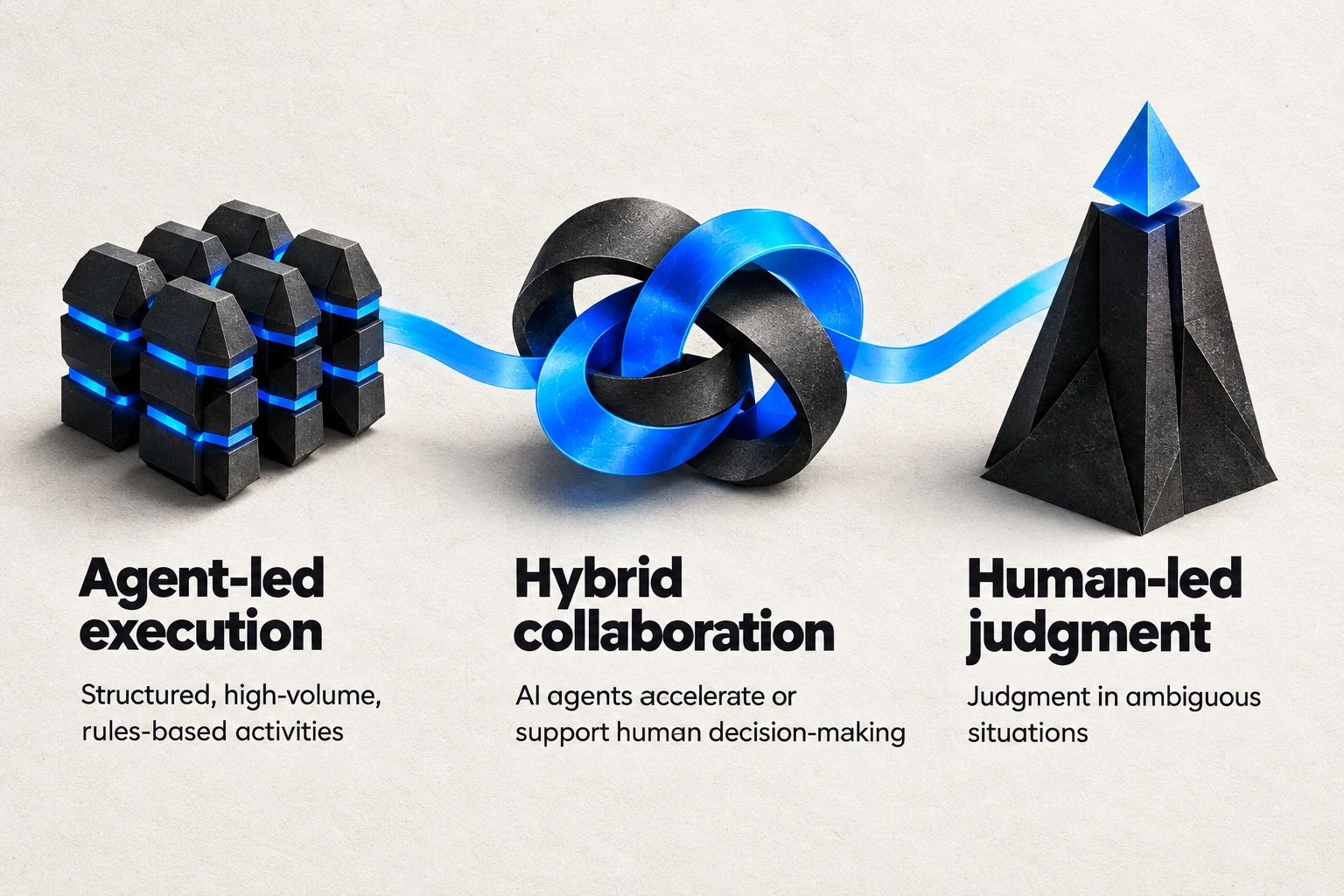
Agent-led, hybrid, and human-led activities occupy distinct parts of a shared workforce.
The operational fix is decomposing every repeatable process into distinct activity tiers. In a hybrid workforce, planning shifts from role-based headcount models to activity-based capacity models by decomposing work into human-led tasks (judgment in ambiguous situations, stakeholder relationships, ethical reasoning), agent-led tasks (structured, high-volume, rules-based activities), and hybrid tasks (where AI agents accelerate or support human decision-making without replacing human judgment) [2]. This shift stops you from measuring capacity solely by how many full-time people sit on payroll.
To apply this filter across your own operations without creating role confusion, sort every step of a core workflow into three operational buckets:
- Agent-led execution: High-volume, rules-based tasks where inputs and outputs follow strict formatting, such as data extraction, initial structuring, and status routing.
- Hybrid collaboration: Drafts, research synthesis, and diagnostic checks where the digital colleague builds the foundation and the human specialist refines the angle using domain truth.
- Human-led judgment: Ambiguous trade-offs, final sign-off on high-stakes assets, relationship management, and encoding the business logic that guides the entire system.
Designing Decision Rights and Escalation Paths
Ambiguous accountability breaks hybrid teams. If a digital loop misfires and publishes bad data or sends a flawed deliverable, blaming the software solves nothing. You need explicit governance that dictates when an agent acts alone, when it pauses for permission, and who owns the outcome.
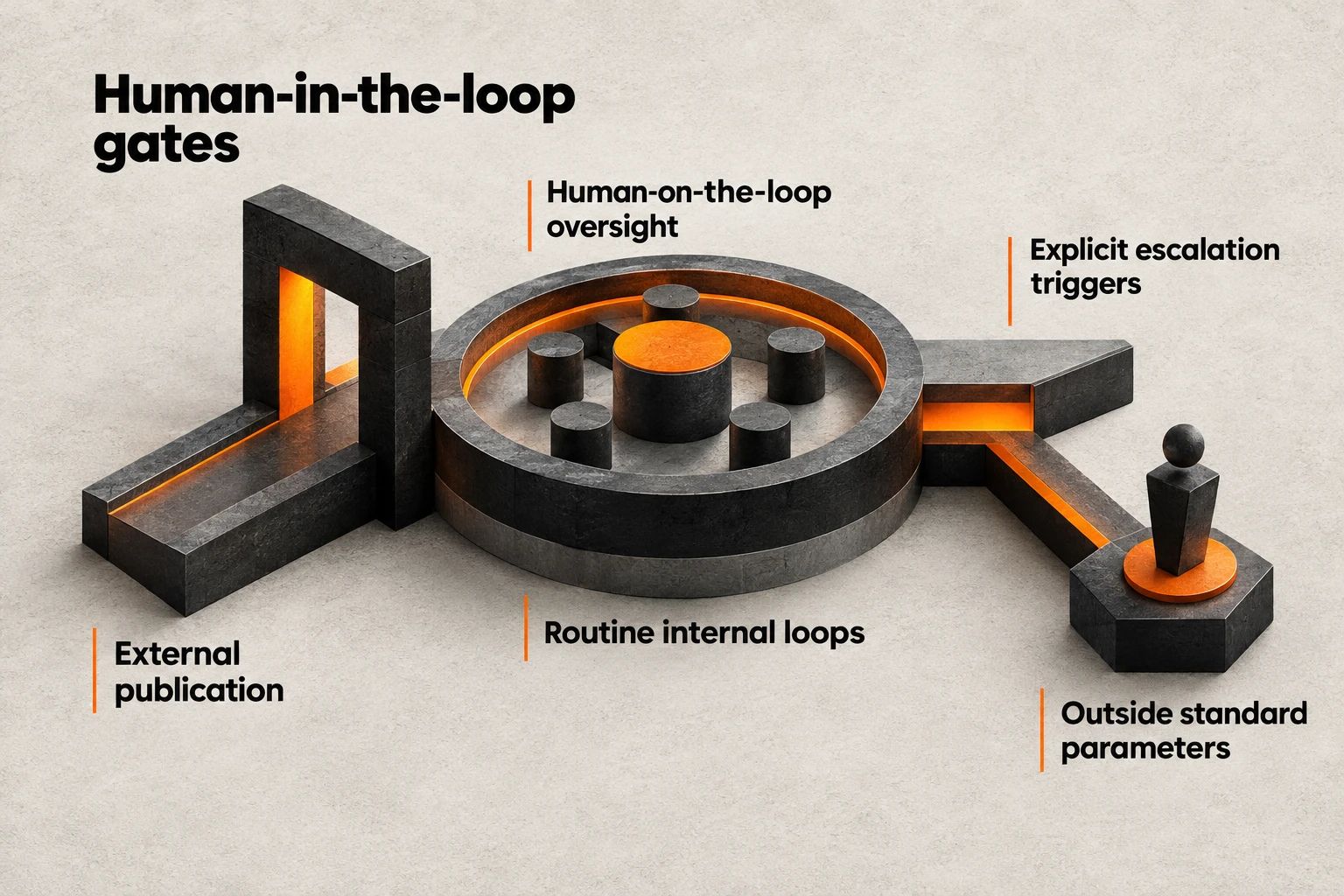
Human approval gates, oversight, and escalation define responsibility around agent activity.
Enterprise frameworks often treat governance as a committee exercise, which stalls lean operations. What you actually need are in-workflow guardrails and clear supervisory roles. Deloitte's survey of 11,387 workers across 17 countries highlights that organizations can maximize the value of agentic AI by keeping humans "on the loop" rather than just "in the loop," allowing human staff to oversee, guide, and correct digital agents similarly to how they manage a junior team member [3].
Treating an agent like a capable junior colleague clarifies your AI accountability frameworks immediately. You would never let a new hire push unreviewed code to production or rewrite core brand positioning on day one, nor would you hover over their shoulder for every routine spreadsheet update. Structure your decision rights with three operational rules:
- Human-in-the-loop gates: Mandatory human review and approval before any external publication, client communication, or irreversible system change occurs.
- Human-on-the-loop oversight: Spot-checking logs, auditing batch outputs, and refining system instructions while routine internal loops run autonomously.
- Explicit escalation triggers: Pre-defined thresholds where an agent must stop execution and route the task to a human specialist whenever inputs fall outside standard parameters.
Preventing Escalation Overload and Siloed Metrics
A hidden trap emerges once your digital colleagues successfully absorb routine volume. Your human staff inherit complex edge cases. Every task that reaches their desk is an exception, a broken handoff, or a high-stakes judgment call. Without structural pacing, removing the easy work causes rapid cognitive burnout among your best specialists.
At the same time, measuring the agent in isolation creates false confidence. An automation loop might score high on speed and formatting accuracy while still creating massive downstream rework for the human who has to fix subtle logic errors. As content tuned for AI and operational outputs scale up, judging the machine separately from the human reviewer hides the true cost of delivery.
Protect your team's bandwidth and measure real operational leverage by changing how you track performance:
- Unified workflow metrics: Measure the combined human-agent cycle time, total rework rate, and final outcome quality rather than tracking agent output speed in a vacuum.
- Exception pacing: Cap the number of complex escalations routed to a single specialist per day, holding non-urgent edge cases in a prioritized queue.
- Root-cause feedback loops: Dedicate weekly capacity for specialists to update the agent's underlying instructions so recurring exceptions become standard rules.
Building Owned Intelligence Without Agency Lock-In
When teams want operational leverage without doing the structural work of task decomposition, they often default to outsourcing. They hire external agencies to build and run their automated workflows on proprietary third-party setups. That choice trades short-term convenience for permanent vendor lock-in.
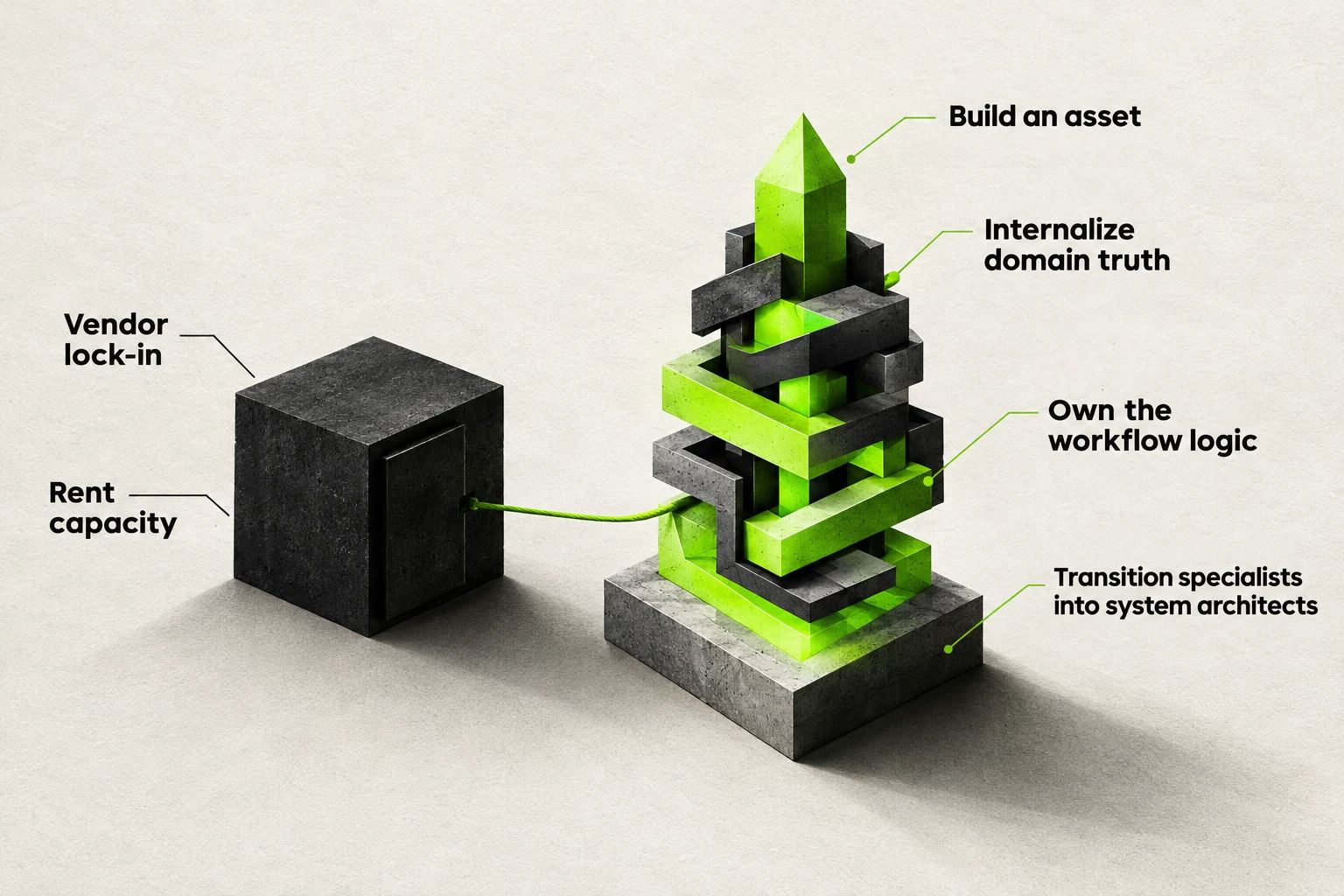
An internally owned system rises beside a constrained vendor dependency.
When an external vendor holds your prompts, workflow logic, and process architecture inside their black box, you rent capacity instead of building an asset. Worse, external agencies rarely understand your specific domain truth, which is the proprietary business logic, customer nuance, and quality threshold that separates your company from generic competitors. Supporting lean tech team scaling requires keeping that intelligence inside your own walls.
In Microsoft's 2026 Work Trend Index survey of 20,000 AI-using workers, organizational factors like culture, manager support, and talent practices account for more than 2x the reported AI impact of individual factors like mindset and behavior (67% vs. 32%) [4]. Building those organizational systems internally compounds your team's value over time. To build owned intelligence rather than agency dependency, anchor your architecture on three principles:
- Internalize domain truth: Document your quality standards, edge-case decisions, and brand rules in centralized repositories that your own team controls and updates.
- Own the workflow logic: Keep the orchestration rules, SOPs, and task boundaries inside your company's environment so swapping out an underlying LLM never breaks your operation.
- Transition specialists into system architects: Train your core staff to refine workflows and govern digital colleagues so your internal capability grows with every process iteration.
Frequently Asked Questions
What is the difference between human-in-the-loop and human-on-the-loop in a hybrid workforce?
Human-in-the-loop requires a person to actively approve or complete a step before the workflow can proceed, while human-on-the-loop places staff in a supervisory role over autonomous runs. Deloitte's survey of 11,387 workers across 17 countries highlights that keeping humans "on the loop" allows human staff to oversee, guide, and correct digital agents similarly to how they manage a junior team member [3]. Use in-the-loop gates for external deliverables and on-the-loop supervision for internal data preparation.
Which human skills matter most when digital colleagues take on routine execution?
Quality control of AI output and critical thinking are the top human skills required as automation absorbs routine tasks. Among 20,000 surveyed AI users in Microsoft's 2026 Work Trend Index, 86% say they treat AI output as a starting point, not a final answer, and that they "stay responsible for the thinking," while identifying quality control of AI output (50%) and critical thinking (46%) as the most important human skills as AI takes on more work [4]. When structuring your team, evaluate and train staff on how well they audit and refine machine drafts rather than how fast they write from scratch.
Does redesigning roles around human-AI interaction actually improve financial returns?
Yes, prioritizing intentional work design directly improves the likelihood of exceeding AI return on investment expectations. While 66% of surveyed leaders in Deloitte's research acknowledge that the intentional design of human-AI interaction is important to organizational success, only 6% say they are leading in this area, and organizations that prioritize work design by thoughtfully redesigning human and machine interactions and roles are twice as likely to exceed their return on investment expectations for AI and nearly 2.5 times more likely to report better financial results [1]. Stop buying disconnected tools and invest that time into mapping exactly how tasks pass between your people and your agents.
Your Next Operational Step
Your decision on structuring a workforce with automation comes down to whether you want to keep bolting tools onto overloaded staff or build an operating model that compounds owned intelligence. Do not start by shopping for new software. Start by auditing one repeatable process that runs every week in your business. Break that process down into a simple list of every single step, label each step as agent-led, hybrid, or human-led, and assign one human specialist to own the final review gate before you automate a single trigger.
Sources:
- Deloitte Insights - Global survey data on human-AI interaction and work design ROI
- RSM US - Planning guide on task decomposition and hybrid workforce governance
- Deloitte Insights - Global workforce survey on human-on-the-loop agent supervision
- Microsoft WorkLab - 2026 Work Trend Index data on organizational AI impact and human skills